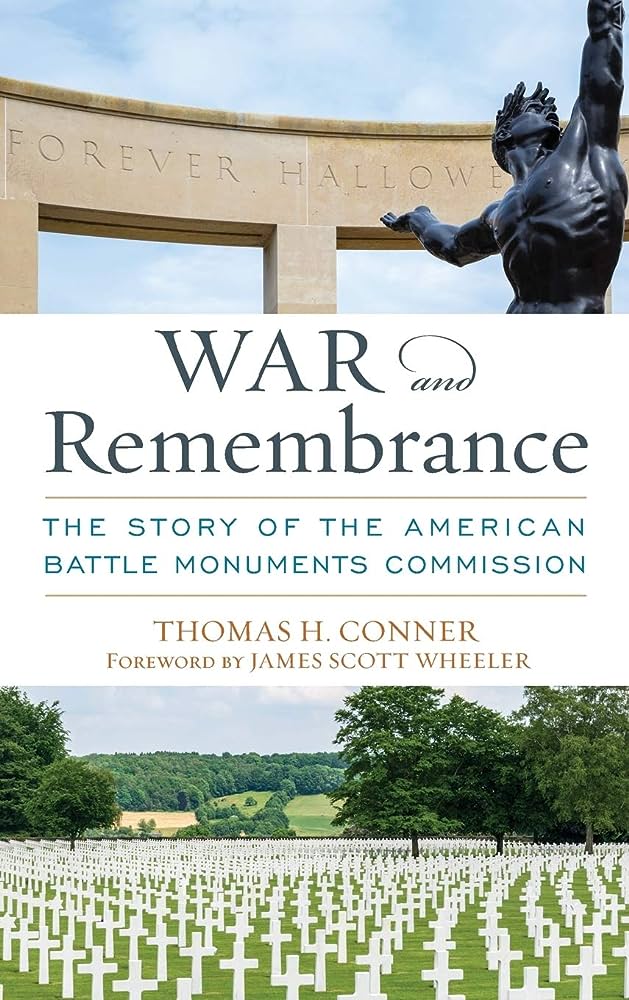
Historian Thomas H. Conner has accomplished the authoritative account of the American Battle Monuments Commission (ABMC). Conner’s thorough history underscores how influential the leadership of the 1920s remains in framing the criteria for many institutions and cultural traditions, including the overseas memorialization and provision for the thousands of Americans who went to fight for the liberation of millions of strangers but never returned home. The Commission, constructed by President Harding in 1923, was a diverse collaboration from the outset, including General John J. Pershing, Gold Star mother Josephine L. Cody Bentley, and the remaining five members from state or federal service who had also worn the uniform in the Great War. It remained an adroit team, a devoted family of colleagues, even as the years saw a second wave of barbaric repression descend on the world. The first round of sites (eight cemeteries and eleven memorials) commenced construction in the mid-1920s and saw completion by the twentieth anniversary of that War’s conclusion with the dedication of the Montfaucon memorial by President Roosevelt in 1937.


In those first critical years, President Coolidge, despite tasking General Pershing to a diplomatic assignment in South America for a time, encouraged the continuation of their work, helping them overcome Budget Bureau constraints, and an ongoing assault by Congress on the ABMC’s autonomy. Coolidge’s appointment of three military officers launching the Commission’s Historical Section, made possible an invaluable record of the War through a team of researchers under then-Major Dwight D. Eisenhower, publishing A Guide to the American Battle Fields in Europe ahead of the tenth anniversary of the Armistice in 1927. Pershing ensured this was followed by an updated and revised Guide by Ike in the ten years that followed.


The Commission’s collaboration, under Pershing then Marshall and beyond, even while navigating the political and diplomatic mine fields between Capitol Hill, the White House, and the nations of Europe, is remarkable and attested in the quality and restraint shown in the structures and layout of each site. The minute attention to detail, the exact care of design, the vision for each of the eight cemeteries and eleven memorials, down to the tasteful design of the headstones, the choice of materials, the skill of the architects, and the devotion through the many practical and personal risks of maintaining and preserving each location speaks, especially as the grounds on which they were built became combat zones again in the Second World War.


The challenges of their work, since there was no prior template for anything like it, had to be worked out with sound judgment, aesthetic skill, and a clear sense of proportion to bequeath an honorable, tasteful, and enduring collection of memorials and final resting places for those who liberated those places but in doing so paid all they had to give, never making it home themselves. The superlative achievement wrought by the ABMC continues to live in the creation of the Commission’s second generation of cemeteries and memorials in Europe, Africa, and Asia even before the close of hostilities in 1945. They demonstrate a continuity of vision and creative excellence to leave beautiful sites that endure despite the lapse of time.


Keenly aware of the way so many markers, inscriptions, and monuments, distasteful or overdone at the outset do not age well, becoming liabilities, even embarrassments to their original sponsors, and reflecting negatively on America and Americans for generations, the Commission resolved to do better by those who had sacrificed overseas and the families who saw them go. The ABMC’s work, its discrete emphasis on minimalism, its reverence for the living and the dead, its judicious investment of political will, wise diplomacy, and an instinct for magnificent craftsmanship are evident at every site, from Pointe du Hoc to Manila, Tunis to Flanders Field, Meuse-Argonne to Normandy.


As the distance in time from these two seismic conflicts increases, we are reminded to reflect again that each of those markers is a life still in service to great ideals. Spielberg’s 1998 film, Saving Private Ryan, opening and closing at Normandy’s American cemetery, brings this moving truth back to sharp relief. The Niland brothers, Patton, and both Quentin and Theodore Roosevelt, Jr., fallen brothers from both wars, are resting in these cemeteries. The ABMC cemeteries and memorials call upon us, the living, to live worthy of what those many comrades in arms unselfishly leave for us in the hills, fields, and beaches they marched upon and fought for in order to liberate millions an ocean away they would never meet. Conner’s War and Remembrance rescues the story little known and less told behind a small but determined team of Americans and overseas friends who led that initiative to give future generations at home and around the world a simple but powerful reminder that these soldiers, sailors, Marines, and Airmen, known and unknown, continue to answer a call which cannot die: the summons to serve.


