On Banks and Prosperity

While the “Occupy Wall Street” mobs have subsided, having served their political purpose last year, the notion that banks are a device of the “excessively wealthy” is not new to our time. The image of fat, out-of-touch, greedy capitalists forming banks to “exploit” workers, the poor and the needy, robbing them of their hard-earned money was just as familiar in the early years of the twentieth century as it is now. Despite the verifiable fact that Secretary Mellon paid millions more in income taxes under his own plan, it did nothing to assuage the attempts throughout the twenties and thirties to finally “pin down” this “excessively wealthy tycoon” as guilty of something. If one keeps looking, they seemed to say, it can be found somewhere. Even F.D.R.’s tax “show trial” of Mellon yielded nothing but an unfairly demolished reputation. On the contrary, Vice President Coolidge addressed this very attitude about banks, a prejudice against capitalism and the myth that forceful redistribution of prosperity is both possible and virtuous. In a speech given on June 27, 1921, he said:

“There can be no permanent prosperity of any class or part. Such a condition can only be secured through a general and public prosperity. This means that to secure this end there must be a general distribution of the rewards of industry. Wherever this condition is maintained there you have the foundation for an increasing production and a sound financial and economic situation.

“One of the strongest reasons for supporting American institutions is that under them this condition is more nearly attained than under any other form of government that has ever met with any permanent success…

“…Too often the uninformed think of a bank as the possession of a few rich people, and as the creditor of the people at large. You who have had any experience with banking know that it is the opposite of this which is true. The resources of banks are not the resources of a few rich, but the resources of the people themselves, small perhaps in any individual instance, but, in the aggregate, very large. Nor are banks exclusively a creditor class. It is usually true that they owe to their depositors more than their borrowers owe to them. Every banker knows that to depend on the business and patronage of the rich would be in vain, that if any success attends his efforts it must be by serving  and doing the business of the people. The stock is generally owned by the people, the deposits are always made by the people. This is the reason that banks partake of the nature of a public institution and perform real public service. They are the sole means by which modern commercial activities can be carried on. They afford the method by which the people combine their individual resources, providing a collection of capital sufficient to extend the necessary credit for financing the whole people of the nation…A bank is not a private institution, responsible to itself alone, or to a few. It is a public institution, under a moral obligation to be administered for the public welfare…Any power which is not used for the general welfare will in the end destroy itself…Such an institution is doing the work of the people.”

This simple explanation lays bare the ignorance of those who vilify banking and American capitalism as the instigators of what is wrong with the country. To go to war against these concepts is to war against the “common man,” the very person protestors claim to be helping. By calling for redistribution and the boycott of banks, the true perpetrators of class conflict, economic stagnation and human suffering are sought out as “saviors.” People like us, ultimately, are held responsible for this “unfairness” while those who create the climate are rewarded with more authority to solve problems they have no inclination or ability to resolve. While certain government officials are usually first and foremost this kind of “savior” sought, it is conveniently ignored that the capital on which banks are made possible belongs to “normal” people engaged in the daily use of what is theirs — buying, selling, saving, earning, investing, exchanging, lending, and borrowing. The complaint is with Washington not with regular folks.

On ‘Freedom and Its Obligations’

Addressing those assembled at Arlington National Cemetery, May 30, 1924, President Coolidge spoke, 

“American citizenship is a high estate. He who holds it is the peer of kings. It has been secured only by untold toil and effort. It will be maintained by no other method. It demands the best that men and women have to give. But it likewise awards to its partakers the best that there is on earth. To attempt to turn it into a thing of ease and inaction would be only to debase it. To cease to struggle and toil and sacrifice for it is not only to cease to be worthy of it but is to start a retreat toward barbarism. No matter what others may say, no matter what others may do, this is the stand that those must maintain who are worthy to be called Americans.”

During the Coolidge presidency, there were nine individuals whose actions merited the Medal of Honor, the highest recognition to those who distinguish themselves while wearing the uniform. Their actions were not all combat-related, as the years between 1923 and 1929 was a time of peace. Their courage and selfless service, however, be it in behalf of their brothers-in-arms, those around the world in need, or in the cause of greater possibilities (with nothing but uncertain flying crafts and their navigational skills) were testaments to what President Coolidge referred — those “worthy to be called Americans.” That tradition of selfless service will continue unbroken and it remains, rightly so, a reason to honor and aspire to those worthy of the name “American” to this day.

Image

President Coolidge awarding the Medal of Honor to Machinist Floyd Bennett, USN (in front of him) and Commander Richard E. Byrd, Jr., USN (behind Coolidge), for their courageous risk of life in the first “heavier than air flight” to and from the North Pole in a tri-motor Fokker F-VII called the Josephine Ford.

Image

The awarding of the Medal of Honor to Torpedoman Second Class Henry Breault, USN, for his quick actions to rescue a shipmate in their submarine 0-5, which sank within one minute. Confined by the hatch that closed after him, he kept himself and his mate alive for thirty-one hours below the surface until rescued.

Image

Chief Gunner’s Mate Thomas Eadie, USN, received the Medal of Honor for an extraordinary rescue of his shipmate, Chief Torpedoman Michels, whose line fouled 102 feet below while trying to connect an airline to the sub USS S-4. CGM Eadie (as his citation states) “knowingly took his life in his hands,” diving down to skillfully extract Michels, bringing them both back to the surface after two hours of heroic effort.

Image

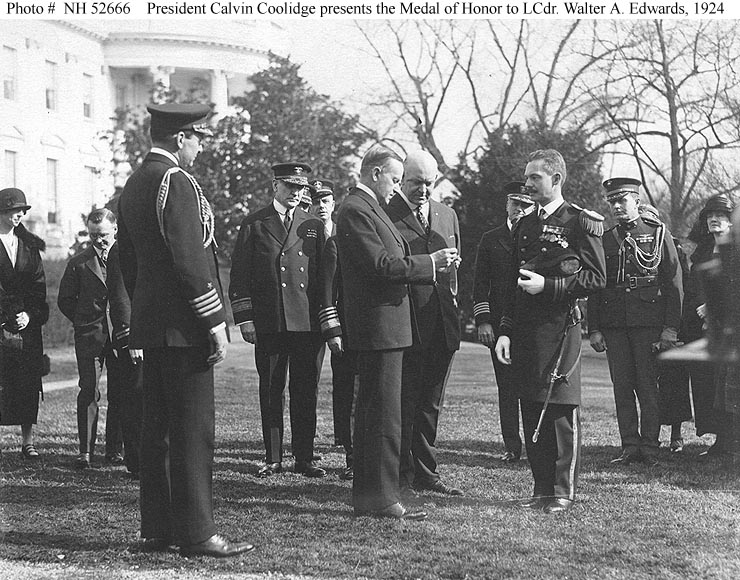
Lieutenant Commander Walter Atlee Edwards, USN, was awarded the Medal of Honor for his rescue of 482 men, women and children from the sinking French transport Vinh-Long, while aflame in the Sea of Marmora, off the coast of Turkey. While commanding the USS Bainbridge, he placed and kept his ship alongside the burning wreck until all alive were safely transferred to the American vessel.

Image

Machinist’s Mate William Russell Huber, USN, was recognized here with the Medal of Honor for his exceptional heroism after a boiler exploded aboard the USS Bruce in Norfolk Navy Yard, 11 June 1928, he went into the “steam-filled fireroom and at grave risk to his life” successfully carried shipmate, Charles H. Bryan, to safety. Machinist’s Mate Huber went below again to aid in removing others from the room despite suffering severe burns to his arms and neck.

Image

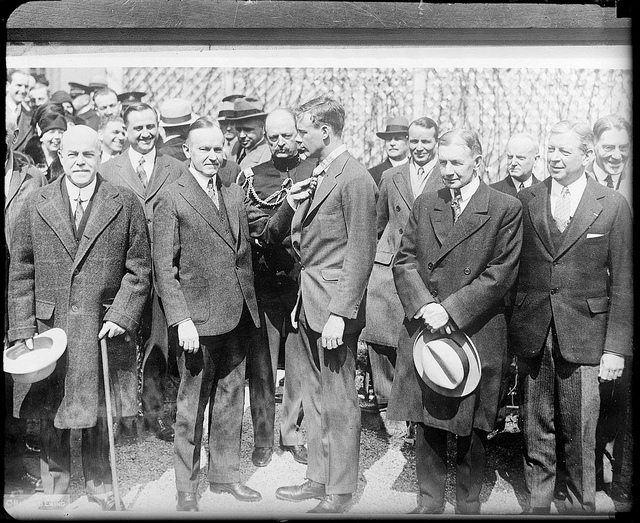
Captain Charles A. Lindbergh, Army Air Corps Reserve, was recognized with the Medal of Honor for both courage and skill despite the risk in navigating by nonstop flight from New York City to Paris, France, in the Spirit of St. Louis, a custom-built single-engine monoplane, achieving (as his citation, held here by President Coolidge, states) “not only…the greatest individual triumph of any American citizen but demonstrated that travel across the ocean by aircraft was possible.”

Image

Ensign Thomas John Ryan, USN, was presented with the Medal of Honor for heroism in rescue of a woman trapped when fire broke out at the Grand Hotel in Yokohama, Japan, September 1, 1923, as the result of an earthquake that hit the city. Ensign Ryan disregarded his own safety to help another, as unexpected events demanded decisive action.

Image

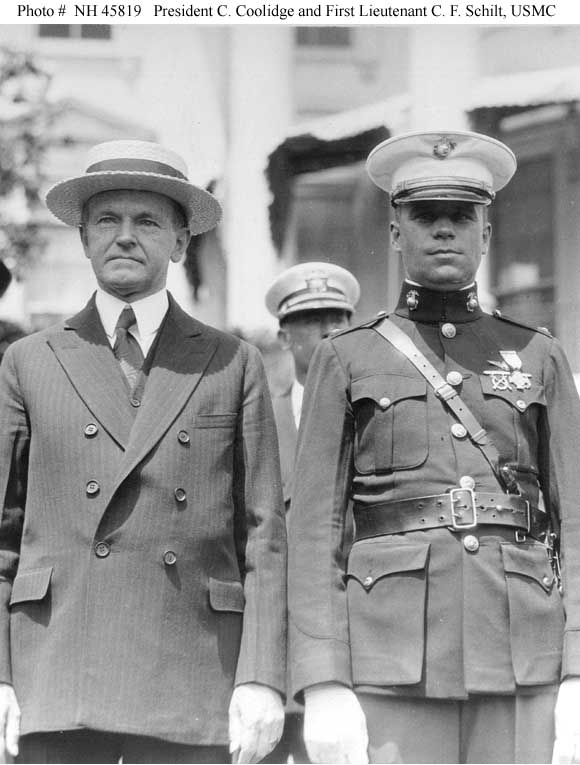
Here is First Lieutenant Christian Frank Schilt, USMC, to whom the President has just given the Medal of Honor for his superb actions in Quilali, Nicaragua, over the course of three grueling days in January 1928. First Lieutenant Schilt, following an intense fight to restore peace to the area, volunteered to evacuate all of the wounded by air and bring in a new commanding officer as relief. Taking off a total of ten times while under steady enemy fire from rough urban terrain, he removed all the wounded, saved three lives and brought back the necessary supplies to those in dire need on the ground.


On the Teamwork of Service

President Coolidge and his Secretary of War, Dwight Davis, were left in a difficult position in the fall of 1925. It been a difficult year for both men, from the retirement of Secretary Weeks, numerous battles with Congress and now the looming court-martial of Colonel William Mitchell. To say that the Army Air Corps officer was “outspoken” would be an understatement. In pointing out the lack of preparedness the country had for air defenses, he demonstrated a self-serving and theatrical manner that did not promote the good order and discipline most expected of commissioned officers in the military. Secretary Davis, having been a world-class tennis player (the namesake for the cup he had designed), appealed to those under his leadership on the basis of teamwork. The military, not unlike a team of athletes, has to collaborate in order to accomplish their goals. Selfish interests, however valid their grievances, must be governed with humility and self-control for the sake of others and the achievement of the mission. This fit perfectly well with President Coolidge’s ideal of service. The concepts were reflections of each other.

Yet Mitchell would continue to demand attention not for the substance of his observations but for the public to embarrass his superiors into action. Such was not in harmony with a humble attitude of teamwork and service of others. Colonel Mitchell would consequently face court-martial, five years suspension of service and loss of pay and other allowances. President Coolidge, not unsympathetic to the man’s case, would affirm Secretary Davis’ restoration of Mitchell’s allowances and half of his base pay, as Nancy Kriplen notes in her book on Mr. Davis. But this public reprimand of Mitchell would stand. The Colonel, Mitchell (as Davis had also risen to the rank of Colonel before his retirement), would turn in his resignation early the next year. Secretary Davis would accept it. Yet, neither the President nor his Secretary were averse to the preparedness of the country — such an accusation is hardly fair or accurate — nor were they stuck in old modes of thinking that refused to acknowledge air power. In fact, the spring of 1926 they would push forward the development of 52 tactical squadrons and the beginnings of an independent Air Corps signed into law by President Coolidge. The Distinguished Flying Cross would be awarded for the first time by Coolidge himself not only to the illustrious Lindbergh but also to the crew of the Pan American flight that tallied 22,000 miles in the air over a month before the better known “Spirit of St. Louis” crossing. Secretary Davis would award the Cross to Orville Wright and his brother, Wilbur (posthumously) in February 1929. It was the Coolidge administration that actively promoted the advancement of the country into modern aviation. Speaking years later of the transcontinental crossing of Costes and Bellonte from Paris to New York, the former President would reemphasize the familiar theme of service and collaboration, “Such flights are of great value in their effect on international comity. When Lindbergh made his historic voyage to Paris, the French people felt almost as much pride in his accomplishment as his own countrymen. It aroused and cemented a most wholesome sentiment of friendship…It hastens the day of good will and co-operation,” September 3, 1930.

            Image