On the Strength of “Weakness”

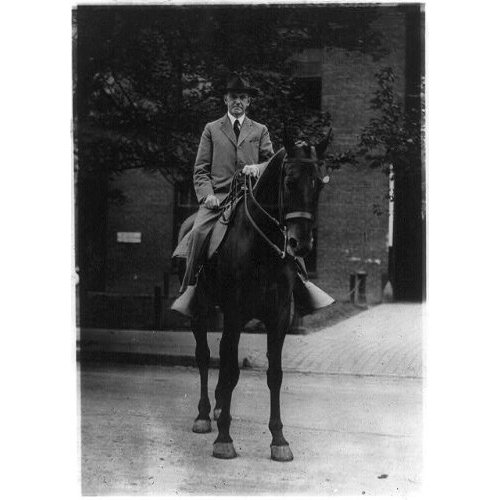
While there is much in Michael J. Gerhardt’s new book, “The Forgotten Presidents: Their Untold Constitutional Legacy,” with which this author disagrees, he ably shows that Coolidge was anything but a pushover or “weak” president. Devoting chapter twelve of his book to the thirtieth president, Gerhardt demonstrates that Coolidge had unique strength when it came to his constitutional role and the exercise of presidential powers. Coolidge, perhaps more than any of his immediate contemporaries in the office, understood both the limits and the authority vested in the Presidency. His display of leadership was unprecedented in a number of ways.

As the previous administration’s scandals went public, it was Coolidge who took the incredible step of ensuring honorable and qualified investigators (not party hacks) took the helm after which he never intervened in the process to determine the facts. The investigation was allowed to find the guilty and acquit suspicion of the innocent. As a result of both their thorough competence and Coolidge setting a tone of full cooperation from the beginning, public trust in the law was preserved.

In the use of the pardon and the veto, Coolidge distinguishes himself as anything but a timid President. Of his twenty-nine predecessors, and his immediate successor, he ranks second only to Wilson in the number of pardons granted during his time. Of his 1,545, his most noteworthy were made at the beginning of his administration, on behalf of several who had been imprisoned for their public criticism of Wilson’s involvement in the War. Even more extraordinary was the fact that he issued these pardons not only over his Attorney General’s opposition but also before request for release had been made. His fifty vetoes stand also set Coolidge apart from his contemporaries. Only Teddy Roosevelt would issue more of them in the first thirty years of the twentieth century. Not until Teddy’s cousin would the record be broken. Standing in the company of Roosevelts, Coolidge can hardly be classified a passive President. Like Grover Cleveland before him, Coolidge would use the “pocket veto” with great effect as well. By allowing a bill to die after ten days unsigned during Congressional recess, Coolidge would leave a lasting impact on the potency of the veto. His firm dissent from McNary-Haugen — twice — ensured that the President’s role in preventing bad legislation remains intact.

Coolidge’s political courage is even lesser known but just as dominant in his protection of the constitutional power to appoint officers of the Executive Branch. The earliest tussles with Congress demonstrated Coolidge could retain his nerves, remain unmoved by “mob” demands for this or that resignation and eventually prevail despite intense political heat. His resolve was not merely stubbornness but rather an abiding sense of duty and integrity. He would not join the crowd in a political lynching, however badly they wanted it. He was fair even to those who proved unfit for responsibility. He would not give in to appearances nor would he condone wrongdoing. As pointed out by others, it actually takes more strength to refrain from acting until the right moment — especially in the heat of the moment — than it is to be seen doing something now to appease onlookers with appearances. It was Coolidge who exemplified the strength of character required for decisive action only when the fullness of time warranted it. Not before. His strength, considered “weakness” by many even today, is a necessary component of wise leadership. To discount this quality is to misunderstand and fail to appreciate what makes good leaders.
Reagan on the Thirtieth President

When Reagan and Coolidge come up in the same sentence, it usually has something to do with Reagan’s placement of Coolidge’s portrait in the Cabinet Room shortly after Reagan’s inauguration in 1981. But not as well known is the radio program in which Reagan explained his reasons for recognizing the hidden worth of this predecessor. If the press corps had been tuning in during August of 1975, they might have better understood Reagan’s actions six years later. They might also have paused to consider what Coolidge accomplished, but then that could be asking too much. On this sixth day of February, Reagan’s one hundred and second birthday, here is an excerpt from that program entitled “Images,”

“Some day it might be worthwhile to find out how images are created–and even more worthwhile to learn how false images come into being…All of us have grown up accepting with little question certain images as accurate portraits of public figures–some living, some dead. Very seldom if ever do we ask if the images are true to the original. Even less so we question how the images were created. This is probably more true of Presidents in our country because of the intense spotlight which centers on their every move…One was Calvin Coolidge the dry, unexciting New Englander who is more often than not remembered as a lacklustre almost laughable figure who just happened to live in the White House for a while…Are these…images true or false? I’ll list a few facts & you can figure out the answer for yourself. Calvin Coolidge–the man H. L. Mencken said had been weaned on a pickle. Was he a kind of do nothing President in one of those lulls in our Nation’s history? If so we should have such lulls today. There was better than full employment–jobs were competing for workers. The cost of living went down 2.3%, the Federal budget was actually reduced and some of the National debt accumulated in WWI was paid off. During Silent Cal’s presidency the number of automobiles owned by Americans tripled and a great new industry, radio, went from $60 million in sales to $842 million. They laughed when Calvin Coolidge said ‘the business of America is business,’ but we had true peace & prosperity–those things we are promised so often but given so seldom…Well as I say you can make up your own mind about the images versus the man but maybe we ought to go back and see what they did that we aren’t doing. This is Ronald Reagan–Thanks for listening” (“Reagan In His Own Hand” pp.252-3). Image Image

On Greatness

Much ridicule has been heaped upon the 1920s, the Coolidge Era in particular, for its utter lack of “great events” and “great men.” Those who claim such have a confused and backward sense of “greatness.” There were no costly wars, no dramatic upheavals of society, no expansive programs sent down from Washington for how we ought to improve ourselves. The country went about its business only marginally sensing government’s existence, let alone a need for its presence. The President did not insert himself into the daily affairs of Americans not only because it was unnecessary but also because he respected his role under the Constitution. His obligation, as Amity Shlaes has noted, was to restrain harmful measures, to check the abuses of executive and legislative power not to champion revolutionary agendas of his own (“The Forgotten Man,” p.18). He did so not from some overriding sense of his own importance but from a sober commitment to duty, for he also once declared, “It is a great advantage to a President, and a major source of safety to the country, for him to know that he is not a great man. When a man begins to feel that he is the only one who can lead in this republic, he is guilty of treason to the spirit of our institutions” (Autobiography, p. 173).Yet, his restraint, judgment and political wisdom make him a great man even now. “His ability to appraise men quickly on the first interview seemed uncanny” was an observation noticed by more than one of those with whom he would serve (Hubert Work, “Why He Did Not ‘Choose to Run,’ “ The Real Calvin Coolidge vol. 1.  Plymouth: CCMF, 1983,  p.27). He exercised it in the appointment and support of like-minded men of integrity and ability throughout his tenure. He listened to the suggestions of others but he kept his own counsel. In fact, his sound judgment and cool headedness helped avert more than one potential disaster, any one of which could have defined the decade. He did not engage in micro-managing the Departments as some Presidents do. To do so would not only undermine the confidence the people should have in their leaders but would trespass on the work belonging to others. If a person was not up to the job, as he told his Labor Secretary James Davis, he would have to find someone else who was. It was simply not his place to know all the details and get involved in the minutiae of the various departments. Coolidge understood his function was to delegate (and thus disburse, not consolidate) authority. Considering the record of collaboration with men like Mellon and Hughes, he deployed it with great success. Scandal could have overwhelmed the new Administration but it did not. When the demand for resignations by Denby and Daughtery were loudest, the President held immovably to the right course, which was fairness even to those suspected of wrongdoing until the process of law demanded action. He was not swayed by the mob mentality since it placed emotional satisfaction above true justice.

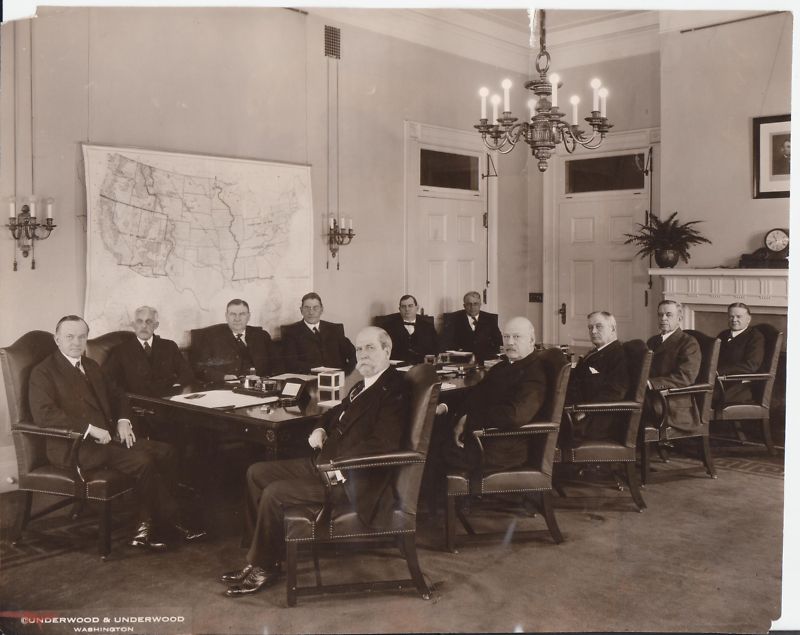
The great men who worked under him were not all of his choosing but he knew their worth and placed them where their talents could be best applied for the good of the country. Andrew Mellon is one of those stellar teammates with whom Coolidge had a unique affinity. But less is said about others like the “great statesman” (as Coolidge considered him, The Autobiography p. 118) Charles Evans Hughes. Hughes’ good sense was evident to him from the night Coolidge succeeded Harding through Hughes’ faithful service even after leaving the limelight of the State Department. The Secretary’s character and experience alleviated many a conflict that could have erupted into violence and discord from Japan to Latin America to Soviet Russia.

Attorney General John G. Sargent was another exemplar of what it means to have capably and quietly carried out what needs to be done without fanfare or need for applause. Sargent’s decency, sense of equity and life training formed the basis of what made him among the best qualified AGs ever to serve. Yet he is unjustly anonymous today. Other men, like Dwight Morrow and Henry Stimson, diffused volatile situations in Mexico and Nicaragua and the Philippines. These “unsung” great men are forgotten today not because of some failure to do enough but because the standard for greatness itself is not properly understood. Ultimately, it is a failing of education. As we live under an increasingly expanding Executive Branch, we would do well to recall the assessment of President Coolidge on the matter, “We have had too much government action, with attendant publicity, proposing to cure human illness which no government can cure and too much public opposition when there was nothing to oppose. The people want from both parties an effective and quiet conduct of public affairs” (November 11, 1930). The same quiet competence from men and women at all levels of public service is what is in order today.

Image

ImageImage