“Exploiting the Presidency” by Cal Thomas

1977-nixon-frost-interview-crop

A session from the interviews between David Frost and Richard Nixon at Yorba Linda, California, 1977. Photo courtesy of http://www.pophistorydig.com.

Cal Thomas, over at Townhall, reflects on how our newest arrival to the “Ex-President’s Club” is already perpetuating the disturbing trend of Richard Nixon (as Joe McGuinness put it in his 1968 book) of “selling the presidency.” Nixon’s $1 million interview with David Frost in 1977 simply built upon what his old boss had initiated in 1958. That was when “Ike” Eisenhower signed the Former Presidents Act, granting the nucleus of benefits that would begin to accumulate around Presidents in retirement. Even so, Nixon never took speaker’s fees beyond that recorded interview. Once he sold the interview to Frost, he did not charge audiences the privilege of hearing him talk in person. He spoke for free.

While “Ike” found the Secret Service detail at his Gettysburg farm unnecessary, and spoke publicly on occasion, the real precedent was set in 1977 by Gerald Ford who took up the plush speaker’s circuit that would continue with Reagan (who gave two speeches in Japan for $2 million) and would become almost a trademark industry under the Bushes and Clintons.

What to do with our former Presidents is not a new question. It has been a concern long before this trend started. However, this precedent – like a growing parasite – demands greater and greater resources simply to sustain more and more privileges from its host. The $200,000 plus pensions, lucrative speaker’s fees, transition staff, stipends, lifetime Secret Service protection for entire families, the increasing extravagance of presidential libraries all point to something far beyond the dignity accorded a statesman. Rather, this exploitation of the Presidential office illustrates a measure of contempt for it and, even more, for the people who will be paying these expenditures long after every one of us is gone. Already yoked to a $20 trillion debt, this helps destroy the Office and the selfless service it was originally intended to embody.

William-H.-Taft

William Howard Taft

Former President Taft once joked to the literary Lotos Club in New York that there would be less a burden to the country if the post-White House life involved chloroform and the lotos fruit (a reference to Tennyson’s “The Lotos-Eaters,” applied by Taft to mean Presidents should surrender to perpetual sleep, drifting into dreams from which they “return no more”).

Harry-Truman-retirement

Former President Harry Truman

Eisenhower’s predecessor, Harry Truman, was clear: “I could never lend myself to any transaction, however respectable, that would commercialize on the prestige and dignity of the office of the presidency.”

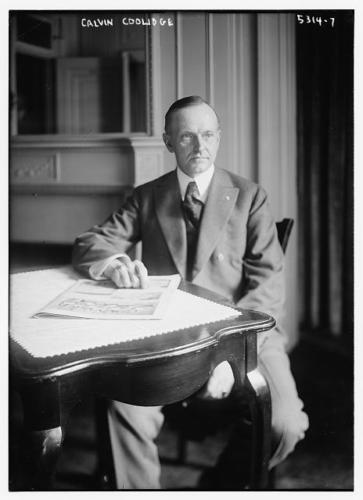
Ironically, he would agree with Calvin Coolidge, who quietly retired to his $32-dollar a month duplex on Massasoit Street in Northampton in 1929. In fact, the Coolidges would be compelled to move simply to get away from the unremitting attentions they now had pressing upon them from the public. When the media reported that their new $40,000 home, The Beeches, had 16 rooms, Grace (knowing there were only 12) wryly retorted, “There are four rooms we can’t find.” When filling out a membership card to the Washington Press Club in 1932, for “Occupation” Cal put “Retired.” Then, in characteristic fashion, under “Comments,” elaborated, “And glad of it.” He refused to take money for public speaking and delivered the few speeches he did give at his own expense. Agreeing reluctantly to work with private news syndicates, he conscientiously composed a daily column for a time, and wrote articles, carefully tallying the word counts and readily returning funds if articles did not “make the cut.” The Coolidges simply would not exploit the Office for their own benefit.

Coolidges-1931

The Coolidges at the July 4th festivities in Plymouth Notch, Vermont in 1931. Photo courtesy of the Alton H. Blackington Collection (PH 061). Special Collections and University Archives, University of Massachusetts Amherst Libraries.

Coolidge was observing the standard befitting all former Presidents, when he wrote, “It is a wholesome thing for them to return to the people…” With relief, he would continue, “Fortunately, they are not supported at public expense after leaving office, so they are not expected to set an example encouraging to a leisure class.” Instead, he would say, “It is becoming for them to engage in some dignified employment where they can be of service as others are.” The Coolidges, with no pension, no Secret Service, no transition staff, no circuit fees, lived as they always had: modestly and simply. It is likely that Cal often remembered his father’s admonition, reiterated since his boyhood, on the humiliation of chickens, trying to roost higher than one’s station, who are eventually corrected by the pecking order.

Perhaps Americans should reassess whether they are supporting a burgeoning series of royal families at unlimited cost or whether we intend to keep a Republic any longer.


On the Universities

Calvin Coolidge, Us President 1923

A University education used to mean something. It imparted more than some scrap of paper (and the requisite cavern of debt to start life) at the end of four or more years. It meant more than a good vocation. It rewarded the diligent and the disciplined with a lifetime all the fuller for what it could give not what it could get. Political campaigns only expose the barren wasteland that all too many universities have become.

Today we see more professors invested in the short-term of partisan activism than the long-term devotion for truth, beauty, and virtue. Instead of being rich gardens engaged in the active cultivation of servant-minded leaders ministering in a thousand ways to the good of others, public and private, many universities are thinly disguised prisons. All too many bar the spirit of inquiry as it naturally strays from political orthodoxy. Universities are too often engaged in the vanity of congratulating themselves for their liberation from all the “sins” of the past while in reality, they are running headlong, like mythic Oedipus, into some of the worst of them – with the height of self-deception. They are busily shackling human potential and demanding every thought march in conformity with the pronouncements of the holy church of Academia. Campuses are adorned with every aesthetic value but like white-washed tombs, what about the human souls within them?

6193341122_131238d87b_b

Calvin Coolidge spoke extensively on education throughout his life of public service. It concerned him not only as the last President to enjoy the training of a classical education but for how the institutions were changing to the detriment of students, teachers, and the nation as a whole. He could see that while a certain measure of it was but a reflection of the culture, universities were not heading forward in a productive direction but backward toward ignorance, bigotry, and nihilism.

Universities had started as repudiations of the closed mind, narrow temper, and callous conscience that anyone could pick up without trying. Universities had been formed by those seeking far more: an appreciation of the sweeping vistas of essential truths, nourishing not only an open mind and unprejudiced heart but a selfless soul.

The students and professors who began centuries ago the project we call Scholasticism were not about mastering trivia, progressing to the place where finally in 2017 we would be worthy enough to take courses like Gender Studies and Global Poverty and Practice. They were searching for the fundamentals and essential foundation stones that moved the world – in all its designed beauty and variety. They sought to distinguish the great ideas from the non-essential ones, to drink from the vibrant head waters of universals not the stagnant pool of useless particulars. They set out to understand the world comprehensively, to glimpse the whole cloth not just a few fibers of it, knowing that everything and everyone has each a proper place, a designed purpose, and a role to carry out in a universal plan. It was a plan not worked out through mortal hands but woven together and set down in the mind of Almighty God before the world was. The quest means something because He first gave it meaning.

VP CC at desk

Life was not to end in meaninglessness and despair. History was not some endless cycle; It was going somewhere. The universities reminded us of those realities. They were not merely engaged in theoretical or abstract exercises but engaging in the very heart of life’s fundamentals. The universities held aloft an oasis offering refreshment every time we return to a consideration of those truths.

If we kept to the essential currents and avoided the shoals and rocks of outlying peripherals, we would discover eternal principles. We would preserve things infinitely more valuable than the ongoing pursuit of particulars that keeps luring us further away from redemption and deeper into a damning web of our own making. With eternity drawing ever nearer, we would do well to return once again to the wellspring at which the universities began and find that truth has not failed us, we have failed it.

CC in NJ 1922
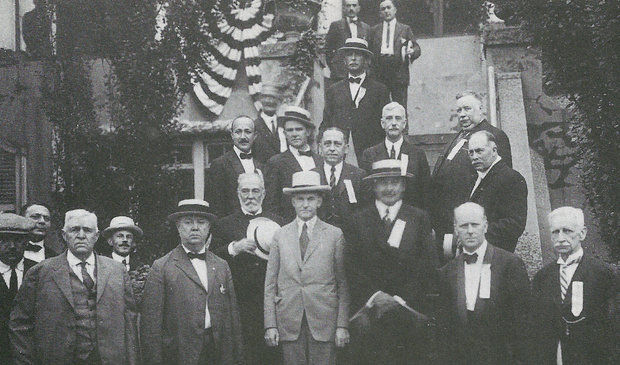
Vice President Calvin Coolidge with citizens of Elizabeth, New Jersey, July 1, 1922. Courtesy of the Elizabeth Public Library.

Coolidge understood all this and so in one of many messages he gave on the powerful influence of the universities, he wrote this in July 1922:

“Our higher institutions of learning are not the apex of our system of education. They are its base. All the people look up to their influence and inspiration. They must be under the guidance of men of piety and men of an open mind. They must continue their indispensable service to the cause of freedom by bringing all the people unto a knowledge of the truth…America lays no claim to the discovery of the theory of freedom or self-government. Its glory lies in the ability of its people to put those theories into practice, not merely the power to state them but the capacity to live up to them.

“The inalienable right of man to life and liberty and to be protected in the enjoyment of the rewards of his own industry have their source in religion. The rights of man as man, the dignity of the individual, find their justification in that source alone. Whenever its teachings were fully admitted, the rest followed as a matter of course. It was religion that came first; then the establishment of free government…”

The universities would do well to navigate free of the mire they have courted and that currently ossifies all in contact with it. This is why starting anew on proven foundation stones is perhaps the one way out of the corroded and crumbling mess. There is no salvaging the wreck left by too many institutions committed to riding over the cliff with Postmodernism at the wheel. Starting over, we would discover a revitalization long absent if we dared embrace the spirit and courage the founders of the original universities had. These new institutions would resume the enterprise of growth that truth makes possible and find rest for parched human souls once again.

6192823293_9e031897ef_b CC in Vermont Hills
President Coolidge at Plymouth Notch during his famous 1928 visit there, giving his “Vermont Is A State I Love” speech from the back of a train car at Bennington. Photo credit: Leslie Jones Collection.


On the Inauguration

From 23 inaugurations ago, President Calvin Coolidge can still be heard crisply and resoundingly with a message for the ages.

“Because of what America is and what America has done, a firmer courage, a higher hope, inspires the heart of all humanity…

“We have been, and propose to be, more and more American. We believed that we can best serve our own country and most successfully discharge our obligations to humanity by continuing to be openly and candidly, intensely and unscrupulously, American…

“But if we wish to continue to be distinctly American, we must continue to make that term comprehensive enough to embrace the legitimate desires of a civilized and enlightened people determined in all their relations to pursue a conscientious and religious life. We can not permit ourselves to be narrowed and dwarfed by slogans and phrases. It is not the adjective, but the substantive, which is of real importance. It is not the name of the action, but the result of the action, which is the chief concern.” — Calvin Coolidge