On Smiling

While Calvin Coolidge could be downright loquacious when the subject warranted, he rarely recounted humorous stories, especially if they were lengthy — yet he loved to listen to them. The stories he did tell were usually in the vein of clever wordplay or illustrations of the antics common to human (or animal) nature. Moreover, in contradiction to decades of assurances by “historians,” contemporaries, and critics, Calvin could and did smile. While we are often reminded that photographs do not capture the full context behind an occasion, we encounter in these pictures windows into stories that deserve a retelling. Here are just a few of the whimsical moments across the Coolidge years.

On Real Patriotism

arlington-national-cemetery-panorama

“…We can not contemplate these graves which are all about us, we can not recall the history which they symbolize, without a deep consciousness that they have placed  upon us an obligation to take a firmer resolution that their sacrifices are to have an influence on our conduct. The place which these heroic figures hold in history is forevermore secure. They did not hesitate, they did not yield, they met their duty squarely. For its fulfillment they were prepared to give their fortunes and their lives. It ought never to be forgotten that it was out of this spirit, supported by these sacrifices, that our country was established, its Constitution adopted and supported, its institutions formed, and its progress and prosperity created, with all that these have meant to the success and happiness of our own people and to the advancement of human welfare all over the world.

“Reverence for the dead should not be divorced from respect for the living. If we hold those who have gone before in high estimation, it will be reflected in our conduct toward those who are still with us. It would be idle to place a wreath on the grave of the dead and leave ungarlanded the brow of the living…

“These men stand ready to respond at any moment to the order of our Government to proceed to any point within our own country or to any portion of the globe where disorder and violence threaten the peaceful rights of our people. Their post is always the post of danger and their lives are spent in service and sacrifice to promote the welfare of their country. America has a just right to satisfaction and pride in the personnel and purpose of its Army and Navy. We can not be loyal to the flag if we fail in our admiration for the uniform.

soldiers-1010631_1920

“However much we wish to pursue the paths of peace, however much we are determined to live on terms of good will both at home and abroad, we can not escape the fact that there are still evil forces in the world which all past experience warns us will break out from time to time and do serious damage to lawful rights and the progress of civilization unless we are prepared to meet such situations with armed intervention. We could no more dispense with our military forces than we could dispense with our police forces…

“If we are sincere in our expressed determination to maintain tranquility at home and peace abroad, we must not neglect to lay our course in accordance with the ascertained facts of life. We know that we have come into possession of great wealth and high place in the world. There is scarcely a civilized nation which is not our debtor. We are sufficiently acquainted with human nature to realize that we are oftentimes the object of envy. Unless we maintain sufficient forces to be placed at points of peril when they arise, thereby avoiding for the most part serious attack, there would be grave danger that we should suffer from violent outbreaks, so destroying our rights and compromising our honor that war would become inevitable. It is to protect ourselves from such danger that we maintain our national defense. Under this policy it is perfectly apparent that our forces are dedicated solely to the preservation of peace…

president-calvin-coolidge-speaking-beside-confederate-flag-at-arlington-KWC489

President Coolidge, May 24, 1924. Courtesy of Everett Collection Inc./Alarmy Stock Photo.

“As Americans we are always justified in glorying in our own country. While offensive boastfulness may be carried to the point of reproach, it is much less to be criticized than an attitude of apologetic inferiority. Not to know and appreciate the many excellent qualities of our own country constitutes an intellectual poverty which instead of being displayed with pride ought to be acknowledged with shame…”

— President Calvin Coolidge at Arlington National Cemetery, Memorial Day, 1927

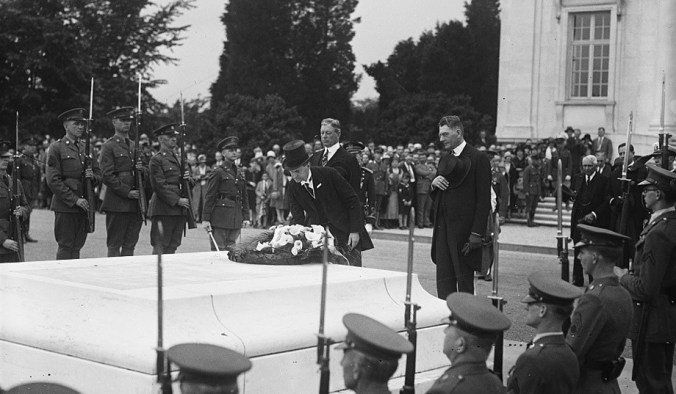
arlington-national-cemetery-photos-30-2

President Coolidge presenting a wreath on the Tomb of the Unknown Soldier, 1927

On the “Lost Art” of Saying ‘No’

Garland Tucker over at National Review reintroduces to us Presidents, Republican and Democrat, who were also masters of what seems a permanently lost art: the art of saying “No.” It is so easy to say “yes,” in the host of forms it has been uttered these eighty-nine years since Cal left office. Coolidge (and Cleveland before him) understood the President’s higher – and often most important – duty rests in the former. Moreover, they took it beyond the realm of sanitized theory into the gritty trenches of consistent practice. They waded in with daring courage and, though they stood where no one else could, they did not shirk. They stood as granite when the halls of government today are replete with those who have surrendered for infinitely less risk. They understood the role of the President much more profoundly than most of their successors.

The uncompromising reality is that the best answers to most problems simply do not reside in government offices.

Yet, it appears the successors of Calvin Coolidge have been engaged in an impossible race to escape that immutable reality. Every stride taken finds them no closer to the goal of leaving it behind in the dust than when Herbert Hoover first tried to do so back in 1929. The harder each successor tries, the closer reality remains. This is not simply some retro version of the “art of the deal” (which is nothing more than a “yes” disguised as a “no”). After eighty-nine years of telling a seemingly limitless list of petitioners “yes,” has it become an impossible expectation to ever hear “no” again? Out of the national shock that would surely result would come a breath of fresh air America has not known since Cal proved it could be done …and done well.

President Calvin Coolidge penning his first official public document while his private secretary Clark watches 8-5-1923

President Coolidge drafting his first state paper as the new Chief Executive. This was by no means his first encounter with official documents, having been Governor of the vital state of Massachusetts, State Senate President, State Representative, Northampton Mayor, and City Council member. He came to the office with more practical experience than most of his successors can claim. He wears the black arm band in mourning for his predecessor, the beloved Warren Harding. Coolidge’s private secretary, “Ted” Clark, watches, August 5, 1923. Courtesy of Getty Images.