Old Home Day, Coolidge Homestead

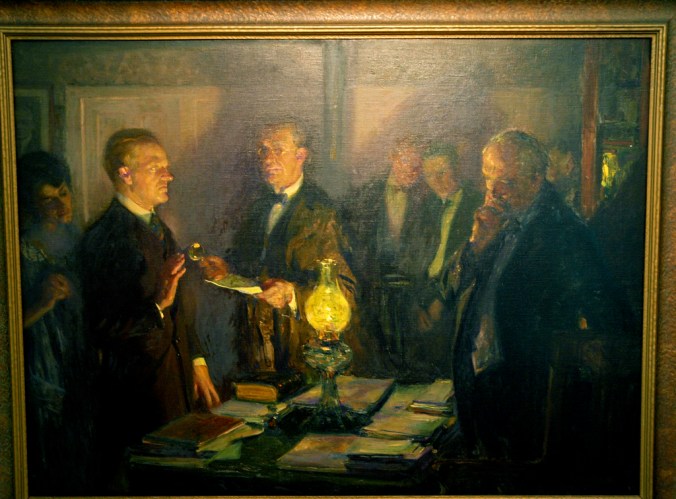
Keller Painting

This weekend, August 4 at Plymouth Notch in Vermont, will mark the ninety-fifth anniversary of Calvin Coolidge’s inauguration as the thirtieth President of the United States. It took place in the early hours of August 3, 1923 (2:47AM to be exact), as the oath of office (derived from the U.S. Constitution in Article II, section 1, clause 8) was administered by none other than the new President’s own father, John Coolidge, a notary public. Gathered around the sitting room table illuminated by kerosene lamp, father and son with Cal’s Grace, were joined – according to the Coolidges themselves – by Erwin C. Geisser (Coolidge’s stenographer), Joe McInerney (Coolidge chauffeur), William H. Crawford (there on assignment to write an article about Coolidge for Colliers), and Porter H. Dale (U.S. Representative and soon-to-be U.S. Senator by special election). Geisser, McInerney, and Crawford had all been staying together at accommodations in Bridgewater, hurrying to the Homestead as soon as they heard the news of President Harding’s death, which had taken place around 7:30pm on August 2. It seems they heard it from the Perkins’ neighbor, Clarence Blanchard, awakened by the loud ringing of the phone next door at 11:30pm. So close he could overhear the message taken down by Nellie Perkins, the operator of the Bridgewater switchboard, Mr. Blanchard rushed to Furman’s Boarding House where Geisser, McInerney, and Crawford were staying to give them the news. Waking her husband Winfred, the “telephone man” (as Colonel Coolidge dubbed him), he was the first to arrive and deliver the message to the Colonel around midnight. With no telephone hooked up at the Homestead (and Florence V. Cilley asleep in the house behind her store), Mr. Perkins had to rush the eight miles from Bridgewater to Plymouth to hand-deliver the news.

On hand but, it seems, not directly present in that room were: Aurora Pierce, the housekeeper; Bessie Pratt, her helper that summer; and, arriving with Mr. Dale, Herbert P. Thompson (American Legion commander at Springfield), Joe E. Fountain (22-year old editor of the Springfield Reporter), and Leonard Lane (presiding officer in the Railway Mail Association), who carried a pistol as part of his job and with it guarded the President and Mrs. Coolidge that night. Of course, others were near, including: Captain Dan Barney drove the taxi taken by Dale, Thompson, Lane, and Fountain; and Miss Cilley, the operator of the store across the street. The Coolidge boys – John and Calvin Jr. – were already gone back to their summer vocations (John at Camp Devens and Calvin Jr. in the fields northeast of Northampton, around Hatfield).
VTC078

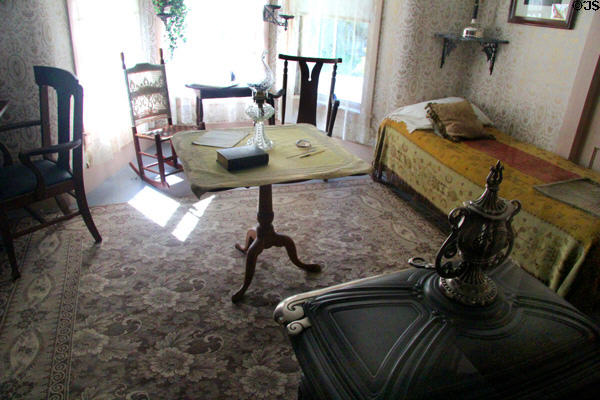
Sitting Room table where the Oath of Office was administered in the early morning of August 3, 1923. Photo courtesy of Jim Steinhart.

Artist Arthur Ignatius Keller, struck by the drama of that night’s events, later painted a depiction of that Inauguration which had unfolded around the kerosene lamp. While Mrs. Keller and Grace Coolidge sat for tea, the President posed for the artist. While the likenesses were imprecise, Coolidge would later confirm “everything in relation to the painting is correct.” The story of that simple inauguration swept across the country and contributed not only to Coolidge lore but gave a preview of the homespun style and manner the country could expect from their new President.

Old Home Day gatherings are a great New England tradition and were a familiar event in the lives of Calvin and his family growing up on the Homestead at the Notch. It was a time to return to the place of one’s upbringing for those who had moved on or to reconnect with those who had left. This Saturday, up at Plymouth, will be the 2018 Homestead Inauguration reenactment. I have been honored with a part in the day’s events. If you can make it, come out and join us. I hope to see you there!
6193352394_9b7fc91dcc_b in Plymouth

On Confusing Proximity with Causation

CC-HotSpringsSD-1927

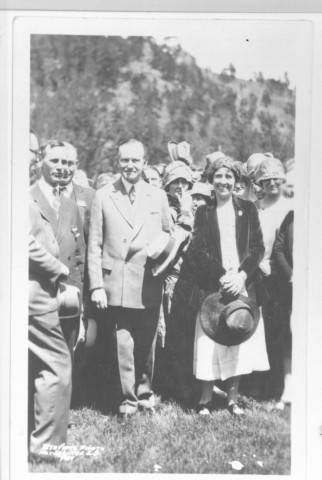
The Coolidges at Hot Springs, South Dakota, summer of 1927. Courtesy of South Dakota Digital Archives.

Mr. Lawrence W. Reed over at the Foundation for Economic Education has written a good reminder today about one of the most repeated myths regarding Calvin Coolidge and the Roaring Twenties: That all of it was responsible for the devastating economic plummet of the Thirties.

Mr. Reed’s analogy about washed cars and rain illustrates the very absence of a logical grasp of the issues when it comes to this attack on Cal. It is easier, though, to remake him into a caricature than to exert the effort to understand him and his ideas. It is easier to blame what came before the disaster than to reckon with those truly responsible: the decision-makers and policy experts of the Hoover and FDR administrations. It was widely noted at the time by numerous observers how dramatic a sea change truly did occur with the departure of the Coolidges from Washington in 1929. It began long before FDR came to town. Even before the 1932 campaign entered full swing, the steady vilification by New Deal advocates (before the term was even coined) of those corrupt, greedy, grasping Twenties remains a persistent impression today. It remains just as flawed and downright incorrect.

It was Coolidge’s substantial record of successes that were the envy of contemporary officeholders because he delivered while they could only posture and promise. None of his accomplishments rested on pandering guarantees or any of the typical electioneering litany of empty promises. He succeeded where others failed. That method and model had to go if business as usual was to prevail. Of first importance, though, was Coolidge’s reputation. Blame him for the depression and it accomplishes both goals: Destroy personal credibility and replace supposed failure of his governing approach.

Such is the handicapping result of this myth. Coolidge did help but not in the way his detractors claim: Consistently unassuming to the end, he was indifferent to any self-preservation or thoroughly explained defense of his record. His early passing only hastened this upheaval and denial of Coolidge’s successes.

Emotion will always be a part of politics. The fallout of guilt by proximity is as old as human experience. Coolidge distinguished the difference between proximity and actual guilt. He held doggedly to that principle in the days when the pressures of Teapot Dome could have implicated an entire company of innocent people on that basis of association alone. He held firm when the temptation was strongest to say nothing regarding race relations, delivering strong rebukes to Sergeant Gardner, to Congress on the crime of lynching, and before the crowds of Omaha (and those listening nationwide), where riots had torn the city. With Mr. Coolidge we are shown a better way, a way that deserves a fair and honest reappraisal. He deserves better than the myth and America has a duty to render at least this measure of appreciation for the service he bestowed not only in his time but for generations yet to be born.


Calvin Junior

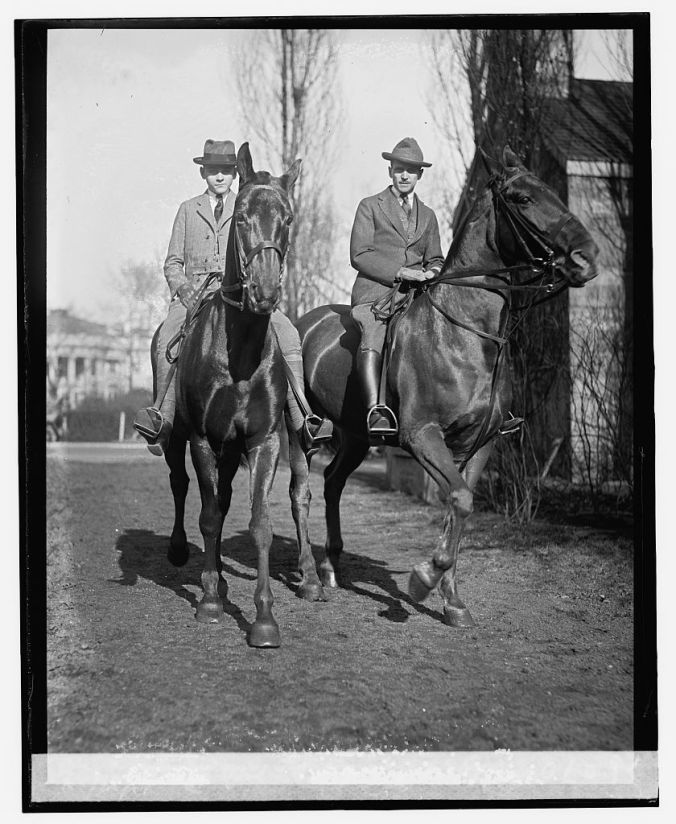
It was on this day, July 7, 1924, at 10:30 in the evening, that the Coolidges’ youngest son, sixteen year old Calvin Jr., lost his fight with blood poisoning (septicemia) from a blister on his foot after playing tennis with his brother, John. In a hurry, young Calvin neglected to wear socks. Of course, the cause of Calvin’s symptoms was at first unknown and had to be accurately diagnosed. Calvin, unusually, is in bed when Dr. Boone arrives to find John is playing tennis with Agent Haley instead of Calvin.

10160v Cal Jr with Dr Boone 12-24-1923

Calvin Jr. and Dr. Boone riding horses, December 1923. Courtesy of the Library of Congress.

Diagnosing the Cause

It was Dr. Joel Boone, assisting physician at the White House who first recognized the seriousness of his condition on July 2. The White House physicians, Major Coupal and Boone, are joined by Colonel William Keller, chief of surgery at Walter Reed Hospital, Dr. Charles W. Richardson, a respected Washington area physician, Dr. John B. Deaver of German Hospital in Philadelphia and a pathologist from the University of Pennsylvania School of Medicine, Dr. Kolmar. The President catches a young rabbit from the White House lawn to cheer his boy, whom they affectionately call “Bunny.”

As the infection moves into Calvin’s other leg, the boy is taken to Walter Reed on July 5. Surgery by Deaver with Keller assisting removes a small portion of the bone to be tested. It confirms the bacteria is staphylococcus aureas. Dr. Boone, searching for blood donors, finds T. Claude Perry, a corpsman during the late War and acquaintance of Boone’s; Perry is called but does not get the message in time. Perry will later write a letter to Dr. Boone expressing his regret at missing that call. Everything possible is being done for the infection in a time when Alexander Fleming’s discovery of penicillin’s potential remained four years in the future.

Surrender

Calvin, fighting on, goes from bad to worse. He begins to manifest respiratory problems on July 6. The President and Mrs. Coolidge sit by his side through most of the fight. The President presses his locket of his mother’s (Victoria Coolidge’s) hair into Calvin’s hand, stroking the boy’s forehead. An oxygen tank being prepared for Calvin explodes in front of Dr. Boone, who is struck in the chest and escorted out for a time. Fortunately, Boone is back in an hour and no one else was hit. Calvin, undergoing a fever, begins giving and receiving battle orders. Dr. Boone encourages him to keep fighting and not surrender. Calvin’s body, overcome by the infection, presents ileus near the end and succumbs that evening. Mrs. Coolidge enters to see her boy in death. Calvin Jr. is brought back to the White House and laid in state in the East Room. It is said the President, in his nightshirt, came down during the night to stroke the boy’s head as he laid in the casket.

25903v Cal Jr Funeral 7-9-24

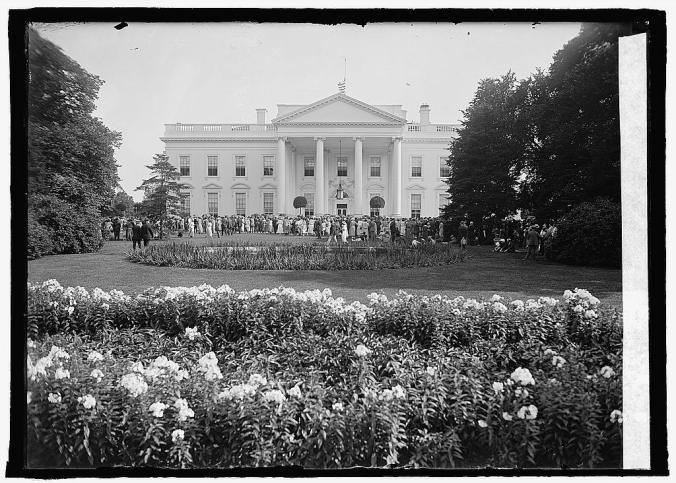
White House grounds from the north side, during Calvin Jr.’s service, July 7, 1924.

Service

Services conducted by Jason Noble Pierce for their son are held in the East Room on July 9, at 4pm. The Coolidges rarely displayed what they felt inside but as the casket was being carried out of the White House, it became too much for the President, who broke down and wept. A funeral train carries the boy toward Northampton, where memorial services are held later that evening at Edwards Congregational Church led by Kenneth B. Wells.

The following day, the funeral party reaches Ludlow and begins the final passage to Plymouth Notch, where Calvin Jr. is interred in the family plot on July 10. Boy scouts pass in tribute. Marine bugler, Arthur Whitcomb (who had played taps at the White House service) having accompanied the family to Plymouth, remains on hand. The President marks John’s height on the doorjam, measuring where Calvin Jr. would be “if alive.” Colonel Coolidge accompanies the family back to Washington.

Each will grieve in his and her own manner but the President will continue to seek election, secure nomination, and faithfully serve for the next four and a half years in such a manner that he makes administration look effortless. The glory of the Presidency may have gone with Calvin’s death but the commitment, fidelity, and exertion duty required never slackened for the President. A place nothing could fill opened before the entire family when Calvin Jr. left but, as the President would later tell Jason N. Pierce, “what would heaven be like, if it were made up only of old men and old women”? The President knew, as did king David of old, the boy could not return to him but the father would see his son again (2 Samuel 12.23).

To one who remains a boy for eternity, Calvin Coolidge Jr. (1908-1924)