On the Sap Bucket

image1

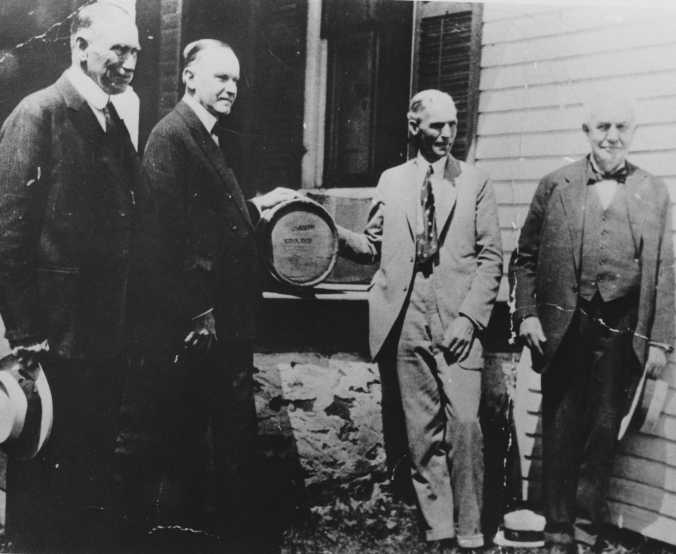
President Coolidge poses for the cameramen with his father, Henry Ford and Thomas Edison with the sap bucket beside the porch of the Homestead at Plymouth, August 19, 1924. Photo credit: Wayside Inn Archives.

When the “Vagabonds” (Henry Ford, Thomas Edison, and both Harvey and Russell Firestone) descended upon President Coolidge’s Homestead on this day (August 19) in 1924, a virtual town arrived with them: the support staff and 50-Ford auto caravan that took care of Ford and his crew while they “camped” up and down the Eastern seaboard. Only at Plymouth for barely an hour, Ford and company did not stay long but Coolidge was ready for them.

Over the previous five years Ford had become the leading collector in the country of Americana: the “relics” (as he called them) or memorabilia of regular folks drawn from everyday objects of the past. Ford loved history but not as it was too often taught in the schools – the emphasis on emperors, kings, and generals. Rather, to Ford, it was the anonymous men and women who labored in fields, mines, mills, and factories who carried history forward. This quest started for Ford when he learned in 1919 that his birthplace stood in the path of highway expansion. He relocated the home and began gathering a collection of furnishings that would form the nucleus of thousands of items by that summer of 1924.
henryfordcollector_inlinearticle_-thf126101

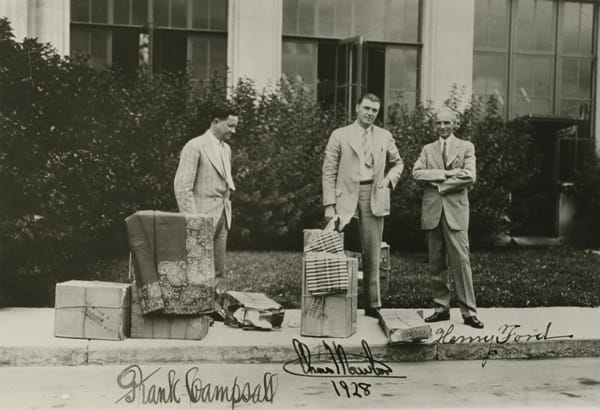
Henry Ford standing with a couple of his assistants (Frank Campbell and Charles Newton) as they receive items for the growing collection at Dearborn (1928). Photo credit: Ford Museum of American Innovation.

Not stopping with his birthplace, he restored the one-room schoolhouse he attended, the Scotch Settlement School, then Longfellow’s old Wayside Inn at Sudbury (Massachusetts) in 1923, and the Botsford Inn at Farmington (Michigan). By that summer of 1924, he was amassing a warehouse-sized collection at Dearborn and the President would contribute generously to its inventory: donating his cradle, first baby carriage, various kitchen items, and things from around the Homestead, including most famously, the 125-year-old wooden sap bucket used by his great great grandfather and Revolutionary War soldier, John Coolidge (1756-1822).

As Ford recounts, remembering in 1935,

“In company with Mr. Edison I visited Mr. Coolidge one summer day at his Vermont farm. I had always heard he was a taciturn man, but found him a man of most friendly conversation, free in the expression of his own opinions and interested in hearing the opinions of others. It was not long after our introduction that he had us out in the little cheese factory behind the farmhouse, where we were eating the cheese curd which we got by using whittled pieces of shingles as spoons. It was good American cheese.

“After we returned to the house Mr. Coolidge spoke about an old sap bucket which his grandfather had used, and offered it to me for our collection at Dearborn. Of course I was very happy to have such a gift and asked him to autograph the bucket. ‘Why, yes,’ he said, ‘we’ll all autograph it.’ So Mrs. Coolidge and Mr. Coolidge’s father and the President and Mr. Edison and the rest of the party autographed the sap bucket.

“Naturally we greatly prized that old wooden sap pail and took great pains to see that it arrived at Dearborn safely. It arrived in time for the addition of another signature to the list. It happened that the Prince of Wales was a luncheon guest at our house, and we told him the story of the bucket. He intimated that he would like to be on the bucket, too, and quickly added his signature.”
Prince-HenryEdselFord-1924

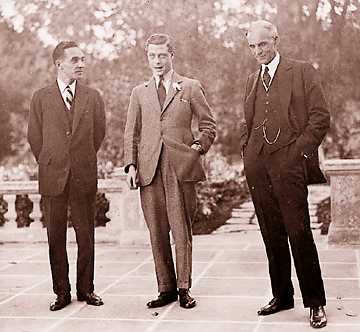
The Prince of Wales (center) on his October visit to Detroit with Henry (right) and son Edsel Ford (left). Photo credit: The Detroit News.

That royal visit occurred on October 14th coming after the Prince had already passed through Washington and met the Coolidge family for a quiet lunch at the White House on August 30th. They had just lost their youngest son the previous month. The Prince would return to America more than once and later meet his future wife there, American Wallis Simpson.
WaysideInn-Diaries

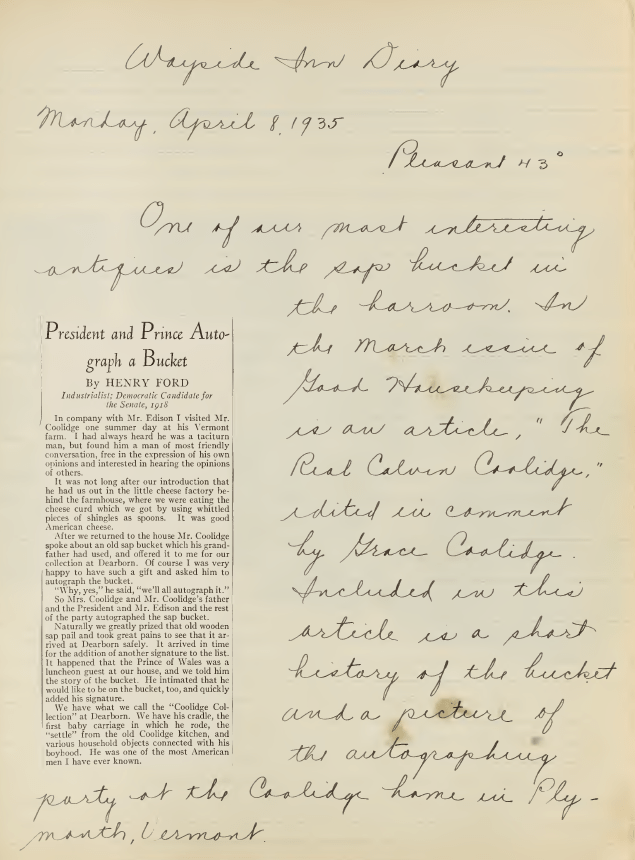
Page from the April 8, 1935 entry of the Wayside Inn Diary maintained through the years under Ford’s ownership.

The sap bucket, displayed all these years in the barroom of the Wayside Inn, is now on exhibit in partnership between the Inn and the Sudbury Historical Society in Massachusetts. The President’s inscription and all the autographs can still be clearly seen. If you are in the Sudbury area, be sure to check it out.

It is a fitting piece of Americana from an era before sheet metal and industrialization. It also bears observing that this great artifact from the founding generation comes from a family of quiet and unassuming public servants. As Ford would say, Coolidge “was one of the most American men I have ever known.” It is a legacy we honor when we emulate their example.


On Fishing

Before Throwback Thursday, sharing a little story for Trout Tuesday…perfect for a summer like this one when Colonel Starling helped win President Coolidge to the joy of fishing. Happy Fishing, everyone!

gouverneurmorris's avatarThe Importance of the Obvious

It was “Colonel” Starling, the head of the President’s Secret Service Detail, who encouraged Coolidge’s fascination with fishing. He had certainly fished before, growing up in Plymouth, but it was due to the Kentuckian’s influence that he became an avid fisherman, including practice in the art of fly fishing. It was during Coolidge’s famous summer of 1927 in South Dakota that Starling recounted the President’s experience with the Royal Coachman and the Black Gnat,

          “One of the first things he did was to admit to the newspapermen that he used worms to catch trout. This precipitated a hullabaloo, with all the fly fishermen in the region shouting that to use worms was unsportsmanlike. The controversy was silly–any fisherman will use worms rather than go home with an empty creel. But I planned to convert the President to flies if I could.

          “A few days later he was fishing…

View original post 496 more words

In the steps of Calvin Coolidge at Home

Coolidge-Dawes-Aug1924

President Coolidge receiving his running mate, Charles G. Dawes, at the Homestead. Photo: Library of Congress.

Unequivocally, for President Coolidge, the strongest place for retreat on God’s earth was the Homestead at Plymouth Notch, Vermont. Here he was born, here he grew up, here he began a lifelong education, here he brought his bride, here his mother, sister, grandparents and great grandparents, and in time, his stepmother, father, and sons came to rest on the hills surrounded by the sound of a constant brook running beside its peaceful folds.

Here the dramatic developments of ninety-five years ago took place, when news of President Harding’s death earlier on the evening of August 2, 1923, could have reached the only phone in the small, quiet village had it only been heard. That phone, located in the General Store across the street from the Homestead, was never answered because Miss Florence V. Cilley was already asleep in the back rooms of the home attached at the rear.

Thus, with no direct line to notify Vice President Coolidge of events, Winfred Perkins (the “telephone man,” as Colonel Coolidge dubbed him) took down the message as it came to his wife, Nellie (the switchboard operator), from White River Junction to their home in Bridgewater, eight miles from the Notch. Mr. Perkins jumped in his vehicle and sped out to the Homestead. He reached there just around midnight, awakening the Vice President’s father asleep in the front room. Perkins then returned to his car and prepared to head home just as others began arriving. Seeing another car pull up, he paused to consider his options. He would eventually take a reporter back to Bridgewater and go home. The reporter would strategically tie up the switchboard in the Perkins home for the next four hours as correspondents struggled to break the unfolding story. The honor of covering the Homestead Inauguration, however, would go to 22-year old Joe Fountain, editor of the Springfield Reporter.

Just moments behind Perkins were Coolidge’s chauffeur (Joe McInerney), stenographer (Edwin Geisser), and William Crawford (working on a story about the Coolidges for Colliers magazine) – all rooming together in Bridgewater – bringing the Pierce Arrow (the Vice President’s car) out to Plymouth. They tumbled out of the automobile and into the house only to find word had already reached the Coolidges and the residence was waking up. The telephone at the Store became a vital tool for the next few hours. More arrived and by 2:47 in the morning, having checked the exact wording of the Oath in the Constitution, Calvin Coolidge was inaugurated by his own father, a notary public, in the sitting room at the front of the house.

Then, he and Grace went back upstairs to sleep a few more hours before heading to Washington later that morning. It is this simple and homespun event that is reenacted on the porch of the Homestead each year. I was honored with the role of Mr. Perkins in this year’s reenactment, the one who delivered the message of President Harding’s death.

6208537332_d62fe09c30_b Coolidges meeting Civil War vet 8-1924

President and Mrs. Coolidge welcoming visitors to the Homestead, including this veteran of the War of 1861-1865. Photo: Library of Congress.

Plymouth remains a hallowed place for me, and the opportunity to see it firsthand is unlike any other I have ever known. My wife and I often observe, after years of studying them, Calvin and Grace live in our house, they are part of our family. That is why this voyage meant so much. At Plymouth, I catch a glimpse of its restful and recuperative qualities, some of the clear reasons Coolidge returned whenever he could. I felt the refreshing debut of its morning air (cool at first but greeted gradually by the warming puffs of summer), the daily routine as nature awakes with the dawn, bird’s voices rising on cue accompanied by the stream beside the cemetery as the hills begin emerging from the fog. All of this wonder unfolds without fanfare just as God endows it, not unlike Mr. Coolidge’s character itself. It becomes evident what filled this place with meaning for President and Mrs. Coolidge, made it so difficult for Colonel John to leave for Washington (choosing to stay at Plymouth instead), and what brought Cal and Grace back – away from it all, even their home in Northampton – to reconnect and restore what only this place could provide.

It was impossible not to be affected deeply by my visit here. In a real way, they felt very close, almost as if Mr. Coolidge might just walk around a corner in his familiar way in the midst of playing some prank or engaged in some errand on the property. I was glad, especially where the bodies of the family wait for eternity’s final reunion, for the time they seemed to generously set aside for me in their company. It was just like them.