I was recently sent these two questions from a reader of The Importance of the Obvious:
I. To what extent did Coolidge’s economic policy lead to the start of the Great Depression?
II. Is there historical evidence that proves Coolidge’s policy actually did more good than Hoover’s policy?
I will attempt to answer these together in the explanations below.
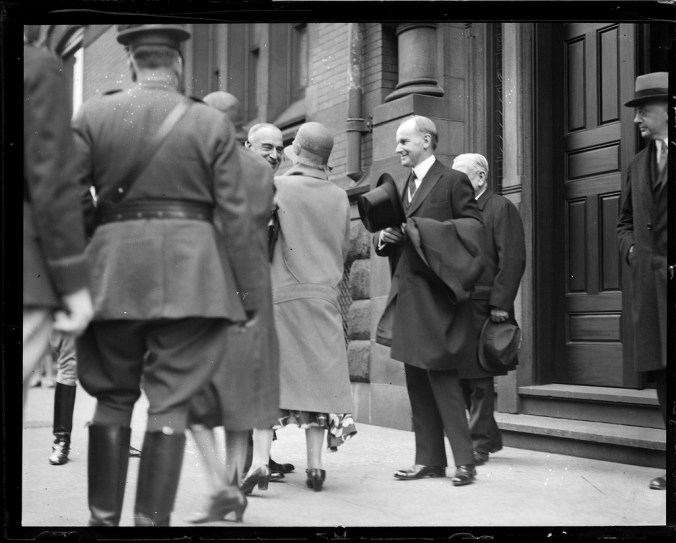
The Coolidges in May 1930. Photo credit: Leslie Jones Collection.
The standard authority that any study of these questions must reckon with is “A Monetary History of the United States, 1867-1960” by Milton Friedman and Anna Schwartz. They look back on depressions throughout American history for insight on the causes and cures. Before the 1930s, there had been a number of depressions and 1873 had been known as the “Great” one. There were even three downturns (1921 depression, and recessions in 1924 and 1927) that directly illustrate the Harding-Coolidge normalization policy at work, which consisted of actual reductions in federal spending, wisely conducted open market operations in the Fed Reserve, and strategic reductions in taxation, all fueling quick recovery and strengthening the market’s reserves not only to survive the Depression but expand into the industrial, technological and agribusiness sectors that are now so significant.
The (1) development of the economy into new sectors, (2) the swift recovery of depression and recession, and (3) Coolidge’s normalization program followed throughout six years in office to rein in spending and pay down debt are the strongest lines of evidence that his actions did much more good than Hoover’s. They resolved so effectually that they are hardly more than an obscure footnote today, known only to specialists. Any comparison done between the Hoover-FDR approach and how Coolidge differed in his actions must study the three declines of the 1920s preceding the market crash of October 1929. Not even that crash necessitated a long-term depression.
It is important to keep in mind that the Depression was neither a foregone event nor only an American phenomena. World War I had a great deal to do with destabilizing the currencies and exchange rates of nations across the world. This destabilization and pursuit of a fixed standard for exchange was one of the defining quests of the 1920s. After the War, the return to gold as the standard gradually took place but the U.S. remained only one part of a very intricate patchwork quilt of finances. It emerged from the War the most financially solvent. Though heavily involved in settlement of debts and other foreign policy issues, the United States could hardly direct or coordinate unilaterally the economic and political situations of other countries. It remained in constant struggle against the take-from-each-other approach prevailing in Europe. Gold actually left the U.S. in substantial quantities as the 20s wound down and went to Europe, especially France. Speculation, mostly by small individual investors (regular folks across the country) increased drastically as the decade wound down too but no President, not even Coolidge, could have dissuaded the nation from such choices, however much he may have personally disagreed with the notion of living on borrowed money. He actually could not interfere, the law itself prohibiting it. As Coolidge scholar Robert Kirby writes in his excellent essay on this very topic,
President Coolidge had no jurisdiction over the stock exchanges in the cities throughout America—the two largest of which, in New York City, were chartered in New York and subject to the laws of the State of New York. Coolidge had no approval authority over the Federal Reserve System. Its authority was derived from statutes enacted by the U.S. Congress and the System was subject only to Congressional oversight. Coolidge worked easily within that framework, though, as he judged people by the consequences of their acts. Benjamin Strong’s experience and skill in dealing with the intricacies of international monetary policy were clearly acknowledged and respected. Coolidge relied on Strong’s unique ability to strike the delicate balance of encouraging economic growth and price stability in the United States while bolstering the financial reconstruction of Europe.
The Depression, as we know it, unfolded in a complex series of waves, the first reflected in the U.S. (notice: not caused, but reflective of a sharp change in both market expectations and commodity values already perceived) by the Crash of October ’29. Critical to this change was the death of Benjamin Strong in October 1928, a year before the Crash. He was the Governor of the Federal Reserve Bank in New York, the most important branch of the Federal Reserve, and Strong himself the leading force in keeping finances sound and reckless decisions in check. In the wake of his unfortunate passing, a power struggle ensued at the Federal Reserve and its members were left without the man who was the glue in many respects. Friedman was even of the studied opinion that had Strong survived a few more years, there would have been no Great Depression at all. I would add, the same would have been true had Coolidge been President. Such was a testament to the steadying hand Coolidge and Strong brought to economic conditions. This struggle for leadership of the Fed went on through 1929. By January, however, the Federal Reserve began abandoning the policies that had supplemented smooth recovery in the past and started yanking on the interest rate and sharply constricting credit. Coolidge left office a month and a half later in March. The Reserve continued to attempt a halt to speculation (instead, it had the effect of undermining its twin: economic growth and investment), shifting more money out of circulation, leading to small bank failures and hitting small farms the hardest. The last wave, occurring in February 1933, pushed the economy into long-term slump that put the “Great” in the event as we now know it.
Between those came the desperate run on banks in 1931 after bankruptcies of a number of important international financial institutions that had made foolish investments with capital. These institutions were not prepared to redeem deposits with hard currency should they be sought. Coolidge watched all of this upheaval in retirement, no longer having even marginal influence in the operations of government. In fact, Hoover had brought in sweeping changes to the outlook and personnel of administrative policy. He won election by campaigning on the continuation of Coolidge’s style but differed from it in personality and mentality. Those won out over any continuation of Coolidge’s leadership. Treasury Secretary Mellon was ignored and increasingly sidelined as Hoover did not pursue the same response that had rapidly resolved earlier downturns, a fact he himself acknowledges in his Memoirs. Hoover even implemented some of the very regulations and economic interventions that Coolidge had resisted as President, creating the Reconstruction Finance Corporation, the highest tariff rates on hundreds of goods under the Smoot-Hawley Tariff of 1931, the Banking Act and Revenue Acts of 1932, the Federal Farm Board and other attempts to bolster recovery by federal spending, preventing bad uses of capital from fully leaving the market. Hoover spoke of ‘American individualism’ and even laissez-faire economics but he practiced an interventionist or “central planner’s” approach to policies. This, in short, blocked a natural process of the marketplace that had worked so well in 1921, 1924, and 1927, not to mention earlier downturns.
Coolidge saw all this unfold and the economic suffering troubled him deeply, all of it being a departure from solutions that had worked in past recessions. He did not believe this one was necessarily any bigger or worse – and thus required different responses – than any other before it but he also could not comprehend why recovery delayed. His health declined quickly, though, at the close of 1932, followed by his death in January 1933. In the final estimate, there was nothing he did to cause it. On the contrary, his policies fortified the economy with the reserve strength to withstand the series of hard hits thrown at it in the 1930s but they also solidified the development of completely new economic sectors in industry, technology and agribusiness that now are commonplace. Sadly, his proven approach became provincial and passé when it was most needed to enable faster recovery and avoid so much suffering at the hands of government good-intentions thinking it necessary to reinvent, if not the wheel, at least what had enabled recovery in every past recession. It is no wonder, Coolidge would remark to friends that he felt he no longer fit in with these times. They were times in which the solutions proposed and implemented were completely at odds with the real-life, practical experiences he had seen work time and again in company with his father on the farm, at college, along the streets of Northampton, in the Massachusetts state house, in the governor’s chair and as President. It was a world flush with the idea that it had outgrown Cal when, in fact, it was merely casting off the benefits of homely wisdom for the pitfalls of abstract experiment (Meet Calvin Coolidge by Edward C. Lathem p.211ff).
In addition to the materials mentioned above, I recommend the following sources for more reading (as with anything approach them with a skeptic’s eye and attention to whether they back arguments with logical and sound evidence):
- Hoover’s 1952 Memoirs, especially his volumes on “The Cabinet and the Presidency (1920-1933)” as well as “The Great Depression (1929-1941).” These are great for examining his own thought process, introspection and defense of his own actions looking back on them two decades later. Even while critical of Roosevelt’s ‘New Deal’ Hoover continued to justify his disagreement as President with Secretary Mellon on policy. Had Mellon been trusted to administer his department (instead of constantly subordinating his perspective to that of Ogden Mills), it might have been a different outcome for Hoover’s administration.
- Reed, Lawrence W. (2010). The Great Myths of the Great Depression. Retrieved from https://www.mackinac.org/archives/1998/sp1998-01.pdf.
- Hazlitt, Henry. (1979). Economics in One Lesson. New York: Three Rivers Press.
- Caldwell, Bruce, ed. (1995). Contra Keynes and Cambridge: Essays, Correspondence – The Collected Works of F. A. Hayek. Indianapolis: Liberty Fund.
- Hawley, Ellis W., ed. (1974). Herbert Hoover as Secretary of Commerce 1921-1928: Studies in New Era Thought and Practice. West Branch, IA: Herbert Hoover Presidential Library Association.
- Warren, Harris Gaylord. (1967). Herbert Hoover and the Great Depression. New York: W. W. Norton.
- Murphy, Robert P. (2009). The Politically Incorrect Guide to the Great Depression and the New Deal. Washington, D. C.: Regnery.
- Rappleye, Charles. (2016). Herbert Hoover in the White House: The Ordeal of the Presidency. New York: Simon & Schuster.
- Folsom, Burton, Jr. (2008). New Deal or Raw Deal? How FDR’s Economic Legacy Has Damaged America. New York: Threshold Editions.
- Grant, James. (2015). The Forgotten Depression: 1921: The Crash That Cured Itself. New York: Simon & Schuster.
- Shlaes, Amity. (2008). The Forgotten Man: A New History of the Great Depression. New York: Harper Perennial.
- Chapter Five “Coolidge Prosperity and the Great Depression” from Silver, Thomas B. (1982). Coolidge and the Historians. Durham: Carolina Academic Press. The whole book is excellent, though. I highly recommend it.
- Haynes, John Earl. (1998). Calvin Coolidge and the Coolidge Era: Essays on the History of the 1920s. Look especially at Michael A. Bernstein’s essay “The American Economy of the Interwar Era: Growth and Transformation from the Great War to the Great Depression.”
- Sobel, Robert. (1998). Coolidge: An American Enigma. Washington: Regnery. Especially note the 13th and 14th chapters (see page 377 onward).

 The Importance of the Obvious