
Marvin L. Stone (1924-2000)
The chief editor of U.S. News and World Report from 1976 to 1985 was Marvin Lawrence Stone. Born in Grace Coolidge’s hometown of Burlington, Vermont, on February 26, 1924, Stone went on to become a premier news correspondent after serving as a small boats captain in the Pacific during World War II. He completed studies at Columbia’s Graduate School of Journalism in 1949. After months of meticulous research, he broke the news in 1951 that the Soviets had developed their own H-bomb, to the astonishment of United States policymakers and military leaders. He was present aboard the last transport plane that dropped paratroopers into Dien Bien Phu before it fell to Ho Chi Minh in 1954. He was there to report on the rise of the Berlin Wall in 1961. He would cover the developments of the Space Age, eyewitness some of the most historic launches from Cape Canaveral, and earn a remarkable collection of awards, including not only accolades from Columbia and Marshall Universities but also three honorary degrees, recognition with the Distinguished Alumnus Award from the American Association of State Colleges and Universities, the Four Freedoms Foundation Award, the American Eagle Award, the American Bar Association’s Silver Gavel Award, the Gold Mercury International Award, and entry into the Washington Journalists Hall of Fame in 1990 among many other honors. He was a member of the White House Correspondents Association, American Society of Magazine Editors, and the National Press Club, in addition to several other nationally and internationally acclaimed organizations. It was his question to President Carter during the 1980 Presidential campaign debates in Cleveland that embarrassed the reelection campaign with Carter’s admission that he discussed nuclear policy with his daughter Amy.
A protege of the “Grand Old Man of Journalism,” W. Page Pitt (whose blindness from age 5 never hindered his success), Marvin Stone would embody Pitt’s admonition: “You are not here to learn mediocrity, you’re here to learn how to excel.” Stone would serve from 1985-1989 in the Reagan administration at the United States Information Agency. He would then chair the International Media Fund after 1989, working to encourage freedom of the press in Eastern Europe. While at U. S. News and World Report, Stone would leave a profound impact on the publication inherited from David Lawrence and passed on to Mortimer Zuckerman. Stone introduced the first full color pictures, stood by personnel others sought to marginalize for their color, and featured an editorial piece every year in honor of Calvin Coolidge, a President he deeply admired in spite of being an unfashionable opinion in most of his professional circle. Stone retains a certain stain on his record, regardless of his incredible 40 years in journalism, not only for his association with Lawrence and Zuckerman (both considered “bad news” to many in the intellgentsia) but also because of his service to “the enemy”: the still resented, even vilified Ronald Reagan administration. Yet, Stone’s credentials, quality and experience run at odds with the political prejudices nursed toward him or, for that matter, toward the quietly heroic thirtieth President (an admiration Stone clearly shared with Ron Reagan). Unfortunately, Stone passed away in 2000 at only 76 years of age.
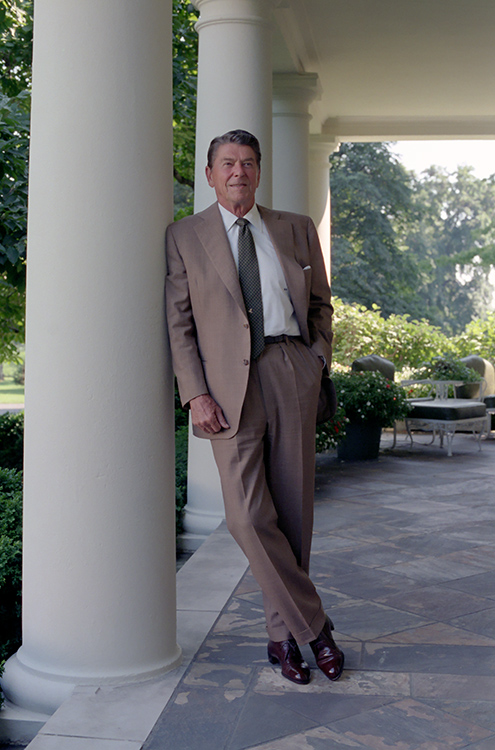
Photo credit: Ronald Reagan Presidential Library.
Reagan writes this in An American Life,
I’d always thought of Coolidge as one of our most underrated presidents. He wasn’t a man with flamboyant looks or style, but he got things done in a quiet way. He came into office after World War I facing a mountain of war debt, but instead of raising taxes, he cut the tax rate and government revenues increased, permitting him to eliminate the wartime debt and proving that the principle mentioned by Ibn Khaldoon about lower tax rates meaning greater tax revenues still worked in the modern world (244).
Today, given it is Ronald Reagan’s birthday and (in twenty more days, Stone’s), we offer Editor Stone’s piece from the July 4, 1981 issue of U. S. News and World Report, entitled, “The Good Sense of ‘Silent Cal.’ “ At a time when some of us struggle with the basic ability to be human or even exercise the higher art of good listening, Stone reminds us to flex those unused skills here. He knew the classless antics and juvenile bitterness that are recurring vices in Washington no less than anyone who works in journalism for as long as he did (and who remains honest with self and toward the profession). He understood this knee-jerk tribalism was the lifeblood for many in D. C. (and anywhere partisans mindlessly grapple) but he also knew in Coolidge we had an example of something better, a higher discipline arresting those base, mean, low reactions that too often prevail against sound judgment and the responsibility to one’s oath. Coolidge once said, “Duty is not collective, it is personal.” I should not then predicate my obligations, my actions, my rhetoric on what the other guy is doing or not doing, it is mine alone to do what is right whatever anyone else is saying or doing.
Of course, Washington had its plethora of elitist windbags and childish partisans in Coolidge’s time no less than now, those charmed by the occasion to grandstand, hear themselves talk, and otherwise misbehave for mere political effect, scoring whatever points they could indifferent to law, constitution, country. That is not new but neither must it perpetuate with our help while we blame “the process” we continue feeding in our own circle.
- If you are truly tired of the political brokenness, stop incentivizing the postponement of responsibility in our representatives. Start looking for a Coolidge where you are, one who will not evade the hard work or difficult tasks ahead.
- If you are afraid of partisan deadlock, don’t keep adding to the rhetoric of antagonism. We have seen what happens when you give political opponents free advertising. How about trying something new? Take the oxygen out of the fire once in a while and do something generous, even for an opponent. They won’t see it coming and those coals will burn for quite a while.
- If you are genuinely fed up with the way the networks report, quit fueling the “cage match” news cycle. The hydra grows with every feeding. Nobody is forcing you to watch or listen, turn it off occasionally and deliberately get away. World events will still be there when you get back. In fact, there is a world of healthful wonder and wholesome beauty waiting for you out there. Go explore it.
- If you are truly weary of incivility, don’t yourself be uncivil toward others. Your rights, however important you think you are, do not include abusing the rights of others. Your freedom to have and share an opinion does not carry with it the instant obligation to be provided a platform or an audience. Go out and earn it. Be careful about confusing volume with effectiveness, though, and don’t let envy of others’ success convince you that those who do it better than you do must be personally or politically wrong. Nor should you blame the other half of the country that doesn’t see it your way. Remember it might not be them, it might be something you are missing.
- If you want people to be better listeners, be a better listener yourself. You who malign others for their ignorance and blindness, are you listening to what is actually said or emoting as much, if not more, than those you attack? The plank in our own eyes often gets in the way of a clear (or fair) estimate of others. The dissatisfaction we at times have for our situation often has less to do with others and much more to do with ourselves. As Michael Jackson put it: “Take a look at yourself and then make a change.”
We really only control our own attitudes and actions. If we want something to stop or something new to start, it begins with the person looking back at us in the mirror. Destruction is always easier and involves infinitely less courage, less wisdom, and less maturity. But if we would enjoy building something that endures to pass on to those who come after we are gone, we better decide to get busy at it, stop tearing everything down, and begin building others up. Coolidge exemplifies this good sense and rather than consign him to historical oblivion, exert the additional effort to comprehend not caricature. You’ll start to grow when you do and look out, you may discover what you feel you so confidently know now has wisdom to guide and strengthen it.

Here is Marvin Stone’s “The Good Sense of ‘Silent Cal’ “:
“Calvin Coolidge…our 30th President (1923-1929) is greatly admired by Ronald Reagan. Mr. Reagan is sometimes derided for this devotion because most people do not understand how unfairly Coolidge has been victimized by history. He is one of our most inexplicably maligned Presidents. As was said in this space just a year ago, it is left to those of perspicacity to remember Coolidge in a better light. He was a man who understood his countrymen. He suffered few illusions. Some may poke fun at the conventional caricature of Coolidge, but it takes only a sampling of his statements to recognize his good sense. The following is from the record:
‘It has always seemed to me that common sense is the real solvent for the nation’s problems at all times–common sense and hard work.’
‘Americans have not fully realized their ideals. There are imperfections. But the ideal is right. It is everlastingly right. What our country needs is the moral power to hold to it’ …
‘There is no dignity quite so impressive and no independence quite so important, as living within your means.’
‘The only way I know to drive out evil from the country is by the constructive method of filling it with good. The country is better off tranquilly considering its blessings and merits, and earnestly striving to secure more of them, than it would be in nursing hostile bitterness about its deficiencies and faults.’
‘The meaning of America is not to be found in a life without toil. Freedom is not only bought with a great price; it is maintained by unremitting effort.’
‘Of course we look to the past for inspiration, but inspiration is not enough. We must have action. Action can only come from ourselves; society, government, the state, call it what you will, cannot act; our only strength, our only security, lies in the individual. American institutions are built on that foundation. That is the meaning of self-government, the worth and the responsibility of the individual. In that America has put all her trust. If that fail, democracy fails, freedom is a delusion, and slavery must prevail.’
‘If you see 10 troubles coming down the road, you can be sure that nine will run into the ditch before they reach you.’
‘The world has had enough of the curse of hatred and selfishness, of destruction and war. It has had enough of the wrong use of material power. For the healing of the nations there must be good will and charity, confidence and peace. The time has come for a more practical use of moral power, and more reliance on the principle that right makes its own might.’
‘Industry, thrift, and self-control are not sought because they create wealth, but because they create character.’
‘There is no right to strike against the public safety by anybody, anywhere, anytime.’
‘Prosperity is only an instrument to be used, not a deity to be worshiped.’
‘People criticize me for harping on the obvious. Perhaps someday I’ll write an article on The Importance of the Obvious. If all the folks in the United States would do the few simple things they know they ought to do, most of our big problems would take care of themselves.’ “
Happy Birthday, President Reagan, and thank you for the years, Mr. Stone!


 The Importance of the Obvious