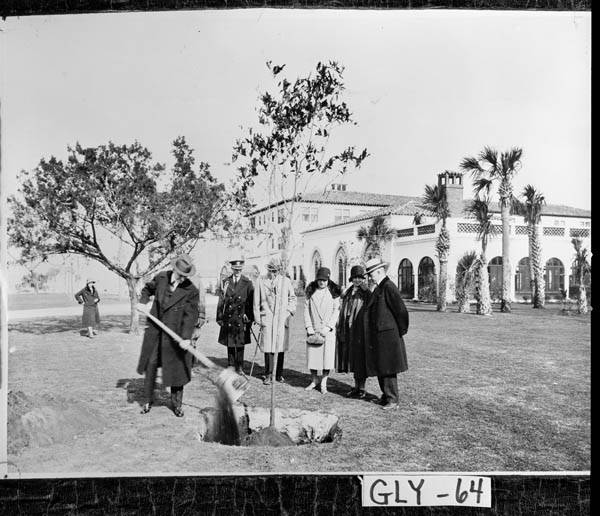
President Coolidge, seven years after this speech (1928), planting the Constitution Oak on the grounds of The Cloister, Sea Island, Georgia. Photo credit: Georgia Archives.
Respect for law is a fundamental American principle. Not that there are no law breakers in our land. There are. But, even among these, there is not lacking some respect for the administration of the law. Those who deny its binding obligation, especially where their own rights are concerned, are few, and their counsels for the most part go unheeded.
It is this respect for law which makes the American people worthy of every confidence, and whenever their attention can be gained, always to be trusted. Some of them may be swayed, momentarily, by strange doctrines taken through lack of information and discussion, but in the end good sense prevails. There may be a lack of appreciation on the part of new arrivals, but among them there are conspicuous examples of a sturdy American spirit, not outrivaled by the inheritors of generations of American training.
There is need to resist radicalism, not because it may overthrow the Government, but because it is a disturbing and wasteful element in society. This does not mean resistance to the growth and expansion of our Constitution, but it does represent resistance to any change in its underlying principles.
Those principles guarantee to American citizens the right of life, liberty and the pursuit of happiness. What more can be required? All that any revolution ever sough to accomplish was a life guarantee. What the oppressed of other lands may seek, every American holds as his birthright.
There is an eternal obligation to remember the meaning of liberty, that liberty which goes with American citizenship. It is not license. It is far from the privilege of disregarding the rights of others. It is the fullest freedom of individual thought and action, limited by a like freedom of thought and action on the part of others.
Men are free to think as they will, to speak as they will, to write as they will, provided thereby they do not trespass on the like privileges or do injury to others. The firm foundation of all liberty is the protection of the individual against the wrong-doing of others.
All liberty is based on justice. The fair dealing between man and man. It is the law of unselfishness. Its basis is equality. Any class, any organization undertaking to secure for itself privileges not open to any other class or organization is hostile to American institutions and a menace to American liberty.
There is a right of contract, of agreement, and association among individuals which is to be protected so long as the end sought is equal justice; but, any effort which contemplates coercion and force is an interference with our conception of American liberty and is justly denounced by American law.
It is true that we hold to the theory of equality, not of character or possessions, but equality of opportunity and equality before the law. This does not mean that the Government guarantees any standard of achievement to its citizens, but that in its dealings with them it will grant to all an opportunity to be heard and the right to a decision based on the evidence of the law, without favor and without prejudice. It is the belief of an American that he creates opportunity, that his achievement, his destiny, his greatness, lies not in others but in himself.
This respect for law has been justified by American accomplishments. In the 145 years which have intervened since the signing of the Declaration of Independence, the success of our nation has been the marvel of history. Those who desire to criticise, those who desire to destroy, will do well to study these accomplishments. Those who wish to join in any enterprise of destruction will do well to inquire what substitute is proposed. It needs no long investigation to demonstrate that under a reign of law there is an accumulation of property and the distribution of the rewards of industry among all the people, and that under a reign of disorder there is a destruction of property and a general increase of want, misery and destitution among the people.
It is true that our institutions were established long ago, that they are justified alike by reason and by experience. It is equally true that they are not self-existent. Their defense and perpetuation requires constant effort and constant courage. If ever the time arrives that existence becomes so easy that effort and courage are not required, the decline and fall of civilization will be at hand. The glory of our history has been in the display of these qualities, from the clearing of the forests, the breaking away from old-world traditions, the prosecution of the Revolution, down to the fields of France, all have been examples of effort and courage. We may not know its source, we may attribute it to our contact with our broad plains or our lofty mountains, or ascribe it as the heritage of our forefathers; but, whatever it is, it has been the mark of American achievement. They may study it in the character of Washington, in Lincoln, in Roosevelt, or in the everyday life of the great body of our citizenship in war and in peace. It has won our wars, it has triumphed in our peace. It has made a garden place of the wilderness. It has raised up cities from their ashes.
That courage, and effort, and confidence, which has marked our progress in the past, have not disappeared. They will not disappear. When conditions call for them, they come surging on. When there is need for leadership there are men appear who can lead. American resources have not failed, American faith must not fail.
Obedience to law is not a mere appeal to the past, it is the sure foundation of progress. Our institutions provide for an orderly process of change, not through revolution but through the action of a wise, a duly ascertained and mature public opinion. This process goes on at every ballot box and in the deliberations and conclusions of every legislative assembly, from the Congress of the United States to the New England town meeting. The Government recognizes the binding force of all such actions.
No party, no organization holds any guarantee of power. It acts under the direction of public opinion. Whenever its action becomes unwise and unwelcome, it is changed for some other party, some other organization, which is delegated to interpret the will of the people and execute the laws of the land. This is the rule not of force, not of a minority, but the rule of justice and of reason.
There are those who speak of overthrowing the Government. In America, this reduces itself to the absurdity of overthrowing the people, for here the people are the government. Administrations and offices may change, have changed, as at the last election when the people entrusted their destinies to a wise and clear-visioned man from Ohio, who, in their service, toils on from day to day, seeking not his own but the public welfare.
More than six score years have written our Constitution, not on parchment alone, nor yet on bronze, but into the everlasting soul of the nation. That is our security. That is our guarantee.
There is discontent and unemployment at home, there are disorders abroad. Their remedy lies in our loyalty to our Government, in our obedience to constituted authority, that our own country, strong, well ordered, resolute, may continue to be the prosperous abiding place of such an institution of publicity and education as we have met here this evening to honor and acclaim, the stronghold of an enlightened liberty, the supporter of an advancing civilization.
— Calvin Coolidge, marking the 150th Anniversary of the New York Commercial, May 23, 1921
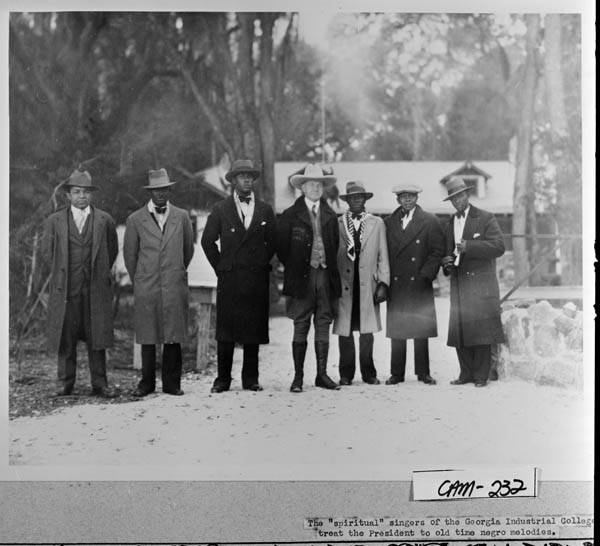
President Coolidge and the musicians and artists of Georgia Industrial College, 1928. Photo credit: Georgia Archives.




 The Importance of the Obvious