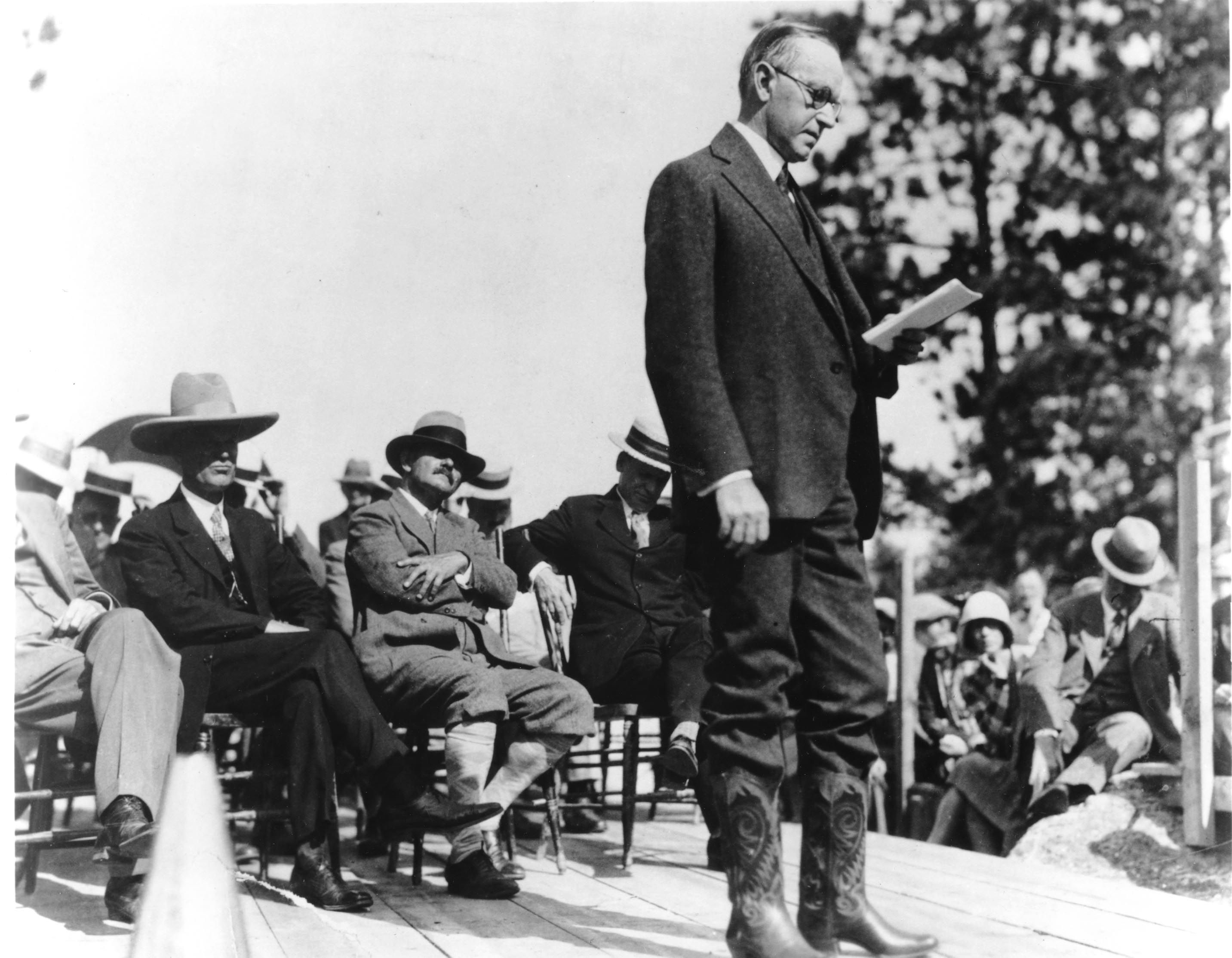
President Coolidge dedicates the site that will be the Mount Rushmore Memorial, August 10, 1927. Flamboyant sculptor, Gutzon Borglum is seated cross-legged directly behind the standing President. Coolidge will sign Public Law 805 creating the Mount Rushmore National Memorial and the Commission overseeing the project on February 25, 1929. The law provided a system of matching funds whereby private donations up to $250,000 would be matched by appropriations allocated by the rest of the states through the Federal government. Strings attached to that money by Washington would not be allowed, however, while fifty percent of the cost would have to be carried by individual investment. The project aspired not only to honor America’s ideals but to live by them.
Sunday, August 10, will mark the eighty-seventh anniversary of the dedication of Mount Rushmore by President Calvin Coolidge. As the late Rex Smith points out, however, in his great account of The Carving of Mount Rushmore, this was neither the first nor the last dedication of so remarkable a site. The President had already come to South Dakota two months before, who better than he could underscore the importance of its continuation and symbolism? Riding to the foot of the mountain on horseback, decked out in the gifts the people of South Dakota had so generously presented to him that summer, President Coolidge came to honor not merely what Borglum and his team would sculpt but what the Almighty had already wrought there.
It was proper that Washington would begin the design, followed by Jefferson, Lincoln and finally, Theodore Roosevelt. Washington embodied the very character of America, giving the “highest aspirations” of our constitutional system form and solidity. “He stands as the foremost disciple of ordered liberty, a statesman with an inspired vision” unmatched by any other since. It was Jefferson “whose wisdom insured that the Government which Washington had formed should be entrusted to the administration of the people.” Emphasizing the centrality of self-government, Jefferson confirmed both its practicality and permanence, Coolidge reminded his audience. Even through purchase of the Louisiana Territory, Jefferson “gave new guarantees to the rule of the people.” The nation having been established and its “dedication to popular government” confirmed, it remained for Lincoln to prove the resilience of the Union and the power of its commitment to freedom to all. It was Lincoln who carried the Founder’s principles to their logical conclusions. To the work of these three was added the efforts of Theodore Roosevelt. “To political freedom he strove to add economic freedom,” Coolidge proclaimed, building the path of the Panama Canal that connects east with west and realizes the purpose of Columbus’ voyage in search of economic opportunity.

Mount Rushmore, as it appeared before carving began

Work officially began on October 4, 1927. Here Borglum has measured out and begun to clear the site for what will be the first of four busts.
Majestic as this mountain would be — still to be carved that summer of 1927 — Coolidge saw more there than a bald rock-face. He saw the deep impressions of what would be there one day and, even more importantly, what those depictions meant. It was “a distinctly national monument,” Coolidge said, because it carried far more than the eye would behold, it would be a “picture of hope fulfilled.” It was suitable that this location — in the very heart of the country — would bring people together in the future to glimpse something more than mortal likenesses. What this memorial testified to was nothing less than eternal truths that endure immutable and unshakable despite what men attempt to do to them. “They will know that the figure of these Presidents has been placed here because by following the truth they built for eternity. The fundamental principles which they represented have been wrought into the very being of our Country. They are steadfast as these ancient hills.” People may attempt to do violence to those principles, intending their dismantlement and eradication, but, even more permanent than the Mount, they withstand time itself because they are eternally true whatever upheaval society experiences.
America’s “genius for self-government” did not come from some genetic or material superiority to the rest of the world, Coolidge declared. It came from the indestructible life of individual liberty. Only when it dies in the hearts and minds of individuals does it disappear, and then, only until ordered liberty is kindled again in the spirit and soul. Many do not understand America, Coolidge observed. “They do not understand the economic progress of our people. It is true that we have had the advantage of great natural resources, but those have not been exclusively ours. Others have been equally fortunate in that direction. The progress of America has been due to the spirit of the people. It is in no small degree due to that spirit that we have been able to produce such great leaders. If coming generations are to maintain a like spirit, it will be because they continue to support the principles which these men represented. It is for that purpose that we erect memorials. We can not hold our admiration for the historic figures which we shall see here without growing stronger in our determination to perpetuate the institutions which their lives revealed and established.”

Approached by Borglum to compose a timeline to be carved into the rock beside the Presidential heads, Coolidge lent his talents for expression with a conscientious concern for historical accuracy to the project. It all ended abruptly, however, when Borglum published his own error-riddled revision of what then-former President Coolidge had written — without bothering to notify him of his actions. As the press began to mistake what Borglum had written for Coolidge’s original prose, Cal suspended any further participation. Since the law passed to form the Rushmore Memorial stipulated that only Coolidge’s words could be used for the Entablature, the idea was scrapped…almost. It would be years until a contest in 1935 would recognize William Burkett as the winner of the best Entablature essay. His work can be seen on a bronze plaque, installed in 1975, inside the viewing facility at the foot of the mountain.
It was hardly surprising that so new a state as South Dakota led the way toward this important work. It did not require the most populous state to stir a remembrance of what America is and means, it came from those who, yet endowed with that pioneering courage and rugged perseverance, made never-before-accomplished things reality. It confirmed “that the old American spirit still goes where our people go, still dominates their lives, still inspires them to deeds of devotion and sacrifice. It is but another illustration of the determination of our people to use their material resources to minister to their spiritual life. This memorial will be another national shrine to which future generations will repair to declare their continuing allegiance to independence, to self-government, to freedom and to economic justice.” The memorial at Rushmore would remind those who came to see it of those timeless standards as long as their real meaning lived in the human spirit. No mortal could blot out the truth or erase the validity of such transcendent intangibles as had formed the foundations of America’s experience. President Coolidge could not have known where the country would be in 2014 but of this, he was certain: those foundational truths had struck something far deeper and lasting than the granite and mica of that Mount in South Dakota. The rocks of Rushmore but signify the preeminence and perpetuity of ideals even more majestic, solid and enduring.

 The Importance of the Obvious