On Criticism, Lawlessness and Public Order

Calvin J Coolidge

CRITICISM
“That agitation and unrest which has been characteristic of the whole world since the close of the war has had some manifestations here. There is a natural desire in every human mind to seek better conditions. Such a desire is altogether praiseworthy. There must, however, be discrimination in the methods employed. Wholesale criticism of everybody and everything does not necessarily exhibit statesmanlike qualities, and may not be true. Not all those who are working to better the condition of the people are Bolsheviki or enemies of society. Not all those who are attempting to conduct a successful business are profiteers. But unreasonable criticism and agitation for unreasonable remedies will avail nothing. We, in common with the whole world, are suffering from a shortage of materials. There is but one remedy for this, increased production. We need to use sparingly what we have and make more. No progress will be made by shouting Bolsheviki and profiteers. What we need is thrift and industry. Let everybody keep at work. Profitable employment is the death blow to Bolshevism and abundant production is disaster to the profiteer. Our salvation lies in putting forth greater effort, in manfully assuming our own burdens, rather than in entertaining the pleasing delusion that they can be shifted to some other shoulders. Those who attempt to lead people on in this expectation only add to their burdens and their dangers.”

LAWLESSNESS
“The people of Boston have recently seen the result of agitation and unrest in its police force. The policy of that department, established by an order of former Commissioner O’Meara and adopted by a rule which has the force of law by the present Commissioner Curtis, prohibited a police union from affiliating with an outside union. In spite of this such a union was formed and persisted in with acknowledged and open defiance of the rules and of the counsel and almost entreaties of the officers of the department. Such disobedience continuing, the leaders were cited for trial on charges and heard with their counsel before the Commissioner. After thorough consideration, and opportunity again to obey the rules, they were found guilty. In order to give a chance to recant sentence was suspended. Shortly after, three fourths of the police force abandoned their posts and refused further to perform their duties. During the next few hours, there was destruction of property in the city but happily no loss of life…It was my duty to support him [Commissioner Curtis] in the execution of the law and that I should do…On account of the public danger, I called on the Commissioner to aid me in the execution of my duties of keeping order, and issued a proclamation to that effect…There is an obligation to forgive but it does not extend to the unrepentant. To give them aid and comfort is to the support their evil doing and to become what is known in law as an accessory after the fact. A government which does that is a reproach to civilization and will soon have on its hands the blood of its citizens.”

Mass-Gov-Coolidge+Natl-Guard_1919

PUBLIC ORDER
“The response to the appeal to support the Government of Massachusetts in sustaining law and order was instantaneous. It came from the State Guard, from volunteers for police, and the militia, from contributions gathered among all classes now reaching hundreds of thousands of dollars, from the loyal police of Boston, from all quarters of the Commonwealth and beyond. These forces may all be dissipated, they may be defeated, but while I am entrusted with the office of their Commander-in-Chief they will not be surrendered. Over them and over every other law-abiding citizens has gone up the white flag of Massachusetts. Who is there that by compromising the authority of her laws dares to haul down that flag? I have resisted and propose to continue in resistance to such action. The issue is perfectly plain…It is seeking to prevent a condition which would at once destroy all…that is the foundation of civilization by maintaining the authority and sanctity of the law. When that goes all goes. It costs something but it is the cheapest thing that can be bought; it causes some inconvenience but it is the foundation of all convenience, the orderly execution of the laws.
“The people understand this thoroughly. They know that the laws are their laws and speak their voice. They know that this Government is their Government founded on their will, administered by their representatives. Disobedience to it is disobedience to the people. They know that the property of the Commonwealth is their property. Destruction of it destroys their substance. The public security is their security. When that is gone they are in deadly peril. And knowing this the people have a determination to support the Government with a resolution that is unchanging.
“It is my purpose to maintain the Government of Massachusetts as it was founded by her people, the protector of the rights of all but subservient to none. It is my purpose to maintain unimpaired the authority of her laws, her jurisdiction, her peace, her security. This ancient faith of Massachusetts which became the great faith of America, she reestablished in her Constitution before the army of Washington had gained our independence, declaring for ‘a government of laws and not of men.’ In that faith she still abides. Let him challenge it who dares. All who love Massachusetts, who believe in America, are bound to defend it. The choice lies between living under coercion and intimidation, the forces of evil, or under the laws of the people, orderly, speaking with their settled convictions, the revelation of a divine authority”
— Governor Calvin Coolidge, excerpts from an Address at the Tremont Temple in Boston to the Republican State Convention, October 4, 1919.

"Massachusetts Did It" by Grant Hamilton, cartoon from 1919, shortly after the Boston Police Strike and consequent public disorder.

“Massachusetts Did It” by Grant Hamilton, cartoon from 1919, shortly after the Boston Police Strike, consequent lawlessness, and the Governor’s decisive defense of law and public order.

On the Unlearned and Historical Perspective

“It is characteristic of the unlearned that they are forever proposing something which is old, and, because it has recently come to their own attention, supposing it to be new. Into this error men of liberal education ought not to fall. The forms and processes of government are not new. They have been known, discussed, and tried in all their varieties through the past ages. That which America exemplifies in her Constitution and system of representative government is the most modern, and of any yet devised gives promise of being the most substantial and enduring.

“It is not unusual to hear arguments against our institutions and our Government, addressed particularly to recent arrivals and the sons of recent arrivals to our shores. They sometimes take the form of a claim that our institutions were founded long ago; that changed conditions require that they now be changed. Especially is it claimed by those seeking such changes that these new arrivals and men of their race and ideas had no hand in the making of our country, and that it was formed by those who were hostile to them and therefore they owe it no support…But scholarship answered ignorance. The learned and patriotic research of men of the education of Dr. James J. Walsh and Michael J. O’Brien, the historian of the Irish American Society, has demonstrated that a generous portion of the rank and file of the men who fought in the Revolution and supported those who framed our institutions was not alien to those who are represented here…

“In these days of violent agitation scholarly men should reflect that the progress of the past has been accomplished not by the total overthrow of institutions so much as by discarding that which was bad and preserving that which was good; not by revolution but by evolution has man worked out his destiny. We shall miss the central figure of all progress unless we hold to that process now. It is not a question of whether our institutions are perfect. The most beneficent of our institutions had their beginnings in forms which would be particularly odious to us now. Civilization began with war and slavery; government began in absolute despotism; and religion itself grew out of superstition which was oftentimes marked with human sacrifices. So out of our present imperfections we shall develop that which is more perfect. But the candid mind of the scholar will admit and seek to remedy all wrongs with the same zeal with which it defends all rights…

“The long and toilsome processes which have marked the progress of the past cannot be shunned by the present generation to our advantage. We have no right to expect our portion something substantially different from human experience in the past. The constitution of the universe does not change. Human nature remains constant. That service and sacrifice which have been the price of past progress are the price of progress now…the evidence was never so overwhelming as now that men and nations must live rationally or perish. The defenses of our Commonwealth are not material but mental and spiritual” — Governor Calvin Coolidge, Commencement at Holy Cross College, June 25, 1919.

Benedict Joseph Fenwick, the founder of Holy Cross, established in 1843.

Benedict Joseph Fenwick, the founder of Holy Cross, established in 1843.

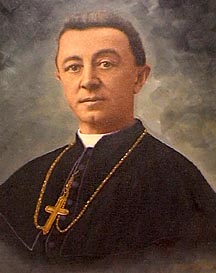
James A. Healy, valedictorian in the class of 1849, was the first black Catholic bishop in the United States. Two of his younger brothers attended the College as well.

James Augustine Healy, valedictorian in the class of 1849, was the first black Catholic bishop in the United States. Two of his younger brothers attended the College as well.

Justice Clarence Thomas, alumnus of Holy Cross College, class of 1971.

Justice Clarence Thomas, alumnus of Holy Cross College, class of 1971.

Frank Waterman Stearns, long-time friend of the Coolidges, at home in Swampscott. His papers now rest in the special collections of Holy Cross College.

Frank Waterman Stearns, long-time friend of the Coolidges, at his home in Swampscott. Many of his papers now reside in the special collections of Holy Cross College.

President of Holy Cross College, when Governor Coolidge delivered the commencement address to both the graduates of 1919 and underclassmen, James J. Carlin would see the College grow and expand from 1918 to his departure in 1924 for work in the Philippines.

Reverend James J. Carlin, President of Holy Cross College when Governor Coolidge delivered this commencement address in June 1919. Carlin would see the College continue to grow during his tenure from 1918 to his departure in 1924, to take on work in the Philippines.

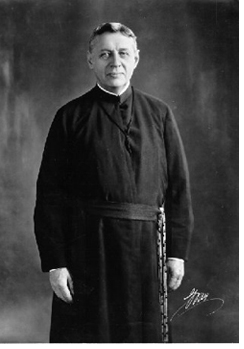
The Most Reverend Joseph N. Dinand, President of Holy Cross in the years leading up to the War, 1911-1918 and during most of Coolidge's administration, 1924-1927. It was President Dinand who largely built up the College's great library, which bears his name today.

The Most Reverend Joseph N. Dinand, President of Holy Cross in the years leading up to the War, 1911-1918 and during most of Coolidge’s administration, 1924-1927. It was President Dinand who largely built up the College’s great library, which bears his name today.

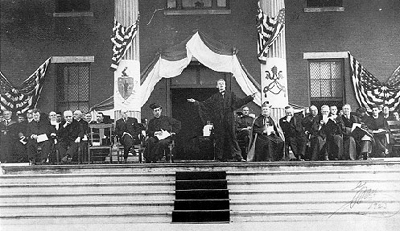
Here is a scene from the commencement in 1923. When Governor Coolidge spoke to those gathered on these grounds five years before, the men of Holy Cross had already proven to be an expression of patriotic duty, as many of those who would have graduated sooner, were among the first to volunteer for military service. Not only this, however, the young men to whom Coolidge directed his address that summer of 1919 did not all spring from long-established families, but mirrored the rich differences and opportunities America has made possible for everyone. Most of the young men Coolidge addressed were from Irish, Italian, French, Slavic, and even Lithuanian roots. Coolidge, keenly aware of both the College's excellent past and accomplished present, saw America in miniature. This great success was not an anomaly, it was the norm because here freedom and opportunity came not through ancestry or blood but through diligence and perseverance, competence and ability. Having taken up the full burden of citizenship, the young men of Holy Cross demonstrated what it means to know (as Coolidge would express it years later) the "high estate" of American citizenship, "the peer of kings."

Here is a scene from the commencement in 1923. When Governor Coolidge spoke to those gathered on these grounds five years before, the men of Holy Cross had already proven to be an expression of patriotic duty, as many of those who would have graduated sooner, were among the first to volunteer for military service. Not only this, however, the young men to whom Coolidge directed his address that summer of 1919 did not all spring from long-established families, but mirrored the rich differences and opportunities America had made possible for the most recent arrivals. While most of the young men Coolidge addressed were of Irish ancestry, students could also claim Italian, French, Slavic, and even Lithuanian roots. Coolidge, keenly aware of both the College’s excellent past and accomplished present, saw America in miniature. This great success was not an anomaly, it was the norm because here freedom and opportunity came not through ancestry or privilege but through diligence and perseverance, competence and ability. Having taken up the full burden of citizenship, the young men of Holy Cross demonstrated what it meant to know (as Coolidge would express it years later) the “high estate” of American citizenship, “the peer of kings.”

Coolidge Meets Gene Tunney, November 19, 1927

After beating World Champion Jack Dempsey for the second time that fall of 1927, former Marine and then-current World Heavyweight Boxing Champion, Gene Tunney, was brought to meet President Coolidge at the White House. The story of their meeting, recounted in newspapers at the time, reads…

Santa Ana Register, 11-19-1927, page 8. Courtesy of newspapers.com.

Santa Ana Register, 11-19-1927, page 8. Courtesy of http://www.newspapers.com.

It is an interesting similarity that after winning all but 1 of his fights, including his second defense of the World Heavyweight Title the following year, Mr. Tunney, like the man he met in the White House, quietly walked away. Like Coolidge, he remained undefeated, at the peak of his success and content with what he had accomplished.

Gene Tunney at the National Library of Ireland's Long Room Library, Trinity College, Dublin, August 24, 1928.

Gene Tunney at the National Library of Ireland’s Long Room Library, Trinity College, Dublin, August 24, 1928.

Tunney was a voracious reader. Here he is taking a few moments in training for his rematch against Dempsey to read and think.

Tunney was a voracious reader, who loved the classics. Here he is taking a few moments in training for his rematch against Dempsey to read and think.

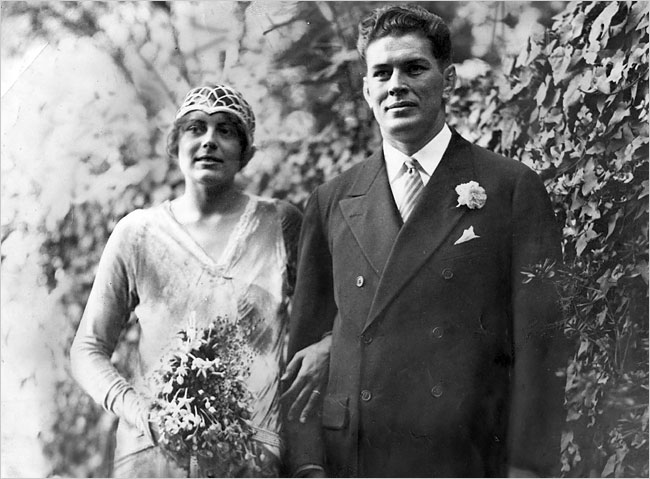
Gene Tunney married Polly Lauder upon his retirement from the ring, October 3, 1928. One of the great romantic matches of the 1920s, the Tunneys were married for 50 years, until his death at age 81 in 1978. She would live to see age 100, passing in 2008.

Gene Tunney married Polly Lauder upon his retirement from the ring, October 3, 1928. One of the great romantic matches of the 1920s, the Tunneys were married just over 50 years, until his death at age 81 in November 1978. She would live to see age 100, passing in April of 2008.

It would be well to learn from the example of Tunney and Coolidge, men in very different work but who, having fought and won, kept humility, perspective and a healthy measure of contentment for life’s seasons. After all, they knew, there was a time for every purpose under heaven:

“A time to plant,

And a time to pluck what is planted…

“A time to break down,

And a time to build up…

“A time to gain,

And a time to lose;

“A time to keep,

And a time to throw away;

“A time to tear,

And a time to sew;

“A time to keep silence,

And a time to speak;

“A time to love,

And a time to hate;

“A time of war,

And a time of peace”

— Ecclesiastes 3:3-6