
The Roosevelt Memorial Association Medal, bronze by renowned sculptor James Earle Fraser, 1920.
Presenting that year’s foremost award of the Roosevelt Memorial Association, the ceremony began in the East Room of the White House. President Coolidge honored the three men chosen by their service in the areas of law, statesmanship and education who most exemplified the tenacious spirit and tireless sense of service embodied by the late Theodore Roosevelt. They were Supreme Court Justice Oliver Wendell Holmes, Harvard University’s President-Emeritus Charles W. Eliot, and elder statesman-diplomat Elihu Root. President Eliot, unable to attend, was represented by his friend, philanthropist and financier Jerome D. Greene.
The President first turned to Justice Holmes, saying, “In peace and in war, as a soldier and as a jurist, you have won the gratitude of a nation by your uniformly gracious and patriotic devotion of great talent to its service. One can but well feel very confident that President Roosevelt would have been peculiarly gratified to know that this distinction was to be conferred upon you. This medal will be to you as a testimony to the universal recognition of your great public contributions.”
Presenting the next medal to Mr. Greene, President Eliot’s representative, Coolidge reflected on the great educator’s work, “In making its selection the Committee of Awards has but vindicated the judgment that your countrymen everywhere would have pronounced, if as a body they could have been permitted to make this award. Yours has been a true and an especially impressive conception of the great business of living. Premier for many years among educational leaders, you have maintained standards in which in that field we cannot imagine the future will have reason to question or alter. You have been a guide in your time, and a prophet of our future.”
Turning at last to the final recipient of the award, the President spoke to Elihu Root, “Your career of public service has been among the longest, most noted and varied in our American public life. It has made you known as a scholar, lawyer, statesman and a patriot. You have made America more American and humanity more humane. You have made more secure the peace of nations, and more certain justice among men.”
For a man not given to effusive praise, these are high commendations indeed. Coolidge’s words reflect more than just a politician’s pursuit of favor, they rest upon sober observations of men and what makes for authentic greatness. For Coolidge, it rested eternally on the principle of service.
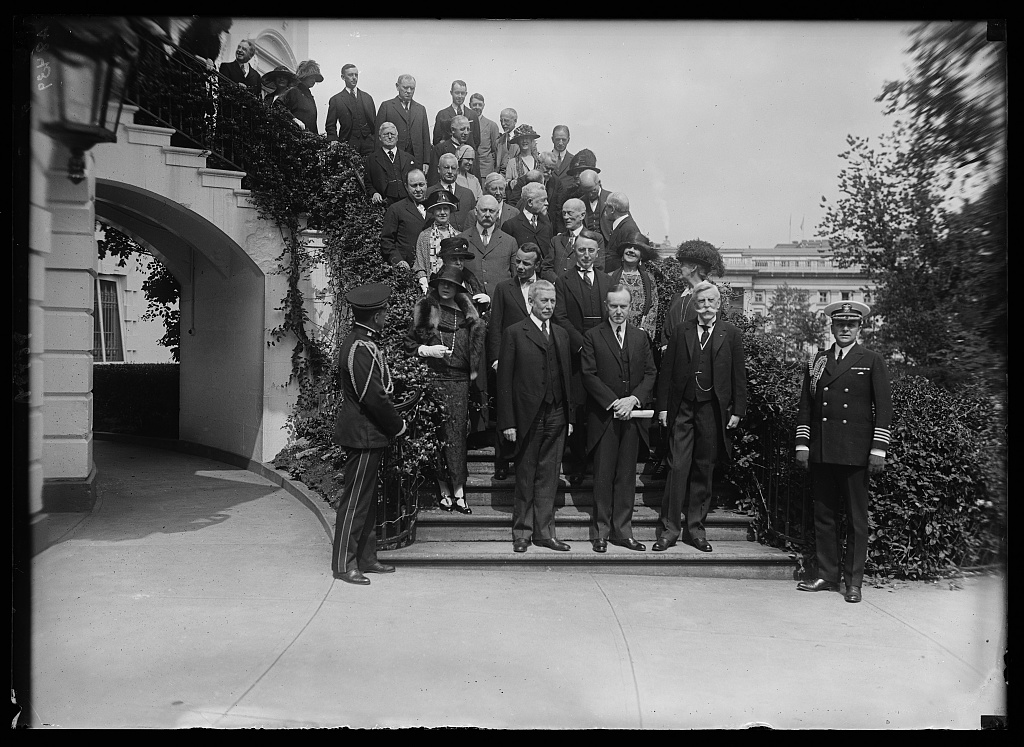
When the ceremony was done, the party stepped outside to mark the occasion with photographs. Here they fill the White House steps as it descends to the President and the three exceptional Americans honored on that day. The late Teddy Roosevelt’s son, also a Theodore, stands second from left in the second row from the bottom.


 The Importance of the Obvious