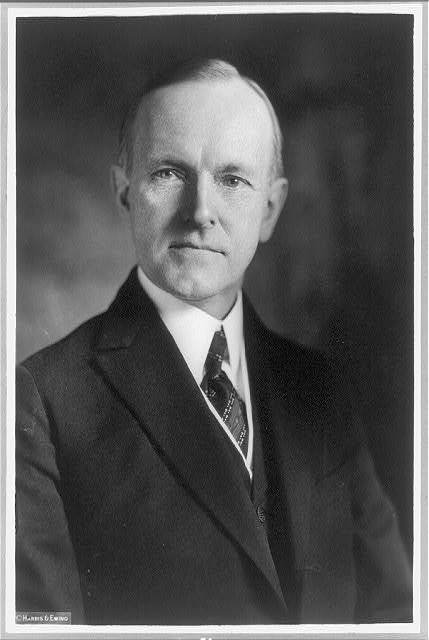
 “The world to-day is filled with a great impatience. Men are disdainful of the things that are and are credulously turning toward those who assert that a change of institutions would somehow bring about an era of perfection. It is not a change that is needed in our Constitution and laws so much as there is need of living in accordance with them. The most fundamental precept of them all — the right to life, liberty, and the pursuit of happiness — has not yet been brought into universal application. It is not our institutions that have failed, it is our execution of them that has failed…”
“No power can ever be brought into existence which will relieve of obligations. The sole opportunity for progress lies in their faithful discharge. There is no reason for Americans to lack confidence in themselves or in their institutions. Let him who doubts look about him. Let him consider the power of his country, its agriculture, its industry, its commerce, its development of the arts and sciences, its great cities, its enormous wealth, its organized society, and let him remember that all this is the accomplishment of but three centuries” — July 6, 19221
“The ancient ideals of human brotherhood, of service, the application of the Golden Rule, of peace on earth and good will toward men, are idle dreams, unless they can be translated into practical action. It is necessary, on the one hand. to avoid the illusions of the visionaries, and on the other hand, the indifference of the selfish. Each individual and each nation owe their first duty to themselves. Beyond that, there is the obligation of the strong to serve the weak, but to administer such service in a way that will not destroy or degrade by making mendicants, but will restore and strengthen by making character. It is the policy which helps in an emergency, but realizes that, finally, each individual and each nation must work out their own destiny” — September 24, 19232
“There has been abroad many times some criticism of our Government, of our people, and our ways, but that has demonstrated, I think, that when they are in real trouble and real difficulty over there, they turn to us as a nation that will be fair with them–one in whose judgment and in whose character they can rely; and notwithstanding differences that have seemed to exist, they are willing to abide by the faith that they have in us, and I think it is a very substantial accomplishment” — December 11, 19233
“Believing in our Nation thoroughly and unreservedly, confident that the evidence of past and present justifies that belief, it is our one desire to make America more American. There is no greater service that we can render the oppressed of the earth than to maintain inviolate the freedom of our citizens” — November 2, 19184
“On what nations are at home depends what they will be abroad. If the spirit of freedom rules in their domestic affairs, it will rule in their foreign affairs. The world knows that we do not seek to rule by force of arms, our strength is in our moral power. We increase the desire for peace everywhere by being peaceful. We maintain a military force for our defence, but our offensive lies in the justice of our cause. We are against war because it is destructive. We are for peace because it is constructive. We seek concord with all nations through mutual understanding. We believe in treaties and covenants and international law as a permanent record for a reliable determination of action. All these are evidences of a right intention. But something more than these is required, to maintain the peace of the world. In its final determination, it must come from the heart of the people. Unless it abide there, we cannot build for it any artificial lodging place. If the will of the world be evil, there is no artifice by which we can protect the nations from evil results. Governments can do much for the betterment of the world. They are the instruments through which humanity acts in international relations. Because they cannot do everything, they must not neglect to do what they can. But the final establishment of peace, the complete maintenance of good will toward men, will be found only in the righteousness of the people of the earth. Wars will cease when they will that they shall cease. Peace will reign when they will that it shall reign” — April 22, 19245
“The encouraging feature of our country is not that it has reached our destination, but that it has overwhelmingly expressed its determination to proceed in the right direction” — March 4, 19256
“Our country, our people, our civil and religious institutions may not be perfect, but they are what we have made them” — June 30, 19307
“The higher our standards, the greater our progress, the more we can do for the world” — July 23, 19308
“Why, two upstarts from Amherst were in Washington before breakfast one morning to tell me how we should handle the Nicaraguan trouble! I didn’t waste much time on them. Seemed to me, my information and that of the State Department was better than the information at the disposal of Amherst underclassmen. There’s too ready a hearing abroad for Americans who make a habit of criticizing their own country” — 19309
“They say we are not ‘doing our part.’ They mean we are not doing their dirty work, using our army and navy to lick those they don’t happen to like at the moment. Why, if England, for instance, was in our position today she would ‘take charge of Civilization for the benefit of Humanity’ within forty-eight hours!” — 193010
“America follows no such delusion as a place in the sun for the strong by the destruction of the weak. America seeks rather, by giving of her strength for the service of the weak, a place in eternity” — June 17, 191811
“There are criticisms which are merited, there always have been and there always will be; but the life of the nation is dependent not on criticism but on construction, not on tearing down but on building up, not in destroying but in preserving. If the American Revolution meant anything, it meant the determination to live under a reign of law. It meant the assertion of the right of the people to adopt their own constitutions, and when so adopted the duty of all the people to abide by them. The colonists of that day had had enough of the reign of force. They had had enough unlawful usurpation of their government, enough of the domination of a military force quartered in their midst. They wanted to escape from the rule of a force imposed from without and live in accordance with the light of reason which comes from within. That is the real mark of progress. That is the true liberation of mankind. Those who now, under any form or for any purpose, seek to substitute for the reign of public law their own private desire, or any species of force, coercion, or intimidation, are not in harmony with the aims of the great Virginians. The industrial life of the nation cannot stand except on the recognition and observance by everybody connected with it of the fundamental precepts of American institutions. Nothing will ever be settled unless it be settled in accordance with them. Any other attempt will have as its result nothing but confusion, destruction, anarchy, and failure” — July 6, 192212
___________________________________________________________
1 Calvin Coolidge, The Price of Freedom: Speeches and Addresses, Fredonia Books, Amsterdam, 2001, pp.180, 181.
2 C. Bascom Slemp, The Mind of the President: As Revealed by Himself in His Own Words, Doubleday, Page & Company, Garden City, 1926, p.19.
3 Howard H. Quint and Robert H. Ferrell, eds. The Talkative President: The Off-The-Record Press Conferences of Calvin Coolidge, University of Massachusetts Press, Amherst, 1964, p.181.
4 Calvin Coolidge, Have Faith in Massachusetts: A Collection of Speeches and Messages, Gray Rabbit Publications, Brooklyn, New York, 2011, p.75.
6 Calvin Coolidge, Supplement to the Messages and Papers of the Presidents Covering the Second Administration of Calvin Coolidge March 4, 1925 to March 4, 1929, Bureau of National Literature, New York, p.9488.
7 Edward Connery Lathem, ed., Calvin Coolidge Says: Dispatches Written by Former President Coolidge and Syndicated to Newspapers in 1930-1931, Calvin Coolidge Memorial Foundation, Plymouth, 1972, p.69.
9 Edward Connery Lathem, ed. Meet Calvin Coolidge: The Man Behind the Myth, Stephen Greene Press, Brattleboro, 1960, p.176-177.


 The Importance of the Obvious