On The People

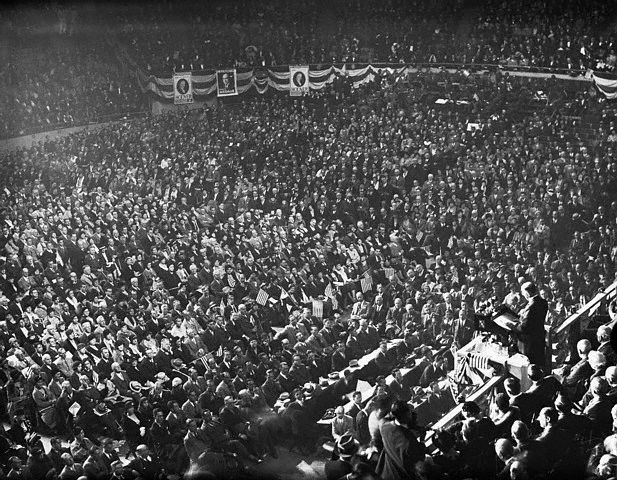
Former President Coolidge addressing Americans gathered at Madison Square Garden, October 11, 1932.

Former President Coolidge addressing Americans gathered at Madison Square Garden, October 11, 1932. Courtesy of Corbis.

In Robert J. Thompson’s fabulous compilation of Coolidge quotations up to 1924, entitled Adequate Brevity, there can be found some of my favorite thoughts regarding us, The People. The truth of these insights was grounded upon an unshakable confidence in people qualified to govern themselves, Coolidge held. It was a personal obligation and a public power in each American that remained very obvious to him all of his life. Too many folks today are prepared, however ill at ease they are doing so, to abdicate their fitness to speak up when things are wrong, when justice cries out that what is going on throughout this country needs someone to say the truth, pronounce what is reasonable to a situation otherwise stripped of all sanity or sense. The hold of political correctness only works when we cooperate and conform to this absurd game of national suicide. Refuse to play that game, being guilted into an unending atonement for someone else’s sins, perceived or real. Meanwhile, the current culprits of criminal wrongs in public office escape electoral consequences, passing accountability ultimately on to us for their inadequacies. Coolidge understood that our system was too important to leave to “experts” who, by virtue of their superior station or class, are somehow best suited to manage our freedoms, making our public decisions for us. We are absolutely qualified to weigh in on what is going on right now, to participate in our governance, to make and repeal our own laws, to choose who is worthy to represent us, The People, and decide as a people what kind of nation we are to be. These and so many other matters are not beyond our “pay grade” to determine. Coolidge’s thoughts on us, The People, could not be more timely, especially as Election Day draws near.

Cal said,

     “The ultimate decision of all questions of law and justice rests with the people themselves. They have the complete authority to enlarge or diminish, to support and to overthrow.”

He also said,

“In the last resort the people are the military power, they are the financial power, they are the moral power of the government. There is and can be no other.”

Again, he said,

“What they [the people] think determines every question of civilization.”

He even met one of today’s common threats that we, mere amateurs, better keep quiet or else face the public ostracism of politically incorrect felonies of racism, sexism, bigotry, homophobia, extremism, or any of the other labels attributed to anyone brave enough to make themselves a target by speaking truth honestly, earnestly and plainly,

“Of course it would be folly to argue the people cannot make political mistakes. They can and do make grave mistakes. They know it, they pay the penalty, but compared with the mistakes which have been made by every kind of autocracy they are unimportant.”

Or, again,

“Unless the people struggle to help themselves, no one else will or can help them. It is out of such struggle that there comes the strongest evidence of their true independence and nobility, and there is struck off a rough and incomplete economic justice, and there develops a strong and rugged national character.”

And,

“The power to preserve America, with all that it now means to the world, all the great hope that it holds for humanity, lies in the hands of the people.”

And finally,

“There are now no pains too great, no cost too high, to prevent or diminish the duty that wisdom and knowledge, as well as virtue, be generally diffused among the body of the people.”

Well said, as always, Mr. Coolidge.
On the Power of Radio

Addressing the four hundred plus delegates from over seventy nations gathered to open the International Radiotelegraphic Conference on October 4, 1927, President Coolidge, who had signed the Radio Act (helping to bring order and room for growth in radio communications) earlier that year, offered his assessment of the medium’s progress and future potential. He said,

“Ladies and Gentlemen:

“It is my privilege to extend to the delegates to this conference a most cordial welcome on behalf of the people of the United States. Seldom has a more representative world conference assembled. The presence here of delegates from so large a proportion of the nations of the earth is of itself sufficient evidence of the importance which will attach to your deliberations. The large number of subjects to be considered is at once apparent when it is remembered that there has been no conference of this nature for about fifteen years. Meantime there have been many improvements in transmitting and receiving radio messages and a perfectly tremendous expansion in their use.

“It is scarcely thirty years ago that the transmission of intelligence by radio began. For almost twenty-five years it was largely confined to Government use, mostly in navigation. Within the past five or six years has come the enormous popular development which has brought the radio receiving set into such general use in the home and the construction of so many privately controlled broadcasting stations. The chief marvel and usefulness of this modern invention lies in the instantaneous service it is able to render over great areas of the earth’s surface, using as its medium of transmission only the natural elements of the atmosphere. In military defense, in navigation, in commerce, in education, in musical and theatrical entertainment it has come to play a great part in the life of our people.

“Communication is one of the important supports of civilization. If we glance at any of the backward portions of the earth we shall see at once that methods for the transmission of intelligence are lacking. In such places there are few and poorly constructed highways, railroads are lacking, telephone and telegraph lines do not exist, newspapers do not circulate, the radio is unknown, and, finally, there is almost nothing in the way of post-office service. These are the necessary equipments for a people desiring to live according to modern standards and become partakers in modern progress. I believe that the radio holds great promise of reaching into these dark places of the earth because the cost of its installation and maintenance will represent almost nothing in comparison with the cost of the other means of communication. To use it does not even require an elementary education of reading and writing. Its main weakness appears to me to lie in the fact that it produces no permanent record for future consideration.

“An instrument of such far-reaching magnitude, fraught with so great a power for good to humanity, naturally requires national and international regulation and control, to the end that there may be the most perfect order and the largest possible uniformity in its use and enjoyment. It is to consider methods and rules for securing these results that this conference has been called. I commend to you the adoption of the policy of candid discussion, generous conciliation, and wide cooperation. This is a field where it will be exceedingly easy for a single nation to render uncertain and useless a broad area of surrounding territory, greatly to the disadvantage of itself and all others concerned. A large opportunity exists for an economic treatment of radio problems through standardization. A uniformity of action among different peoples is always a most important step in advance.

“In many fields our country claims the right to be the master of its own independent development. It cordially concedes the same right to all others. But in the radio field the most complete development, both at home and abroad, lies in mutual concession and cooperation. Your main endeavor will be to discover the rules which will be for the mutual advantage of all those who are connected with this great industry and who are the users of this means of communication.

“This conference recognizes that the radio has become a great influence in the world. Like every invention which increases the power of man it may be used for good or for evil. It can serve the cause of understanding and friendship among people and among nations, or it can be used to create ill will and dissension. The world will not be benefited by this increase in the scope of its power unless there is corresponding increase in moral development. Your main object will be to raise this great industry into the realm of beneficent public service.

“Those of you who are present here from foreign lands I trust may gain a deep appreciation of the cordial friendship which this country entertains toward all of you. I hope you may have the opportunity of coming into closer contact with the life of our people, that you may secure a helpful knowledge of our commercial and political institutions, and that out of the deliberations of this conference there may come an increased power for the service of humanity.”

The Conference of radio entrepreneurs, broadcasters, producers, inventors, advertisers, and regulators would not only revise the regulations governing radio communications under the new law but would do much to foster a place for where it had all began: the amateur owners, operators and innovators. Creating the ten-meter band on a world-wide basis, and new spaces on the dial for broadcasting, the members who heard Coolidge that day were keeping radio’s openness, opportunity and creativity without making future progress impossible. Had they not done so, participants would have spilled into other frequencies and listeners would not have found much of anything coherent, useful or entertaining on the airwaves. The medium simply would have succumbed to chaos and never known the power Coolidge saw possible in its development as he stood before those men and women on that October afternoon eighty-seven years ago.

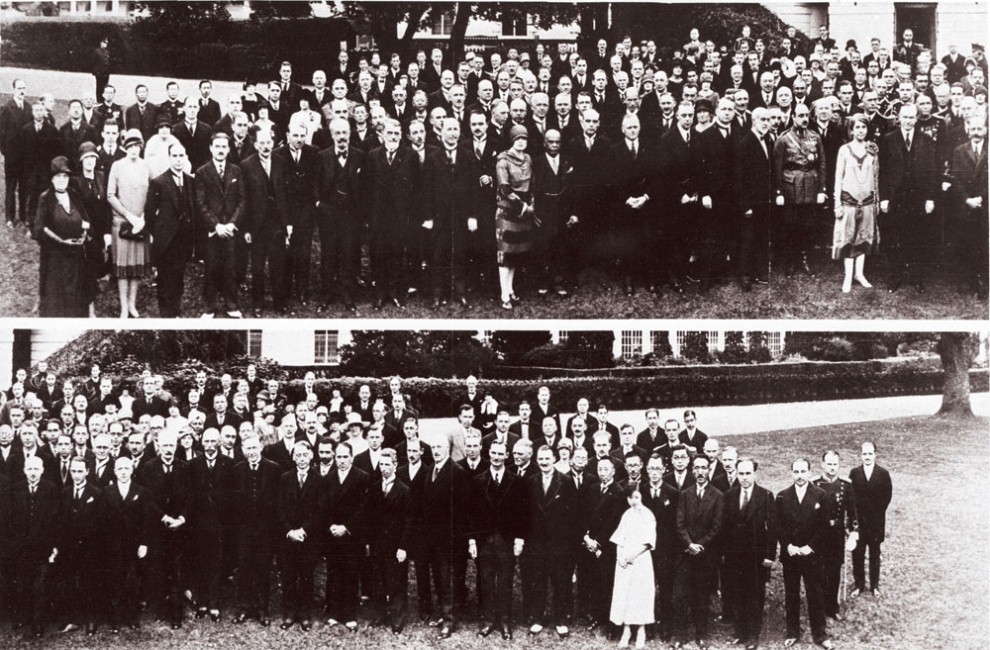
The delegates of the International Radiotelegraphic Conference, October 4, 1927, split in two photographs. Notice who stands in their midst in the top shot: President and Mrs. Coolidge.

The delegates of the International Radiotelegraphic Conference, October 4, 1927, split in two photographs. Notice who stands in their midst in the top shot: President and Mrs. Coolidge.