Third in our series of “Best of Coolidge” Readings comes his second Inaugural Address as Governor of Massachusetts, delivered on January 8, 1920. Keep tuned in as more are on the way!
On the Mind of the President, Part 2
President Coolidge: “Mr. Strother, who had something to do about arranging and compiling in conjunction with Mr. Slemp that book that Mr. Slemp issued, was in this morning and brought me in a presentation copy of it. Glancing at it I see that it is very well indexed and there is topically arranged in the book things that I have said in relation to a great many subjects. I think your offices ought to provide each one of you with a copy of that book.”
Press: “Would you autograph each copy?”
President Coolidge: “Yes, I would be glad to, and whenever you want to know what my position is on any subject, if you will just glance at that index it will very quickly refer you to a place in the book where you can learn what I have said in relation to a very great many different subjects” — Press Conference on March 12, 1926.
Another conference on May 31, 1927, revealed this witty exchange,
President Coolidge: “Here are two or three questions that perhaps could be answered more desirably by reference to Mr. Slemp’s book–what is the title of that?”
Press: “The Mind of the President.”
Coolidge: “The Class is perfect.”
What elected official today would gladly refer you to something they already said that had been set in printed form going back as many as four years?
“An extremely interesting study is the relation of President Coolidge to the Presidency itself. He has reversed a recent tradition of the Presidential office. For a quarter of a century our Presidents have professed democracy and have practised benevolent autocracy. They believed that they could advance the welfare of the nation better than the people could advance it. They announced what they declared to be progressive policies and tried to convert the people to these policies. They tried to improve government from the top.
“Calvin Coolidge believes that progress comes direct from the people. He believes that the people, out of their local problems, out of their individual consciousness of national problems, sense the great issues of the day and reach the right conclusion regarding them. As President Coolidge sees it, the task of a great national leader is not to try to go ahead of this majestic army of human thought and aspiration, blazing new and strange paths. His function is rather to become the sensitized personal embodiment of their thoughts and aspirations, and the instrument through which they reach public expression. In this respect his chief forerunners in the Presidential office are none other than Andrew Jackson, the founder of the Democratic Party, and Abraham Lincoln, founder of the Republican Party and its first President, both exponents of the theory that the people are the seat of political wisdom as well as political power. President Coolidge’s view of these matters is an absolute reversal of the theory of the President’s function as practised in recent years. It is a restoration of the old conception of democracy. I must leave to philosophical students of history the question as to whether it is the better conception…
“It is worthy of note here that President Coolidge has appointed more committees of private citizens to investigate and report upon current problems for his guidance than any other President. He thus utilizes the resources of political wisdom embodied in the citizenry.
“In following this habit of direct reliance upon the mass of the people the radio has fitted into the situation perfectly. It seemed to have been invented for him. It came just as he did. His voice is perfectly adapted to its use in an enunciation clear and distinct. The invisible audience without the dramatic appearance of the speaker must listen, if at all, to the thought of the speaker. In this role the President shines. It has thus placed him in direct communication with the people. It is estimated that thirty million listeners heard his speech the night before the last national election and as many more during the campaign. Repeatedly he has utilized this instrumentality to give the people his views simultaneously in all parts of the country. It may, in part, account for the unanimity of sentiment now prevailing on public issues” — C. Bascom Slemp, An Analysis and an Interpretation to The Mind of the President, 1926, pp.4-6, 8-11.

The President, First Lady and Mr. Slemp outside the White House, February 1924.
On the Mind of the President, Part 1
“It would not be just to conclude that President Coolidge is obstinate or opinionated because of this exhibition of consistency as to principles and policies of government. These are fundamentals. He has no egotistical belief that he can immediately solve a perplexing national problem, without study and without reflection. The public is protected from hasty action later to be regretted, yet when the Senate demanded the resignation of a member of his Cabinet and an immediate answer was necessary, it came like a flash of lightning. He knows, however, that by intense mental application there is every probability that he can always secure the right solution to any problem. He begins an important inquiry with all the zest of his spirit. He takes counsel. He seeks advice. His methods are those of a trained research worker. He sends for wise and informed men, and for books and document–but especially for men. He loves to listen.
“Patiently and thoroughly he continues this process until he gets the principal facts and the various points of view pertaining to his subject. The President then weighs the evidence in his own mind and reaches his conclusion. He acts from logic rather than from inspiration. He concentrates more intensely and more continuously than any man I have ever known. Morning, noon, and night he keeps thinking, thinking. He indulges in no distracting pleasures. He has no recreation, even, beyond daily walks and occasional week-end trips on the Mayflower. All his working hours, except those involved in the inescapable routine of his office, are devoted to intense, concentrated mental labour upon his duties and problems. It is not surprising that in the expression of his thoughts he has won the admiration of mankind, for he is a student of history, trained in the science of logical analysis, and disciplined to work steadfastly and hard. Most important of all, his mind is fortified by his character. He is honest–morally honest and intellectually honest. He wants to reach the right conclusion, not only because it is an intellectual pleasure to have the right answer, but because he simply cannot tolerate anything wrong in himself. His decisions are guided by conscience as well as by knowledge, reason, and proper political consideration.
“The Presidency is a test of character as well as a test of wisdom. In reading this book the reader will miss half of its significance if he does not weigh the President’s words for what they tell of his character as well as for what they tell of his mind…
“In dealing with public or political questions President Coolidge has political intuition almost psychic. One cannot see, tough, or hear a political tide, but it can be felt. The man in public life who fails to create a tide or sense an adverse tide will soon be politically lost. Coolidge, with the single exception of [Theodore] Roosevelt, has possessed this intuition in the most marked degree of all our recent Presidents–Taft, perhaps, the least. Wilson developed it; Harrison was cold intellect; Cleveland, rugged force. Neither had this psychic sense. All were great Presidents. No one in his lifetime, of course, should be compared with Lincoln, preserved for all the ages in the shroud of immortality, but I think of President Coolidge as like Lincoln in this respect” — C. Bascom Slemp, “An Analysis and an Interpretation” to The Mind of the President, 1926.
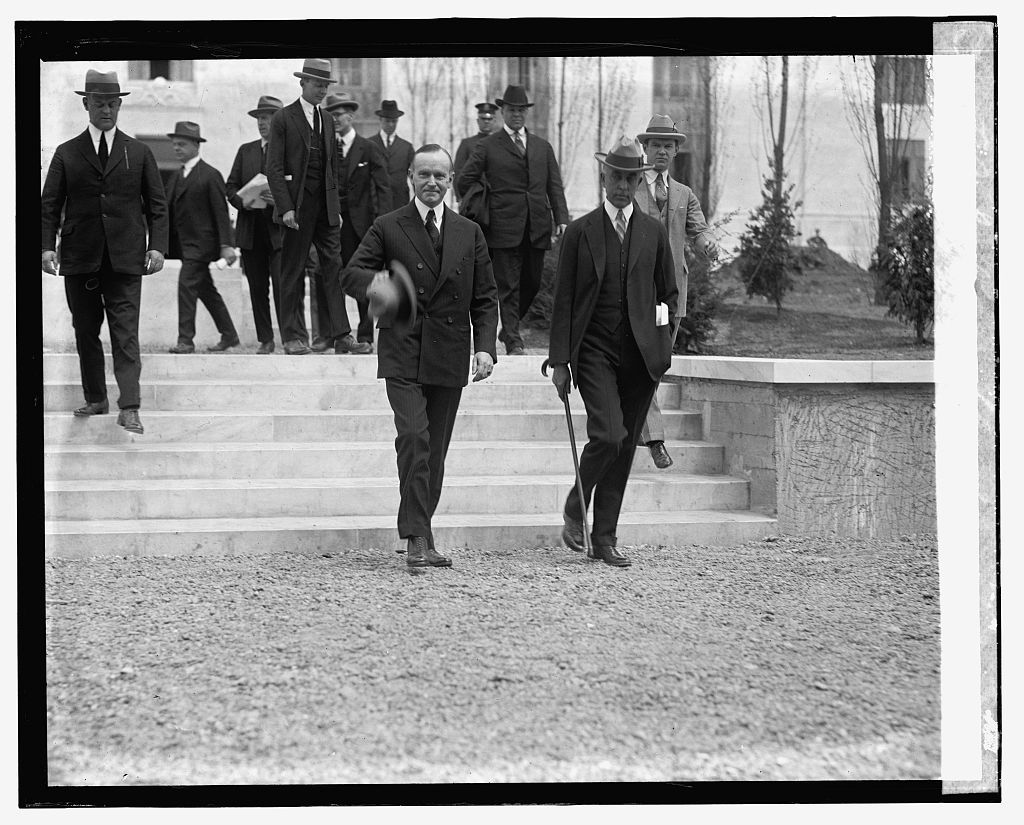
The President and one of the men who worked more closely with him than most ever did, C. Bascom Slemp.
 The Importance of the Obvious