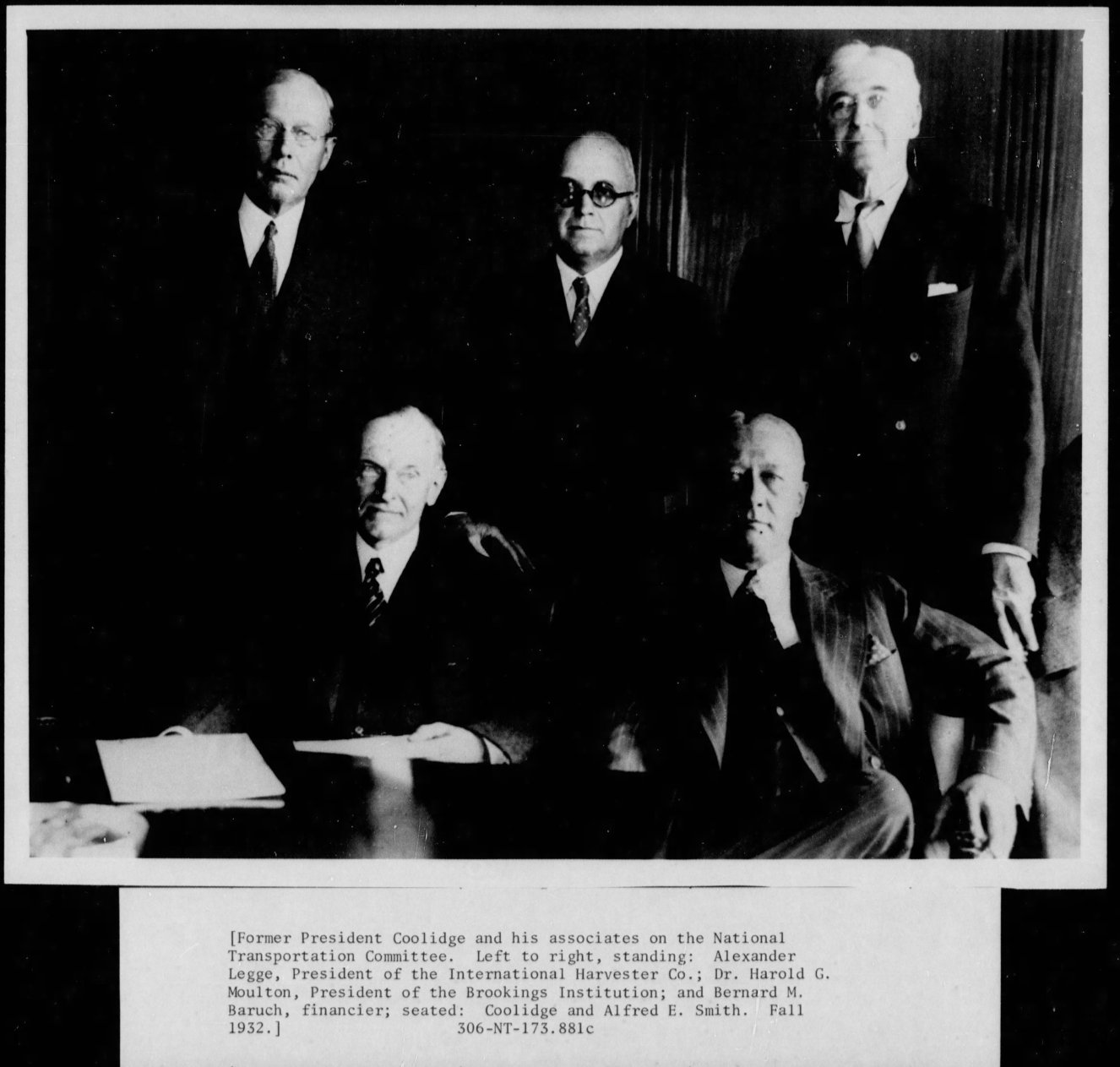
Mr. Coolidge was selected to chair the National Transportation Committee after his service in the White House but he warns fellow member, Mr. Baruch, against the indulgence of expenditures that committee proposals could very easily allow, undermining the duty they owed the public. Unfortunately, Mr. Coolidge did not live to temper the results of this Committee’s work. Photo courtesy of the National Archives.
Former President Coolidge, having left Washington for a permanent home in his Northampton, once warned friend Bernard Baruch of the national Capital’s proclivity for extravagance at every opportunity. He knew Washington does not work automatically, left to responsibly police its own actions. They must be constantly watched and vigilantly checked. The people of the country knew it then and know it now. Americans wanted government to stop trying to “fix” problems that previously did not exist, creating issues that merely strengthen an ongoing growth of Washington rather than its limited sphere under enumerated responsibilities. Coolidge understood how embedded a mindset it was, not cured simply by who held the powers of office at the time, however courageous, principled or moral one was. A love of power had taken root deeply in the hearts of those who worked there. Liberties are always at risk in proportion to Washington’s growth in importance and reach of authority.
Coolidge wisely observed, “It is necessary to watch people in Washington all the time to keep them from unnecessary expenditure of money. They have lived off the national Government so long in that city that they are inclined to regard any sort of employment as a Christmas tree, and if we are not careful, they will run up a big expense bill on us. I hope you are checking them up to see what results they are getting, either by personal contact or letter.”
Mr. Coolidge appreciated the potency of personal accountability. Such is a novel concept in our world of email and digital anonymity. Yet, would government be as convinced it can “work out” ways to rescue disastrous policies — in spite of our express disapproval — and without lasting consequences, if it no longer had the impersonal cover afforded by nearly continuous sessions of Congress, the 24/7 news cycle and all the other amenities of distant Washington?


 The Importance of the Obvious