Remembering Good Women

On this day in 1885, twelve-year old Calvin Coolidge lost his mother. Her worth and the power of her loving impression on the boy who would become our thirtieth President cannot be measured. Though her passing was clearly a devastation for the Coolidge family, it did not crush Calvin’s spirit. It could have. Through the grief, Calvin tenaciously persevered. At any point in life Coolidge could have given way to despair. Essential to his resolute optimism, however, was the influence of good women. This was a fact he fully credited to those ladies in his Autobiography. Among those women were his mother’s sister, Aunt Sarah Pollard.

“…She was wonderfully kind to me and did all she could to take the place of my own mother in affection for me and good influence over me while I was at the Academy and ever after. The sweetness of her nature was a benediction to all who came in contact with her. What men owe to the love and help of good women can never be told.”

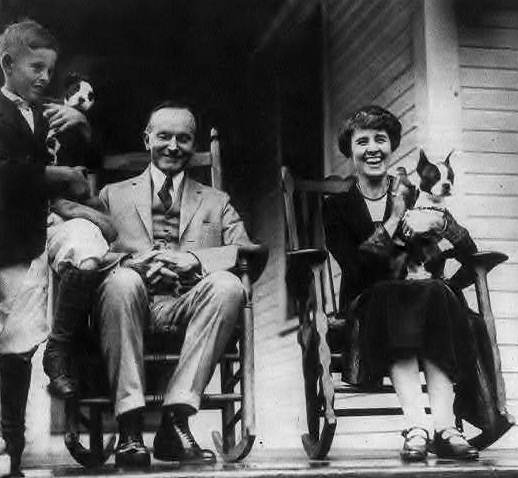
Superlative among those “good women,” however, was Mrs. Grace Coolidge. Her parents, the Goodhues, aptly named her for her graciousness. It was evident to all she met. Her kind regard for all people, however great or small, as well as her joyful manner and readiness to serve smoothed many a ruffled feather and diffused more than one potentially explosive situation through the years. Ever thankful for Grace, Coolidge would express that love and appreciation with this tribute to her in the Autobiography: “For almost a quarter of a century she has borne with my infirmities, and I have rejoiced in her graces.”

          Image

On Being American

Standing before those gathered at the American Legion Convention in Omaha, Nebraska, President Coolidge on October 6, 1925, offered one of the plainest expositions of what it means to be an American citizen ever uttered. He could have said any number of vague platitudes to avoid alienating anyone. He could have tried placating the supporters of the Klan with sympathetic doublespeak. He could have even appealed to the emotional and racial invectives of two administrations before, under President Wilson. To Coolidge, being “American” meant far more than any of these attitudes could comprehend. Weighing the heavy costs of the war, concluded a mere six years before, Coolidge recognized the long-term burdens but also the exceptional example of service Americans of all national origins had demonstrated to the world. Despite the dangers personal and national, the humble and devoted efforts of individuals serving side by side for common defense of life and liberty, that is, “Americanism” (as Coolidge would call it) shone forth. For Americans, it was not an imperial conquest. It was not the racial or ethnic superiority of “Americanism” that willingly shouldered the burden and cost. It matters not from where you came or how long you have been here. What matters is the sharing of a common respect for law, our founding institutions and our sense of moral obligation.

Being American, to Coolidge, is a unity of spirit not a physical birthright. It is an agreement on what is eternally essential, not earthly, racial and unessential. This is why Coolidge never appeals to class differences or racial distinctions. They are irrelevant and counterproductive to being American. “Americanism” is not a call to absolute conformity, emptying the individual into “cookie-cutter” blueprints. It is a voluntary enterprise ventured upon together with a common set of navigational truths that do not grow old with time or fade with use. By these essentials, Americans assimilate to embrace not only the freedoms of self-government but also the responsibilities. Both are necessary to ensure liberty remains intact. Liberty is not to be a cover for license. Flouting the law is just as un-American as is enforcing laws in contradiction to those essential truths of human nature discovered by the Founders. As Coolidge would aptly summarize,

“We must not, in times of peace, permit ourselves to lose any part from this structure of patriotic unity. I make no plea for leniency toward those who are criminal or vicious, are open enemies of society and are not prepared to accept the true standards of our citizenship. By tolerance I do not mean indifference to evil. I mean respect for different kinds of good. Whether one traces his Americanisms back three centuries to the Mayflower, or three years to the steerage, is not half so important as whether his Americanism of today is real and genuine. No matter by what various crafts we came here, we are all now in the same boat. You men constituted the crew of our ‘Ship of State’ during her passage through the roughest waters. You made up the watch and held the danger posts when the storm was fiercest. You brought her safely and triumphantly into port. Out of that experience you have learned the lessons of discipline, tolerance, respect for authority, and regard for the basic manhood of your neighbor. You bore aloft a standard of patriotic conduct and civic integrity, to which all could repair. Such a standard, with a like common appeal, must be upheld just as firmly and unitedly now in time of peace. Among citizens honestly devoted to the maintenance of that standard, there need be small concern about differences of individual opinion in other regards. Granting first the essentials of loyalty to our country and to our fundamental institutions, we may not only overlook, but we may encourage differences of opinion as to other things. For differences of this kind will certainly be elements of strength rather than of weakness. They will give variety to our tastes and interests. They will broaden our vision, strengthen our understanding, encourage the true humanities, and enrich our whole mode and conception of life. I recognize the full and complete necessity of 100 per cent Americanism, but 100 per cent Americanism may be made up of many various elements.”

It is the current cultural climate that is intolerant of these essentials and fixated on non-essentials that forecasts even rougher waters ahead for the American enterprise. If we are to navigate safely to port, we have to rally around the moral nature of our voyage while giving no berth to those resolved on dragging the ship back from real progress into the barbarity of ignorance, lawlessness and government paternalism.

On ‘Freedom and Its Obligations’

Addressing those assembled at Arlington National Cemetery, May 30, 1924, President Coolidge spoke, 

“American citizenship is a high estate. He who holds it is the peer of kings. It has been secured only by untold toil and effort. It will be maintained by no other method. It demands the best that men and women have to give. But it likewise awards to its partakers the best that there is on earth. To attempt to turn it into a thing of ease and inaction would be only to debase it. To cease to struggle and toil and sacrifice for it is not only to cease to be worthy of it but is to start a retreat toward barbarism. No matter what others may say, no matter what others may do, this is the stand that those must maintain who are worthy to be called Americans.”

During the Coolidge presidency, there were nine individuals whose actions merited the Medal of Honor, the highest recognition to those who distinguish themselves while wearing the uniform. Their actions were not all combat-related, as the years between 1923 and 1929 was a time of peace. Their courage and selfless service, however, be it in behalf of their brothers-in-arms, those around the world in need, or in the cause of greater possibilities (with nothing but uncertain flying crafts and their navigational skills) were testaments to what President Coolidge referred — those “worthy to be called Americans.” That tradition of selfless service will continue unbroken and it remains, rightly so, a reason to honor and aspire to those worthy of the name “American” to this day.
Image

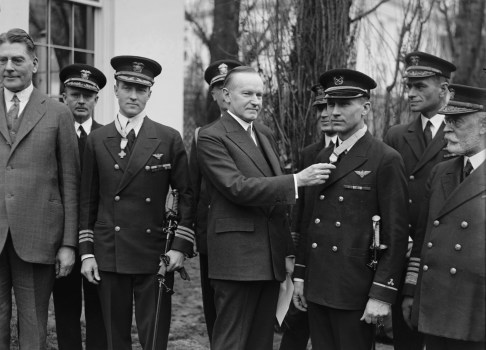
President Coolidge awarding the Medal of Honor to Machinist Floyd Bennett, USN (in front of him) and Commander Richard E. Byrd, Jr., USN (behind Coolidge), for their courageous risk of life in the first “heavier than air flight” to and from the North Pole in a tri-motor Fokker F-VII called the Josephine Ford.

Image

The awarding of the Medal of Honor to Torpedoman Second Class Henry Breault, USN, for his quick actions to rescue a shipmate in their submarine 0-5, which sank within one minute. Confined by the hatch that closed after him, he kept himself and his mate alive for thirty-one hours below the surface until rescued.

Image

Chief Gunner’s Mate Thomas Eadie, USN, received the Medal of Honor for an extraordinary rescue of his shipmate, Chief Torpedoman Michels, whose line fouled 102 feet below while trying to connect an airline to the sub USS S-4. CGM Eadie (as his citation states) “knowingly took his life in his hands,” diving down to skillfully extract Michels, bringing them both back to the surface after two hours of heroic effort.

Image

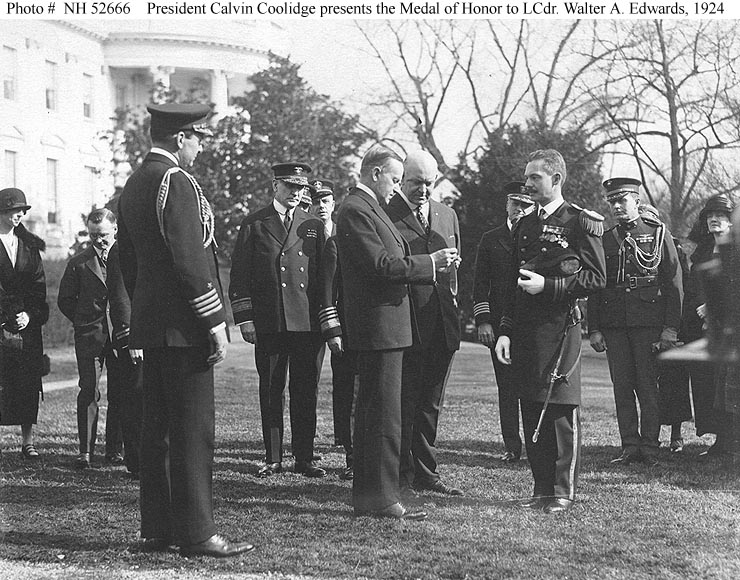
Lieutenant Commander Walter Atlee Edwards, USN, was awarded the Medal of Honor for his rescue of 482 men, women and children from the sinking French transport Vinh-Long, while aflame in the Sea of Marmora, off the coast of Turkey. While commanding the USS Bainbridge, he placed and kept his ship alongside the burning wreck until all alive were safely transferred to the American vessel.

Image

Machinist’s Mate William Russell Huber, USN, was recognized here with the Medal of Honor for his exceptional heroism after a boiler exploded aboard the USS Bruce in Norfolk Navy Yard, 11 June 1928, he went into the “steam-filled fireroom and at grave risk to his life” successfully carried shipmate, Charles H. Bryan, to safety. Machinist’s Mate Huber went below again to aid in removing others from the room despite suffering severe burns to his arms and neck.

Image

Captain Charles A. Lindbergh, Army Air Corps Reserve, was recognized with the Medal of Honor for both courage and skill despite the risk in navigating by nonstop flight from New York City to Paris, France, in the Spirit of St. Louis, a custom-built single-engine monoplane, achieving (as his citation, held here by President Coolidge, states) “not only…the greatest individual triumph of any American citizen but demonstrated that travel across the ocean by aircraft was possible.”

Image

Ensign Thomas John Ryan, USN, was presented with the Medal of Honor for heroism in rescue of a woman trapped when fire broke out at the Grand Hotel in Yokohama, Japan, September 1, 1923, as the result of an earthquake that hit the city. Ensign Ryan disregarded his own safety to help another, as unexpected events demanded decisive action.
Image

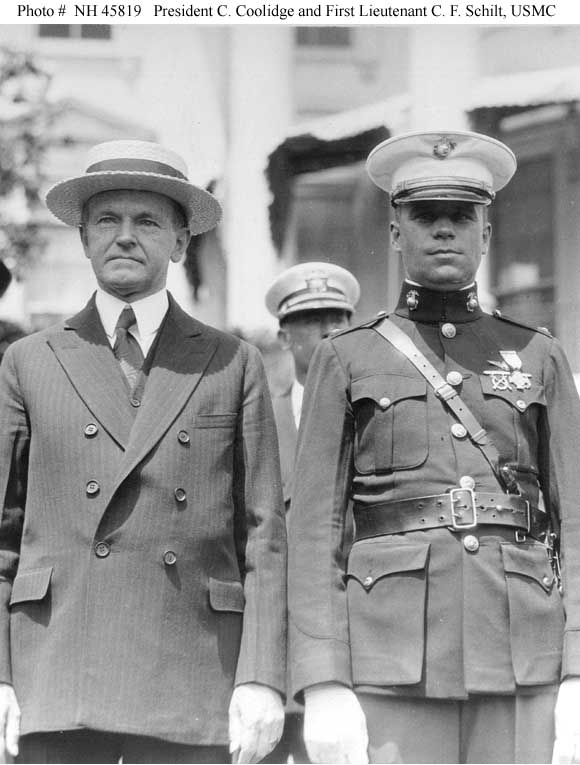
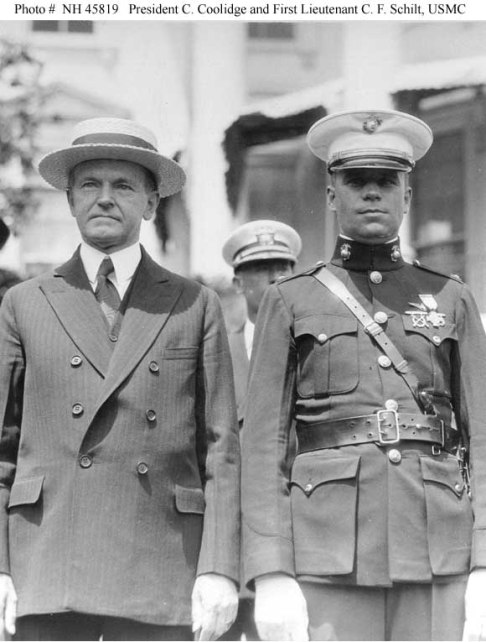
Here is First Lieutenant Christian Frank Schilt, USMC, to whom the President has just given the Medal of Honor for his superb actions in Quilali, Nicaragua, over the course of three grueling days in January 1928. First Lieutenant Schilt, following an intense fight to restore peace to the area, volunteered to evacuate all of the wounded by air and bring in a new commanding officer as relief. Taking off a total of ten times while under steady enemy fire from rough urban terrain, he removed all the wounded, saved three lives and brought back the necessary supplies to those in dire need on the ground.