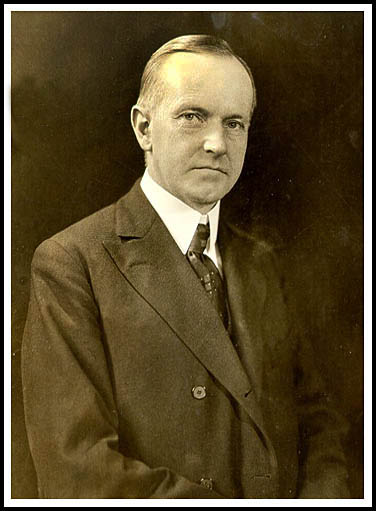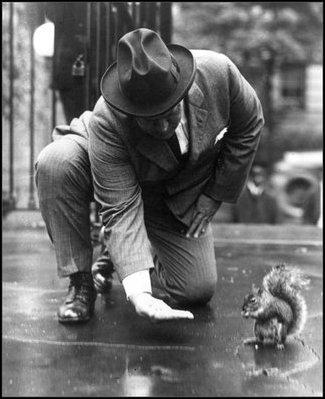
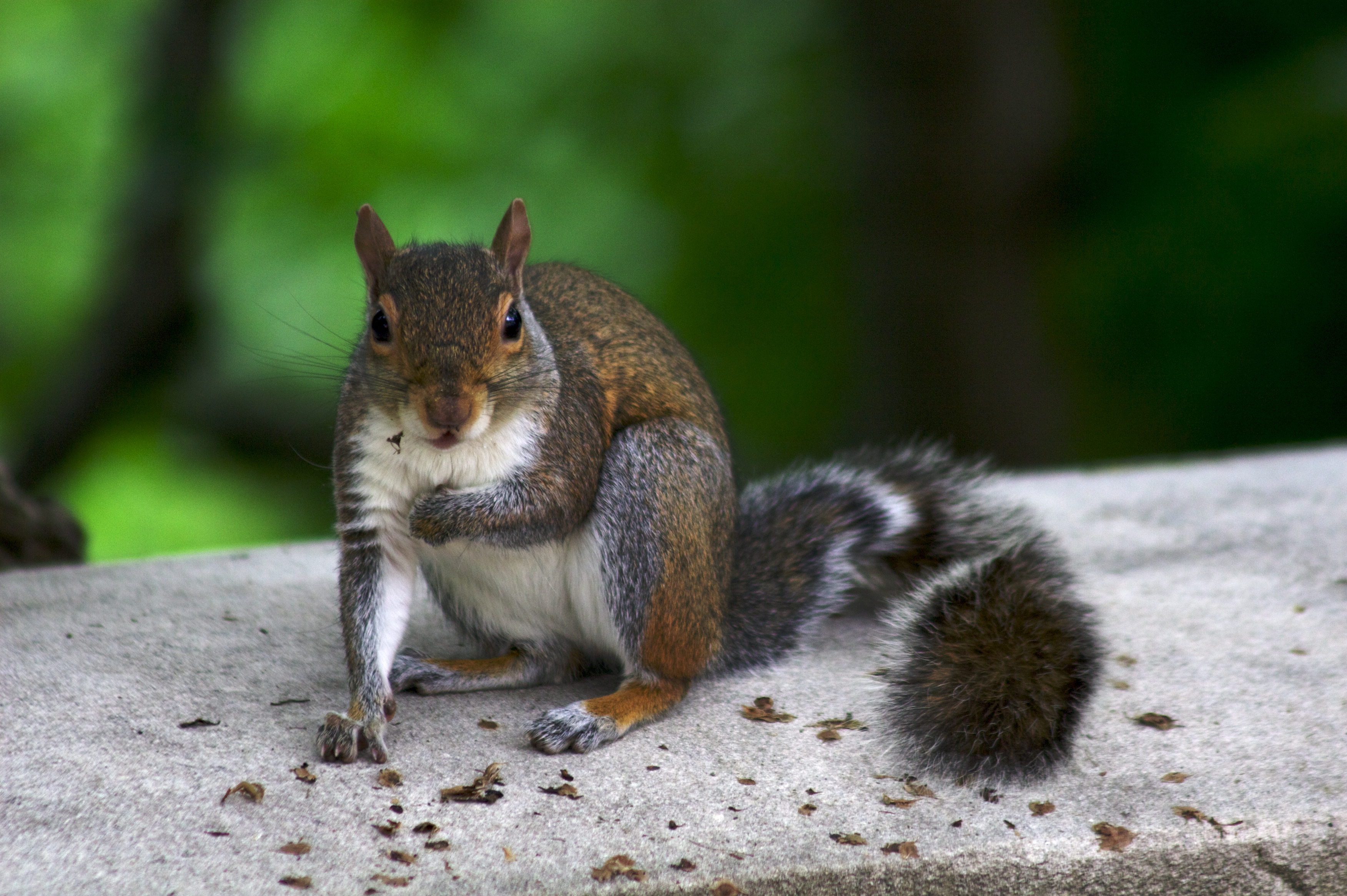
Calvin Coolidge was a master of deadpan. Will Rogers once noted that Coolidge expended more wit on unsuspecting people than anyone else he knew because he would not give away the joke. The person either got it or did not. The satisfaction to Calvin was in the delivery not the response. A chuckle in response to his humor was sufficient to any joke. The humor afforded by a squirrel was a different matter. Colonel Starling recounts the first time he heard Coolidge laugh aloud, when he recalled one of their walks. The President “was smoking a cigar, and as we approached the gate he took it from his mouth and flipped it to the lawn–he never smoked while walking outside the White House grounds. The cigar struck the ground in a shower of sparks just in front of a squirrel, who jumped straight up in the air. He turned before he hit the ground. In a moment he was up a tree and out on a limb, where he sat staring at us in surprise and disappointment. His look of disillusionment was almost human. The President laughed until he had to hold his sides” (Starling of the White House, p.209).
Author: gouverneurmorris
On the Comfort of Giving

It was today, eighty-nine years ago, that Calvin Coolidge Jr. died of blood poisoning at the age of sixteen. Even in his profound grief, however, Calvin Coolidge found comfort in giving time and attention to others. He was not a self-absorbed man and his acute thoughtfulness and abiding optimism prompted him to give to others in need. He kept his faith, knowing he would see his boy again in eternity. Restraining his emotions in public was one of his trademarks but on occasion, the dignity he maintained succumbed to the measure of loss he felt. Colonel Starling recounts one such instance when, through his sadness, he offered himself in the service of encouragement to someone else. Colonel Starling recounts,
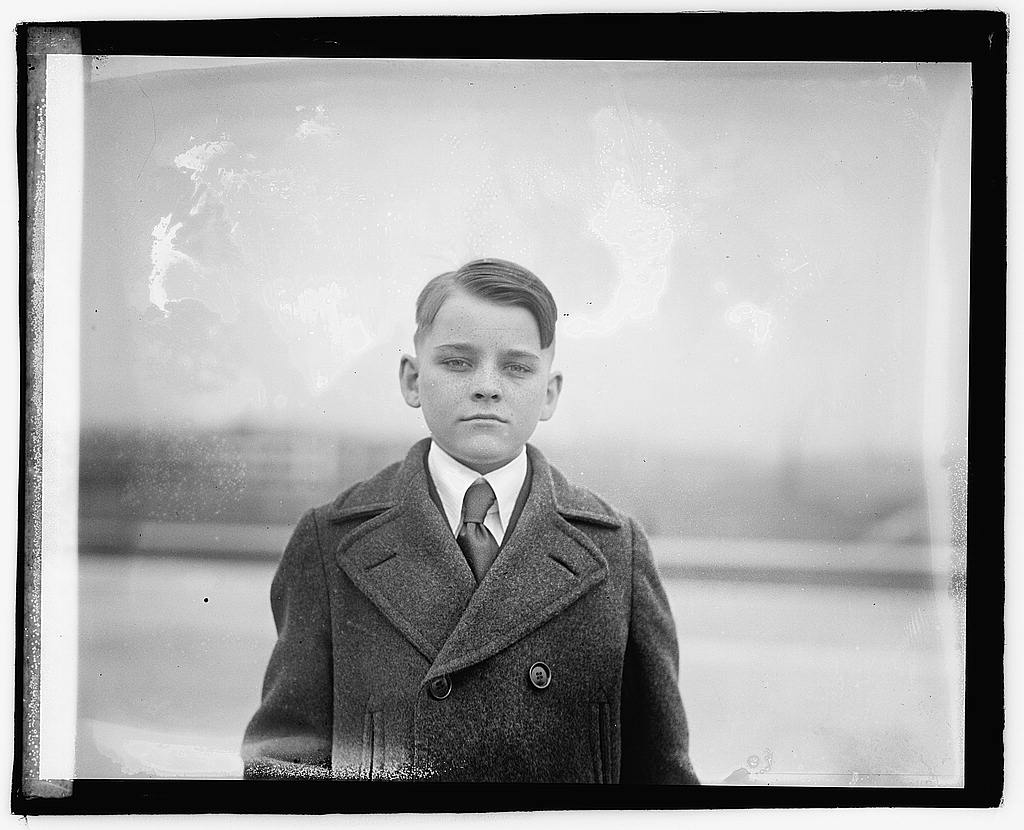
“Very early one morning when I came to the White House I saw a small boy standing at the fence, his face pressed against the iron railings. I asked him what he was doing up so early. He looked up at me, his eyes large and round and sad.
‘I thought I might see the President,’ he said. ‘I heard that he gets up early and takes a walk. I wanted to tell him how sorry I am that his little boy died.’
‘Come with me, I’ll take you to the President,’ I said.
He took my hand and we walked into the grounds. In a few minutes the President came out and I presented the boy to him. The youngster was overwhelmed with awe and could not deliver his message, so I did it for him.
The President had a difficult time controlling his emotions. When the lad had gone and we were walking through Lafayette Park he said to me: ‘Colonel, whenever a boy wants to see me always bring him in. Never turn one away or make him wait'” (Starling of the White House, p.224).
On Freedom and Ownership
“One of the rights which the freeman has always guarded with most jealous care is that of enjoying the rewards of his own industry. Realizing that the power to tax is the power to destroy, and that the power to take a certain amount of property or of income is only another way of saying that for a certain proportion of his time a citizen must work for the Government, the authority to impose a tax on the people has been most carefully guarded. Our own Constitution requires that revenue bills should originate in the House, because that body is supposed to be more representative of the people. These precautions have been taken because of the full realization that any oppression laid upon the people by excessive taxation, any disregard of their right to hold and enjoy the property which they have rightfully acquired, would be fatal to freedom.
“A government which lays taxes on the people not required by urgent public necessity and sound public policy is not a protector of liberty, but an instrument of tyranny. It condemns the citizen to servitude. One of the first signs of the breaking down of free government is a disregard of the taxing power of the right of the people to their own property. It make little difference whether such a condition is brought about through the will of a dictator, through the power of a military force, or through the pressure of an organized minority. The result is the same. Unless the people can enjoy that reasonable security in the possession of their property, which is guaranteed by the Constitution, against unreasonable taxation, freedom is at an end.
“The common man is restrained and hampered in his ability to secure food and clothing and shelter. His wages are decreased, his hours of labor are lengthened. Against the recurring tendency in this direction there must be interposed the constant effort of an informed electorate and of patriotic public servants. The importance of a constant reiteration of these principles can not be overestimated. They can not be denied. They must not be ignored” — Calvin Coolidge, June 30, 1924, at the Seventh Regular Meeting of the Business Organization of the Government, Memorial Continental Hall, Washington, D.C.