On Limited Government

Our system of limited powers enumerated in the Constitution has regularly proven to be a source of frustration to those who want to do more than the law allows. For them, it is an obstruction to progress, as they see it, by “negative rights,” preventing the government from doing all it can to make life better. These constraints are there by design to safeguard the rights of the people over their government, not government over its people.

Before Calvin Coolidge had even stepped off the public stage into retirement, pursuit of the ideal “good man in politics,” as Mason puts it (in “Harlan Fiske Stone: Pillar of Law,” p.267), was underway around him. Attitudes were shifting away from a faith in the people to govern themselves and back toward a confidence that government, armed with a greater efficiency and sharpened intelligence, could better plan and prepare for the nation’s future. President-elect Hoover, Associate Justice Stone and later Franklin D. Roosevelt would champion this trend. In fact, Robert H. Jackson, Roosevelt’s Attorney General and future Justice on the Supreme Court, would note Roosevelt’s attitude toward the constraints of the Constitution, writing,

“The President had a tendency to think in terms of right and wrong, instead of terms of legal and illegal. Because he thought that his motives were always good for the things that he wanted to do, he found difficulty in thinking that there could be legal limitations on them” (“That Man,” p.74).

These limitations of government were not sources of antagonism for Coolidge. The limits imposed by the Constitution are not sources of obstruction to those who respect law and the people. It was Coolidge who often spoke in praise of the wisdom and continued importance of these limits. On one such occasion in September 1924, he said,

“Ours, as you know, is a government of limited powers. The Constitution confers the authority for certain actions upon the President and the Congress, and explicitly prohibits them from taking other actions. This is done to protect the rights and liberties of the people. The Government is limited, only the people are absolute. Whenever the legislative or executive power undertakes to overstep the bounds of its limitations, any person who is injured may resort to the courts for protection and remedy. We do not submit the precious rights of the people to the hazard of a prejudiced and irresponsible political determination, but preserve and protect them by an independent and impartial judicial determination. We do not expose the rights of the weak to the danger of being overcome in the public forum by popular uproar, but protect them in the sanctity of the courtroom, where the still, small voice will not fail to be heard. Any attempt to change this method of procedure is an attempt to put the people again in jeopardy of the impositions and the tyrannies from which the first Continental Congress sought to deliver them. The only position that Americans can take is that they are against all despotism whether it emanate from a monarch, from a parliament, or from a mob.

“A significant circumstance of the first Congress, one which ought never to be overlooked, lies in the fact that it results from the voluntary effort on the part of the people to redress their own grievances and remedy their own wrongs. We pay too little attention to the reserve power of the people to take care of themselves. We are too solicitous for government intervention, on the theory, first, that the people themselves are helpless, and second, that the Government has superior capacity for action. Often times both of these conclusions are wrong” (“Foundations of the Republic,” p.122).
Image

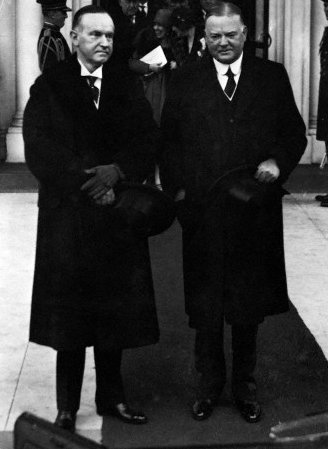
Coolidge, professionally pausing for the sake of photographers, stands beside the incoming President, Herbert Hoover, on Inauguration Day, March 4, 1929. Notice Grace over her husband’s shoulder as she enthusiastically greets folks on her way to join the men in the open car ride to the official ceremonies.

On Doing Your Job

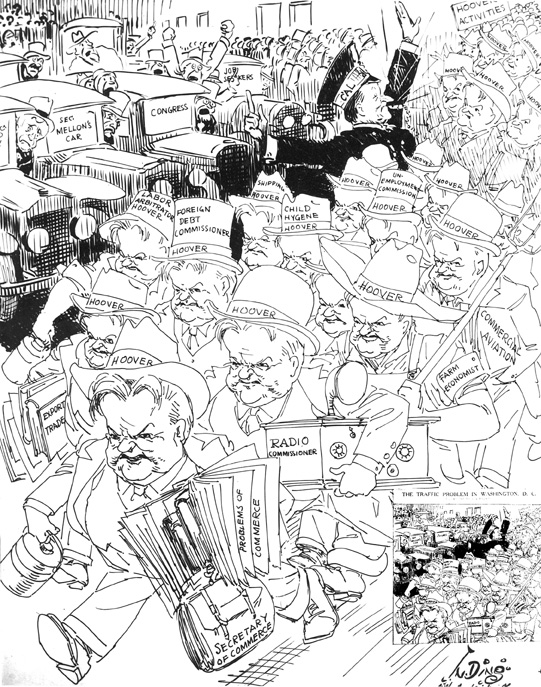
Hoover Traffic Jam - Darling

Rudolph Forster, invited by President McKinley in 1897 to “help out for a few days,” stayed through eight Presidents. By Coolidge’s time, Forster was a veteran administrator. Some Presidents found the work too demanding, leaving Forster with a larger daily load. Not so with Coolidge. Forster quickly learned the thirtieth President could handle his job. Daily responsibilities did not overwhelm him as they had others. His attention to detail and conscientious efficiency ensured the work got done. Forster said, “The little fellow wades into it like Wilson…He knows what he is doing and what he wants to do. He doesn’t do anyone else’s work either. He’ll be alright at this job. He does a lot of thinking, and he looks a long way ahead.” The Office was not “too big” for Coolidge. He could “swing it.”

Not doing others’ work is important. In our system of liberty, power is specifically limited to maximize individual initiative. Coolidge would not undo that balance by expanding Presidential power, assuming duties belonging to others. He made this clear to Labor Secretary James Davis. When Davis wanted the President to read Department documents, Coolidge said, “I hired him as Secretary of Labor and if he can’t do the job I’ll get a new Secretary of Labor.” The solution was not to take on more, but to find someone who could bear his own load. After all, he said, “A President shouldn’t do too much…” A President presides.

The man who followed Coolidge in the White House was a chronic interferer. Contemporaries observed that Hoover may have been Secretary of Commerce, but he was “undersecretary of everything else.” His penchant for involving himself in other department’s jurisdictions as well as state and local affairs was presumptuous at best. Hoover thought doing anything, even poorly, was better than refrained action. He contrasted sharply to Coolidge, who knew from experience that people were better equipped to solve their own problems. Writing twenty years later, Hoover would designate his predecessor a “strict legalist,” refusing to use government authority to avert the stock crash. For Hoover, Coolidge was too conscientious about the legal, and natural, limits of his job.

By holding Coolidge (and seemingly everyone else) responsible, Hoover overlooked his own role in turning normal recession into historic disaster. With liquidation prevented, wasteful uses of capital remained in the market. Ending Coolidge’s policy of constructive economy, Hoover’s spending ate away the people’s savings. By centralizing executive oversight, Hoover denied people’s ability to make their own decisions. For all his “doing,” however, Hoover was unable to fix anything. Such “fixing” is a task no one is qualified to exercise because Presidents, however intelligent and capable, simply cannot know or do it all. Coolidge understood this. Hoover did not. When Coolidge could act, he chose men, like Roy Young, who knew their specific jobs and did them without Presidential “babysitting.” Young, as Federal Reserve chair, worked to tap the brakes on speculation.

Hoover, trying to justify his own intervention, either misremembered or placed words in Coolidge’s mouth. When Coolidge spoke of economic conditions January 6, 1928, he never said speculation was “not dangerous…merely reflecting the growing wealth and power of the United States,” as Hoover claims. Knowing broad Presidential pronouncements usually inflict more harm than good, Coolidge would not speak without facts. The law gave him no authority to set market values. That task remained with the people, Congress, and the Federal Reserve. Coolidge would not pretend otherwise. Citing reports from the Treasury, Coolidge did say, “I haven’t had any indications that the amount [stock sums] was large enough to cause particularly unfavorable comment.” He used a report from Hoover’s Commerce Department to address speculation January 8, 1929. Coolidge never declared the market was “absolutely sound” and stocks “cheap at current prices,” as Hoover asserts, but said,

“I haven’t a great amount of information concerning the business situation, but I was advised this morning by the Department of Commerce that the last six months, according to their reports, was better than the first six months of the year 1928 and was up to the standard of 1927. So far as they can determine present conditions in business throughout the country are good and the prospect for the immediate future seems to be as good as usual.”

This was no glowing endorsement. There were “encouraging signs” of deregulation at first, but by 1932 a “general lack of judgment,” to which millions of people contributed, had produced depression. Solutions, true to Coolidge’s lifelong faith in the people, were never going to come by giving government more authority over our choices. Individual freedom means being allowed to fail as well as flourish. Hoover, in his ambition to manage it all, never learned what Coolidge was teaching: the greatest help a President can render is to mind his own business.