On Annual Addresses

President Coolidge with a group visiting the White House, 1928. Courtesy of the Library of Congress.

President Coolidge with a group visiting the White House, 1928. Courtesy of the Library of Congress.

Calvin Coolidge, after setting the tone of his administration with a personal delivery of the Annual Message to Congress in December 1923 (in a sparse 6,703 words), observed the wisdom of Jefferson’s preference for a written Message. Coolidge understood the intangible worth of this custom not only for the people’s business but for the sake of the people themselves.

Coolidge submitted his messages in writing thereafter.

Moreover, the actions he took were anchored in what was right according to the law, what upheld his oath, and what served the whole people not just a specially favored demographic or interest. When he could have used the Bully Pulpit to drive wedges of discord and fuel hatred, he appealed to the fundamental principles that united thirteen different colonies into one American people, brought together in the common cause of liberty and service.

Everything he did functioned to re-balance the scales away from administrative centralization and back toward the original roles of Washington, the States, the local authorities, and the people themselves, who needed the confidence that they had the capacity to govern their own affairs.

His executive approach was strong because he relied on the institutions and traditions put into place by the American people themselves. He led in such as way as to validate the faith they held in that constitutional system and its distribution of power.

As a result, America was freer in its exercise of liberty and self-government in the 1920s on many essentials that cannot be said today.

The journey begins with our faith and confidence in the reality of self-governance and our ability to exercise it without an incessant hand-holding at every stage by Washington and, in some important instances, the States as well.

He delivered six Annual Messages as President between 1923 and 1929. His last, submitted in writing like the previous four and dispatched to Congress on December 4, 1928 (8,057 words, 702 words shorter than his 1925 Message), remains one of the best examples of Coolidge’s style. He had a superlative skill for accomplishing more with less than anyone of his era. This was especially true of his use of words. He could pack more cogent thought in a sentence than it took most officeholders a paragraph or more to convey. It can be read here.

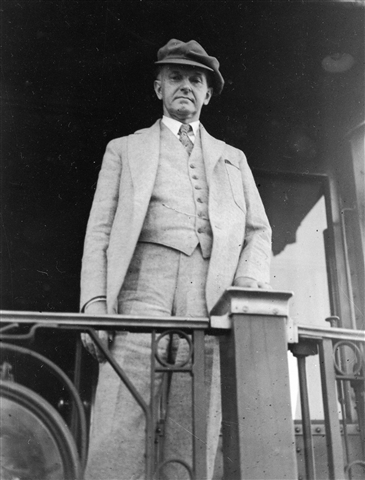
President Coolidge en route to Brule, Wisconsin, earlier that year, June 14, 1928.

President Coolidge en route to Brule, Wisconsin, earlier that year, June 14, 1928.

Among the many issues President Coolidge covers, as he surveys the state of the union after nearly six years in office, we find these:

We have been coming into a period which may be fairly characterized as a conservation of our national resources. Wastefulness in public business and private enterprise has been displaced by constructive economy. This has been accomplished by bringing our domestic and foreign relations more and more under a reign of law. A rule of force has been giving way to a rule of reason. We have substituted for the vicious circle of increasing expenditures, increasing tax rates, and diminishing profits the charmed circle of diminishing expenditures, diminishing tax rates, and increasing profits…”

Four times we have made a drastic revision of our internal revenue system, abolishing many taxes and substantially reducing almost all others. Each time the resulting stimulation to business has so increased taxable incomes and profits that a surplus has been produced. One-third of the national debt has been paid, while much of the other two-thirds has been refunded at lower rates, and these savings of interest and constant economies have enabled us to repeat the satisfying process of more tax reductions. Under this sound and healthful encouragement the national income has increased nearly 50 per cent, until it is estimated to stand well over $90,000,000,000. It has been a method which has performed the seeming miracle of leaving a much greater percentage of earnings in the hands of the taxpayers ‘with scarcely any diminution of the Government revenue. That is constructive economy in the highest degree. It is the corner stone of prosperity. It should not fail to be continued…”

It is necessary therefore during the present session to refrain from new appropriations for immediate outlay, or if such are absolutely required to provide for them by new revenue; otherwise, we shall reach the end of the year with the unthinkable result of an unbalanced budget. For the first time during my term of office we face that contingency. I am certain that the Congress would not pass and I should not feel warranted in approving legislation which would involve us in that financial disgrace…”

The Coolidges at a public ceremony, 1928.

The Coolidges at a public ceremony honoring America’s military services, 1928. Courtesy of the Library of Congress.

On National Defense: I wish to repeat again for the benefit of the timid and the suspicious that this country is neither militaristic nor imperialistic. Many people at home and abroad, who constantly make this charge, are the same ones who are even more solicitous to have us extend assistance to foreign countries. When such assistance is granted, the inevitable result is that we have foreign interests. For us to refuse the customary support and protection of such interests would be in derogation of the sovereignty of this Nation. Our largest foreign interests are in the British Empire, France, and Italy. Because we are constantly solicitous for those interests, I doubt if anyone would suppose that those countries feel we harbor toward them any militaristic or imperialistic design. As for smaller countries, we certainly do not want any of them. We are more anxious than they are to have their sovereignty respected. Our entire influence is in behalf of their independence. Cuba stands as a witness to our adherence to this principle…”

On Veterans: The administration of all the laws concerning relief has been a difficult task, but it can safely be stated that these measures have omitted nothing in their desire to deal generously and humanely. We should continue to foster this system and provide all the facilities necessary for adequate care. It is the conception of our Government that the pension roll is an honor roll. It should include all those who are justly entitled to its benefits, but exclude all others…

The Coolidges at the family Homestead, 1928.

The Coolidges at the family Homestead, Plymouth Notch, Vermont, 1928.

On Agriculture: In the past eight years more constructive legislation of direct benefit to agriculture has been adopted than during any other period. The Department of Agriculture has been broadened and reorganized to insure greater efficiency. The department is laying greater stress on the economic and business phases of agriculture. It is lending every possible assistance to cooperative marketing associations. Regulatory and research work have been segregated in order that each field may be served more effectively…”

On the Surplus Problem: Temporary expedients, though sometimes capable of appeasing the demands of the moment, can not permanently solve the surplus problem and might seriously aggravate it. Hence putting the Government directly into business, subsidies, and price fixing, and the alluring promises of political action as a substitute for private initiative, should be avoided…”

On Conservation: The practical application of economy to the resources of the country calls for conservation. This does not mean that every resource should not be developed to its full degree, but it means that none of them should be wasted. We have a conservation board working on our oil problem. This is of the utmost importance to the future well-being of our people in this age of oil-burning engines and tile general application of gasoline to transportation…”
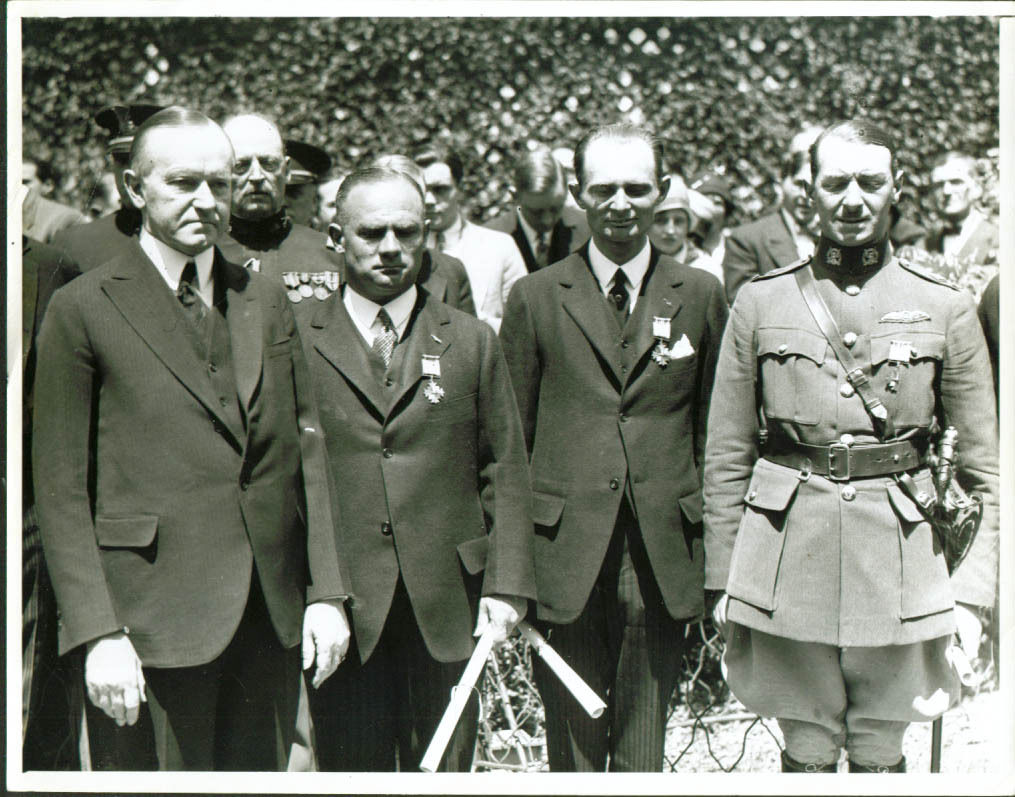
President Coolidge honoring the aviation pioneers of the Junker "Bremen" for the first East to West transatlantic crossing accomplished in April 1928. Here the crew, L to R: Captain Hermann Kohl, Baron von Huenefeld (both of Germany), and Major James C. Fitzmaurice of Ireland, are bestowed the Distinguished Flying Cross, the highest award in aviation, by President Coolidge at the White House, May 1928.

President Coolidge honoring the aviation pioneers of the Junker “Bremen” for the first East to West transatlantic crossing accomplished in April 1928. Here the crew, L to R: Captain Hermann Kohl, Baron von Huenefeld (both of Germany), and Major James C. Fitzmaurice (of Ireland), are bestowed the Distinguished Flying Cross, the highest award in aviation, by President Coolidge at the White House, May 1928.

On Wage Earners: Here and there the councils of labor are still darkened by the theory that only by limiting individual production can there be any assurance of permanent employment for increasing numbers, but in general, management and wage earner alike have become emancipated from this doom and have entered a new era in industrial thought which has unleashed the productive capacity of the individual worker with an increasing scale of wages and profits, the end of which is not yet. The application of this theory accounts for our widening distribution of wealth. No discovery ever did more to increase the happiness and prosperity of the people…”

On Women and Children: The Federal Government should continue its solicitous care for the 8,500,000 women wage earners and its efforts in behalf of public health, which is reducing infant mortality and improving the bodily and mental condition of our citizens...”

President Coolidge addressing 10,000 Sioux Indians, South Dakota, the previous year (1927).

President Coolidge addressing 10,000 Sioux Indians, South Dakota, the previous year (1927).

On the American Indian: The Government’s responsibility to the American Indian has been acknowledged by annual increases in appropriations to fulfill its obligations to them and to hasten the time when Federal supervision of their affairs may be properly and safely terminated. The movement in Congress and in some of the State legislatures for extending responsibility in Indian affairs to States should be encouraged. A complete participation by the Indian in our economic life is the end to be desired…”

President Coolidge with the Singers of Georgia Industrial College, at Cabin Bluff, Georgia, December 1928.

President Coolidge with the Singers of Georgia Industrial College, at Cabin Bluff, Georgia, December 1928.

On the Negro: For 65 years now our negro population has been under the peculiar care and solicitude of the National Government. The progress which they have made in education and the professions, in wealth and in the arts of civilization, affords one of the most remarkable incidents in this period of world history. They have demonstrated their ability to partake of the advantages of our institutions and to benefit by a free and more and more independent existence. Whatever doubt there may have been of their capacity to assume, the status granted to them by the Constitution of this Union is being rapidly dissipated. Their cooperation in the life of the Nation is constantly enlarging…”
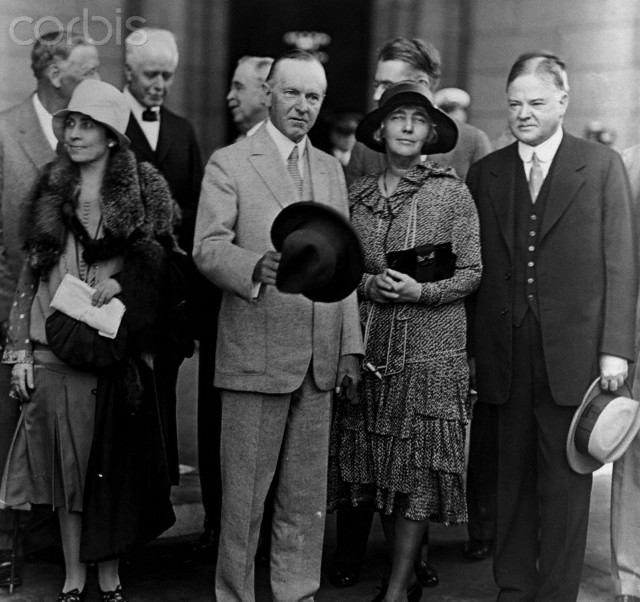
The Coolidges welcomed at Union Station on their return from the last summer escape before the end of official duties, Washington, 1928.

The Coolidges welcomed at Union Station on their return from the last summer escape before the end of official duties, Washington, 1928. Courtesy of Corbis. Cabinet officers around them, L to R: Attorney General Sargeant, Secretary Whiting, Secretary Work, Secretary Wilbur, and Mrs. and Mr. Hoover, soon to follow the Coolidges in office.

On Prohibition: The country has duly adopted the eighteenth amendment. Those who object to it have the right to advocate its modification or repeal. Meantime, it is binding upon the National and State Governments and all our inhabitants. The Federal enforcement bureau is making every effort to prevent violations, especially through smuggling, manufacture, and transportation, and to prosecute generally all violations for which it can secure evidence. It is bound to continue this policy. Under the terms of the Constitution, however, the obligation is equally on the States to exercise the power which they have through the executive, legislative. judicial, and police branches of their governments in behalf of enforcement…”

“The country is in the midst of an era of prosperity more extensive and of peace more permanent than it has ever before experienced. But, having reached this position, we should not fail to comprehend that it can easily be lost. It needs more effort for its support than the less exalted places of the world. We shall not be permitted to take our case, but shall continue to be required to spend our days in unremitting toil. The actions of the Government must command the confidence of the country. Without this, our prosperity would be lost. We must extend to other countries the largest measure of generosity, moderation, and patience. In addition to dealing justly, we can well afford to walk humbly.

“The end of government is to keep open the opportunity for a more abundant life. Peace and prosperity are not finalities; they are only methods. It is too easy under their influence for a nation to become selfish and degenerate. This test has come to the United States. Our country has been provided with the resources with which it can enlarge its intellectual, moral, and spiritual life. The issue is in the hands of the people. Our faith in man and God is the justification for the belief in our continuing success.”

President Coolidge and his official secretary, Everett Sanders, outside the gathering of the Pan-American Conference on Arbitration and Conciliation, December 12, 1928. Courtesy of the Library of Congress.

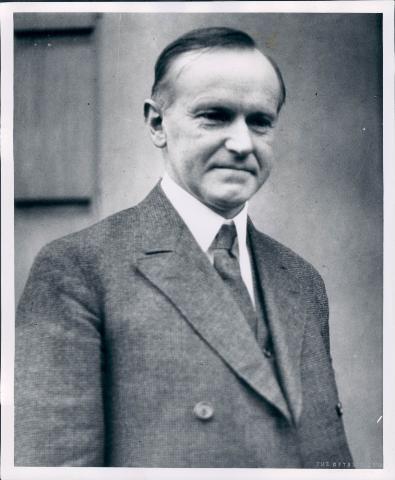
President Coolidge and his official secretary, Everett Sanders, outside the gathering of the Pan-American Conference on Arbitration and Conciliation, December 12, 1928. Courtesy of the Library of Congress.
On the Country’s Business

Bruce Frohnen has written a great piece explaining, “Not Betrayal: The Real Reason Paul Ryan Should Be ‘Primaried.'” While this delves into current politics, something we try to do regularly, what makes Frohnen’s point so powerful is the distinction he draws between what Ryan believes he’s doing and what Calvin Coolidge strove to do. As Frohnen says, “People like Mr. Ryan must be primaried out of office, not because they are false to their principles, but because their principles are false.” The difference is important. Ryan believes he is doing some great things, even serving the interests of his constituents and the people at large.

What the new Speaker misses is pivotal, however, as Frohnen continues: “Mr. Ryan and his establishment colleagues seem to believe that a bit of common sense of the business variety will reign in Mr. Obama and his social justice warrior administration. They are wrong. By seeking to merely streamline governmental machinery that warps the values and motivations of the people, Mr. Ryan is aiming, in reality, to make that machinery more efficient. This might buy his well-off constituents some more years of relative prosperity, but it definitely will empower those who always run such machinery (the sort of people who prefer administering others rather than letting them do for themselves) and who always see its central purpose as reconfiguring society. Whatever economic surplus the rest of us may produce, these would-be masters will see as rightly belonging to them.”

Enter Calvin Coolidge. As Frohnen writes, “Coolidge’s statement evinces an understanding that the people themselves are chiefly concerned to make a living and go about their lives unmolested.”  Even throughout Coolidge’s constructive economy program, applying (as he did) basic budgetary principles, he knew the goal was not the efficiency of the process as an end in itself but an obligation owed to people whose lives were directly and indirectly impacted by every decision Washington made.

When people misquote his “business of America is business” statement, they are accepting the false notion that the very livelihood and creative energy of the people flows from – even equivalent to – the national government. This is simply another way of endorsing what Coolidge time and time again condemned: the people working more for government than for themselves. Coolidge knew this apparatus, even cloaked as it could be in the guise of good intentions, left life all more the meager and real people prostrate before a Washington unwilling and uninterested in restraining its desire to spend what others have worked to earn.

Cal vehemently opposed the assumption of those burdens that the people themselves must necessarily bear to remain free. He despised the bureaucratization of life and warned continually about the extinguishing of culture and the loss of bountiful variety that local self-government had kept kindled for a century and a half. He demonstrated that streamlining government needed to happen through restraining it first and simplifying it not creating more layers of it. He made the case that government was for humanity not humanity for government. He saw people not as “economic units” to be carefully arranged into some overall plan for maximum efficiency,  but as human souls with the capacity to govern themselves, possessing needs and aspirations that no central authority, however well-meaning, is equipped to administer. There was a natural limit to what Washington can and should do, Cal observed. He understood well that there were real people at the end of all those regulations, rules, and statutes. It would be they, especially the poorest among us and those least able to bear it, who would have to carry the greatest share of the cost for all that “help” from D. C.

Life in America was so much more than the all-consuming demands of the machinery of government administration. Coolidge appreciated the massive difference between putting out a fire and simply managing the flames. What Mr. Ryan has yet to learn Coolidge grasped all too well: The problem isn’t to get government “working” with a more user-friendly array of goods and services, the problem is to get government out of the way so we can live, keep the rewards of our effort, and “work out our own salvation” as a free people once more.

deathstar

Simply adding oil to the State machinery, handling people as so many worker-bees beholden to the Beltway, or placing a smiley faces atop the destructive reality government’s omnipresence in daily consciousness inflicts, may condition people to accept it as normal, even permanent, but it fixes nothing. It is akin to helping complete the Emperor’s Death Star not once but twice so that we can “create jobs” for the unemployed and bolster the Galactic economy. The death part we’ll worry about later, today’s “leadership” seems to say.

746938

Instead, we should take up Cal’s challenge: to so exercise both our rights and responsibilities, as The People, to such an extent that we would not notice if Washington actually shut down for six months…preferably much longer.

On the “Chief Business of America”

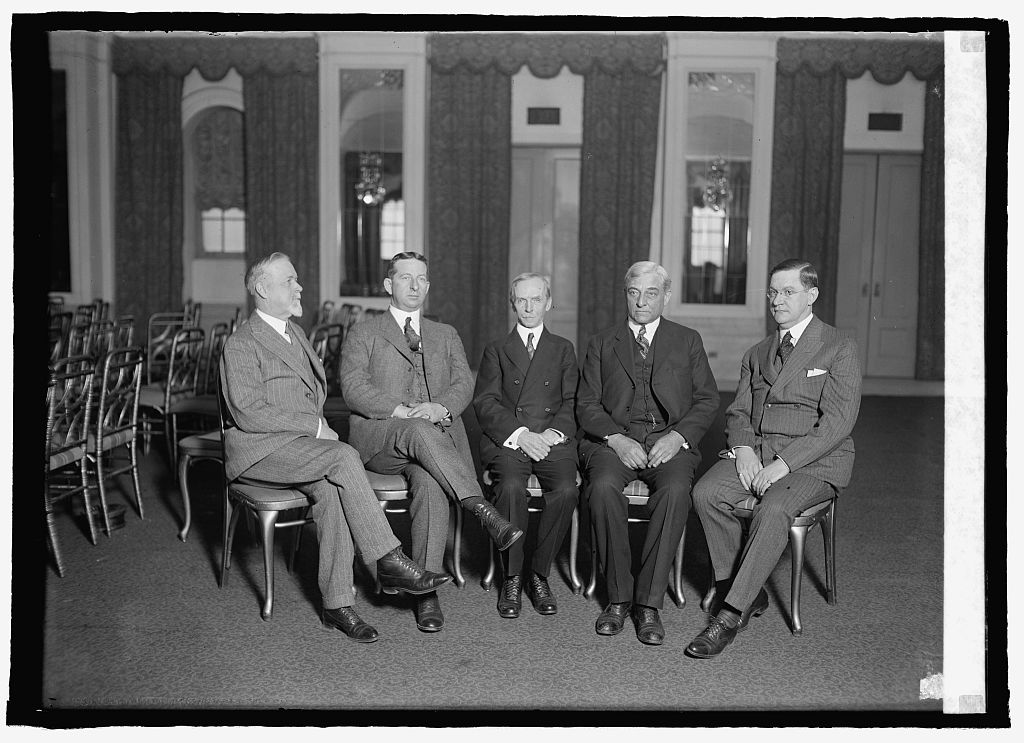
The officers of the American Society of Newspaper Editors taken at the Willard, January 16, 1925. Courtesy of the Library of Congress. Caspar S. Yost of the Globe-Democrat, President of the Association, sits in the center chair. Coolidge would speak to the entire assembly the following day.

The officers of the American Society of Newspaper Editors taken at the Willard, January 16, 1925. Caspar S. Yost of the Globe-Democrat, President of the Association, sits in the center chair. Coolidge would speak to the entire assembly the following day. Courtesy of the Library of Congress.
The most often misquoted line of Calvin Coolidge is “the business of America is business,” (when he actually said, “The chief business of America is business”) typically paraded out as proof positive that #30 blindly worshiped Big Business, and encouraged its worst manifestations when partaking in the buying and selling of government influence. This injustice to Coolidge – torn violently from a speech that is (irony of ironies) about reporting the truth versus spreading propaganda – has been refuted so many times, those who have done the refuting almost wonder whether there is not a fair dose of malice in the misquotation. Still, many have not heard the actual quote in its context. It was almost ninety-one years to the day that, addressing the American Society of Newspaper Editors meeting at the New Willard Hotel in Washington, D. C., he said,

The relationship between governments and the press has always been recognized as a matter of large importance. Wherever despotism abounds, the sources of public information are the first to be brought under its control. Where ever the cause of liberty is making its way, one of its highest accomplishments is the guarantee of the freedom of the press. It has always been realized, sometimes instinctively, oftentimes expressly, that truth and freedom are inseparable. An absolutism could never rest upon any thing save a perverted and distorted view of human relationships and upon false standards set up and maintained by force. It has always found it necessary to attempt to dominate the entire field of education and instruction. It has thrived on ignorance. While it has sought to train the minds of a few, it has been largely with the purpose of attempting to give them a superior facility for misleading the many. Men have been educated under absolutism, not that they might bear witness to the truth, but that they might be the more ingenious advocates and defenders of false standards and hollow pretenses. This has always been the method of privilege, the method of class and caste, the method of master and slave.

American women at work in a mill, late 1920s.

American women at work in a mill, late 1920s.

He goes on to say,

The public press under an autocracy is necessarily a true agency of propaganda. Under a free government it must be the very reverse. Propaganda seeks to present a part of the facts, to distort their relations, and to force conclusions which could not be drawn from a complete and candid survey of all the facts. It has been observed that propaganda seeks to close the mind, while education seeks to open it. This has become one of the dangers of the present day.

The great difficulty in combating unfair propaganda, or even in recognizing it, arises from the fact that at the present time we confront so many new and technical problems that it is an enormous task to keep ourselves accurately informed concerning them. In this respect, you gentlemen of the press face the same perplexities that are encountered by legislators and government administrators. Whoever deals with current public questions is compelled to rely greatly upon the information and judgments of experts and specialists. Unfortunately, not all experts are to be trusted as entirely disinterested. Not all specialists are completely without guile. In our increasing dependence on specialized authority, we tend to become easier victims for the propagandists, and need to cultivate sedulously the habit of the open mind. No doubt every generation feels that its problems are the most intricate and baffling that have ever been presented for solution. But with all recognition of the disposition to exaggerate in this respect, I think we can fairly say that our times in all their social and economic aspects are more complex than any past period. We need to keep our minds free from prejudice and bias. Of education, and of real information we cannot get too much. But of propaganda, which is tainted or perverted information, we cannot have too little…And so I have conceived that the news, properly presented, should be a sort of cross section of the character of current human experience.

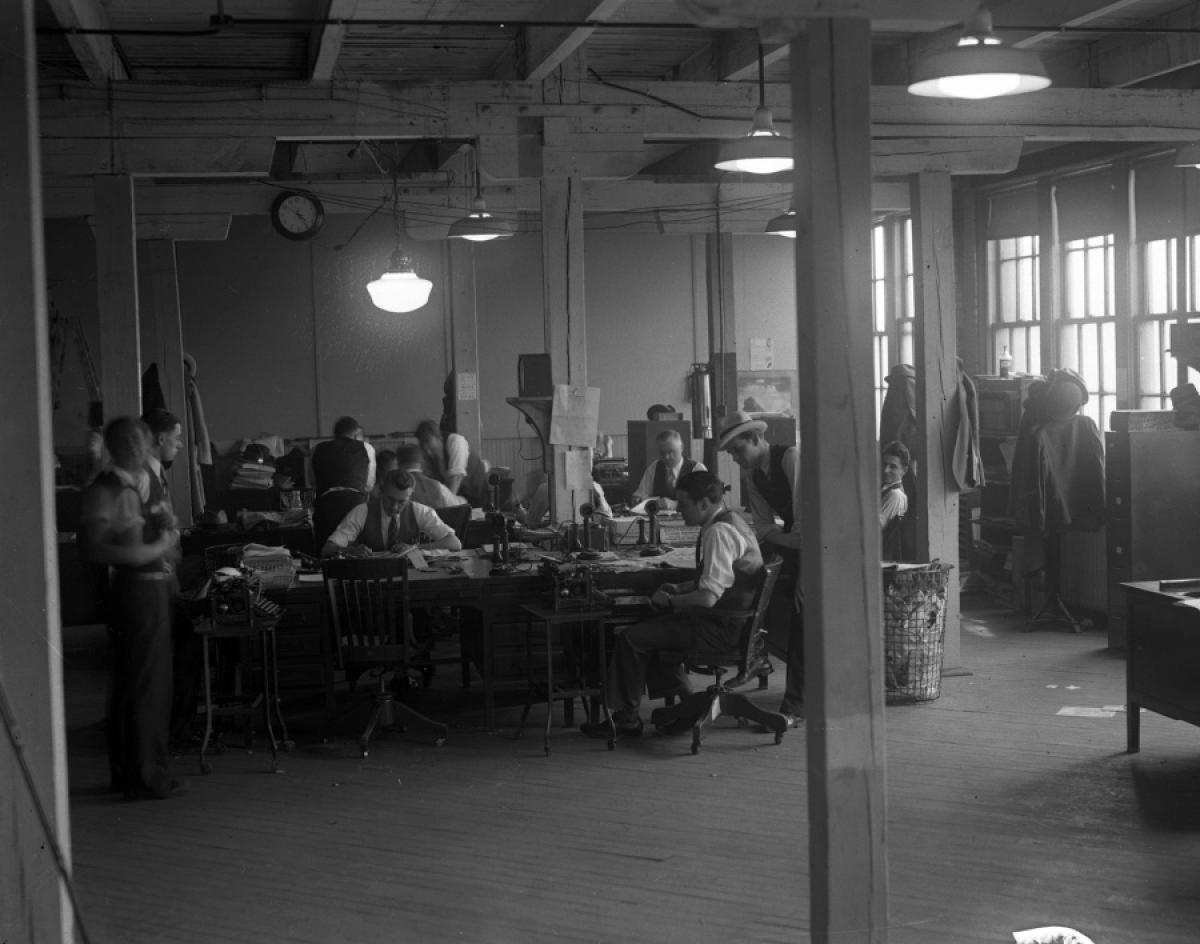
The New York Daily News editorial department, 1920s.

The New York Daily News editorial department, 1920s.

The President explains the basis for this approach to the task of news reporting,

Our American newspapers serve a double purpose. They bring knowledge and information to their readers, and at the same time they play a most important part in connection with the business interests of the community, both through their news and advertising departments...When I have contemplated these adjustments of business and editorial policy, it has always seemed to me that American newspapers are peculiarly representative of the practical idealism of our country.

He illustrates this with the disagreement over publishing individual income returns in the news. The facts had been faithfully reported in the news columns while at the same time the editorial pages gave full vent to the dissent that such information should be available at. In this way, Coolidge explains, As practical newsmen they printed the facts. As editorial idealists they protested that there ought to be no such facts available.” In this way they represented the “practical idealism” of America as opposed to assuming the fiction or inconsistency of merely objective non-participants. The news had a stake in the game, as it were, and should not be in denial of practical realities for the good of the country.

Snapshot from a business office in Hempstead, Texas, 1920s.

Snapshot from a business office in Hempstead, Texas, 1920s.

Then, Coolidge comes to the point,

There does not seem to be cause for alarm in the dual relationship of the press to the public, whereby it is on one side a purveyor of information and opinion and on the other side a purely business enterprise. Rather, it is probable that a press which maintains an intimate touch with the business currents of the nation, is likely to be more reliable than it would be if it were a stranger to these influences. After all, the chief business of the American people is business. They are profoundly concerned with producing, buying, selling, investing and prospering in the world. I am strongly of opinion that the great majority of people will always find these are moving impulses of our life.

Coolidge was not done, though many are content to cut him off then and there, as if no more context was necessary. If the characterization held true, Coolidge would launch into an unqualified defense of marrying politics with business. He does not do so. He explains the many practical benefits that accrue when those who have accumulated wealth voluntarily give it to others, not have it confiscated or exchange it for access to the public treasury. It manifests in the private endowment of schools, the quality of education that results, the encouragement of scientific inquiry, the broadening of outlook, the expansion of liberties, the widening of culture.” All of life does not, and should not, flow through Washington. Life was so much more to Coolidge than what government’s little part of it. People did not start their day with an agenda or tone dispatched from Washington. They went about their work and responsibilities with barely an acknowledgement that D.C. existed. To Cal, this was not something to change but to praise and promote as the way things ought to be. The news needed to reflect this practical reality instead of distorting the picture with a lopsided or disproportionate coverage of the anomalies of society and abstractions of theory. America was not merely a national government, it was a people, a culture, a vibrant reality where promoting liberty and service were far more important than the slowly encroaching bureaucratization of daily existence.

Team of "newsies" in 1925 not far from where Caspar S,. Yost and several other editors disembarked on the trek west that would reveal Yost's vision to form an "ethical organization" bringing together individuals committed to the raising the standards and purpose of the news in what would become the American Society of Newspaper Editors, 1922.

Team of “newsies” in 1925 not far from where Caspar S,. Yost and several other editors first embarked on the trek west in 1912 that would reveal Yost’s vision to form an “ethical organization” bringing together individuals committed to elevating the standards and purpose of the news business. Yost’s idea would be realized with the founding of the American Society of Newspaper Editors in 1922. Yost served as its first president and invited President Coolidge to address the group on its third anniversary.

Coolidge retained an unshakable faith in the power of the spirit to always prevail over all the schemes of fleshly selfishness, even in the news. The truth would prevail and those who would try to be self-serving in their respective roles would find defeat. He knew that denying the practical concerns or self interests of daily news coverage would fail while championing liberty always works. He commended the newspapers of his day because they recognized that commitment to the practical realities that animate and inspire the rest of the country. By describing what America really is, the media had to truly live in the same world of working, earning, and serving. There was no danger in trusting America’s freedom because it possessed the remedies to its own “disorders.”

Coolidge is proclaiming the very opposite point than the mindlessly parroted caricature “the business of America is business” conveys. He powerfully concludes,

It can safely be assumed that self interest will always place sufficient emphasis on the business side of newspapers, so that they do not need any outside encouragement for that part of their activities. Important, however, as this factor is, it is not the main element which appeals to the American people. It is only those who do not understand our people, who believe that our national life is entirely absorbed by material motives. We make no concealment of the fact that we want wealth, but there are many other things that we want very much more. We want peace and honor, and that charity which is so strong an element of all civilization. The chief ideal of the American people is idealism. I cannot repeat too often that America is a nation of idealists. That is the only motive to which they ever give any strong and lasting reaction. No newspaper can be a success which fails to appeal to that element of our national life. It is in this direction that the public press can lend its strongest support to our Government. I could not truly criticize the vast importance of the counting room, but my ultimate faith I would place in the high idealism of the editorial room of the American newspaper.

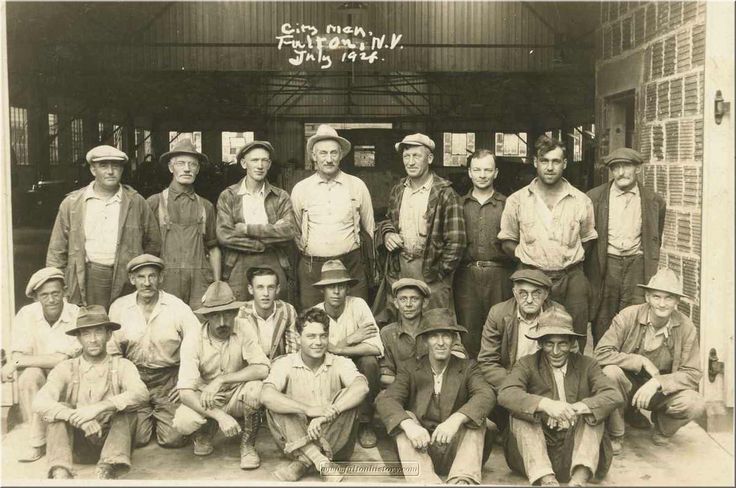
American laborers, 1920s

American work crew, 1924. Courtesy of Fulton History.

We deprive ourselves when we fail to grasp Coolidge’s full meaning and impose a mold into which his words and his character is supposed to fit. Papers like The New York Times and networks like CNN (and the case could be made for Fox News), now so enslaved to their political cause, have long abandoned the real world and practical understanding that Coolidge lauded in the news of his day. Many are proudly committed to this fantasy world because it adheres to their self-righteous purity in their political “old-time religion.” They have gladly entered a suicide pact believing reality and the American people be condemned, they will hold fast to the Faith of their impractical worldview. No paper, network, or individual correspondent will avoid becoming obsolete which (or who) does not give proper place to the ideals that motivate and engage the American people. That is why we are experiencing a passing of the old media and rise of the new but that new resonates for the very reason Coolidge cites. It lives in the practical reality of daily life. As long as the media of today understands America and its ideals, continues to engage in the business of living as the rest of us do, it will remain worthy of freedom, and contribute to the genuine advance of human life.

That is the takeaway from this speech, proof that Cal said so much more than the tepid and empty “business” line which has mischaracterized him too long.

President Coolidge on his to Wisconsin, 1928.

President Coolidge on his way to Wisconsin, 1928.