“What Calvin Coolidge Teaches Us Today”

184603_4283659969885_567340097_n

“What Calvin Coolidge Teaches Us Today”

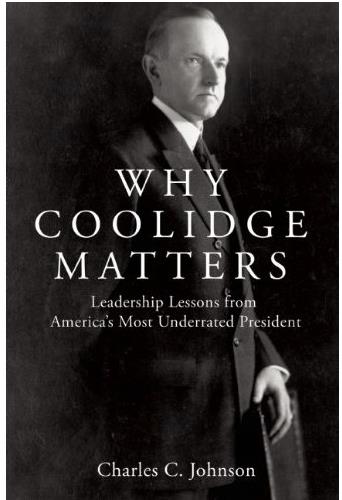
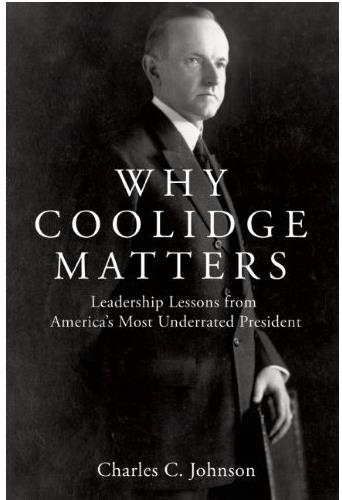
Here is a great conservation initiated by a rigorous scholar of our most underrated President. It takes place at an institution that shines forth as a beacon for what education is supposed to be — Hillsdale College. Mr. Johnson has recently published “Why Coolidge Matters: Leadership Lessons from America’s Most Underrated President.”

Mr. Johnson tackles his subject with the skills of someone all too rare today — an investigative journalist. He is doing the job most “historians” won’t do. In a field of superb thinkers and diligent expositors of Coolidge, his work stands out as the best in recent years. Mr. Johnson’s work is not a simple recital of biographical trivia. Unlike most historians, Mr. Johnson delves into a study of Coolidge’s ideas and is equally an examination of statesmanship. While Ms. Shlaes has written a well-done treatment of debt and Coolidge’s approach to it, Mr. Johnson takes on the entire worldview of the man. In Ms. Shlaes’ book we see Coolidge as a very credible witness on economics. In Mr. Johnson’s book we see Coolidge as authoritative on the high calling of public service (chapter 1), the duties of self-government (chapter 2), the purpose of education (chapter 3), the Founder’s theory of government (chapter 4), the use of presidential powers (chapter 5), the shared nature of all people: race, immigration and women (chapter 6), a sensible foreign policy: mind our own affairs, conserve our strength and protect our citizens (chapter 7, p.224), and an Afterword containing Coolidge’s post-presidential wisdom, as he looked at current trends and drew from the often overlooked “obvious” essentials that can still guide us now.

In “Why Coolidge Matters,” the way Coolidge thought and acted is brought into clearer relief as all part of one, complete whole. It is both a primer to Coolidge’s own words — of which there are many, including three books of his speeches — but also is an introduction to Coolidge’s comprehensive and consistent outlook. Mr. Johnson reminds us that President Coolidge is discounted today not because he never said or did anything but because what he teaches is the most powerful refutation of “modern” liberalism’s destructive legacy, from the schools to the inner cities to Washington itself. The man discounted for a lack of vision, saw where the mountain of bad policies covered by good intentions would lead long before later generations have. Coolidge is a force to be reckoned with and is marginalized at one’s peril. Perhaps the fear that what Coolidge has to say might break through the assembly line of untaught and unchallenged students who become uninformed and complacent citizens is why he is not welcome in many of our schools.

Be ready not to simply scan through the book, but delve into the principles of the last classically-trained statesman-philosopher to serve in the White House. Be prepared to grapple with the problems he faced and how to comprehend the substance of the ideas he articulated. Be equal to the challenge of thinking the Founder’s thoughts, as Coolidge would say, to apply their timeless discoveries to what issues confront us now.

You will be disappointed only if you refuse this challenge to think, to move past ignorant frames of reference and thereby begin to understand that the principles to which Coolidge directs our respectful attention — the things of the spirit, as he called them — build great and just societies. It is the Declaration and Constitution which gave birth to all our affluence and comfort, not the other way around. Before we can honestly discard the former two as obsolete or unworkable, we have to have tried them. Instead, it is time we start getting reacquainted with the ideas they contain and the sacrifice it requires of us to make them work.

“Does cutting taxes really shrink government?”

“Does cutting taxes really shrink government?”

Three weeks before the passage of the Revenue Act of 1928, the President was analyzing the results of his administration’s formula: cut taxes, enforce constructive economy and retire debt with surplus. The President was not pleased, however. The reason was not in making the case for cuts and shrinking expenditures. The reason was not in retiring the national debt, which would be reduced $5.4 billion over the course of five and a half years, a feat not replicated since. Had the rate of reduction been constant, the debt would have been eliminated in just over fifteen years. The reason was in the incessant temptation by those around him to spend the “surplus revenue.”

The administration’s plan had worked beyond everyone’s expectations. It had worked so well that Congress was eager to start spending all that extra money. The President wanted it returned in cuts and put toward the debt. It was becoming increasingly clear that tax cuts were going to be tougher and tougher to sell as surpluses grew larger and larger. Ironically, thanks to Coolidge being “too successful,” spending would be even harder to restrain in the future than it was in the present.

The fiscal year would yield a surplus of $398,000,000, well beyond even the President’s initial figures. But as Coolidge lists all the projects Congress wanted, it not only made future tax reductions impossible but would have overturned them with increases to cover government profligacy: the flood bill, $500 million, the farm bill, $400 million, the Boulder Dam bill, $125 million, the pension bill, $15 million, the salary bill, $18 million, the Muscle Shoals bill, $75 million, the Post Office pay bill, $20 million, a reduction of post payments costing another $38 million, the corn borer, $7 million, and $6 million for “vocational training,” just to name a few. Meanwhile, the President observed, tax reduction between $203 and $289 million remained before Congress as he spoke. “If all these bills went through and became law I should think it would not only endanger tax reduction at the present time, but would make necessary the laying of additional taxes.” This was an impermissible step backward, not forward. As the President reminded reporters early the following month, “the surplus was secured, of course, by very careful management of expenditures…” not by spending it all away. 

The size of the surplus and the urge to spend it, however strong, did not make indulging the desire any more responsible with the people’s money than in lean years. Government, not unlike children, has to learn self-control. The existence of “more somewhere” does not free government to find it and spend it with impunity.

“We must have no carelessness in our dealings with public property or the expenditure of public money. Such a condition is characteristic either of an undeveloped people, or of a decadent civilization…We must have an administration which is marked, not by the inexperience of youth, or the futility of age, but by the character and ability of maturity. We have had the self-control to put into effect the Budget system, to live under it and in accordance with it. It is an accomplishment in the art of self-government of the very highest importance. It means that the American Government is not a spendthrift, and that it is not lacking in the force or disposition to organize and administer its finances in a scientific way. To maintain this condition puts us constantly on trial. It requires us to demonstrate whether we are weaklings, or whether we have strength of character” — President Coolidge, June 30, 1924.

Amity Shlaes’ thought-provoking piece recalls that even good policies can carry unintended side effects that have the potential to destroy the gains made. Tax cuts are but one part of the whole. President Coolidge knew this firsthand and if trends back toward expansive government are to be checked, it will demand from us, informed and engaged citizens, the same unwavering self-restraint and courage he demonstrated. The times also require statesmen, mature men and women, who take the whole task seriously of restoring limited government, not merely one element of tax policy. Tax cutting without the people’s determination for making government shrink can be cast aside when expediency calls it time to spend. Such was the bitter pill of the Reagan years. When what is easy is allowed to prevail over what is right, self-government suffers and liberty loses.