“To the World?”

                                            Image

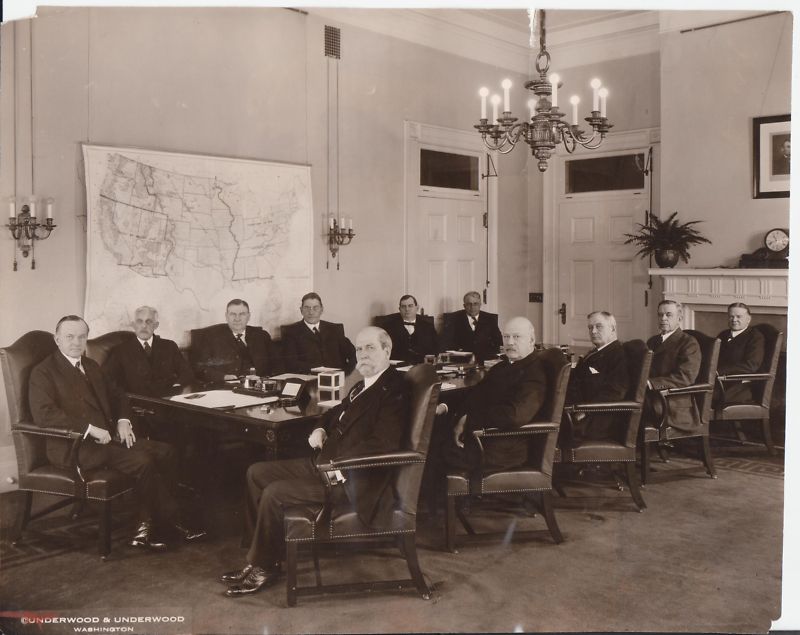
Harry S. New, chosen to be Postmaster General after Hubert Work was moved to head the Interior Department, served faithfully for the next six years during the final months of the Harding administration and all of the Coolidge era. He always appreciated the humorous anecdote, however, and peppered his Cabinet meeting notes with the witty exchanges of the President and his department heads. He writes, “On a certain occasion, Attorney General Stone and Secretary Hoover had slipped away to the Florida Keys for a week, at the end of which they came back wonderfully tanned but without having had very good luck.

     “When the President entered his first query on looking at the two sunburned members was, — ‘Fish bitin’?’

     “Hoover said, ‘No, Mr. President, not very well but we were out of touch with the world for a week and that was worth a good deal.’

     ‘To the world?’ queried Coolidge.”

All good humor contains an element of truth. While President Coolidge’s characteristically dry wit is on display here so is the reminder that Hoover diverged sharply from Coolidge’s worldview and executive approach.

Some “scholars,” having accepted without question the political rhetoric of the 1930s, omit this vast difference in philosophy and attitude. They have overlooked the incessant activity of Mr. Hoover and hold Coolidge responsible for his successor’s mistakes. Coolidge points us back to the virtue of political temperance. In the flurry to pass ever more expansive legislation, implement stricter regulations and, with good intentions in both parties, step in to save people with the premise that “bad legislation is better than no legislation at all,” Coolidge’s principled restraint could not be emulated soon enough.
                          Image

                          Image


  McMains, Howard F. “Retorts and Ripostes: President Coolidge’s Cabinet Room Humor,” Vermont History 54 (Fall 1986): 229-232.

“Silent Cal Speaks: Why Calvin Coolidge Is the Model for Conservative Leadership Today”

“Silent Cal Speaks: Why Calvin Coolidge Is the Model for Conservative Leadership Today”

In this superb piece by Cal Thomas, which could have easily been written yesterday (not in 1996, as is the case), it is remembered that Coolidge was not merely an advocate of classical economics but he was a witness to an entire worldview of God, man and government. Mr. Thomas argues that it is Coolidge who stands as the pivotal and symbolic contrast to Franklin D. Roosevelt’s vision for America. It is this latter vision that has none of the mechanisms for solving human problems that its competitor, the spiritual worldview of Coolidge and the Framers, came closer to addressing than any other system has discovered. Coolidge’s worldview did not presume to be the voice of God in all matters social or political. It simply appeals to objective standards of right and wrong, to constitutional checks upon the destructive impulses of human nature and endorses the necessary philosophical foundations on which to build the best attainable civilization. In light of experience, the abandonment of this worldview has proven to be regression not progress. Roosevelt’s America takes people back to the barbarous days of imperial control, not republican liberty. Experience indicts this reactionary approach for a return to the practical wisdom of Coolidge’s worldview.

“A Standard of Righteousness”: The Worldview of Calvin Coolidge

“A Standard of Righteousness”: The Worldview of Calvin Coolidge

Here is an excellent essay from David Pietrusza delivered three years ago that deserves renewed consideration. Few take the time it really deserves to discover, let alone test, the substance of a worldview. It is not staying abreast of the news. It is not picking a hodge-podge of “facts” and fitting them to one’s preferences. It is foremost an intellectual and moral exercise. Colleges used to teach it. The family used to instill it. It is understanding what are causes from effects, what are timeless truths from temporal specifics, and what makes sense of all the complex parts comprising the world. The denial of truth and being able to confidently know it prevents understanding the world with any consistency or coherence. Without this rational framework, it is no wonder that technology and culture have made people the servant rather than deferred to them as the master. Overwhelmed by the imbalance, people deny what was blatantly obvious to generations not that long ago.

The specialization of knowledge and the denial of absolutes have deprived millions from a real and internally consistent understanding of the world. It need not be this way. Each individual has the choice to accept the enforced confusion fed to him or her by modern education or to return to a “standard of righteousness” that brings sense, virtue and balance back to the world. God is the source of that balance. It is not man’s perfection on earth nor puritanical theocracy, it is restoring order around a personal God and His “law of service.” Man’s resort to force assumes control when there is no objective right and wrong honored by society. When this happens, self-government loses to tyranny. Coolidge’s worldview, no different from the views of the Founders, stands tall against the chaotic and empty vision America is now living. The choice, as it has always been, is between life and death, wholeness and sickness, liberty and slavery, hope and suicide.