The Coolidges in Brule, 1928

The Coolidges in Brule, 1928

Depicted here is the President and First Lady leaving the small country church services one of the Sundays during the summer of 1928.

Deliberately avoiding the elaborate churches and ordained preachers of Superior, the Coolidges went to hear “lay-preacher” Mr. John Taylor, a blind man of 70 years. His sermons, on what newspapers have summarized “plain living and high thinking,” were reminders that the truth is often found in the simplest, humblest of circumstances.

If too enamored by the elaborate and sophisticated, the individual often misses the obviousness of truth entirely just as the apostle asked in 1 Corinthians 1:20 and 1:18: “Where is the wise? Where is the scribe? Where is the disputer of this world? Hath not God made foolish the wisdom of this world?” “For the message of the cross is foolishness to those who are perishing, but to us who are being saved it is the power of God.”
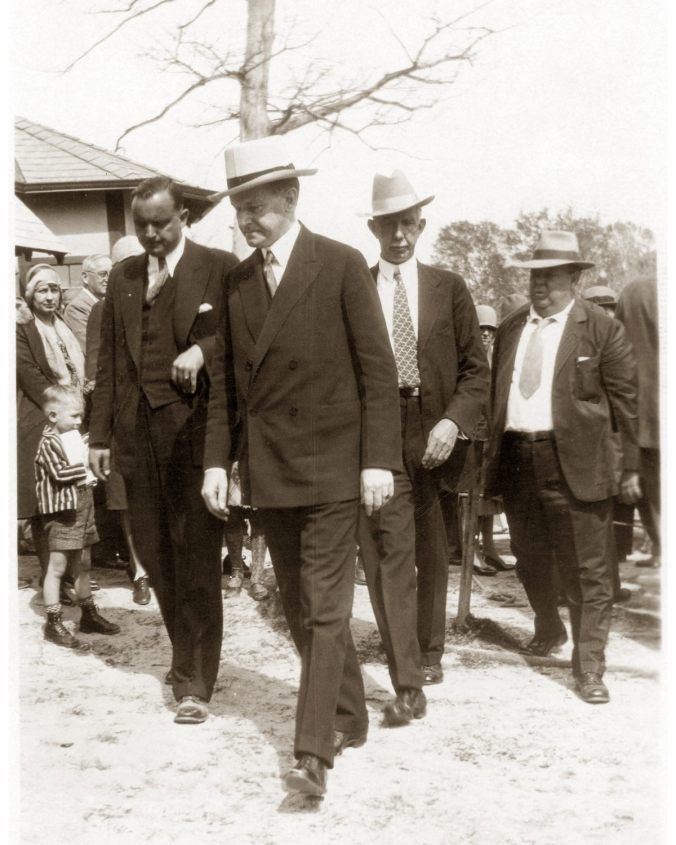
On the Move

On the Move

Here former President Coolidge, staying at the Lakeside Inn, Mount Dora, Florida, is walking along with Archie Hurlburt (behind Coolidge), Cal’s friend and also the manager of the Inn at that time, Carl Ray (to his right), and “Shorty” Davidson (behind Hurlburt).

Ray and Davidson, both Ocala-area entrepreneurs, teamed up in 1924 to revitalize Silver Springs into a successful attraction. They made it work and it drew folks for decades afterward as a result of their efforts.

On this Sunday afternoon, February 9, 1930, Coolidge accompanied them on the hour-long glass-bottom boat tour, seeing the various underwater springs including the area near the dock which, even then, was becoming a favorite for underwater filming.

The Coolidges stayed at Lakeside for a month on their way to California. Trying to travel as private citizens again, the Coolidges could not escape the crowds drawn to their every stop. Finally concluding unobtrusive travel was no longer possible, Coolidge never saw all he wanted to of the country. He sacrificed his curiosity to see and do to the solitude and separation from public life he wished still more after having walked away from the most powerful office in the world.

On Traveling Incognito

On Traveling Incognito

President Coolidge is pictured in Charlottesville, Virginia, in November 1928.

It was after the White House that he most acutely missed the privacy enjoyed before national notoriety. He did not relish the notion of being a celebrity in anyone’s eyes. Regretting the lack of anonymity during his recently completed trip to Florida and out West, he observed to Bruce Barton, “People seem to think the presidential machinery should keep running even after the power has been turned off” (Gloria M. Stoddard, “Grace & Cal: A Vermont Love Story,” p.137). He did not believe in idleness but he also refused any effort to insulate former Presidents with official duties, pension or security. He wanted to travel without the incessantly conspicuous ordeal of often well-meaning but burdensome crowds following his every move. He chuckled at the thought of wearing a disguise of whiskers and thick-rimmed glasses like this one, such as Harold Lloyd wore and reminiscent of the “Groucho glasses” of the 1940s and later.