On the Teamwork of Service

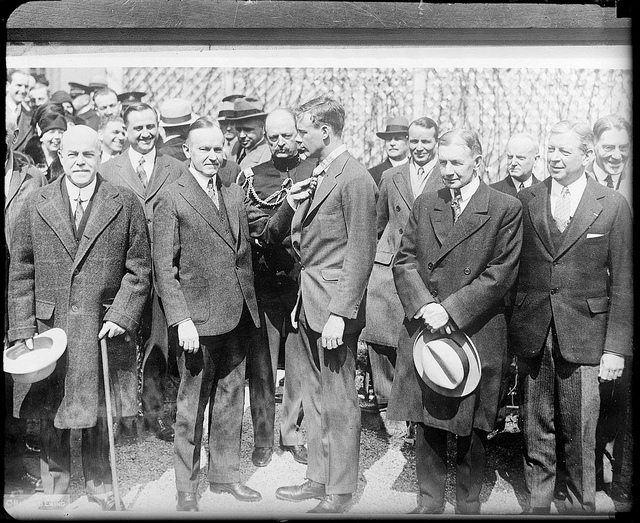
President Coolidge and his Secretary of War, Dwight Davis, were left in a difficult position in the fall of 1925. It been a difficult year for both men, from the retirement of Secretary Weeks, numerous battles with Congress and now the looming court-martial of Colonel William Mitchell. To say that the Army Air Corps officer was “outspoken” would be an understatement. In pointing out the lack of preparedness the country had for air defenses, he demonstrated a self-serving and theatrical manner that did not promote the good order and discipline most expected of commissioned officers in the military. Secretary Davis, having been a world-class tennis player (the namesake for the cup he had designed), appealed to those under his leadership on the basis of teamwork. The military, not unlike a team of athletes, has to collaborate in order to accomplish their goals. Selfish interests, however valid their grievances, must be governed with humility and self-control for the sake of others and the achievement of the mission. This fit perfectly well with President Coolidge’s ideal of service. The concepts were reflections of each other.

Yet Mitchell would continue to demand attention not for the substance of his observations but for the public to embarrass his superiors into action. Such was not in harmony with a humble attitude of teamwork and service of others. Colonel Mitchell would consequently face court-martial, five years suspension of service and loss of pay and other allowances. President Coolidge, not unsympathetic to the man’s case, would affirm Secretary Davis’ restoration of Mitchell’s allowances and half of his base pay, as Nancy Kriplen notes in her book on Mr. Davis. But this public reprimand of Mitchell would stand. The Colonel, Mitchell (as Davis had also risen to the rank of Colonel before his retirement), would turn in his resignation early the next year. Secretary Davis would accept it. Yet, neither the President nor his Secretary were averse to the preparedness of the country — such an accusation is hardly fair or accurate — nor were they stuck in old modes of thinking that refused to acknowledge air power. In fact, the spring of 1926 they would push forward the development of 52 tactical squadrons and the beginnings of an independent Air Corps signed into law by President Coolidge. The Distinguished Flying Cross would be awarded for the first time by Coolidge himself not only to the illustrious Lindbergh but also to the crew of the Pan American flight that tallied 22,000 miles in the air over a month before the better known “Spirit of St. Louis” crossing. Secretary Davis would award the Cross to Orville Wright and his brother, Wilbur (posthumously) in February 1929. It was the Coolidge administration that actively promoted the advancement of the country into modern aviation. Speaking years later of the transcontinental crossing of Costes and Bellonte from Paris to New York, the former President would reemphasize the familiar theme of service and collaboration, “Such flights are of great value in their effect on international comity. When Lindbergh made his historic voyage to Paris, the French people felt almost as much pride in his accomplishment as his own countrymen. It aroused and cemented a most wholesome sentiment of friendship…It hastens the day of good will and co-operation,” September 3, 1930.
            Image

On the Strength of “Weakness”

While there is much in Michael J. Gerhardt’s new book, “The Forgotten Presidents: Their Untold Constitutional Legacy,” with which this author disagrees, he ably shows that Coolidge was anything but a pushover or “weak” president. Devoting chapter twelve of his book to the thirtieth president, Gerhardt demonstrates that Coolidge had unique strength when it came to his constitutional role and the exercise of presidential powers. Coolidge, perhaps more than any of his immediate contemporaries in the office, understood both the limits and the authority vested in the Presidency. His display of leadership was unprecedented in a number of ways.

As the previous administration’s scandals went public, it was Coolidge who took the incredible step of ensuring honorable and qualified investigators (not party hacks) took the helm after which he never intervened in the process to determine the facts. The investigation was allowed to find the guilty and acquit suspicion of the innocent. As a result of both their thorough competence and Coolidge setting a tone of full cooperation from the beginning, public trust in the law was preserved.

In the use of the pardon and the veto, Coolidge distinguishes himself as anything but a timid President. Of his twenty-nine predecessors, and his immediate successor, he ranks second only to Wilson in the number of pardons granted during his time. Of his 1,545, his most noteworthy were made at the beginning of his administration, on behalf of several who had been imprisoned for their public criticism of Wilson’s involvement in the War. Even more extraordinary was the fact that he issued these pardons not only over his Attorney General’s opposition but also before request for release had been made. His fifty vetoes stand also set Coolidge apart from his contemporaries. Only Teddy Roosevelt would issue more of them in the first thirty years of the twentieth century. Not until Teddy’s cousin would the record be broken. Standing in the company of Roosevelts, Coolidge can hardly be classified a passive President. Like Grover Cleveland before him, Coolidge would use the “pocket veto” with great effect as well. By allowing a bill to die after ten days unsigned during Congressional recess, Coolidge would leave a lasting impact on the potency of the veto. His firm dissent from McNary-Haugen — twice — ensured that the President’s role in preventing bad legislation remains intact.

Coolidge’s political courage is even lesser known but just as dominant in his protection of the constitutional power to appoint officers of the Executive Branch. The earliest tussles with Congress demonstrated Coolidge could retain his nerves, remain unmoved by “mob” demands for this or that resignation and eventually prevail despite intense political heat. His resolve was not merely stubbornness but rather an abiding sense of duty and integrity. He would not join the crowd in a political lynching, however badly they wanted it. He was fair even to those who proved unfit for responsibility. He would not give in to appearances nor would he condone wrongdoing. As pointed out by others, it actually takes more strength to refrain from acting until the right moment — especially in the heat of the moment — than it is to be seen doing something now to appease onlookers with appearances. It was Coolidge who exemplified the strength of character required for decisive action only when the fullness of time warranted it. Not before. His strength, considered “weakness” by many even today, is a necessary component of wise leadership. To discount this quality is to misunderstand and fail to appreciate what makes good leaders.

On “The Limitations of the Law”

It was on the occasion of the 45th meeting of the American Bar Association, that the Vice President of the United States rose to speak on August 10, 1922. As he prepared to explain here what law cannot do, none could have foreseen that almost a year to the day later he would be President. Known for writing all his own speeches, this one was no less the product of years of careful thought affirmed by his own twenty-four continuous years in public service, up to that time. He saw that law had limitations. When the national government is expected to encompass all decision-making, it will prove itself incapable of the task, however well-intentioned, well-supplied or well-led. Such is the result of ignoring the limits of law. There is no “magic” road to perfection by “nationalizing” morals through legislation. Besides, people cannot defer powers to Washington that they themselves do not possess, Coolidge would observe. That is the safeguard of federalism. Federalism limits responsibilities to those best able to handle them: local affairs belong to local citizens, states making their own decisions in statewide matters, and national government, defined and limited, making decisions through representatives of the people, while each respects their proper sphere of authority.

On a more basic level, the limits of law reside not in a denial of society’s growth and advancement but acknowledges the universal truth that law cannot do everything. It certainly cannot do all we would like it to do. As Coolidge would observe, “Real reform does not begin with a law, it ends with a law.” For the received standards of society — the “laws” they embrace — come not by government deciding such and such is so, but originates from the people themselves. In this way, Coolidge foresees the failure of every measure to make people conform to “laws” handed down to them rather than as the acknowledgment in law of long-practiced and accepted norms of sovereign citizens. As Coolidge would remind his listeners, the limits of what law can properly do should not be a cause to despair for the future. On the contrary, Coolidge, full of optimism, pointed ahead to the inexhaustible resourcefulness of engaged citizens. “It is time to supplement the appeal to law, which is limited, with an appeal to the spirit of the people, which is unlimited.” Solutions lie not in the halls of government offices but in the ingenuity, character and competent hands of informed citizens.