On Bureaucracy and Functional Government

Image

When President Coolidge spoke to those gathered at the illustrious College of William and Mary in 1926, he reminded his listeners of what makes government function. For government to work, it must be local and accountable. Established by the earliest arrivals from the Old World, the experiences with bureaucratic authority taught the colonists that government centralized (and thereby removed from the problems it attempts to fix) never works. For this reason, as government advanced from colonial to state forms, bureaucracies had no part in the drafting, passage or implementation of state constitutions, laws and standards.

It was up to the towns, cities, counties and ultimately states to make government function. It is the cradle of true states’ rights and the basis for a genuine national unity. The one-size-fits-all approach always succumbs to its own inherent weaknesses. In the process of forming their own governments, Americans learned how liberty is only possible when the ability to make decisions is preserved at the local and personal level. Anything more and government, even in the name of compassion and efficiency, becomes inhuman, destructive and incompetent — the murderer of what Coolidge earlier called an individual’s “self-direction,” known also as freedom.

Experience has actually proven, so that Coolidge could truthfully say, “No method of procedure has ever been devised by which liberty could be divorced from local self-government. No plan of centralization has ever been adopted which did not result in bureaucracy, tyranny, inflexibility, reaction, and decline.” Liberty and local self-government cannot be separated as with a clinical incision to the body politic. This is why transforming government into the expansive, all-encompassing State it is today, whatever the intentions, always kills the liberty exercised by the individual.

The most adept planners fail not because someone disrupts the plan from its certain success nor because the plan can only work with the right kind of people in charge. The plan fails because it is inherently flawed. It attempts to liberate humanity by denying its humanness. Forced to conform to an unrealistic set of approved behaviors, government is stripped of any human quality, turning what is supposed to be the humane agency of free individuals, the “expression of the life” by a sovereign people, into “a cold, impersonal machine.” No longer the personal involvement of individuals deciding their own affairs, government perverts to infinite layers of “expert practitioners.” An unaccountable and reckless bureaucracy takes the place of local self-determination, giving and taking away freedom with the draft of every new form and the sweep of every expert’s pen.

We see states are no longer allowed to diverge from total conformity to Federal specifications, however mundane the state matter. This administration has made clear it will sue any state refusing to march in step with the arbitrary and selective enforcement of law it exemplifies. We watch as counties, boroughs and parishes are threatened to accept designated “Federal” money or else be cut off from future “favor.” We look while cities, towns, and villages are told to adopt a complete overhaul of zoning regulations by the Housing and Urban Development Department in Washington. We then stand aghast as Washington invades our most personal decisions of child-raising, employment, education, health care, retirement, and, through the institutionalization of political correctness, what we are allowed to say in political opposition and believe in religious conviction.

Coolidge, addressing the issues of housing, food, wages, hours, conditions, justice and opportunity, placed the power for addressing all these with the welfare of all the people in his state squarely where it belonged, where the laws properly placed them — with the people themselves. It is they who bear the burdens of government, who pay its costs and activate its provisions. It was for the people of Massachusetts to decide these details of their lives because they comprised its government from little Monroe to Beacon Hill. What Coolidge said of Massachusetts could be said of governments everywhere across this Union, “Our government belongs to the people. Our property belongs to the people. It is distributed. They own it. The taxes are paid by the people. They bear the burden. The benefits of government must accrue to the people. Not to one class, but to all classes, to all the people. The functions, the power, the sovereignty of the government, must be kept where they have been placed by the Constitution and laws of the people.”

The power of these truths, the “rules of action” originating from the people from whom governments are constituted, are what make bureaucracies such an affront to civilization everywhere. Lifting power out of the hands of the people directly concerned with a given issue, bureaucracies clog the proper function of government by setting up “the pretense of having authority over everybody and being responsible to nobody.” It is the assumption of control without an equal measure of responsibility that makes a bureaucracy so destructive of local self-government and, inseparably, individual freedom. Coolidge put it in even clearer terms, “Of all forms of government, those administered by bureaus are about the least satisfactory to an enlightened and progressive people. Being irresponsible they become autocratic, and being autocratic they resist all development. Unless bureaucracy is constantly resisted it breaks down representative government and overwhelms democracy.”

There are definite issues the Federal government is simply, even at its best, not equipped to handle, being “too far away to be informed of local needs, too inaccessible to be responsive to local conditions.” It has proven unworthy of few things, yet it is still given many more to manage. As Coolidge said, “It does not follow that because something ought to be done the National Government ought to do it.” Liberty diminishes in proportion to increasingly centralized control. Where freedom is concerned, it actually is a zero-sum game.

The solution, as Coolidge analyzed this problem, remains the same now. The states can help end or irreversibly enable the dysfunction of government by bureaucracy. The rights held by states are not given them to never use just as they are not given to abuse those to whom they are accountable, the people of each state. If they are unfaithful in the exercise of delegated powers, the Federal Government is thereby invited to step in and get involved. The willing weakness of local and state government only encourages the intrusion of Federal controls.

This danger provoked President Coolidge not to absorb power, but to restore the correct balance between the people, the states and national government. He did so consistently. By vetoing the double attempts to socialize American agriculture, chopping down the Federal outlay for flood aid, cutting and cutting again the size of the Federal budget, paying down the nation’s $20 billion debt, reducing tax rates across the board and fighting the Congressional urge to spend each year’s growing surplus, Coolidge left the recipe that works when Washington is governed responsibly. It remained for the states and local decision-makers to follow that constructive lead. Far too often they did not do so, working instead against Coolidge’s program.

Local self-government cannot afford, fiscally, politically, morally, to shirk its duty a moment longer. The states cannot emulate the direction they took in the 1920s and 30s. It must be the sovereign people, through their municipal, county and state governments, who stand when no one else seems willing to stand. The alternative will hasten only more of the same disastrous consequences ahead for us already.

The way lit by Coolidge forward, back toward progress and justice, requires courage but it is the only way. It means robustly asserting local and state authority, dragging Washington back to its limited and lawful sphere of responsibilities. “I want to see the policy adopted by the States of discharging their public functions so faithfully that instead of an extension on the part of the Federal Government there can be a contraction.” The march back toward a government of the people and away from central bureaucracy starts where all good governance begins — at the local level.
On Political Parties

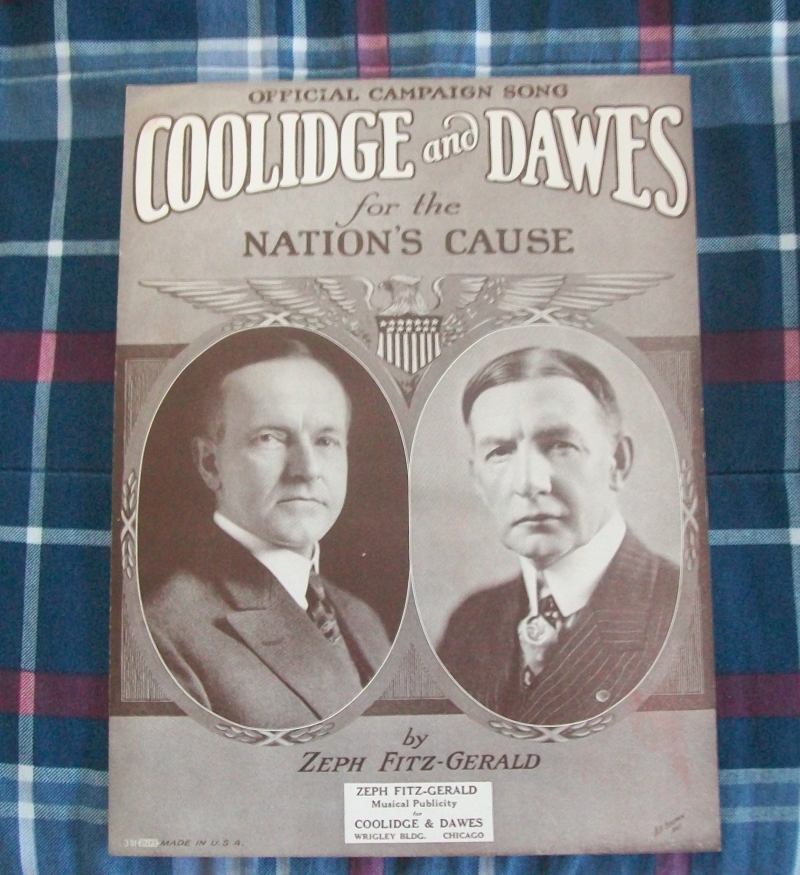
The campaign song, "Keep Cool with Coolidge" underscored the steady leadership and calm reliability of the 1924 Republican team and its Party platform.

The campaign song, “Keep Cool with Coolidge,” underscored the steady leadership and calm reliability of the 1924 Republican team and its Party platform.

As the train wrecks converge of “Obamacare” and the Federal Government’s refusal to account for its criminally reckless spending habits — except by the “band-aid” of Continuing Resolutions and debt limit increases, Americans are more and more proving to be the last constituency with any political representation in Washington. This is a grave disservice, especially to those who backed the party platforms for “tough budgetary decisions across the board” (for Democrats) and passing a Balanced Budget Amendment to the Constitution that would make it so “future Congresses cannot balance the budget by raising taxes” (for Republicans).

Realizing, as the Supreme Court confirmed last summer, “Obamacare” is an overt tax, at least for everyone who does not reside in the District of Columbia. The costs about to fall upon everyone across the Country, especially the poorest among us, are still multiplying as the contents of its regulations begin implementation in less than two weeks.

This is why political parties, as expressions of the sovereign people’s will, serve an imperative purpose in our Republic. Ours is not a mere democracy of simple majorities deciding every political question for us. Ours is a representative Republic, setting two fundamentally opposing agendas before the people who express their support or disapproval through the ballot box. These agendas are implemented by political parties and outlined in platform promises every four years.

Calvin Coolidge recognized the obligation of that party system to carry out the pledges and policies for which each Party stands, declaring, “…[I]t is necessary under our form of government to have political parties. Unless some one is a partisan, no one can be an independent. The Congress is organized entirely in accordance with party policy. The parties appeal to the voters in behalf of their platforms. The people make their choice on those issues. Unless those who are elected on the same party platform associate themselves together to carry out its provisions, the election becomes a mockery. The independent voter who has joined with others in placing a party nominee in office finds his efforts were all in vain, if the person he helps elect refuses or neglects to keep the platform pledges of his party…”

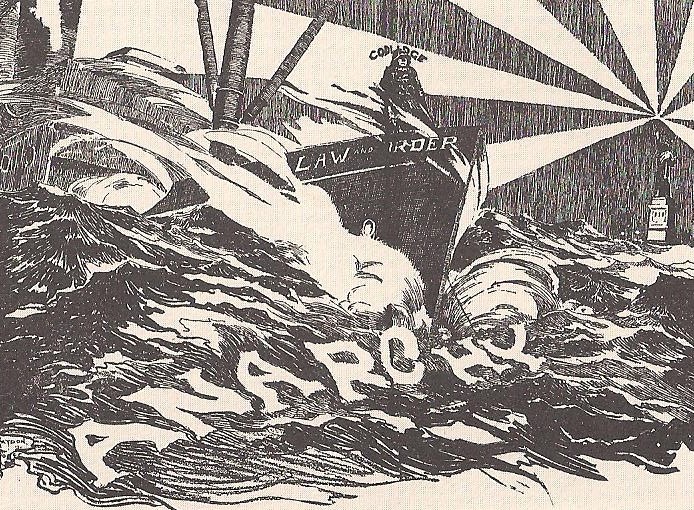
It is the reason why he did not immediately overturn the Cabinet or alter the policy direction started under Harding until the people voted again in 1924. Even then, he conscientiously upheld the Party platform, despite some in his own Party abandoning him for political convenience. For Coolidge, Party platforms were serious contracts between the voter and the candidate. The candidate is not empowered to break his promises when he gets to Washington. Facing unforeseen circumstances, the principles of the Party define the fixed channels and hazardous shoals wise leaders must navigate to accomplish the goals of one’s Party. The principles are not to be jettisoned when storms hit, they are the compass to reach harbor.

Image

The House vote to defund “Obamacare” and the efforts by Senator Cruz in the Senate are simply attempts to keep the Republican Party honest about its own platform, carrying out the political promises made to those who supported the issues of repeal and balanced budgets last year. Republicans who want to help implement the Democrat Party’s platform are in the wrong business. It is no different in any other area of life: If everyone agrees, something is seriously missing. Ours is not a one-party system for that reason.

Real legislators, contrary to the wishes of David Brooks, are those who furnish principled opposition to the other Party’s agenda in order that the expressed will of the other side has a voice in the direction the Country is to take. Our system is not a pure democracy of mere majorities settling every political question, be it Democrat or Republican.

Senators like Cruz are doing what much of the GOP is too timid to do — uphold Party principles.  Republicans were not supported last year to rubber stamp the other Party’s agenda, they were sent to be Republicans, a Party in opposition to the agenda of Obama and his small majority in the Senate. Republicans, like Cruz, are expected to represent those who chose them to obstruct and defeat the Democrat Party’s persistent commitment to spending, avoid actual budgeting and expedite the outright conquest of one-sixth of America’s economy by government control of our health care.

This means Republicans are obligated and expected to act in unison, especially on so fundamental an issue as now stands before the Senate — the defunding of “Obamacare” linked with the long overdue halt on government spending. Coolidge affirmed this as a principle for any party which intends to remain effective for long,

[i]f there is to be responsible party government, the party label must be something more than a mere device for securing office. Unless those who are elected under the same party designation are willing to assume sufficient responsibility and exhibit sufficient loyalty and coherence, so that they can cooperate with each other in the support of the broad general principles of the party platform, the election is merely a mockery, no decision is made at the polls, and there is no representation of the popular will. Common honesty and good faith with the people who support a party at the polls require that party, when it enters office, to assume the control of that portion of the Government to which it has been elected. Any other course is bad faith and a violation of the party pledges. 

By "Ding" Darling November 14, 1924

By “Ding” Darling November 14, 1924

The Democrat Party, conveniently ignoring the “tough budget decisions” it promised last year are not winning issues, they are silencing any effective opposition through fear and intimidation, counting on our ignorance to blame Republicans for others’ actions. Instead of joining Democrats in this evasion of who they are and what they really believe, Republicans need to be boldly and unashamedly Republican. Instead, the “experts” are urging Republicans to just stop being Republicans and conform to a one-party system so that the White House can achieve Utopia for us all.

Coolidge knew better. He knew that, “[s]ince its very outset, it has been found necessary to conduct our Government by means of political parties. That system would not have survived from generation to generation if it had not been fundamentally sound and provided the best instrumentalities for the most complete expression of the popular will.” Neither party perfectly represents, nor can it, the popular will in everything. Opposing parties serve as an indispensable check upon political power (whichever Party is in office), continually reminding both sides that principles (not holding government powers) matter most and no majority however strong can defy the people’s will indefinitely.

It serves a continual reminder that parties are not empty vessels to be shattered and remade on the whim of politicians for the expediency of the moment but rather they are the instruments through which the people speak, enacting the principles we expect of our government. They are to stand for very specific and irreconcilable directions. To silence, deny and dispense with that difference is a betrayal of every last one of us, every time we vote and every choice we make, Republican, Democrat, or otherwise.

On Lafayette and Foreign Affairs

Image

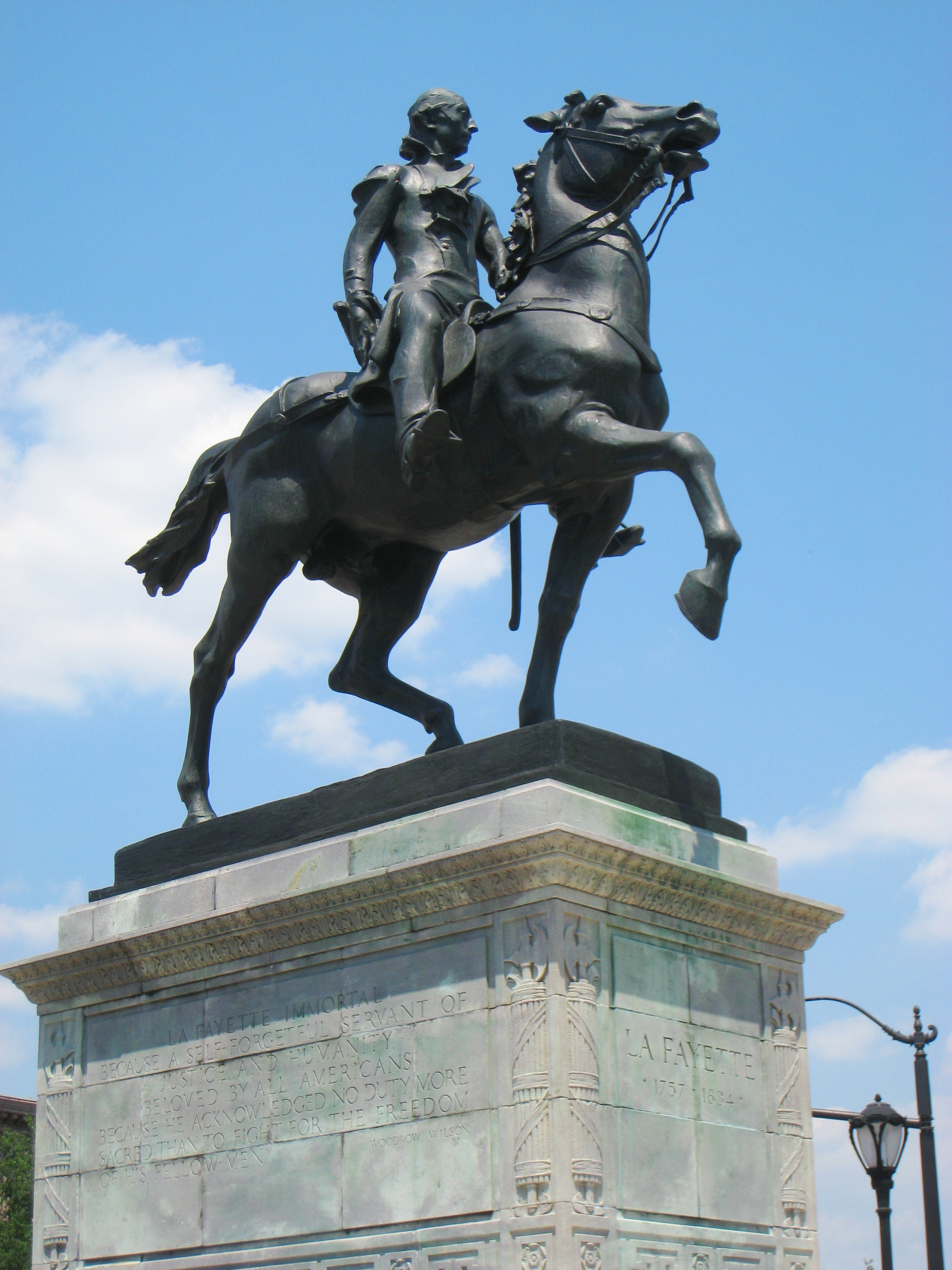
Tomorrow, September 6, marks two important occasions: the birthday of and official farewell to Lafayette by President John Quincy Adams during the French patriot’s last visit to America in 1825. President Coolidge, a century later, upon dedicating the monument to Lafayette placed in Baltimore, Maryland, observed that “[h]is picture to me seems always to have the enthusiasm and freshness of youth, moved with the high-minded and patriotic purpose of maturity. He displayed the same ambition for faithful service, whether he was leading his soldiers in the last charge for American liberty at Yorktown or rebuking the mob at Paris for its proposal to make him king. His part in the French Revolution is well known. He served the cause of ordered liberty in America; he was unwilling to serve any other cause in France…He represents a noble and courageous dedication to the service of freedom. He never sought for personal aggrandizement, but under heavy temptation remained loyal to the great Cause. He possessed a character that will abide with us through the generations. He loved his fellowmen, and believed in the ultimate triumph of self-government.”

As Coolidge continued to reflect upon the freedoms Lafayette fought to preserve in a constitutional republic, he surveys the substance of liberties protected by that document. Coolidge recognized also the deliberate limits placed on the government so that the rights of even the smallest minority — the individual — cannot be deprived of those protections by an ambitious, irresponsible majority.

Coolidge then turns to foreign affairs, hitting upon the true basis for sound foreign policy: guarding independence in our decisions and our interests. Respect, Coolidge shows, comes as a result of that tenaciously guarded independence; not as a product of surrendering it. Being afraid to lead, refusing to use America’s moral power for good, is not the route to successful foreign policy, in other words.

President Coolidge, decried as too provincial for the global burdens of the office, understood the situation far better than the “smartest of the smart” think they do now, as he declared what American foreign policy had been for its first one hundred and fifty years, “We have always guarded it [i.e., independence] with the utmost jealousy. We have sought to strengthen it with the Monroe Doctrine. We have refrained from treaties of offensive and defensive alliance. We have kept clear from political entanglements with other countries. Under this wise and sound policy America has been a country on the whole dedicated to peace, through honorable and disinterested relations with the other peoples of the earth. We have always been desirous not to participate in controversies, but to compose them,” that is, to bring calm back to each situation.

The result? “What a success this has brought to us at home, and what a place of respect and moral power it has gained for us abroad…” No wonder serious statesmen and genuine patriots are astonished at the pathetic equivocations and reckless display of weakness from our current leadership regarding Syria and everywhere else in the world.

Coolidge points to solid ground for future American foreign policy, “To continue to be independent we must continue to be whole-hearted American. We must direct our policies and lay our course with the sole consideration of serving our own people. We cannot become the partisans of one nation, or the opponents of another. Our domestic affairs should be entirely free from foreign interference, whether such attempt be made by those who are without or within our own territory. America is a large country…It has room within its borders for many races and many creeds. But it has no room for those who would place the interests of some other nation above the interests of our own nation.”

“I want to see America set the example to the world both in our domestic and foreign relations of magnanimity. We cannot make over…people…We must help them as they are, if we are to help them at all, I believe that we should help, not at the sacrifice of our independence, not for the support of imperialism, but to restore…a peaceful civilization. In that course lies the best guarantee of freedom. In that course lies the greatest honor which we can bestow upon the memory of Lafayette.”

Image