
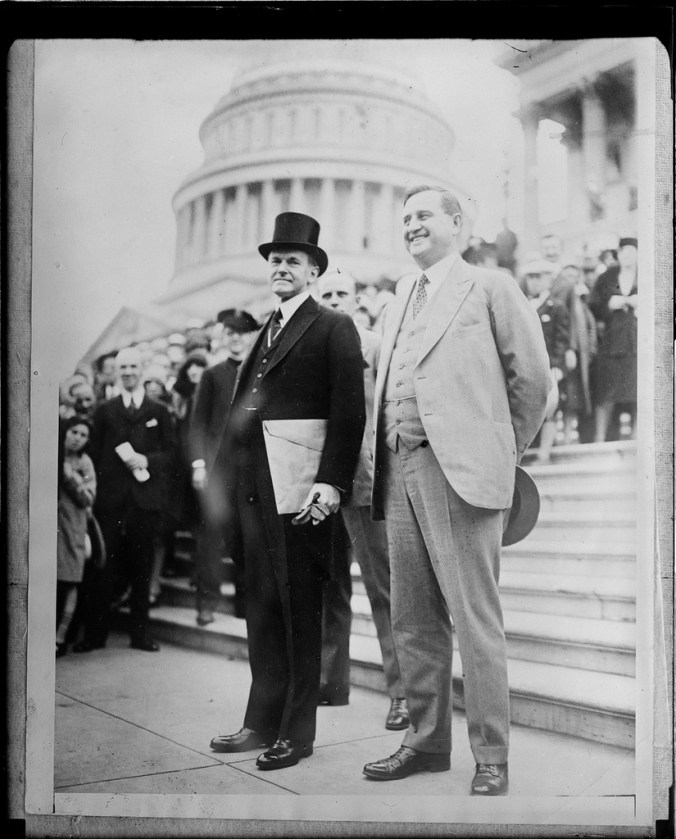
“There is yet another manifest disposition which has preyed on the weakness of the race from its infancy, denounced alike by the letter and the spirit of the Constitution, and repugnant to all that is American, the attempt to create class distinctions. In its full development this means the caste system, wherein such civilization as exists is rigidly set, and that elasticity so necessary for progress, and that recognition of equality which has been the aim and glory of our institutions, are destroyed and denied. Society to advance must be not a dead form but a living organism, plastic, inviting progress. There are no classes here. There are different occupations and different stations, certainly there can be no class of employer and employed. All true Americans are working for each other, exchanging the results of the efforts of hand and brain wrought through the unconsumed efforts of yesterday, which we call capital, all paying and being paid by each other, serving and being served. To do otherwise is to stand disgraced and alien to our institutions. This means that government must look at the part in light of the whole, that legislation must be directed not for private interest but for public welfare, and that thereby alone will each of our citizens find their greatest accomplishment and success” — Governor Calvin Coolidge, formally accepting Republican nomination as Vice-President, July 27, 1920.
More than ten years later, in the midst of economic downturn, Garet Garrett would echo the same point through his column in the Saturday Evening Post. In articles like, “There Goes Mine,” written in 1932, Garrett attacks the fallacy that economic classes are both fixed and permanent. He refers to the resentment during depressions of car ownership and how confidence in one’s ability to move upward from poverty to prosperity remains entirely within each person’s reach. Coolidge and Garrett both understood that liberty means opportunity, an opportunity that is not coincidental but directly due to our unique political and economic system as founded. Margaret Thatcher, the late British prime minister, grasped the significance of this truth better than have many Americans. She observed that when opportunity is maximized, class distinctions diminish and the disparity between “rich” and “poor” decreases, contrary to every economic “expert.”
As all three realized, however, the opposite holds true every time socialism is allowed to set policy, be it locally or nationally. For the Left, as Thatcher noted, it is better for the poor to stay poor “provided the rich were less rich.” Such a view summarizes modern liberalism. It is the Left’s animus against success and its vested interest in perpetual victim-hood which drive its agenda. It is never about rising to higher aspirations or striving for greater ideals. It is about exchanging our independence for the security they provide, a security of marginal existence.
Coolidge, Garett and Thatcher all knew what the Left denies to this day: policies that maximize individual opportunity remove class distinctions automatically and enable equality on the basis of each person’s determination and potential. Modern liberals would have us all equally poor, feeling guilty of ever rising above the marginal, dependent and miserable and call that “progress.” Incapable of fixing the problems Coolidge’s policies addressed, all that is left for modern liberalism is to keep the class warfare going, to provoke violence, and to project its failures onto those striving to heal and reunite us with the freedom of a truly classless society envisioned by our Framers.


 The Importance of the Obvious