Colonel John Coolidge remained a widower until right before the beginning of Amherst College classes for Calvin in 1891. It was then that the Colonel married what his son considered “one of the finest women of our neighborhood,” Miss Carrie A. Brown, whom he had known all of his life growing up in Plymouth. Thinking of her many years later, he wrote, “After being without a mother nearly seven years I was greatly pleased to find in her all the motherly devotion that she could have given me if I had been her own son. She was graduate of Kimball Union Academy and had taught school for some years. Loving books and music she was not only a mother to me but a teacher. For thirty years she watched over me and loved me, welcoming me when I went home, writing me often when I was away, and encouraging me in all my efforts. When at last she sank to rest she had seen me made Governor of Massachusetts and knew I was being considered for the Presidency.” It was principally to both his mother and loving stepmother that Coolidge credits these measures of his success. The next morning after taking the Presidential oath by parlor lamp light, Calvin (having first knelt and prayed) went downstairs and paused at the grave of his mother, Victoria, before hastening to board the train and take up responsibilities in Washington for the next six years. A locket with his mother’s picture remained with him always and it was found next to his heart when death came on the crisp day of January 5, 1933. It was clear that Coolidge, blessed with good mothers, cherished their love and constant care, was inspired to greater heights by them and returned from a life of public service with an abiding gratitude no child can ever repay.
religion
On the Death of American Exceptionalism
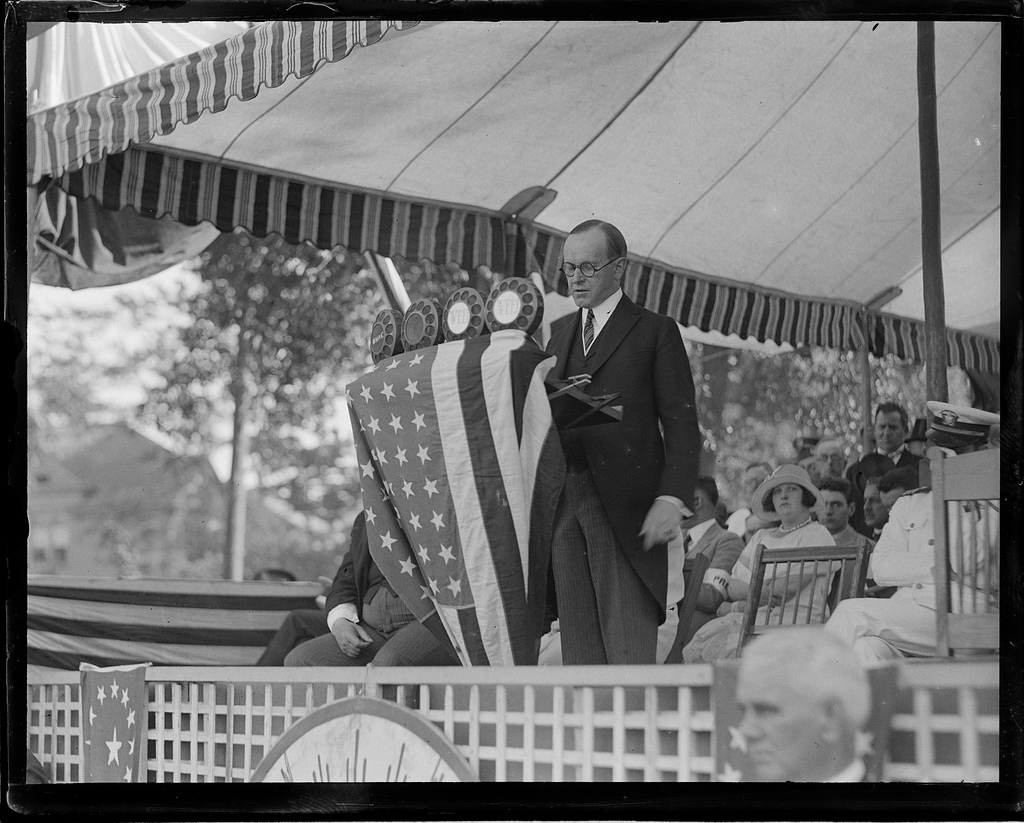
The assertion that America has unfairly led the rest of the world is not a new claim. For decades the argument has been pushed forth that it is incumbent on the United States to lower its standards around the globe, share its power, scale back its presence and a fairer, more equitable world would rise. We are led to believe that for civilization to advance it must all be in the direction of less individual freedom and more bureaucratic control. It is unjust, they insist, for America to realize such unprecedented prosperity, success and progress while the rest of the nations live in poverty, decay and oppression. Meanwhile, the denial of individual liberty and government by men instead of laws — notions irreconcilable with America’s ideals — are never recognized as central causes to all the suffering. It is as if the subordination of America’s ideals is something over which to rejoice and hasten. Such attitudes are like condemning the victim for the crime rate.
Why America is different is only impugned and criticized, never understood. After all, they assume, Americans took all this wealth, opportunity and its historic living standards from everyone else. Containing far more envy of America’s power than reality warrants, it is conveniently omitted that America is the exception to the rule because of a voluntarily agreed upon set of principles. These ideas, including government by consent, freedom of conscience, the sanctity of individual life, liberty and one’s pursuit of happiness, do not originate from the tyranny and injustice that have defined normal human existence since the beginning.
The rule of a few on the backs of the many has been tried, weighed and found wanting. It makes no difference whether it be called absolute monarchy, democracy, socialism or liberalism, it is the same prevalent, recurring weed that releases the same toxins upon society every time. America, founded as a refuge from suppression of conscience, denial of political choice and refusal of economic opportunity, applied the years of practical experience gleaned since ancient time to forge a government that served a sovereign people, not the people enslaved to government. Authority would reside not in personalities and social classes but in duly enacted laws through representatives delegated with specific responsibilities from the sovereign people. Endowed with the infusion of freedom, restrained by virtue and directed by sound education, America worked beyond the highest expectations of our visionary and audacious founding men and women. Preserved by the duty and service of each generation to those proven ideals, America demonstrated the exception not only succeeds, it perpetuates a very real good at home and for the rest of the world.
Simply because America is no more perfect than any other nation does not disprove that goodness and righteousness are either unattainable in her future or altogether absent from her past. In less than two and a half centuries, America has empowered millions with unprecedented upward mobility, withstood dictators, toppled regimes wedded to personal power rather than the might of its ideals, ventured into every corner of the globe not to dominate and conquer but to defend the weak, build trade and goodwill with all, share with those in distress and serve those in need. Where there has been need for improvement, our constitutional system affords remedy through amendment and circumspect legislation insofar as it follows reform in the people themselves. America has soberly embraced what Coolidge understood so well: With great blessings come greater responsibilities.
America has done all these things because at one time or another, no one else in the “room” stood up when the occasion demanded. The world has been and will continue to be far better off as long as moral power triumphs over material power. While the few redistribute wealth and call it “fairness,” the only commodity being equalized is misery and its attendant restriction of opportunity for everyone. The only ones who gain from this denial of eternal truths are those who already hold political power, and seek to extort more from the rest of us.
America’s ideals, as the exception to the ancient “might makes right” governance of world affairs, will prevail only if the original sovereigns — we, the people — reclaim our governance. The world will not rise simply by our descent. The vacuum will not be filled by some other equally legitimate set of lofty standards. We will do nothing for the world by relinquishing moral leadership now, expecting that fairness comes by descending to the lowest common denominator. The world will simply be less equal, less just, less free and less morally coherent.
As Calvin Coolidge said, “Some say we cannot go on maintaining a higher standard of living for our people than that enjoyed in other nations. We have done so for generations. That is the fact. The theory that it cannot continue may be no better than the theory that it will last indefinitely. Some nation always has taken the lead. But supposing we shall finally reach the same position as others that is no reason why we should now relinquish our supremacy and descend to their level. It is our business to make our conditions the best as long as we can. We would not be justified in tamely surrendering our treasure now because at some time it may be exhausted. To become equal to others we must go down or they must go up. For us to go down would not in itself raise others. Our example of a free and prosperous people has been the sovereign remedy for world oppression. The truth is our trade regulations are more fair to others than theirs are to us. And what is of chief importance is the great service we render by giving credits and furnishing markets. The higher our standards, the greater our progress, the more we do for the world.”
Coolidge once put it even more concisely, “Do not expect to build up the weak by tearing down the strong.” Those who advocate ultimate liberation on the wings of America’s departure from exceptionalism expect more than reality can give. As with so many observations on government and human nature, however, Coolidge could not be more correct. It is a wisdom that can never be escaped, however much nations or individuals wish to jettison the obligations of righteousness or the constraints of moral standards.

Coolidge dedicating the Jewish Community Center, Washington, D. C., May 3, 1925

“The Jewish faith is predominantly the faith of liberty. From the beginnings of the conflict between the colonies and the mother country, they were overwhelmingly on the side of the rising revolution. You will recognize them when I read the names of some among the merchants who unhesitatingly signed the non-importation resolution of 1765: Isaac Moses, Benjamin Levy, Samson Levy, David Franks, Joseph Jacobs, Hayman Levy, Jr., Matthias Bush, Michael Gratz, Bernard Gratz, Isaac Franks, Moses Mordecai, Benjamin Jacobs, Samuel Lyon and Manuel Mordecai Noah.
“Not only did the colonial Jews join early and enthusiastically in the non-intercourse program, but when the time came for raising and sustaining an army, they were ready to serve wherever they could be most useful. There is a romance in the story of Haym Solomon, Polish Jew financier of the Revolution…Major Benjamin Nones has been referred to as the Jewish Lafayette…Captain De La Motta, and Captain Jacob De Leon…It is interesting to know that at the time of the Revolution there was a larger Jewish element in the southern colonies than would have been found there at much later periods; and these Jews of the Carolinas and Georgia were ardent supporters of the Revolution. One corps of infantry raised in Charleston, South Carolina, was composed preponderantly of Jews, and they gave a splendid account of themselves in the fighting of that section.
“It is easy to understand why a people with the historic background of the Jews should thus overwhelmingly and unhesitatingly have allied themselves with the cause of freedom. From earliest colonial times, America has been a new land of promise to this long-persecuted race…
“Our country has done much for the Jews who have come here to accept its citizenship and assume their share of its responsibilities in the world. But I think the greatest thing it has done for them has been to receive them and treat them precisely as it has received and treated all others who have come to it. If our experiment in free institutions has proved anything, it is that the greatest privilege that can be conferred upon people in the mass is to free them from the demoralizing influence of privilege enjoyed by the few. This is proved by the experience here, not alone of the Jews, but of all the other racial and national elements that have entered into the making of this Nation. We have found that when men and women are left free to find the places for which they are best fitted, some few of them will indeed attain less exalted stations than under a regime of privilege; but the vast multitude will rise to a higher level, to wider horizons, to worthier attainments.”
 The Importance of the Obvious