On the Danger of Cynicism

It has always been easier to criticize and find fault than to contribute toward and respect the constructive ideal. Optimists, always the creators, have to work not only to realize what previously seemed impossible but they also have to overcome the destructive habits of the pessimists. Those pessimists are the first to surrender in the face of difficulty while they trumpet the message of hopelessness. “Nor is it worth trying,” these closet nihilists aver. Failure to measure up to certain expectations is enough for some to give up entirely on a project and declare defeat for the cause. America is no different. It has always had a healthy share of pessimists and other weak-willed “experts” who knew it would fail in this or that endeavor. The purpose of America, as Coolidge would reiterate, remains valid. It has raised for all the world to see a set of truths that preserve liberty with duty in a way that no set of principles has before, or can surpass. The failure to eradicate all the failings and frailties inherent in human nature is no more proof of failure than evidence of any grander success by empowering government now to accomplish it for us. For these “armchair” critics, it discredits the entire foundation and persuades them that progress means abandoning moral clarity, surrendering confidence in self-government entirely and trusting in our modernity to move past the “old” and “inadequate” concepts of an “ignorant” and “limited” eighteenth century existence. It would be one thing to adopt so foolhardy and naively defeatist outlook for oneself. These self-proclaimed skeptics are imparting this to the next generation, however, through “modern education.” To this issue of education, Coolidge turned in June of 1922, when he said,

“This is the civilization which intelligence has created and which sacrificed has redeemed. We did not make it. It is our duty to serve it. Education ought to assess it at its true worth. It ought not to despise it but reverence it. If there be in education a better estimation of true values, it must be on the side of a great optimism. Under its examination human relationship stands forth as justified and sanctified. There is no place for the cynic or the pessimist. Who is he that can take no part in business because he believes it is selfish? Who is he that can take no part in religion because he believes it is imperfect? These institutions are the instruments by which an eternal purpose is working out the salvation of the world. It is not for us to regard them with disdain; it is for us to work with them, to dedicate ourselves to them, to justify our faith in them…The great service which education must perform is to confirm our faith in the world, establish our settled convictions, and maintain an open mind.”

The annual American Educational Research Association meeting in April made evident that improved testing and eradicating poverty are but symptoms of an education missing its core. As schools all across the country let out for the summer, now is an ideal time to consider the service education is actually rendering for us and our children. Is it consigning our proven ideals to failure, proclaiming a gospel of hopelessness and permanent moral uncertainty? Is it rejecting the worth of Christian standards of behavior because America is forever trapped, they claim, in racism, hypocrisy, chauvinism, bigotry and oppression? Is it championing the control of a few who can finally achieve the perfection which is our right, if only we abandon this failed framework of eighteenth century slaveholders? Such goes the cynic’s mantra. What is not so readily apparent are the rocks waiting on the other side of those words. It has wrecked and will continue to wreck the lives of those who are taught to embrace pessimism, to rely on the force of government to compensate for all of America’s shortcomings. The cynic, ultimately, doubts liberty. America has never worked, he assumes, so why work at it as responsible and informed citizens? Just as Coolidge remarked, though, an open mind can co-exist with settled convictions. Forever holding out undecided on everything is the perfect soil for cynicism. Moral relativity, taught by too many schools in this country, is actually moral surrender in a more subtle form. On the contrary, knowing certain things are right and true broadens the mind to keep learning. It is the pessimist whose mind is closed, failing to accept that the people can be trusted with their liberty far more than government has or ever will. Education serves its purpose when it keeps that flame of optimism in our ideals alive. It is the more difficult task than the ease of cynicism but faith is vindicated in the end.
Image

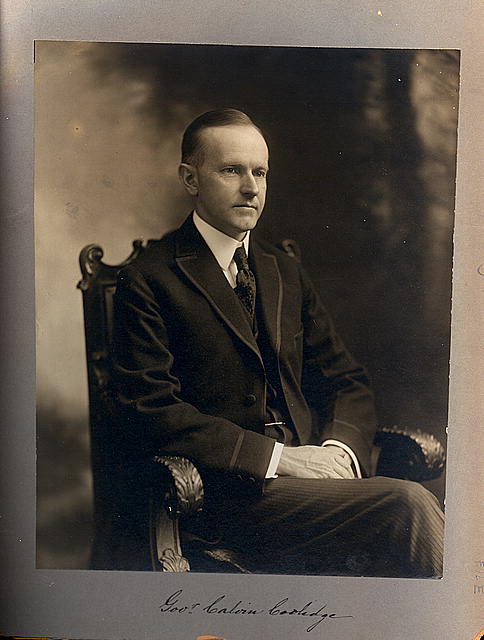
Governor Calvin Coolidge

Governor Calvin Coolidge

John Derbyshire, speaking as the character Chai, writes of Coolidge, “Closer study revealed some harmonics. Humor, certainly. Something in the turn of the mouth…something impish, irreverent, boyish. Yet a steadiness in the eyes–a certitude weightier than mere smugness. Beneath the clerkishness, great strength and wisdom. I trusted this man at once, and wanted to know him better” (‘Seeing Calvin Coolidge in a Dream,’ p.23).

The trust he earned went deeper than his office, it went to the soundness of his character, the power of his philosophy, the confidence without arrogance that he conveyed and the consistency of his actions.

This is what makes him so threatening to those who reject the finality of what the Founders discovered regarding human nature and society. In place of truths like equality before God and a government of limited power, there has come an institutionalized inequality maintained through a virtually unlimited control by a few. America’s experiment of self-government, with its moral nature cut away, is fast becoming the playground of despots and libertines.

It is up to us, serious-minded and mature citizens, to summon the courage and responsibility necessary to be worthy of freedom.

On Great Examples

     “This Governor of Massachusetts, deep in public service, was by temperament a private man. In public reticent and unwilling to speak, he conversed constantly in closed meetings, in quiet conferences, and on the telephone….he never said more than he had to, and he said it once…His program was not one of sweeping changes, but one of small steps toward his goals: curtailed expenditures, reduced indebtedness, and increased legislative self-discipline…His administration was unspectacular and widely praised; he had not been expected, or elected to introduce grand reforms…He was the classic man-behind-the-scenes. Avoiding limelight and applause, he was a man who ‘knew,’ a collector of information, an acute observer who had many sources…With an easy private approach to individuals, he won their confidence; with sound perceptions, he gained their respect. His colleagues knew that he could keep a secret. He was honest, not extravagantly frank, and eminently sensible, with a deep knowledge of men and a wide grasp of affairs” (Carolyn W. Johnson’s book, pp.24, 29, 39).

One could read these descriptions and easily mistake them as a characterization of Calvin Coolidge. They were, instead, all about the man who had served as Governor while Coolidge rose in county politics, married Grace and found a living demonstration of the principled public service he would come to exemplify. The man was Winthrop Murray Crane. Nineteen years Coolidge’s senior, Crane had begun in business, working up through his family mills to secure the contract for printing paper currency for the nation.

He would establish a solid record as Governor, earn appointment to the Senate to complete the term of the late incumbent and serve eight years in Washington, returning again to a quiet service in his home state in 1913. It would conveniently coincide with Coolidge’s election as President of the State Senate, giving the younger Coolidge the benefit of Crane’s political wisdom and approach to leadership.

When older men fail to exert the influence for good and young men take the advantage of experience for granted, society suffers for it. When young men instead seek out their peers or surround themselves with equally short-sighted “mentors,” devoid of character, rights and responsibilities are both at risk. Like the naive young Rehoboam in 1 Kings 12, who divided the kingdom because of his pride, we are living in times that need wise men and women.

In offering his thoughts on so valuable a friend, worthy example and faithful public servant, President Coolidge, writing five years after the great man’s passing, introduced a biography of him entitled, “W. Murray Crane: A Man and Brother,” with these words: “More people trusted him than any one else of who I can think, because of his broad human sympathy. He seemed to have a fellow feeling for every one to such an extent that he could make their wants and desires his own. He had a broader comprehension of American life, reaching from the humblest fireside through all the various activities of the business and political world, than any other man of his time. Of course many others excelled him in special directions and in details, but in the broad grasp of the whole he had no superior. He was a product of that intensive effort that has long characterized the men of prominence in his region, one of the best examples of American life on both its material and spiritual sides. The world is distinctly better because he lived in it.”

Though rising to the Presidency some day may not be in our future, we can resolve to exercise  integrity and genuinely demonstrate for the young what trustworthy service and sound judgment are supposed to be. Who knows what powerful examples for good we can leave? It may be that we are the next Mr. Crane to a future Calvin Coolidge.

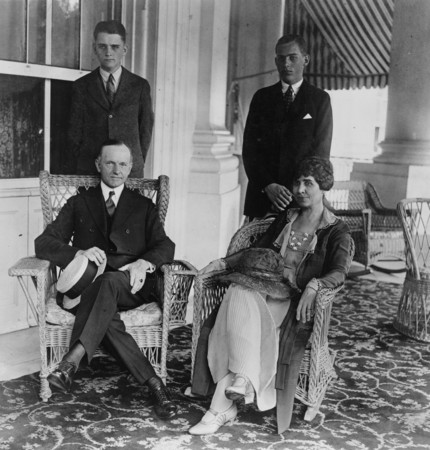
                                                           Image

                         Image

                    Included in “Calvin Coolidge: The Man From Vermont” by Claude M. Fuess