On Columbus Day

Image

Few individuals in Western civilization have undergone as pervasive a demonization as Christopher Columbus. He has been designated the “poster boy” of all that is wrong with the West, in general, and America, in particular. He is blamed for Western racism and slavery (as if those policies are unique to dead white Europeans) because of his enslavement of the indigenous population, despite discovering a New World that would establish freedom as the governing ideal of human existence. He is blamed for Western Christendom because of his conversion of the natives, despite taking the first step toward what would become a haven of religious liberty and freedom of conscience in America. He is blamed for Western imperialism because of his accidental destruction (by an uncontrollable lack of immunity) of the various cultures with which he came in contact, despite introducing a New World that would form the greatest melting pot of diversity ever accomplished. It was nothing less than American opportunity and freedom, at the basis of our institutions, that made this possible. None of the good America has meant to human history and its unprecedented advancement would have happened without that first step into the dark unknown.

The same folks who discredit and ridicule men like Columbus for his failures not only defend the most violent thugs and genocidal regimes of this and the twentieth century — one need only recall the Western media’s adulation for Mao, Castro, Qaddafi and “Uncle Joe” Stalin — to recognize the double standard. The “blame America first” mentality illustrates the failure, not of America, but of human nature itself. The principles that formed America as the exception to the rule of human affairs is not at fault here. We honor our heroes not because they lack imperfections or never committed any wrongs. We honor men like Columbus because we revere and love what good they did accomplish. It is a respect for good above evil that merits our praise and admiration. Meanwhile, as Coolidge would say,

[I]t is a very hasty and ill-considered judgment to conclude that there is more bad than good in any one. We are all a combination of both elements. While we ought not to approve of the evil in ourselves or in others…The only perfect man ate and drank with publicans and sinners. It did not scandalize Him, it was some of those who were not perfect who were scandalized.

The politically correct demand for perfection is chasing an eternally elusive object. When the only subjects worthy of study are those who never violated the politically correct creed, we will have an extremely narrow, and uninformed, view of human nature. We may know much but without a full understanding of our nature, the good with the bad, it becomes a fantasy fixated on the reality we choose, not the reality which is.

Coolidge reminded those reading his daily column,

There is enough good in all of us to support the law of human fellowship. We shall be much more effective for good if we treat men not as they are but as they ought to be. If we judge ourselves only by our aspirations and every one else only by their conduct we shall reach a very false conclusion. When we have exhausted the possibilities of criticism on ourselves it will be time enough to apply it to others. The world needs high social standards and we should do our best to maintain them, but they should rest on the broad base of Christian charity. 

If the politically correct code sought to lift and inform the culture with higher standards, it would not mock the only Perfect Man Coolidge mentioned. Christ would be its greatest example. The hypocrisy evident in “blaming America first” is laid bare by this point. The offense of Columbus, in these folks’ eyes, is not what they claim it to be. His offense is helping to make America possible. The exploitation and oppression he perpetrated (meant to assign the full guilt we should all feel for being Americans) defines all we need to “know” about him. The good he did — not the first to arrive but the first to introduce the New World to the Old — is spoiled and negated by his sins against political correctness. Nothing but the evil he represents matters to such people because it fits the political agenda not honest historical perspective.

Ultimately, it is a denial of good itself. Truth learns from both the wrong examples and the right ones, honoring good where it can be found, even in flawed and imperfect people like Columbus. Pessimists and cynics may long for the “good old days” when Meso-American empires sacrificed their own human populations and chiefs, like Powhatan, consolidated power through war and genocide. But, if not for the Christian boy Chanco, murder would have continued unabated. Considering Americans were the first to appeal to higher ideals, ideals grounded in a moral conscience, Coolidge could rightly say of Columbus on October 11, 1930,

He is entitled to rank forever as the greatest of all explorers. But the glory of his exploit, great as it was, becomes almost unimportant when compared with its results. It marked the inception of the modern era. The minds of men were opened to new thoughts. The gold and silver of America gave a new trend to the life of Europe. The arts began to flourish. The people began to assert their rights. More colonies brought more trade. A new age appeared, great in captains, admirals, statesmen, poets and philosophers, and finally new nations dedicated to human freedom arose on this side of the Atlantic. These are partly the reasons why Christopher Columbus is entitled to be honored.

The substance for recognizing Columbus in this, the five hundred and twenty-first year since his discovery, resides not so much in what he personally did, or failed to do. It resides in the part he played in the opportunity to establish, for the first time, a place where people can live free to govern themselves, keep the rewards of their own work, and practice, unfettered, the obligations of their conscience before God and mankind.
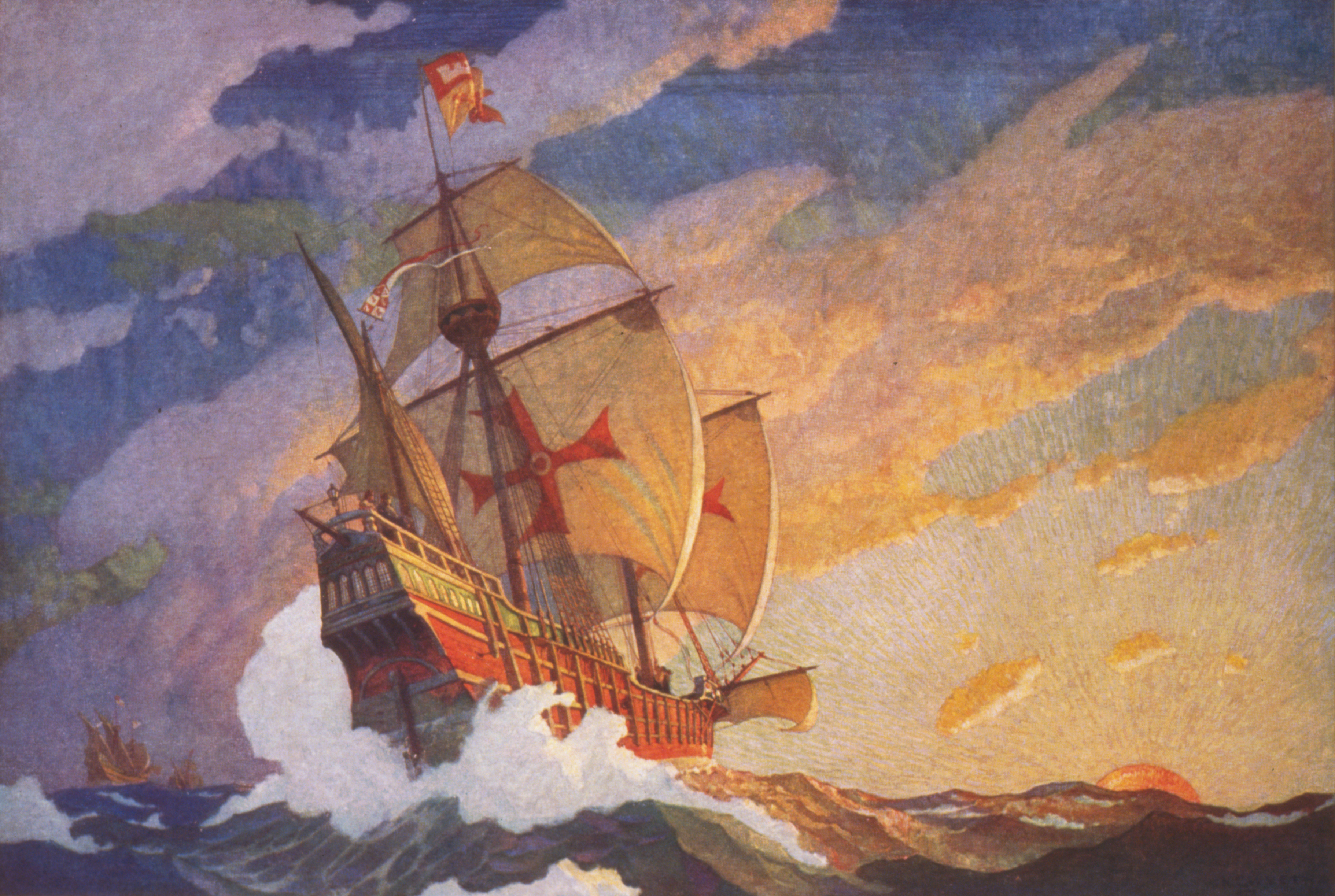
Ships_of_Christopher_Columbus

On Bureaucracy and Functional Government

Image

When President Coolidge spoke to those gathered at the illustrious College of William and Mary in 1926, he reminded his listeners of what makes government function. For government to work, it must be local and accountable. Established by the earliest arrivals from the Old World, the experiences with bureaucratic authority taught the colonists that government centralized (and thereby removed from the problems it attempts to fix) never works. For this reason, as government advanced from colonial to state forms, bureaucracies had no part in the drafting, passage or implementation of state constitutions, laws and standards.

It was up to the towns, cities, counties and ultimately states to make government function. It is the cradle of true states’ rights and the basis for a genuine national unity. The one-size-fits-all approach always succumbs to its own inherent weaknesses. In the process of forming their own governments, Americans learned how liberty is only possible when the ability to make decisions is preserved at the local and personal level. Anything more and government, even in the name of compassion and efficiency, becomes inhuman, destructive and incompetent — the murderer of what Coolidge earlier called an individual’s “self-direction,” known also as freedom.

Experience has actually proven, so that Coolidge could truthfully say, “No method of procedure has ever been devised by which liberty could be divorced from local self-government. No plan of centralization has ever been adopted which did not result in bureaucracy, tyranny, inflexibility, reaction, and decline.” Liberty and local self-government cannot be separated as with a clinical incision to the body politic. This is why transforming government into the expansive, all-encompassing State it is today, whatever the intentions, always kills the liberty exercised by the individual.

The most adept planners fail not because someone disrupts the plan from its certain success nor because the plan can only work with the right kind of people in charge. The plan fails because it is inherently flawed. It attempts to liberate humanity by denying its humanness. Forced to conform to an unrealistic set of approved behaviors, government is stripped of any human quality, turning what is supposed to be the humane agency of free individuals, the “expression of the life” by a sovereign people, into “a cold, impersonal machine.” No longer the personal involvement of individuals deciding their own affairs, government perverts to infinite layers of “expert practitioners.” An unaccountable and reckless bureaucracy takes the place of local self-determination, giving and taking away freedom with the draft of every new form and the sweep of every expert’s pen.

We see states are no longer allowed to diverge from total conformity to Federal specifications, however mundane the state matter. This administration has made clear it will sue any state refusing to march in step with the arbitrary and selective enforcement of law it exemplifies. We watch as counties, boroughs and parishes are threatened to accept designated “Federal” money or else be cut off from future “favor.” We look while cities, towns, and villages are told to adopt a complete overhaul of zoning regulations by the Housing and Urban Development Department in Washington. We then stand aghast as Washington invades our most personal decisions of child-raising, employment, education, health care, retirement, and, through the institutionalization of political correctness, what we are allowed to say in political opposition and believe in religious conviction.

Coolidge, addressing the issues of housing, food, wages, hours, conditions, justice and opportunity, placed the power for addressing all these with the welfare of all the people in his state squarely where it belonged, where the laws properly placed them — with the people themselves. It is they who bear the burdens of government, who pay its costs and activate its provisions. It was for the people of Massachusetts to decide these details of their lives because they comprised its government from little Monroe to Beacon Hill. What Coolidge said of Massachusetts could be said of governments everywhere across this Union, “Our government belongs to the people. Our property belongs to the people. It is distributed. They own it. The taxes are paid by the people. They bear the burden. The benefits of government must accrue to the people. Not to one class, but to all classes, to all the people. The functions, the power, the sovereignty of the government, must be kept where they have been placed by the Constitution and laws of the people.”

The power of these truths, the “rules of action” originating from the people from whom governments are constituted, are what make bureaucracies such an affront to civilization everywhere. Lifting power out of the hands of the people directly concerned with a given issue, bureaucracies clog the proper function of government by setting up “the pretense of having authority over everybody and being responsible to nobody.” It is the assumption of control without an equal measure of responsibility that makes a bureaucracy so destructive of local self-government and, inseparably, individual freedom. Coolidge put it in even clearer terms, “Of all forms of government, those administered by bureaus are about the least satisfactory to an enlightened and progressive people. Being irresponsible they become autocratic, and being autocratic they resist all development. Unless bureaucracy is constantly resisted it breaks down representative government and overwhelms democracy.”

There are definite issues the Federal government is simply, even at its best, not equipped to handle, being “too far away to be informed of local needs, too inaccessible to be responsive to local conditions.” It has proven unworthy of few things, yet it is still given many more to manage. As Coolidge said, “It does not follow that because something ought to be done the National Government ought to do it.” Liberty diminishes in proportion to increasingly centralized control. Where freedom is concerned, it actually is a zero-sum game.

The solution, as Coolidge analyzed this problem, remains the same now. The states can help end or irreversibly enable the dysfunction of government by bureaucracy. The rights held by states are not given them to never use just as they are not given to abuse those to whom they are accountable, the people of each state. If they are unfaithful in the exercise of delegated powers, the Federal Government is thereby invited to step in and get involved. The willing weakness of local and state government only encourages the intrusion of Federal controls.

This danger provoked President Coolidge not to absorb power, but to restore the correct balance between the people, the states and national government. He did so consistently. By vetoing the double attempts to socialize American agriculture, chopping down the Federal outlay for flood aid, cutting and cutting again the size of the Federal budget, paying down the nation’s $20 billion debt, reducing tax rates across the board and fighting the Congressional urge to spend each year’s growing surplus, Coolidge left the recipe that works when Washington is governed responsibly. It remained for the states and local decision-makers to follow that constructive lead. Far too often they did not do so, working instead against Coolidge’s program.

Local self-government cannot afford, fiscally, politically, morally, to shirk its duty a moment longer. The states cannot emulate the direction they took in the 1920s and 30s. It must be the sovereign people, through their municipal, county and state governments, who stand when no one else seems willing to stand. The alternative will hasten only more of the same disastrous consequences ahead for us already.

The way lit by Coolidge forward, back toward progress and justice, requires courage but it is the only way. It means robustly asserting local and state authority, dragging Washington back to its limited and lawful sphere of responsibilities. “I want to see the policy adopted by the States of discharging their public functions so faithfully that instead of an extension on the part of the Federal Government there can be a contraction.” The march back toward a government of the people and away from central bureaucracy starts where all good governance begins — at the local level.