Jamie K. Wilson has written a profound piece at PJ Media that strikes a resonance with many of Calvin Coolidge’s observations on civilization, including this one from 1921:
Civilization is always on trial, testing out, not the power of material resources, but whether there be, in the heart of the people, that virtue and character which come from charity sufficient to maintain progress. When that charity fails, civilization, though it ‘speak with the tongues of men and of angels,’ is ‘become as sounding brass or a tinkling cymbal.’ Its glory has departed. Its spirit has gone out. Its life is done.
And then, there is this one from 1922:
It is conceived that there can be a horizontal elevation of the standards of the nation, immediate and perceptible, by the simple device of new laws. This has never been the case in human experience. Progress is slow and the result of a long and arduous process of self-discipline. It is not conferred upon the people, it comes from the people. In a republic the law reflects rather than makes the standard of conduct and the state of public opinion. Real reform does not begin with a law, it ends with a law. The attempt to dragoon the body when the need is to convince the soul will end only in revolt.
Perhaps in our current existential dilemma over what anchors we should not have collectively cut and what moorings we can, if at all possible, salvage, we can rediscover that Cal was right all along:
Men do not make laws. They do but discover them. Laws must be justified by something more than the will of the majority. They must rest on the eternal foundation of righteousness.
Perhaps the etiquette we have jettisoned demands a renewed public commitment if we are to survive. If we do not, the American experiment may just deserve the dustbin of history.
The poppies evocative of Flanders Field inspiring Lieutenant Colonel McCrae’s poem. Photo credit: World War I Centennial Commission.
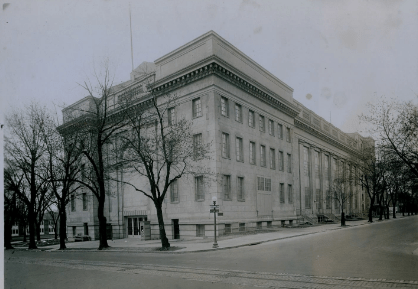
Looking back on the tenth anniversary of the Armistice that ended the Great War on the eleventh hour of the eleventh day in 1918, the occasion that marks this day one hundred seven years later, President Calvin Coolidge, at the Washington Auditorium (now no longer extant) in the nation’s capital, observed:
The Washington Auditorium back in 1926, on 19th street in D. C. Photo credit: Library of Congress.
“While we are placing our faith in more complete understanding which shall harmonize with the universal conscience, we ought not to forget that all the rights we now possess, the peace we now enjoy, have been secured for us by a long series of sacrifices and of conflicts. We are able to participate in this celebration because our country had the resources, the character, and the spirit to raise, equip, and support with adequate supplies an Army and a Navy, which, by placing more than 2,000,000 men on the battle fields of Europe contributed to the making of the armistice on the 11th day of November, 1918. Our first thought, then, is to acknowledge the obligation which the Nation owes to those who served in our forces afloat and ashore, which contributed the indispensable factor to the final victory. Although all our people became engaged in this great conflict, some in furnishing money, some in producing food and clothing, some in making munitions, some in administering our Government, the place of honor will always be accorded to the men and the women who wore the uniform of our country – the living and the dead…
“Every dictate of humanity constantly cries aloud that we do not want any more war. We ought to take every precaution and make every honorable sacrifice, however great, to prevent it. Still, the first law of progress requires the world to face facts, and it is equally plain that reason and conscience are as yet by no means supreme in human affairs. The inherited instinct of selfishness is very far from being eliminated; the forces of evil are exceedingly powerful. The eternal questions before the nations are how to prevent war and how to defend themselves if it comes. There are those who see no answer, except military preparation. But this remedy has never proved sufficient. We do not know of any nation which has ever been able to provide arms enough so as always to be at peace. Fifteen years ago, the most thoroughly equipped people of Europe were Germany and France. We saw what happened. While Rome maintained a general peace for many generations, it was not without a running conflict on the borders which finally engulfed the empire. But there is a wide distinction between absolute prevention and frequent recurrence, and peace is of little value if it is constantly accompanied by the threatened or the actual violation of national rights.
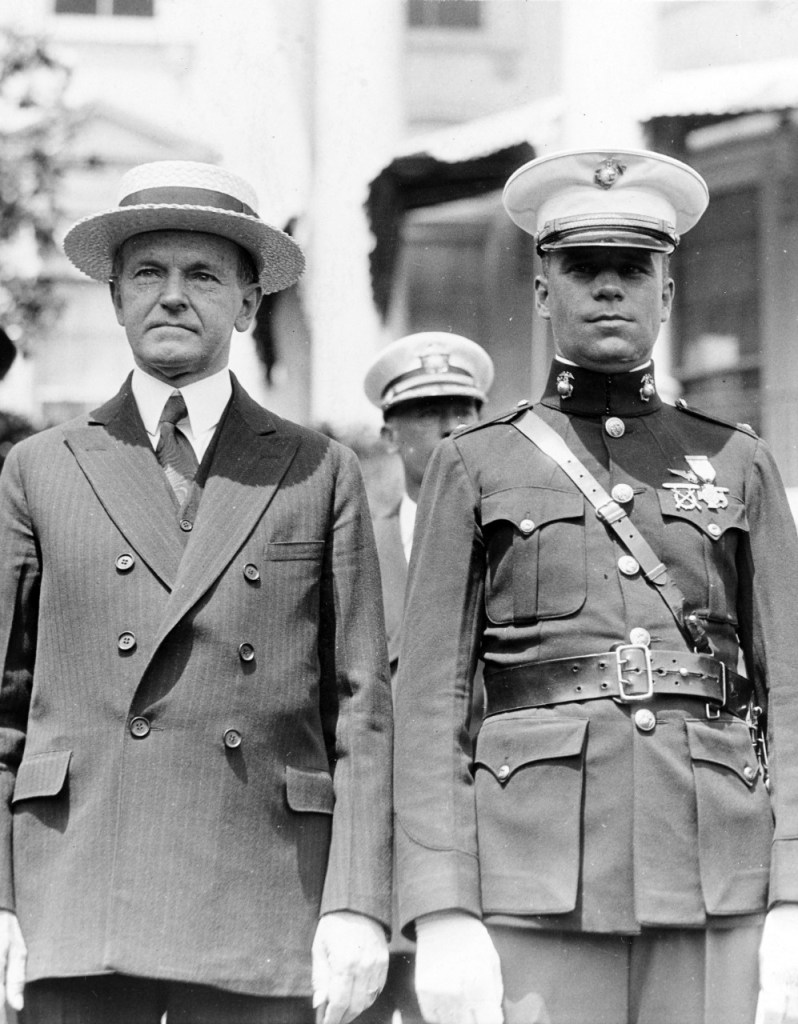
President Coolidge presenting the Medal of Honor to First Lieutenant Christian Schilt, on the White House grounds, c.1928. Photo credit: Library of Congress.
“If the European countries had neglected their defenses, it is probable that war would have come much sooner. All human experience seems to demonstrate that a country which makes reasonable preparation for defense is less likely to be subject to a hostile attack and less likely to suffer a violation of its rights which might lead to war. This is the prevailing attitude of the United States and one which I believe should constantly determine its actions. To be ready for defense is not to be guilty of aggression. We can have military preparation without assuming a military spirit. It is our duty to ourselves and to the cause of civilization, to the preservation of domestic tranquility, to our orderly and lawful relations with foreign people, to maintain an adequate Army and Navy…
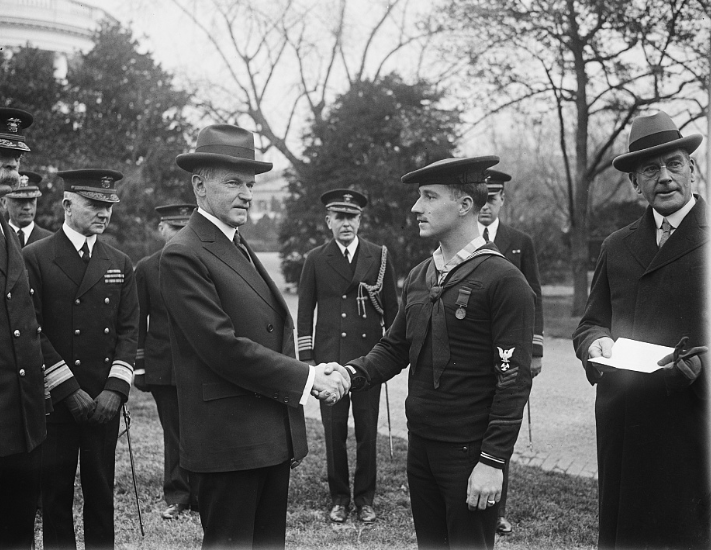
President Coolidge recognizing William R. Huber, Machinist Mate, First Class, U. S. Navy, with a Medal of Honor for his heroic actions aboard the U.S.S. Bruce. Photo credit: Library of Congress.
“So long as promises can be broken and treaties can be violated we can have no positive assurances, yet everyone knows they are additional safeguards. We can only say that this is the best that mortal man can do. It is beside the mark to argue that we should not put faith in it. The whole scheme of human society, the whole progress of civilization, requires that we should have faith in men and in nations. There is no other positive power on which we could rely. All the values that have ever been created, all the progress that has ever been made, declared that our faith is justified…
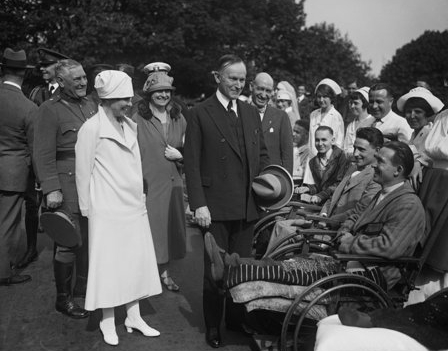
The Coolidges visiting with veterans injured in combat during the Great War.
“We want peace not only for the same reason that every other nation wants it, because we believe it to be right, but because war would interfere with our progress. Our interests all over the earth are such that a conflict anywhere would be enormously to our disadvantage. If we had not been in the World War, in spite of some profit we made in exports, whichever side had won, in the end our losses would have been great. We are against aggression and imperialism not only because we believe in local self-government, but because we do not want more territory inhabited by foreign people. Our exclusion of immigration should make that plain. Our outlying possessions, with the exception of the Panama Canal Zone, are not a help to us, but a hindrance. We hold them, not as a profit, but as a duty. We want limitation of armaments for the welfare of humanity. We are not merely seeking our own advantage in this, as we do not need it, or attempting to avoid expense, as we can bear it better than anyone else. If we could secure a more complete reciprocity in good will, the final liquidation of the balance of our foreign debts, and such further limitation of armaments as would be commensurate with the treaty renouncing war, our confidence in the effectiveness of any additional efforts on our part to assist in further progress of Europe would be greatly increased.
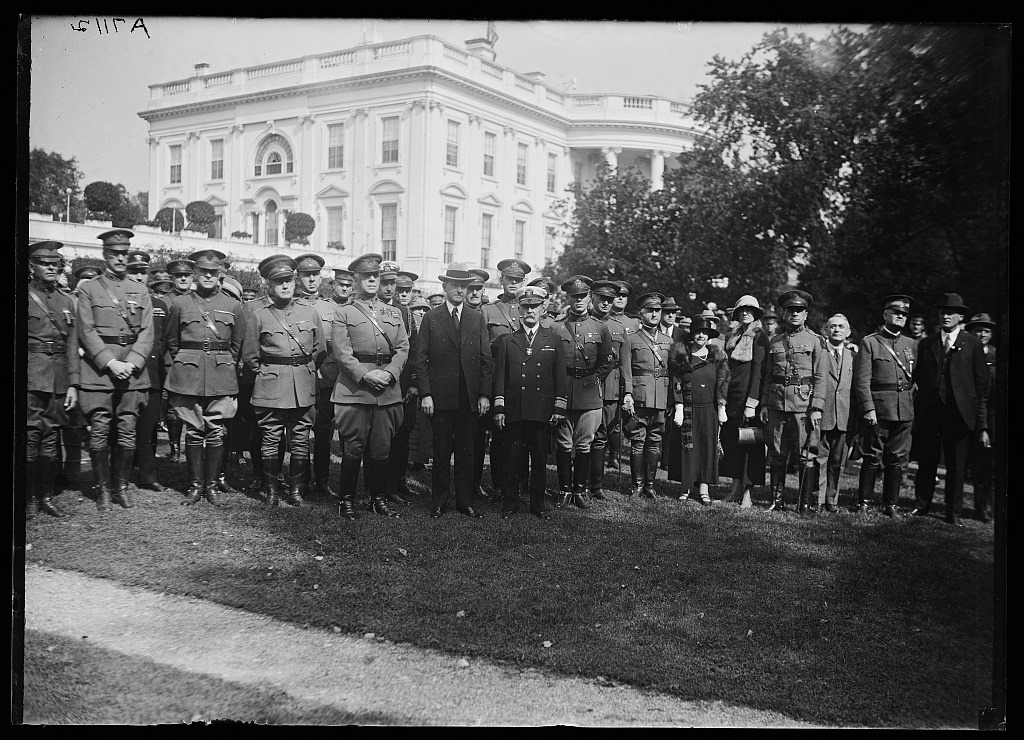
President Coolidge receiving Army and Navy personnel from the Great War on the South Grounds of the White House. Photo credit: Library of Congress.
“As we contemplate the past 10 years, there is every reason to be encouraged. It has been a period in which human freedom has been greatly extended, in which the right of self-government has come to be more widely recognized. Strong foundations have been laid for the support of these principles. We should by no means be discouraged because practice lags behind principle. We make progress slowly and over a course which can tolerate no open spaces. It is a long distance from a world that walks by force to a world that walks by faith. The United States has been so placed that it could advance with little interruption along the road of freedom and faith. It is befitting that we should pursue our course without exultation, with due humility, and with due gratitude for the important contributions of the more ancient nations which have helped to make possible our present progress and our future hope. The gravest responsibilities that can come to a people in this world have come to us. We must not fail to meet them in accordance with the requirements of conscience and righteousness.“
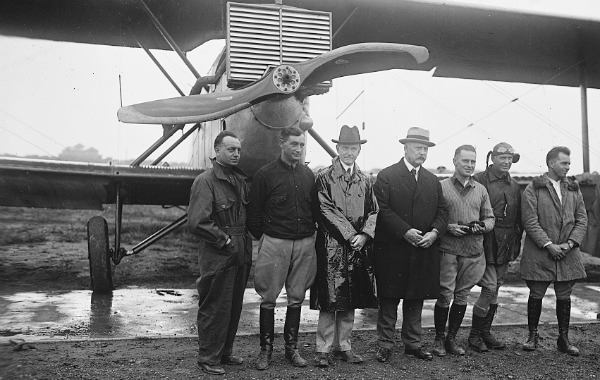
President Coolidge in 1924 beside some of the aviators who gained their first combat experience in the air during the late War. Photo credit: Library of Congress.
A grateful people recognizes, as Cal also once said, that “no person was ever honored for what he received. Honor has been the reward for what he gave.” Thank you to all who serve and have rendered past service in uniform.
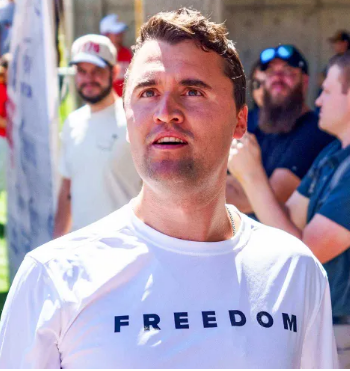
Charlie Kirk at Utah Valley University, September 10, 2025. Photo credit: Trent Nelson/Salt Lake City Tribune/Getty
The shocking assassination of Charlie Kirk on September 10th marks a loss of something far more fundamental than a martyr for America’s heart and soul, beleaguered as it is in the latest phases of the culture wars. Far more elemental than hateful actions rendered proportionately in return for hateful speech, the murder of Kirk reveals a stark collision between despair and hope, the outright repudiation of classically liberal ideals, ones that have inspired acts of heroism and sacrifice from John Quincy Adams’ work on the Amistad case to Frederick Douglass’ efforts to break racial stratification before, during, and after 1865, which have been followed by principled actions of bold, patriotic Americans in countless situations since. The same spirit animated Martin Luther King to envision a world where the content of one’s character triumphed above a regime maintained by violent suppression.
The most radical reformers across every era of the American experiment, from Garrison to Bryan, or Debs to Malcolm X, have presupposed that rational persuasion remained the single most powerful means of changing outcomes as a result of changing minds. An order where killing becomes the sanctioned norm, a culture that remedies electoral losses with blood, silences dissent through terror rather than reason, and solves problems by replacing open debate with dehumanized slaughter of those with whom one differs was the antithesis of the optimism inherent in political activism. Abandoning the freedom to speak, shirking the call to reasonably discuss, respectfully differ, and artfully refute for the license to suppress and silence is a fundamental departure from America’s citizenship.
The ‘final solution’ of literally assassinating influential adversaries plunges America into the service of animalistic impulses while goosestepping away from every vestige of what it means to be human, living life for the betterment of humanity. It discards every shred of the liberating hope and once prevailing faith Americans of every background, creed, and color have possessed for more than three centuries. This is not merely a killing of an individual, it is the death of confidence in anyone or anything still remaining in America to change for the better. It is ultimately a barbaric breach of faith with the historic ability Americans have shown from the beginning to improve themselves, return to ideals, and meet problems squarely and courageously when presented with good reasons for doing so. The force of persuasion connected to shared essentials has always compelled Americans far more effectively than lawless coercion.
This is what made Kirk so impactful a rhetorician whose exercise to the fullest extent of the obligations of his citizenship will continue to shape the future. When he could have shirked the duty and avoided the risk, he entered the arena, gaining support not from the exercise of speech for hateful, selfish ends but for liberating and humanizing ones, appealing to those most ensnared in the intellectual, political, and cultural mires of his generation. That he proved more effective than his opposition in debate vindicated the potency citizenship contains when put to full use, an obligation cowardly skeptics and timid critics fail to realize in themselves or to recognize in others.
As a President Kirk himself greatly admired, Calvin Coolidge had much to say about employing those obligations of American citizenship to their utmost capacity. The failure to do so, whatever one’s political persuasion, was dereliction and betrayal of the trust it still is to be a citizen of the United States. As these excerpts from an address on April 14, 1924 attest, Coolidge delivers what many considered one of the greatest speeches of his career. Whatever one thinks of the late Charlie Kirk, he is certainly not to be found deficient in the full engagement citizenship demands of every American. His sense of decency, even in the midst of fierce debate, and courage in marshaling every resource to win the mind to rational discourse and the will to civic participation will renew the faith and hope that America, by definition, is.
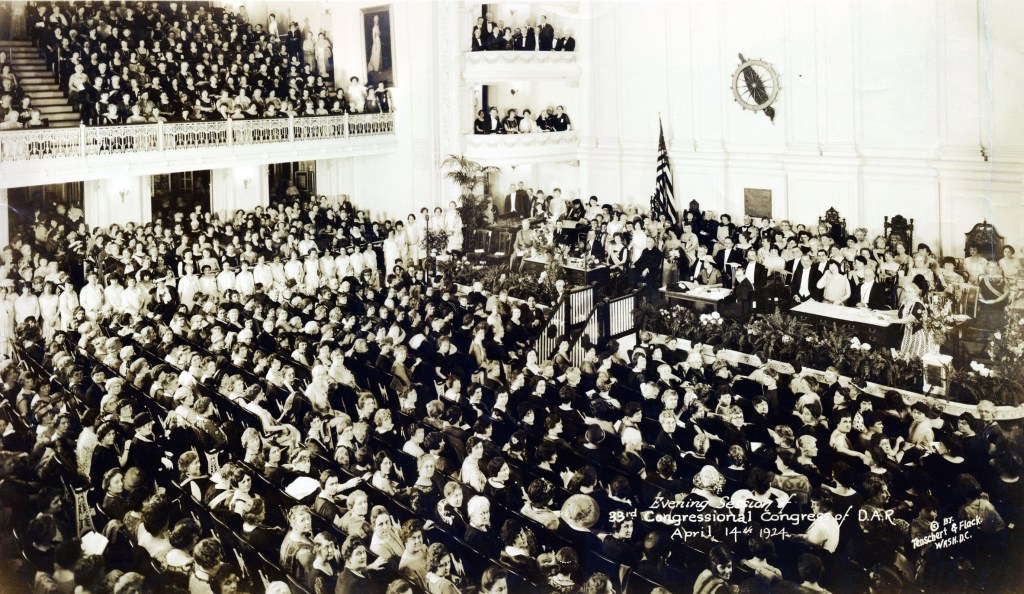
The gathering of the 33rd Continental Congress of the Daughters of the American Revolution, addressed by President Coolidge that evening, April 14, 1924. Photo credit: Daughters of the American Revolution.
“Institutions, whether adopted long ago or of more recent origin, are of themselves entirely insufficient. All of these are of no avail without the constant support of an enlightened public conscience. But still more is needed. Our only salvation lies also in the ever-present vigilant and determined action of the people themselves. The heroic thought and action of the Revolution must forever be supplemented by the heroic thought and action of to-day. Along with the great expansion of free institutions, which has carried them to all parts of the world in a startlingly brief historic period, there has gone a broadening of the principle of self-government. The ballot, in the earlier forms of democracy, was the privileged possession of a limited class. It was not looked upon as a right, but rather as the reward of some kind of high achievement, perhaps material, perhaps intellectual. But lately we have come upon times in which the vote is esteemed, not as a privilege or a special endowment bestowed only for cause shown, but more in the nature of an inherent right withheld only for cause shown. This new conception makes it no longer a privilege, no longer even a right which may be exercised or omitted as its possessor shall prefer. It becomes an obligation of citizenship, to be exercised with the highest measure of intelligence, thoughtfulness, and consideration for the public concern. The fundamental question of keeping America truly American is whether the obligation of citizenship is fully observed.
“Every voter ought not merely to vote, but to vote under the inspiration of a high purpose to serve the Nation. It has been calculated that in most elections only about half of those entitled to vote actually exercise their franchise. What is worse, a considerable part of those who neglect to vote do it because of a curious assumption of superiority to this elementary duty of the citizen. They presume to be rather too good, too exclusive, to soil their hands with the work of politics. Such an attitude cannot too vigorously be condemned. Popular government is facing one of the difficult phases of the perpetual trial to which it always has been and always will be subjected. It needs the support of every element of patriotism, intelligence, and capacity that can be summoned…
“[W]e have never seen, and it is unlikely that we ever shall see, the time when we can safely relax our vigilance and risk our institutions to run themselves under the hand of an active, even though well-intentioned, minority. Abraham Lincoln said that no man is good enough to govern any other man. To that we might add that no minority is good enough to be trusted with the government of a majority. And still further, we shall be wise if we maintain also that no majority can be trusted to be wise enough, and good enough, at all times, to exercise unlimited control over a minority. We need the restraints of a written constitution. To prevent the possibility of such things happening, we must require all citizens who are entitled to do so to take their full part in public affairs. We must be sure that they are educated, trained, and equipped to do their part well. We must not permit the mechanisms of government, the multiplicity of constitutional and statutory provisions to become so complex as to get beyond control by an aroused and informed electorate. We must provide ample facilities of education, and this will require constant expansion and liberalization. We must aim to impress upon each citizen the individual duty to be a sincere student of public problems, in order that they may rightly render the service which their citizenship exacts. But after all, good citizenship is neither intricate not involved. It is simple and direct. It is every-day common sense and justice.”
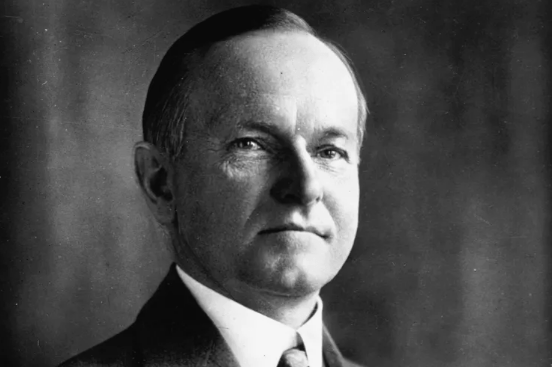
“Not-so-silent” Cal. Photo credit: Library of Congress/Getty Images.


 The Importance of the Obvious