On Aviation

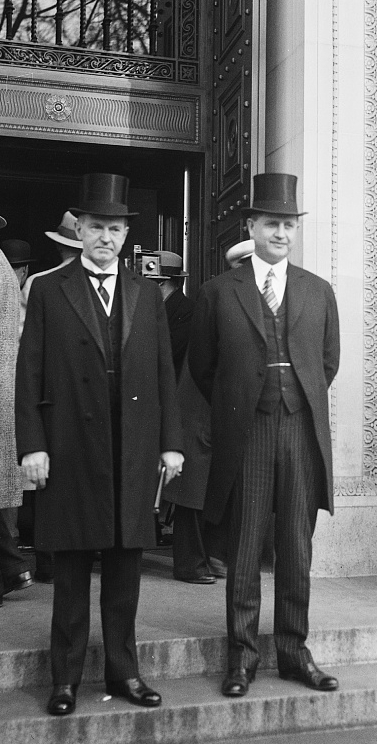
President Coolidge with Secretary Everett Sanders at the International Civil Aeronautics Conference, December 12, 1928.

President Coolidge with Secretary Everett Sanders at the International Civil Aeronautics Conference, December 12, 1928.

Appearing on the opening day of the International Civil Aeronautics Conference on December 12, 1928, President Coolidge marked the first quarter of a century for aviation. So much had been accomplished that seemed absolutely unattainable, except in myth and fable, for all of human existence. That first 12 second flight of a heavier-than-air machine accomplished by Wilbur and Orville Wright on the beaches of Kitty Hawk, North Carolina, opened a world of what was now possible. It would never have happened and certainly never have flourished had not visionary men and women worked to achieve it, perfect it and preserve private ingenuity as the moving force of its future development.

Without President Coolidge’s decisive role in shaping air policy, a strong case could be made that there would have been no private or commercial aviation. It could have remained exclusively under the control of a military establishment. Certainly a civil aeronautics conference would not have occurred. It was through his well-timed deployment of the Morrow Board, his encouragement of the commercial and national defense potential of air technology along independent lines, and his superlative political skill in shepherding and signing the Air Commerce Act in May 1926 brought order out of the chaos in coordinating aviation while keeping the doors of opportunity open to private innovation (Komons, Bonfires to Beacons, p.88). As had been accomplished with the Radio Act of 1927, President Coolidge left a distinct imprint not only on the early development of modern communications but also on the success of air travel.

President Coolidge, speaking to the 441 aviators, inventors, and delegates present (including Orville Wright and Charles Lindbergh), began:

“Members of the Conference:

“This year will mark the first quarter century of the history of human flight. It has been a period of such great importance in scientific development that it seems fitting to celebrate it with appropriate form and ceremony. For that purpose this conference has been called, and to the consideration of the past record and future progress of the science of aeronautics, in behalf of the Government and people of the United States, I bid you welcome.

The first flight at Kitty Hawk by the Wright brothers, December 1903.

The first flight at Kitty Hawk by the Wright brothers, December 1903.

“Twenty-five years ago, at Kitty Hawk, North Carolina, occurred an event of tremendous significance. It was the first extended flight ever made by man in a power-driven heavier-than-air machine. How more appropriately could we celebrate this important anniversary than by gathering together to consider the strides made throughout the world in the science and practice of civil aeronautics since that day, and to discuss ways and means of further developing it for the benefit of mankind?

“Others, whose names will long be remembered, had done much to solve the problem, but it remained for the able, persistent, and modest brothers from Dayton to demonstrate completely the possibility of a machine raising itself by its own power and carrying a man in sustained flight.

“Human flight with wings, which had intrigued the imagination since the beginning of time, became a practical reality on the day that the airplane of Wilbur and Orville Wright rose from the windswept dunes of the Atlantic coast. The elder brother lives with us only in memory, but Orville Wright, who piloted that first plane, is still actively interested in that science. We are glad to have him as one of our delegates to this conference.
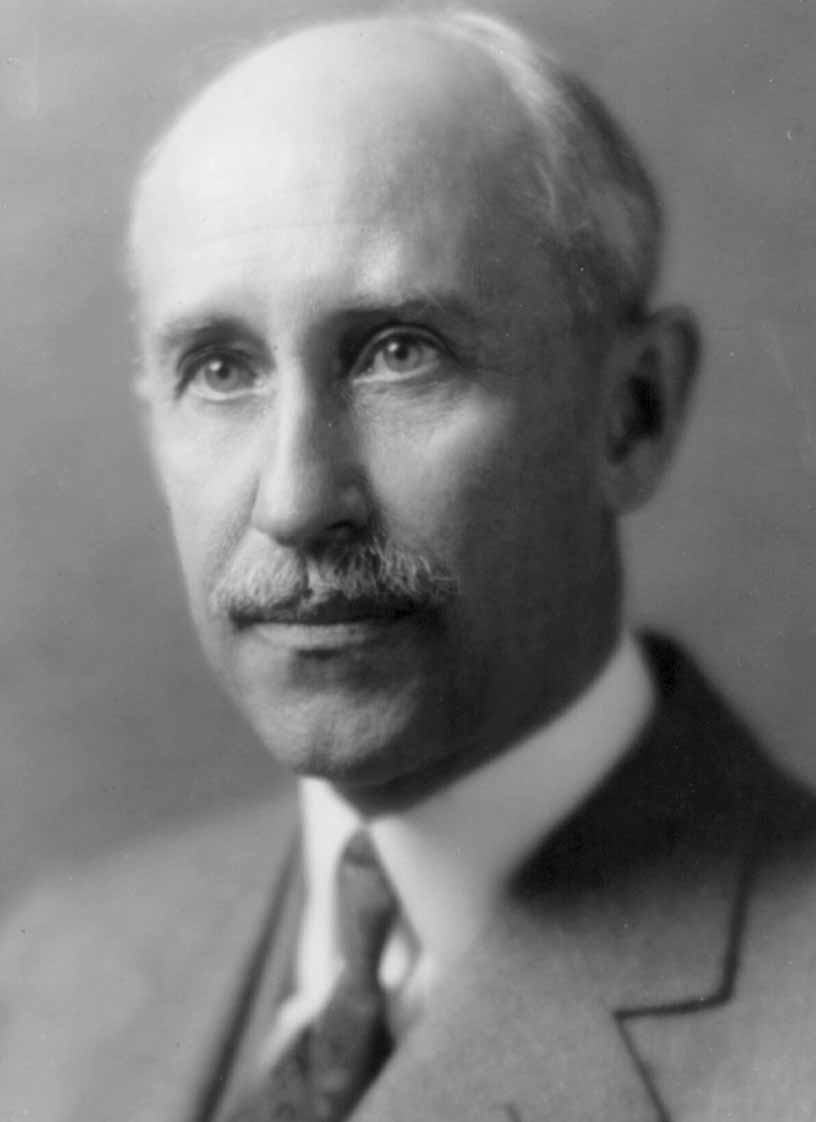
Orville Wright in 1928, at the time of the Conference.

Orville Wright in 1928, at the time of the Conference.

“No achievement of man in the progress of civilization has had a more rapid expansion…Even within our memory utter impossibility was expressed by saying: ‘Might as well try to fly’…

“With genius, indomitable perseverance, and a will to overcome obstacles, the Wrights, mindful of what had gone before, applied themselves to the solution of the problem. They experimented at Kitty Hawk for three seasons; and in the fourth, on December 17, 1903, success crowned their efforts…That first flight lasted only 12 seconds. Three more were made the same day. One of 59 seconds carried the plane a distance of 852 feet. It was wrecked by the wind and tests ended for the time. Further experiments were made in Dayton in 1904 and 1905. In the latter year a Wright plane traveled for 24 miles at the rate of 38 miles an hour. Three years later one was bought by the War Department, our Government being the first to utilize this new device.

“Other countries took up the idea and for a period rather outstripped us in flying…It is to the development of aeronautics as an aid to the peaceful pursuits of transportation, of commerce, and of trade that this conference is to direct its attention…In 1926 this Government officially recognized the importance of flying by establishing the post of Assistant Secretary for Aeronautics in each of the War, the Navy, and the Commerce Departments. Since then we have made remarkable progress. Then the value of the aeronautic industry in the United States was placed at less than $5,000,000. Today it is said to be in excess of $150,000,000. In 1925 the production of aircraft was valued at about $13,000,000; for 1928 the estimate is over $50,000,000…

“Regular flying in the United States, beginning with a short mail line, has increased until this year there are approximately 15,500 miles of airways…The daily mileage is estimated at 52,000 miles. We have three important national lines–New York to Montreal, Seattle to Vancouver, and Miami to Havana. Plans to extend the latter to the Isthmus and South America are under way…The airplane is used for fast day travel, with a transfer to a railroad for the night journey…

“The twentieth century will be known for the development of aeronautics and air transport. The airways of the world now have a greater mileage than the railways did in 1850, the twenty-fifth anniversary of the opening of the first railroad built by Stephenson…

“The country-wide tour of Lindbergh in the United States, following his wonderful and spectacular flight to Paris, did much to make Americans air-minded. A large amount of civil flying is now being done here, and the civilian-owned aircraft number over 6,000…

Charles Lindbergh receives the Harmon Trophy, the annual award for air aces, at the Conference. Beside him, to his left, stands Orville Wright.

Charles Lindbergh receives the Harmon Trophy, the annual award for air aces, at the Conference. Beside him, to his left, stands Orville Wright.

“Air transport means much to the United States, divided as it is in the West by lofty mountain ranges and deserts. In the early days it took six months to go from Missouri to the Pacific coast. An airplane traveled across the continent in less than 24 hours. We are stretching out our arms through the air to Canada and to our other friends and neighbors in the South.

“All nations are looking forward to the day of extensive, regular, and reasonably safe intercontinental and interoceanic transportation by airplane and airship. What the future holds out even the imagination may be inadequate to grasp. We may be sure, however, that the perfection and extension of air transport throughout the world will be of the utmost significance to civilization. While the primary aim of this industry is and will be commercial and economic and the prosperity of the world will be immeasurably advanced by it, indirectly, but no less surely, will the nations be drawn more closely together in bonds of amity and understanding.”
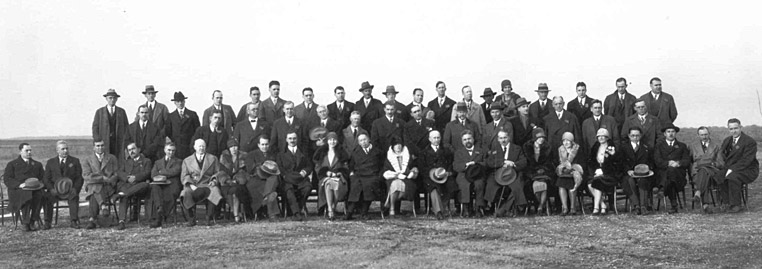
Delegates pose for a group photograph on December 15th, at Langley Memorial Aeronautical Laboratory. Orville Wright is seated in the front row to the right of the woman with the white fur collar.

Delegates pose for a group photograph on December 15th, at Langley Memorial Aeronautical Laboratory. Orville Wright is seated in the front row to the right of the woman with the white fur collar.

The delegates of the Conference made the journey on December 17, 1928, to the site where it all began, Kitty Hawk, North Carolina.
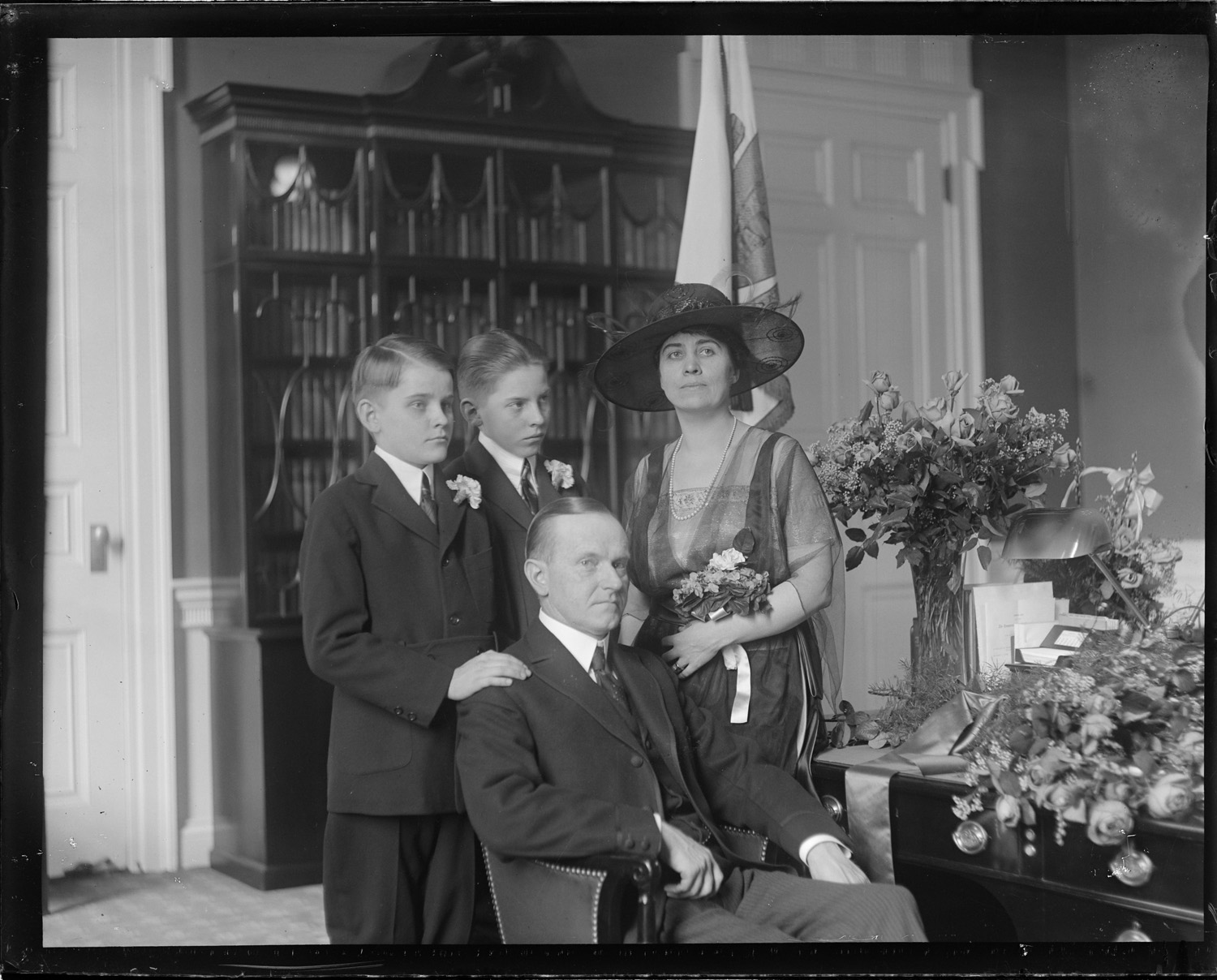
The delegates of the Conference made the journey on December 17, 1928, to the site where it all began, Kitty Hawk, North Carolina.

On Wages and Upward Mobility

Image

Speaking in Plymouth, Massachusetts, on September 1, 1919, Governor Calvin Coolidge could have been critical of national conditions, its economic disparity and bleak situation coming out of war and into a still very uncertain peace. It remained to be seen how smooth an adjustment into peacetime America could accomplish. There was much unrest throughout the country and the Wilson administration’s Progressive rhetoric combined with the Justice Department’s prosecution of political threats continued to keep Americans on edge, a palpable anxiety which hovered over the Nation like a cloud.

1919 was not only the year of the Boston Police Strike but witnessed steel, coal and general strikes from Seattle to Johnstown, Pennsylvania. The immense power of the strikers to halt operations throughout the country reminded people they were not to be crossed without serious consequences. The incessant claims that ours was an unfair and inequitable system took a special kind of courage to publicly confront. Governor Coolidge, eight days before most of Boston’s law enforcement would vote to walk away from their duty, would address those gathered in Plymouth in full display of just that kind of courage. He would tackle the heart of the issue head-on covering the issues of labor, wages, equality and opportunity.

He began with sincere praise for America’s exceptionalism, “…[F]or it was here that for the first time in history a government was founded on a recognition of the sovereignty of the citizen which has irresistibly led to a realization of the dignity of his occupation….For the first time in five years it comes at a time when the issue of world events makes it no longer doubtful whether the American conception of work as the crowing glory of men free and equal is to prevail over the age-old European conception that work is the badge of the menial and the inferior. The American ideal has prevailed on European battle-fields through the loyalty, devotion, and sacrifice of American labor. The duty of citizenship in this hour is to strive to maintain and extend that ideal at home.”

In Coolidge’s estimation, unceasing discontent and perpetually-stirred criticism rendered no benefit to anyone and solved nothing — in fact, they were drains of energy when the challenges to be faced demanded constructive effort and optimism on the part of everyone. Creating a false perception that forced Americans into fixed classes to be constantly pitted against each other was not only dishonest but destructive if improvement and progress were to be continued. Fostering dissension and enmity between those perceived to be “Haves” and “Have Nots” was a denial of the Founding and a deceitful manipulation of the real property owners America empowers, the people themselves.

Coolidge continued, “We have known that political power was with the people, because they have the votes. We have generally supposed that economic power was not with the people, because they did not own the property. This supposition, probably never true, is growing more and more to be contrary to the facts. The great outstanding fact in the economic life of America is that the wealth of the Nation is owned by the people of the Nation. The stockholders of the great corporations run into the hundreds of thousands, the small tradesmen, the thrifty householders, the tillers of the soil, the depositors in savings banks, and the now owners of government bonds, make a number that includes nearly our entire people.”

Citing the figures of Massachusetts alone proved this assertion and laid bare the simplistic notion that justice could be legislated after “assuming that we can take from one class and give to another class.” The “property class” was already one and the same as the “employed class.” The interdependence of interests made it impossible to separate them and preserve what was good or just for either one. Reflecting on the fact that Massachusetts was an industrial state, he raised a series of questions that illustrated the path America would have to take to grow. It lay not in the direction of jealousies, hatred and class warfare but in expanding opportunity, not regulation, and raising prosperity for everyone through policies that encourage profits and its by-product, employment. He asked, “How can our people be made strong? Only as they draw their strength from our industries. How can they do that? Only by building up our industries and making them strong. This is fundamental. It is the place to begin. These are the instruments of all our achievement. When they fail, all fails. When they prosper, all prosper. Workmen’s compensation, hours and conditions of labor are cold consolations, if there be no employment. And employment can be had only if some one finds it profitable. The greater the profit, the greater the wages.”

In this economic axiom, Coolidge made clear the need, not to demonize profits, but to welcome them as a legitimate part of unchaining America’s economic potential. Coercive legislation was not the answer to higher wages. Clearing away the hampering clutter of controls that made people’s participation in the marketplace unprofitable was the solution. This raised wages. The increase in value of each individual’s labor is not determined by penalizing growth and punishing employment. The increase in value manifests itself in higher wages. The value of the individual’s work is as limitless as that person’s potential. Yet, it grows in proportion to the profitability of the enterprise to which a person’s labor is invested. If profits are suppressed, expansion of opportunity stops and, sooner or later, so does employment itself.

Governments, inept at accurately gauging the value of labor cannot set wage rates without harming growth and continued employment. In short, Governments in the business of setting wages always hurt the most vulnerable Americans, the very people wage laws claim to be helping.

Coolidge reminds us of these obvious and yet repeatedly forgotten truths. If we genuinely want everyone to prosper, we can only accomplish it by building up, not tearing down, America’s engine of growth. We do this not through constant appeals to prejudice and anger but through constructive work, encouraging the opportunities to be found in a marketplace of growing value and expanding opportunity. In such an environment, employment, higher wages, increasing profits and upward mobility are made possible for anyone with the will and determination to achieve his or her highest potential. That potential, the ability to work for yourself and keep the rewards of that labor is an American concept. It is through this recognition of the dignity of work, what Coolidge called the “crowning glory” of a free and equal people, that so extraordinary a success has been enjoyed here in America.

Governor CC at home

Economic power cannot be repeatedly stifled and thwarted without an accompanying loss to the people’s political power. Both powers are inseparably joined. While the force of Government fails whenever it attempts to harness capitalism for its own, vastly different ends, America still proves that freedom works.

“Born on the Fourth of July” by Sidney M. Milkis

“Born on the Fourth of July” by Sidney M. Milkis

The latest review of both Amity Shlaes’ Coolidge and Charles C. Johnson’s Why Coolidge Matters adds a welcome take to a renewed conversation of Calvin Coolidge. Mr. Milkis, well-known author and professor with the Miller Center of Public Affairs at the University of Virginia, has much to offer when it comes to the Progressive Era, the period generally classified from 1900 to 1929. In his critique of both books, Mr. Milkis presents the Coolidge neither author may envision but one that resembles the man described by David Greenberg, whose Calvin Coolidge, published in 2006, accepted too many of the assumptions handed down by Art Schlesinger and the New Deal gang. Greenberg unfortunately dug himself into a deeper hole with his 2011 piece further ridiculing Coolidge’s “naive faith in the gospel of productivity” as if Big Government has proven once and for all to be a reliable and permanent fixture of American life.

Mr. Milkis contributes a worthy opinion in the ongoing and overdue discussion about our thirtieth president. However, it is equally as important not to reinforce the same, old misrepresentations of what has, for far too long, been the accepted narrative regarding “Silenced Cal.” The fact that Ms. Shlaes and Mr. Johnson are questioning that narrative with meticulous research is not “revisionist” as much as it is a return to the rigorous standards of scholarship restored by Thomas Silver, popularized by Ronald Reagan, and now being revitalized by, among others, the authors Mr. Milkis has reviewed.

Mr. Greenberg and those who preceded him in defense of the New Deal have more to lose by seeing Coolidge’s principles reintroduced and expounded through the heavy lifting done by those he perceives to be on “the Right,” than they do repeating the tired shibboleth of his naivete and failure. Americans all can appreciate Coolidge not because he identified with this or that “political side” but because the principles he embodied were thoroughly and unabashedly true to the foundations of our exceptional system, declared, constituted and reaffirmed by our ancestors. As Coolidge expressed it on another occasion, “Whether one traces his Americanism back three centuries…or three years…is not half so important as whether his Americanism of to-day is real and genuine. No matter by what various crafts we came here, we are all now in the same boat.” His appeal to eternal truths of human nature and political experience should form ground on which we can all Americans can again be a united and prosperous people.