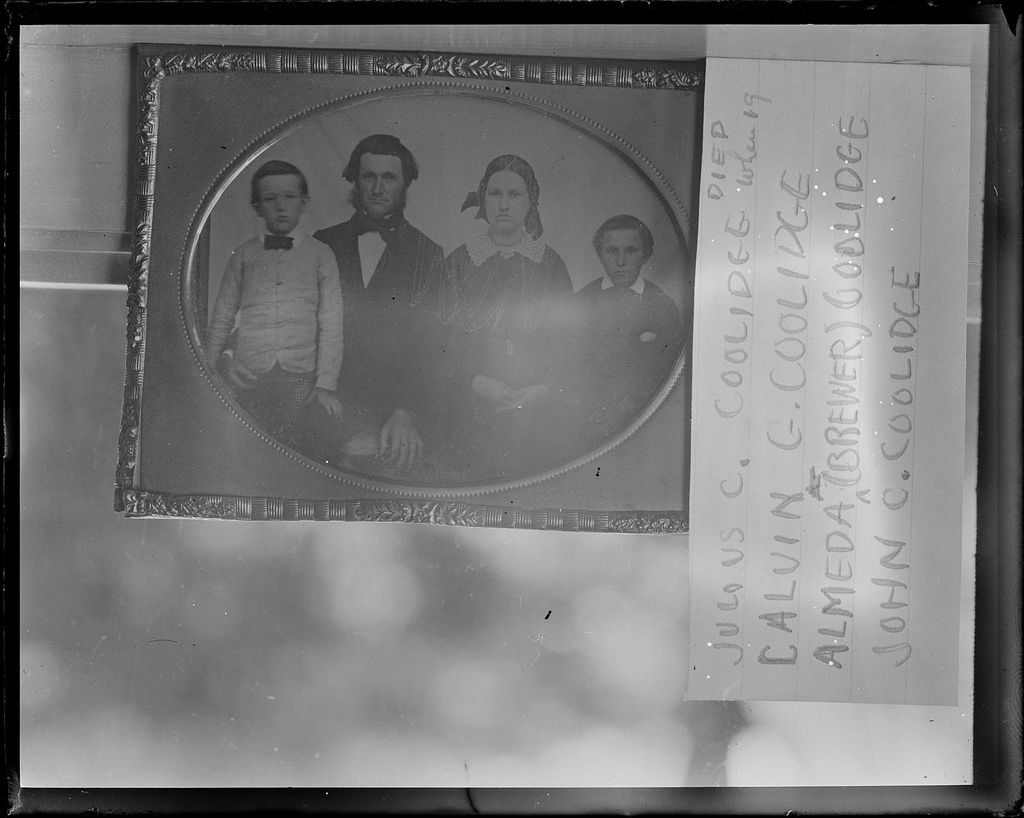
Julius Caesar…Coolidge and Family

Julius Caesar...Coolidge and Family

In observance of the Ides of March, here is an old offering from the Coolidge family album: a photo of Julius Caesar Coolidge (far left) as a boy, the President’s uncle, taken with his family: father, Calvin Galusha; mother, Almeda Brewer; and brother, John Calvin (far right). While Calvin Coolidge never met Julius, who died two years before the future President was born, he experienced much the same mixture of joy and sorrow, play and hard work of which Calvin later summarized from his own experience:

“It would be hard to imagine better surroundings for the development of a boy than those which I had. While a wider breadth of training and knowledge could have been presented to me, there was a daily contact with many new ideas, and the mind was given sufficient opportunity thoroughly to digest all that came to it. Country life does not always have breadth, but it has depth. It is neither artificial nor superficial, but is kept close to the realities” (The Autobiography, p.33).

Like many families of the early nineteenth century, the courageous deeds of heroes from antiquity intermixed with the unshakeable convictions of religious heroes from the Reformation and Great Awakening to be perpetuated in the choice of names for babies born to those early pioneers of Vermont and beyond. What better way to evoke great things for new lives than to name one for the brave conqueror and another for the stalwart reformer?

“Survey of the Presidents of the United States”

“Survey of the Presidents of the United States”

So many Presidential surveys through the years have been encumbered by the subjective biases of the participants rather than the objective standards of fidelity to one’s oath and faithful execution of the laws and Constitution. At long last Franklin’s Opus has conducted such a study with some very unexpected results…at least for the “consensus” in much of modern academia. Of Calvin Coolidge, they said,

“He understood not only the constitutional limits of the presidency and of the central government, but adhered to a strong policy of fiscal discipline and also understood the cultural underpinnings that made free government in America possible.” –Dr. Gary Gregg

“A man of supreme integrity and humility, ‘Silent Cal’ believed not only that the ‘business of the American people is business’ but also, as he said in the same speech, that peace, honor, and charity were the higher things of life. A fiscal conservative, he understood that the limitation of government was the foundation of individual liberty.” –Dr. Stephen Klugewicz

Check out where the Presidents rank (and how different Mount Rushmore would look) when the promises of the solemn oath they take are applied to their administrations. Rankings by others have proceeded with a presupposition against liberty and prosperity but toward centralized power and grand intentions. This time, the scholars on the panel look for who advanced our republican principles in office, not merely campaigned on them to secure support.

Check out Kai’s superb assessment of this research as well and, while there, spend some time learning more about Cal Coolidge.