On the U. S. Army’s 250th Birthday

First Division Monument, Washington, D. C. Photo credit: National Park Service/Kelsey Graczyk.

“We meet to dedicate a monument to the memory of the men of the First Division of the American Expeditionary Forces, who gave their lives in battle for their country. Their surviving comrades bestow this gift upon the Nation. It bears mute but enduring testimony of an affectionate regard for those who made the great sacrifice. This beautiful and stately shaft represents no spirit of self-glorification. It is a tribute of reverence and sorrow to nearly 5,000 of our immortal dead from those who knew and loved them. The figure of winged victory rises above the scrolls of imperishable bronze on which are inscribed alone the ennobled names of those who fell and through their deathless valor left us free. Other soldiers, generals and privates, officers and men, rank on rank, of illustrious fame are unrecorded here. They live. The dead reign here alone.

Calvin Coolidge, head and shoulders, facing right, at base of the marble shaft erected to memory of the hero dead, in front of State, Navy and War Dept., dedicating memorial to heroes of First Division, American Expeditionary Forces — Oct. 4, 1924. Photo credit: Library of Congress.

“This memorial stands as a testimony of how the members of the First Division looked upon the War. They did not regard it as a national or personal opportunity for gain or fame or glory, but as a call to sacrifice for the support of humane principles and spiritual ideals. This monument commemorates no man who won anything by the war. It ministers to no aspiration for place or power. But it challenges attention to the cost, suffering, and sacrifice that may be demanded of any generation, so long as nations permit a resort to war to settle their disputes. it is a symbol of awful tragedy. of unending sorrow, and of stern warning. Relieved of all attendant considerations, the final lesson which it imparts is the blessing of peace, the supreme blessing of peace with honor.
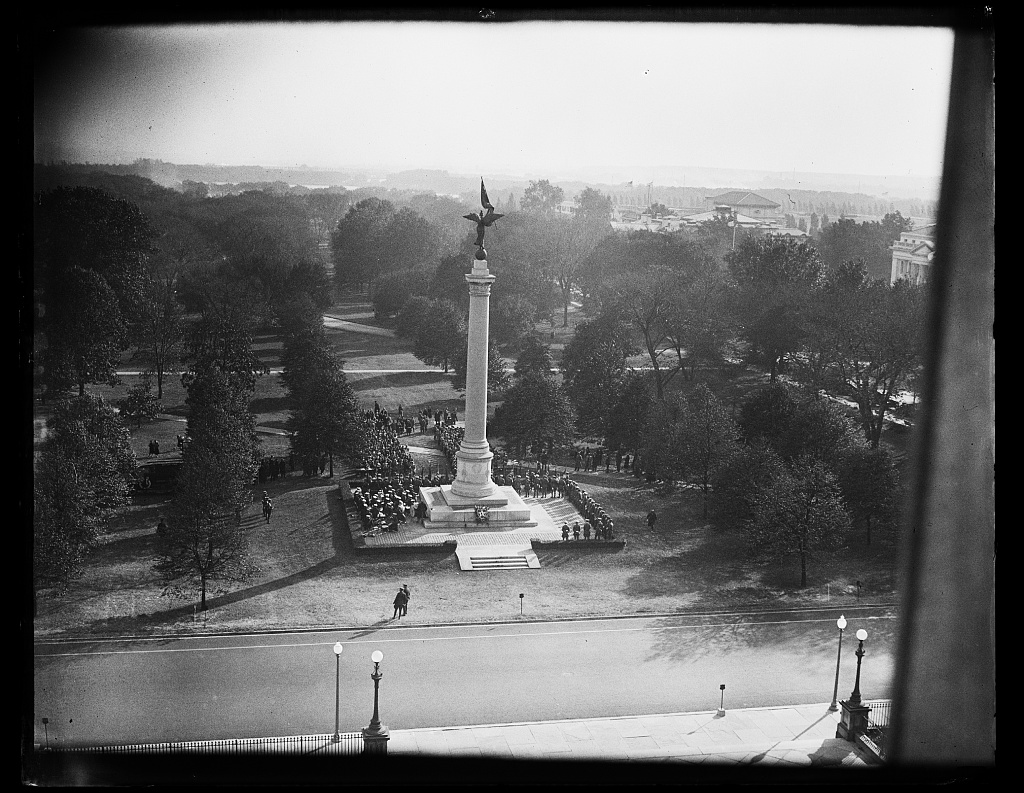
Photo credit: Library of Congress.

“The First Division has the notable record of being the first to enter France and the last to leave Germany. Hurriedly assembled, largely from Regular Army units, its first four regiments landed at Saint-Nazaire at the end of June, 1917, the advance guard which in a little more than a year was to be swelled to the incredible force of two millions. It had two battalions in the Grand Parade of July 4th in Paris, when tradition claims that a great American Commander laid our wreath at the tomb of the great Frenchman with the salutation which was short but all-embracing in its eloquence: ‘Lafayette, we are here.’ Other units, mostly from those who served in Mexico, made the Division so cosmopolitan that it represented every state and all the possessions of the Union. It was comprehensively and truly American.

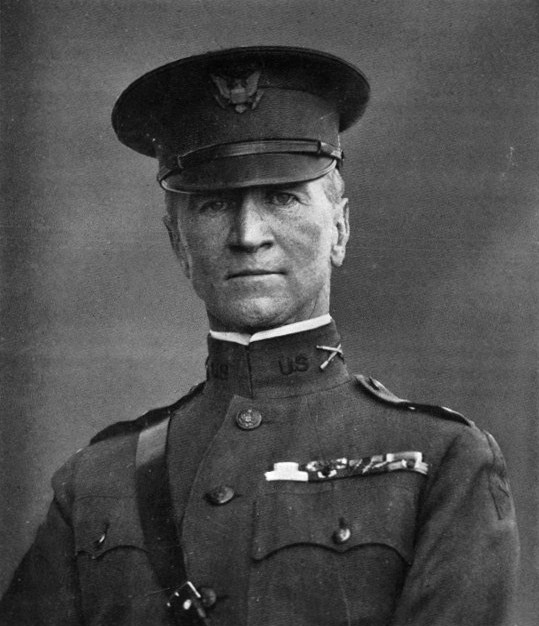
General Pershing honoring Lafayette at Picpus Cemetery, preserved by surviving families of victims of the French Revolution, Paris. Photo credit: USC Libraries.

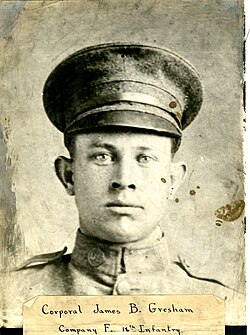
“After short and intensive preparation the Division was ordered from the Gondrecourt training area to the Sommerville sector, where on October 23rd the first American shot was fired. On October 25th the first American officer was wounded, and two days later the first prisoner was taken. On the night of November 2nd Corporal James B. Gresham and Privates Thomas F. Enright and Merle D. Hay, killed when their trenches were raided, were the first Americans lost in the war.
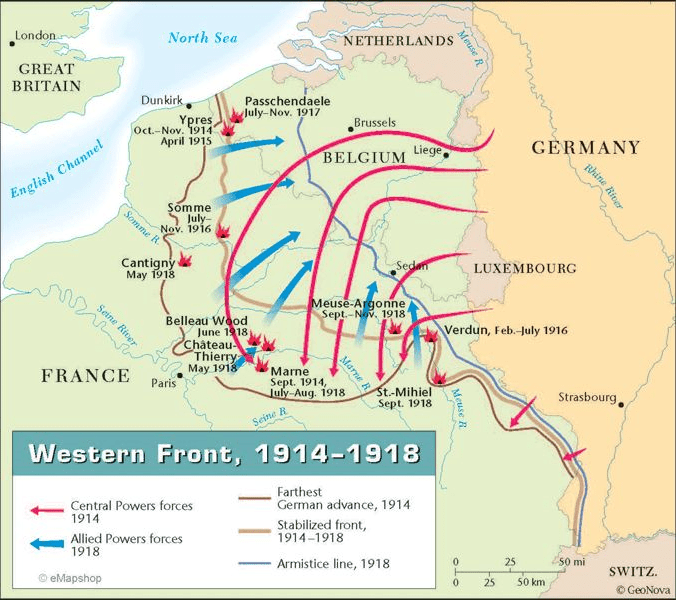
In January, 1918, the Division was removed to the Toul sector, where for the first time Americans were given charge of a section of trenches. From here it was sent to Catigny sector to resist the March drive against Amiens. To this place General Pershing came on a personal visit, warning the officers of the desperate character of the fighting which was soon encountered. The trenches here were imperfect and the troops were constantly exposed to shellfire. The first offensive of an American unit was the attack on Catigny…In July the Division was placed in the Soisson sector to take part in the attack on the German salient. In five days of heavy fighting, it advanced 11 kilometers and captured 3,500 officers and men, with large quantities of materials. Its own losses were 78 officers and 1,458 men killed, 214 officers and 6,130 men wounded, 5 prisoners and 390 missing; a heavy price to pay, but the victory at Soisson has been called the turning point of the war.
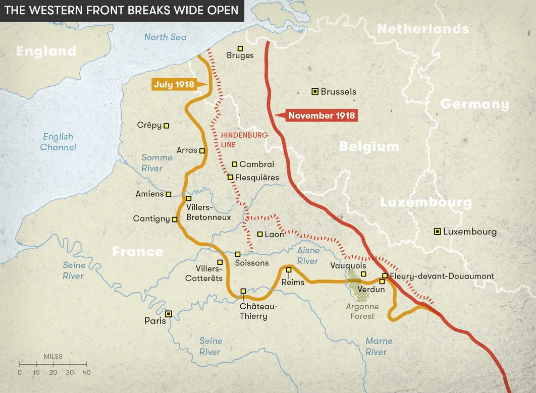
The Western Front. Photo credit: Smithsonian.

“Following a fortnight for rest and replacements a short service in the Vosges preceded the attack on St. Mihiel. The offensive against this position, which has been held for four years, was the first operation of an American army under an American commander. Under the direction of General Pershing nine American and some French divisions won complete victory, the Americans capturing 16,000 prisoners, 443 guns, and 240 miles of territory. The Division was then sent to the Meuse. In the great final offensive about a million American troops were engaged in the Argonne sector. After being held in reserve five days after operations opened, the First Division went into action October 4th to open the way on the east for a flank attack upon the forest. From then until the Armistice fighting and marching were continuous. The early successes of the American forces in the Argonne attack started a general German retirement about November 2nd. From then until Armistice Day the advance continued. On the night of November 5th, the First Division reached the Meuse. It was ordered to attack Sedan. Between 1630 in the afternoon of November 5th and midnight November 7th, the Division advanced and fought constantly. The 16th, 18th, and 28th Infantry Regiments covered 35 miles each, while the 26th Infantry, under the command of Colonel Theodore Roosevelt, traversed no less than 45 miles. Then came the Armistice. Immediately after the Division was ordered into Germany and stationed at the bridgeheads east of the line, from which it was withdrawn about a year later, the last units reaching New York on September 6, 1919.
“Such in barest outline is the war record of the First Division. In little more than a year it lost by death 5,516, of which 4,964 were killed in battle. Over 17,000 were wounded, 170 were reported missing, and 124 were taken prisoners. These numbers nearly equal the original strength of the Division. In General Order No. 201, of November 10, 1918, his only General Order issued referring exclusively to the work of a single Division, after describing your difficult accomplishments, General Pershing concluded thus: ‘The Commander-in-Chief has noted in this Division a special pride of service and a high state of morale, never broken by hardship or battle.’

“Five different Generals commanded the Division, all of whom won high distinction and commendation. They were William L. Sibert, Robert L. Bullard, Charles P. Summerall, Frank Parker, and Edward F. McGlachlin.

“The little that I can say in commendation of the service of your Division is but a slight suggestion of what is deserved. Every unit of the American Army, whether at home or abroad, richly merits its own full measure of recognition. They shrank from no toil, no danger, and no hardship, that the liberties of our country might adequately be defended and preserved.” — President Calvin Coolidge, dedication of the First Division Monument, American Expeditionary Force, President’s Park, Washington, October 4, 1924.

Happy Semiquincentennial to the United States Army!

Snapshot from the 1924 dedication of the First Division Monument. Photo credit: Sixteenth Infantry Regiment Association.

On the Debt to Honor

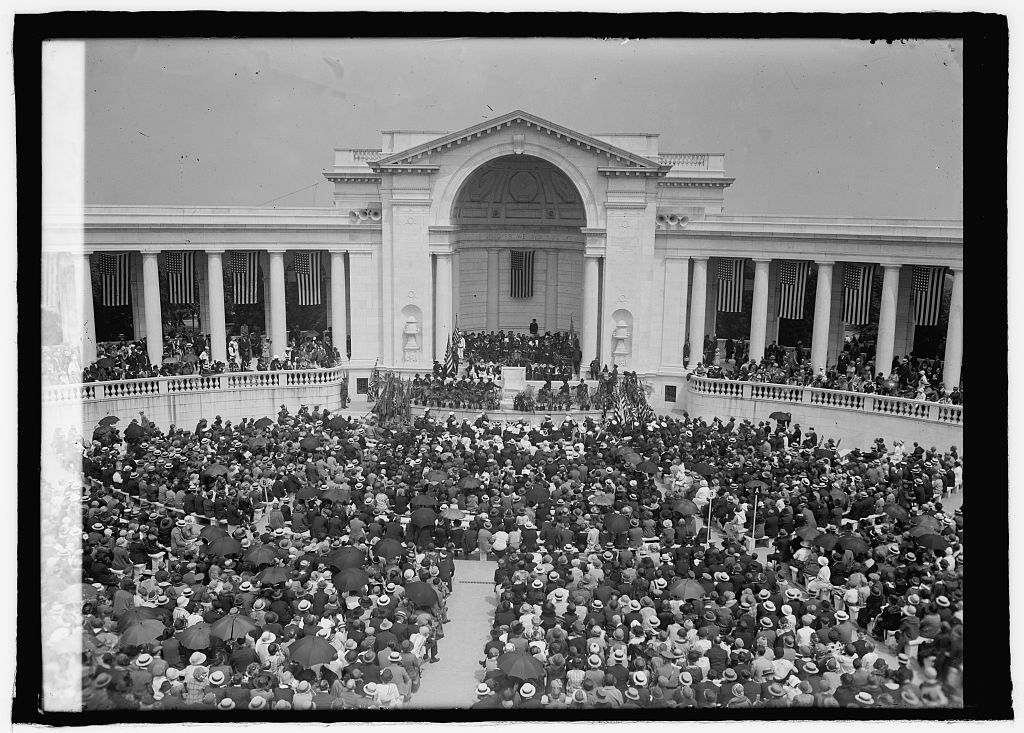
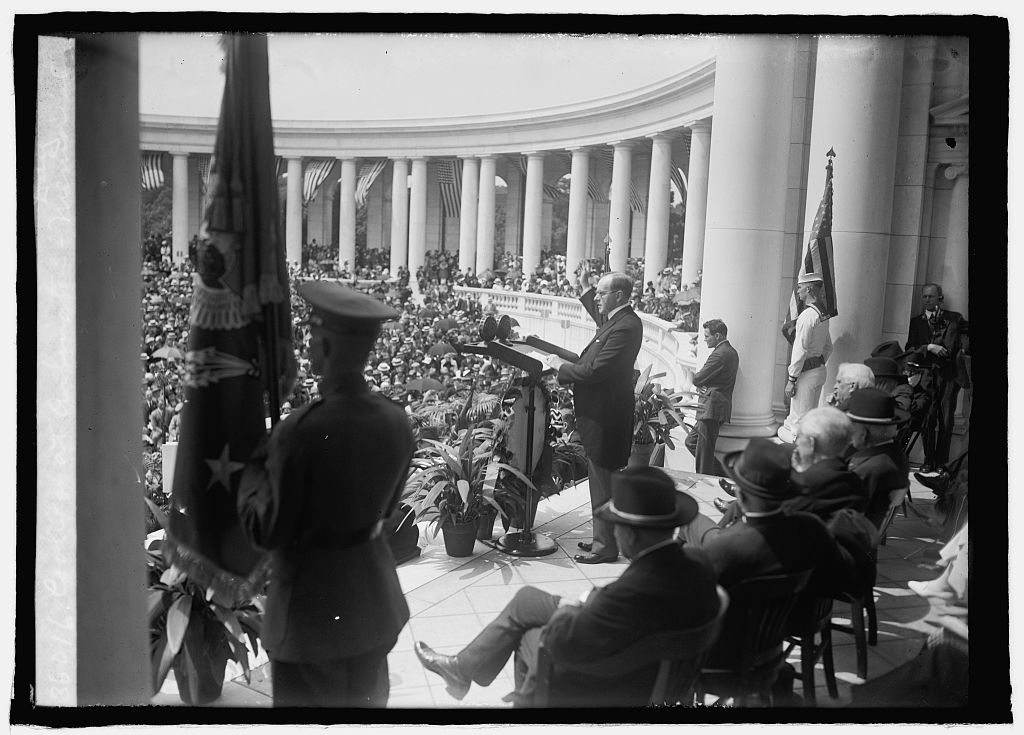
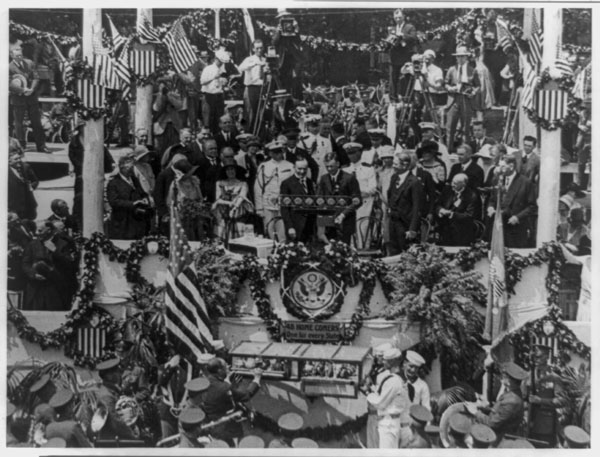
Arlington Amphitheater, May 30, 1925. Photo credit: Library of Congress.

“For those who are the inheritors of a noble estate and a high place in the world, it is a good thing to pause at intervals and consider by what favor of fortune and of ancestry their lines have fallen in such pleasant places. Thus to meditate on that course of events, which has given them what they have and made them what they are, will tend to remind them how great is their debt and how little is their share of merit.

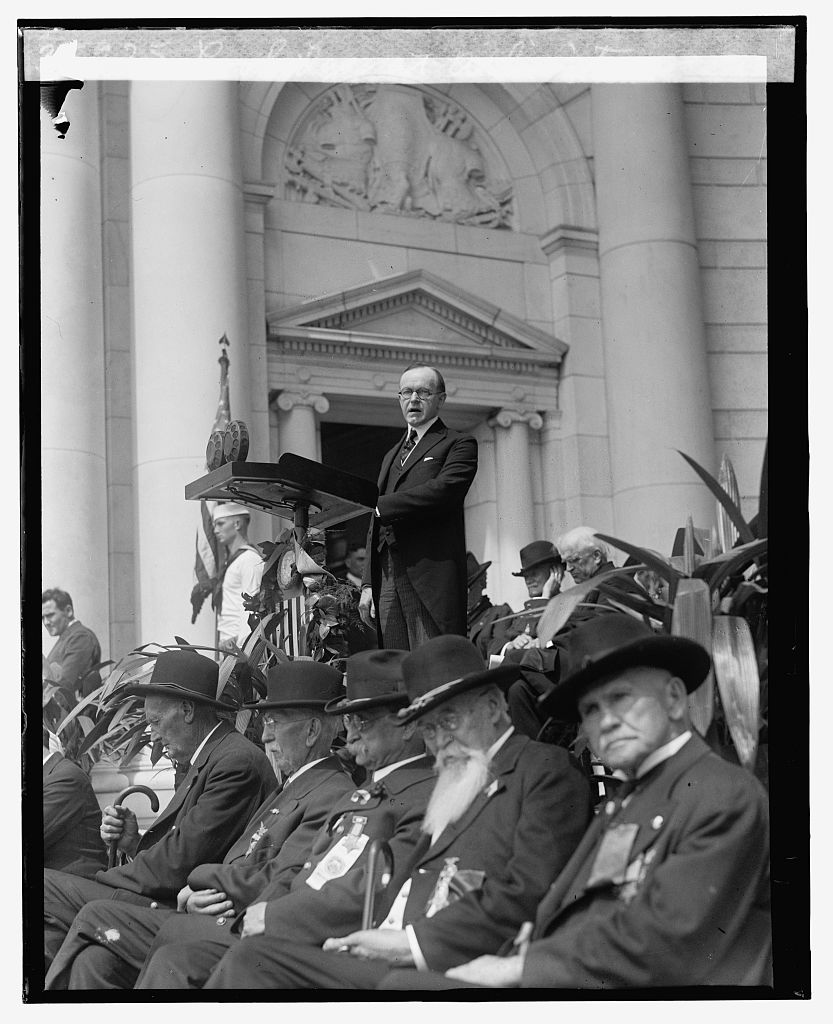
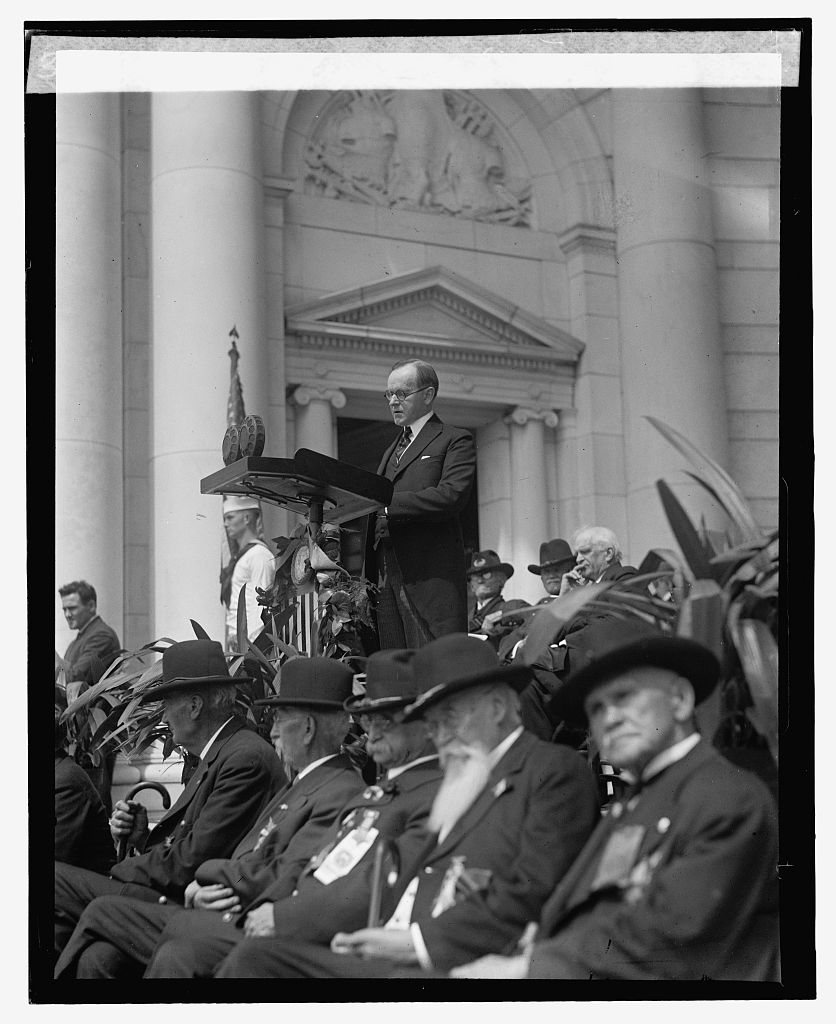
President Coolidge addresses the gathering on Memorial Day, 1925. Photo credit: Library of Congress.

“This is the day on which the American people each year acknowledge that they have such a debt. It has been set aside that a grateful Nation may do fitting honor to the memory of those who have made the greatest and most voluntary contribution to it. Here about us, in this place of beauty and reverence, lies the mortal dust of a noble host, to whom we have come to pay our tribute, as thousands of other like gatherings will do throughout our land. In their youth and strength, their love and loyalty, those who rest here gave to their country all that mortality can give. For what they sacrificed we must give back the pledge of faith to all that they held dear, constantly renewed, constantly justified. Doing less would betray them and dishonor us.

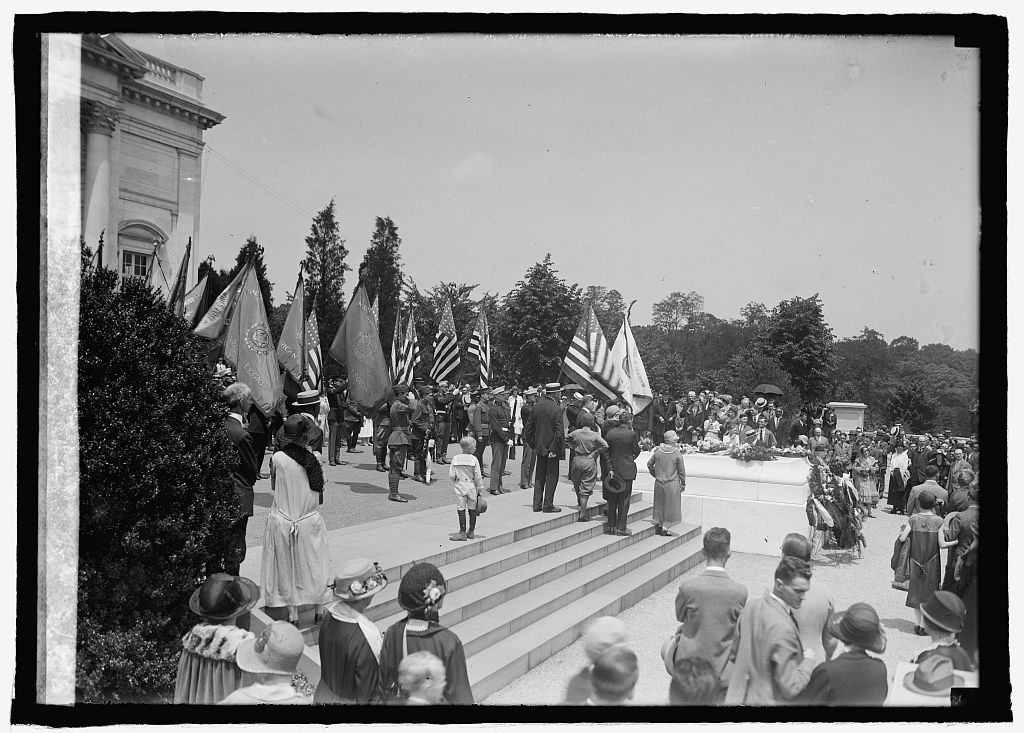
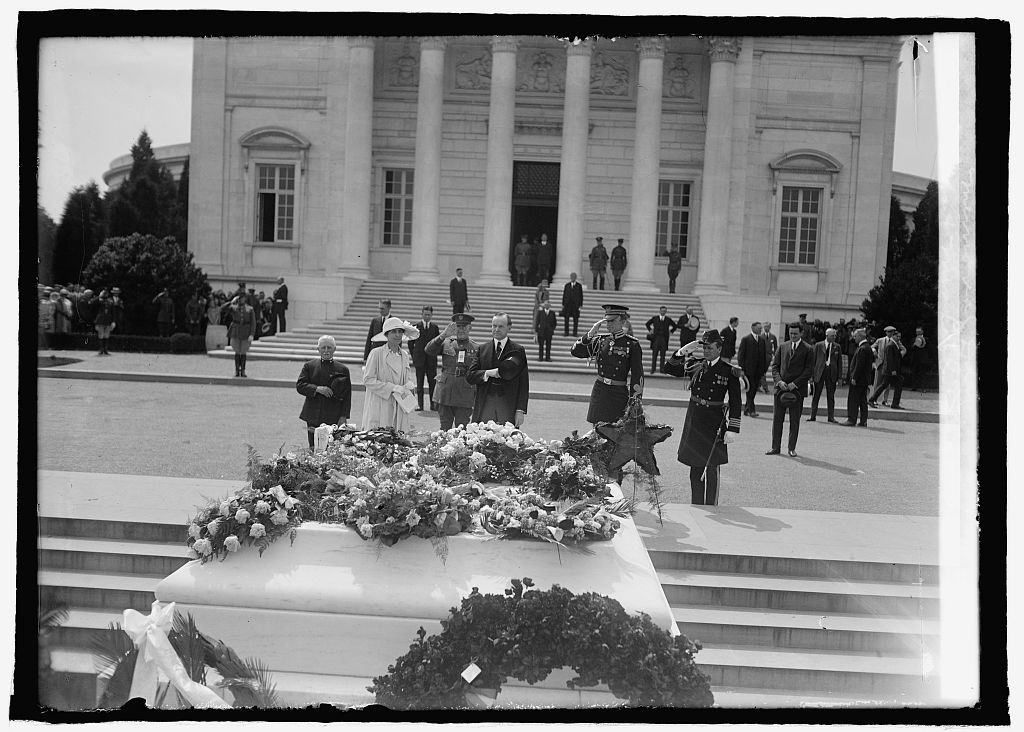
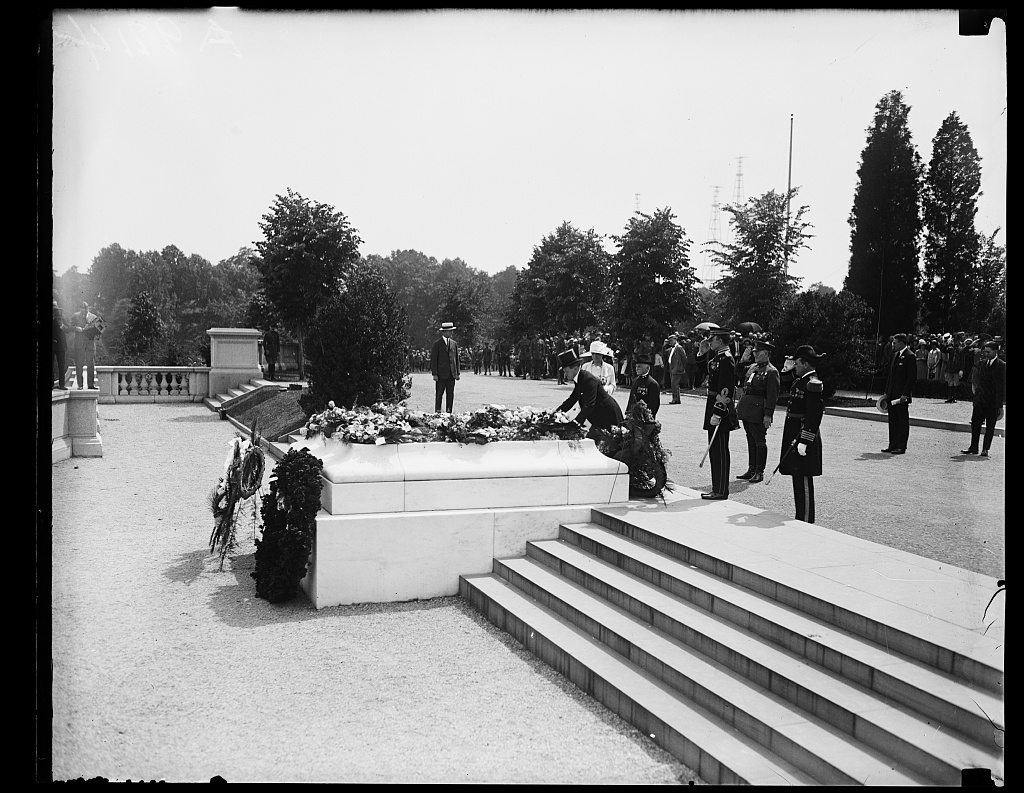
Honoring the Unknown Soldier, Arlington, Memorial Day, 1925. Photo credit: Library of Congress.
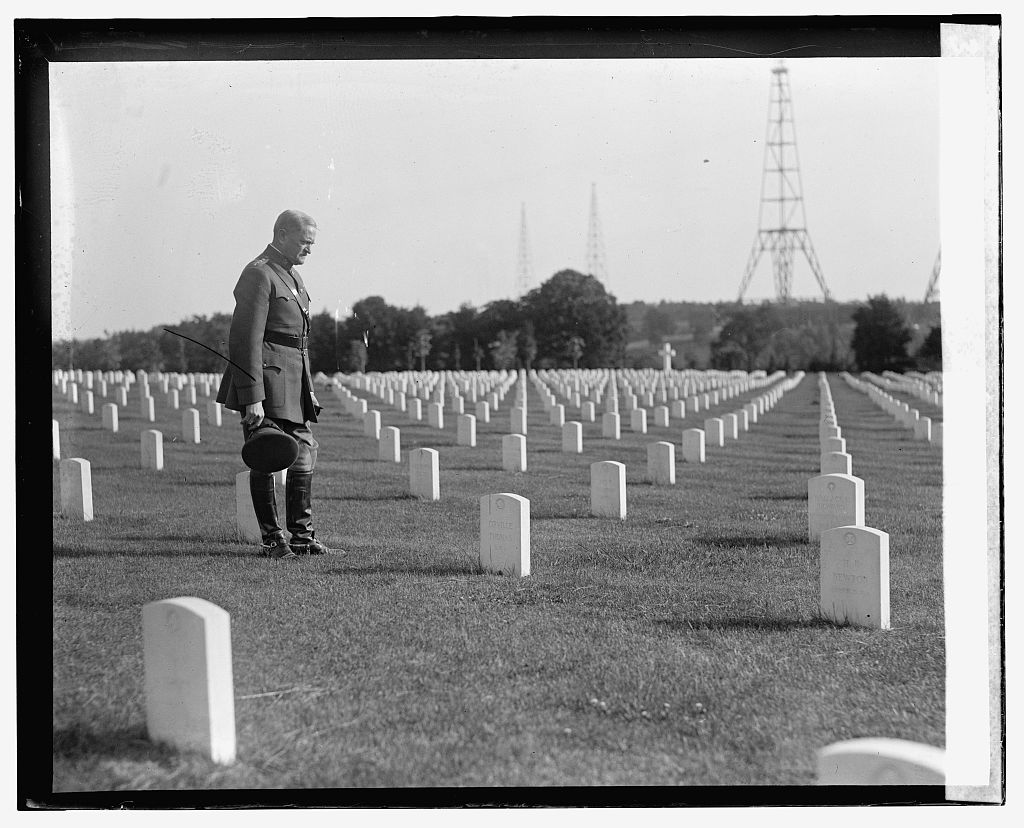
General Pershing among the stones at Arlington, May 1925. Photo credit: Library of Congress.

“To such a memorial as exists here we can only come in a spirit of humility and of gratitude. We can not hope to repay those whom we are assembled to honor. They were moved by a noble conception of human possibilities and human destiny. But we can undertake to find what was their inspiration and seek to make it our guide. By that they will be recompensed…

Photo credit: Library of Congress.

“We live far enough away from those times of test and trial to know that sincerity and honesty did not all lie on either side. We know the conflicts of loyalties, traditions, ancestry, and interest which drew men to one side and the other. I doubt if there ever was another so great and elemental a conflict from which men emerged with so much of mutual respect, with so little of bitterness and lingering hostility. The struggle brought the whole Nation at last to see that its only assurance was in unity. United, it could go its way in all security; divided, both sections becoming the prey of jealousy and intrigue, would have dissipated all the power they now have for good in the world.

Photo credit: Library of Congress.

“Our generation has recently lived through times still so vivid as to seem but as yesterday, which have taught us deeply to appreciate the value of union in purpose and effort. We have come to see as through a crystal that in the national variety of talents and resources, of cultures and capacities, of climates and of soils, of occupations and of interests, lies the guarantee of both our power and our authority. More than that, they have taught us how heavy and important is our responsibility in the world…

Bestowing flowers and salute to the Unknown Soldier, Arlington, Memorial Day, 1925. Photo credit: Library of Congress.

“Our gathering here today is in testimony of supreme obligation to those who have given most to make and preserve the Nation. They established it upon the dual system of State government and Federal Government, each supreme in its own sphere. But they left to the States the main powers and functions of determining the form and course of society. We have demonstrated in the time of war that under the Constitution we possess an indestructible Union. We must not fail to demonstrate in the time of peace that we are likewise determined to possess and maintain indestructible States. This policy can be greatly advanced by individual observance of the law. It can be strongly supplemented by a vigorous enforcement of the law. The war which established Memorial Day had for its main purpose the enforcement of the Constitution. The peace which followed that war rests upon the universal observance of the Constitution. This Union can only be preserved, the States can only be maintained, under a reign of national, local, and moral law…” – President Calvin Coolidge, Arlington National Cemetery, May 30, 1925

Photo credit: Library of Congress.

On Lindbergh and the Spirit of America

Lindbergh-and-Coolidge,-1927It matters not what era or generation we find ourselves, there is an irrepressible impulse to search for and take pride in exceptional deeds, heroic achievements and great examples of character, courage and competence. As Americans we especially prize the opportunity to honor noble men and women. It reminds us that good is still rewarded and it renews our faith. Such was the occasion eighty-seven years ago, when young Charles Lindbergh completed the first ever solo transatlantic flight, a 3,600 mile, 33 and a half-hour feat, from Roosevelt Field in New York to Le Bourge Field, outside Paris, on May 20-21, 1927.

Returning to his homeland, Colonel Lindbergh found a nation ready to recognize what he had done not only for its contributions to aviation but to a much larger degree how he furnished a front-page opportunity to take stock of what was really good and worthwhile about America. Not unlike today, Americans had heard enough negativity and criticism of their ways, their institutions, their shortcomings. Too little regard had been given to her accomplishments, to the things that were genuinely wholesome, admirable and worthy of praise when it came to America. Americans, then as now, loved their country and wanted others to better understand why that love remained justified. It was more than a chance to display scientific acumen, to gloat at what others had failed to do, it was a time to manifest good will, charity and service, especially as the people of France mourned the loss of the two pilots (Charles Nungesser and Francois Coli) sent westward to complete the same challenge just 13 days before Lindbergh’s arrival in Paris. It was not a time to flaunt greatness for its own sake, it was a time to commend bravery and ingenuity in the midst of tangible danger. It was a celebration of what was best about America, not with militaristic nationalism, but with humble circumspection and joy at reaching a human goal that had been years in the striving.

Charles_Lindbergh_and_the_Spirit_of_Saint_Louis_(Crisco_restoration,_with_wings)

The occasion that bestowed the Distinguished Flying Cross, a medal signed into existence by President Coolidge the summer before, on Colonel Lindbergh was not the result of one man or one city, it was the product of some of America’s finest engineers and innovators, like Fred Rohr, whose design of the fuel system for The Spirit of St. Louis made greater distances reachable for the first time. It was the people of San Diego and the determined folks of Ryan Airlines, who turned a tuna cannery into the creator of one of the most exceptional planes ever constructed. They met Lindbergh’s sixty day deadline, spending hundreds of thousands less than the forest of competitors rushing to build the plane that would make the crossing. It was creative minds like those of Donald Hall, the chief engineer for Lindy’s plane, who devised a way to furnish enough lift despite a fuel load heavier than the aircraft itself. On and on the list could go, recounting the great deeds of those who dreamed big dreams, dared to test the bounds of the possible, and finally reaped the rewards and the risks of what had never been done before but now could be thanks in no small part to America’s freedoms and opportunities.

Welcoming this young American home, President Coolidge addressed the 100,000 gathered on this day on the north side of the Washington monument:

“My Fellow Countrymen:

“It was in America that the modern art of flying heavier-than-air machines was first developed. As the experiments became successful, the airplane was devoted to practical purposes. It has been adapted to commerce in the transportation of passengers and mail and used for national defense by our land and sea forces. Beginning with a limited flying radius, its length has been gradually extended. We have made many flying records. Our Army flyers have circumnavigated the globe. One of our Navy men started from California and flew far enough to have reached Hawaii, but being off his course landed in the water. Another officer of the Navy has flown to the North Pole. Our own country has been traversed from shore to shore in a single flight.

“It had been apparent for some time that the next great feat in the air would be a continuous flight from the mainland of America to the mainland of Europe. Two courageous Frenchmen made the reverse attempt and passed to a fate that is as yet unknown. Others were speeding their preparations to make the trial, but it remained for an unknown youth to tempt the elements and win. It is the same story of valor and victory by a son of the people that shines through every page of American history.

“The absence of self-acclaim, the refusal to become commercialized, which has marked the conduct of this sincere and genuine exemplar of fine and noble virtues, has endeared him to everyone. He has returned unspoiled. Particularly has it been delightful to have him refer to his airplane as somehow possessing a personality and being equally entitled to credit with himself, for we are proud that in every particular this silent partner represented American genius and industry. I am told that more than 100 separate companies furnished materials, parts, or service in its construction.

“And now, my fellow citizens, this young man has returned. He is here. He has brought his unsullied fame home. It is our great privilege to welcome back to his native land, on behalf of his own people, who have a deep affection for him and have been thrilled by this splendid achievement, a colonel of the United States Officers’ Reserve Corps, an illustrious citizen of our Republic, a conqueror of the air and strengthener of the ties which bind us to our sister nations across the sea, and, as President of the United States, I bestow the distinguished flying cross, as a symbol of appreciation for what he is and what he has done, upon Colonel Charles A. Lindbergh.”

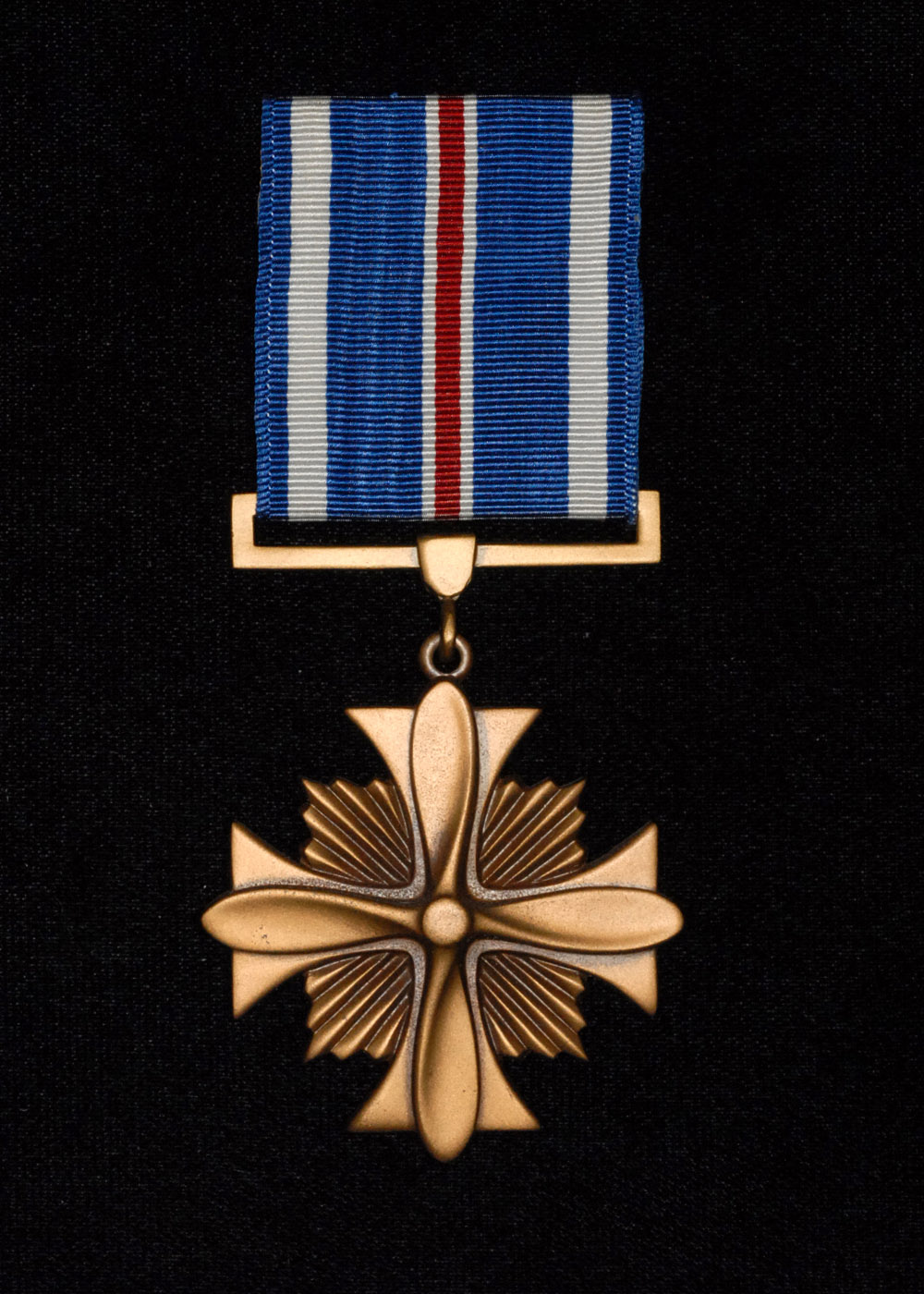
Created in section 12 of the Air Corps Act on July 2, 1926, the eventual design was completed by Miss Elizabeth Will and A. E. DuBois of the Army's Heraldic Section (now called the Institute of Heraldry), who integrated the symbolism of a cross for sacrifice, superimposed with four propellers and completed by five sun rays in each angle of the cross to denote the greatness of the deeds for which bestowed. Finally the red, white and blue drawn from the American flag completes the distinctive yet simple appearance of the medal. Despite criticism of the design by those who did more than most to champion its creation, the rank and file soldier, Marine, sailor and airman always had a strong affection for it. Consequently, despite pressure to alter it, the original design has remained unchanged since its inception eighty-eight years ago.

Created from section 12 of the Air Corps Act on July 2, 1926, the eventual design was completed by Miss Elizabeth Will and A. E. DuBois of the Army’s Heraldic Section (now called the Institute of Heraldry), who integrated the symbolism of a cross for sacrifice, superimposed with four propellers and completed by five sun rays in each angle of the cross to denote the greatness of the deeds for which it would be bestowed. Finally the red, white and blue drawn from our national colors completes the distinctive yet simple appearance of the medal. Despite criticism of the design by those who did more than most to champion its creation, the rank and file soldier, Marine, sailor and airman always had a strong affection for it. Consequently, despite pressure to alter it, the original design has remained unchanged since its inception eighty-eight years ago.

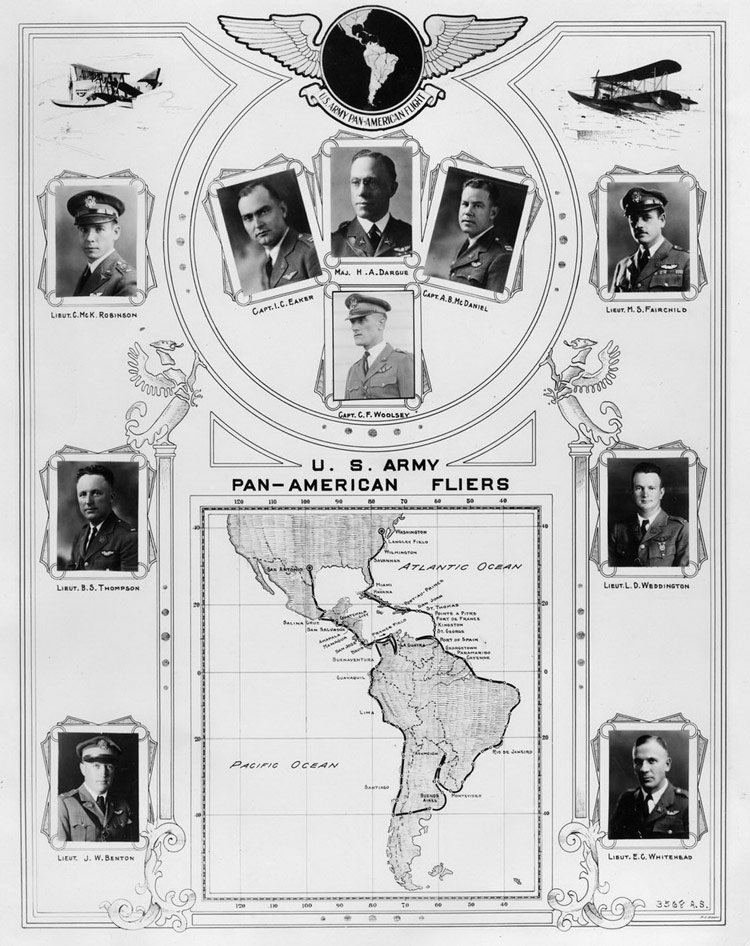
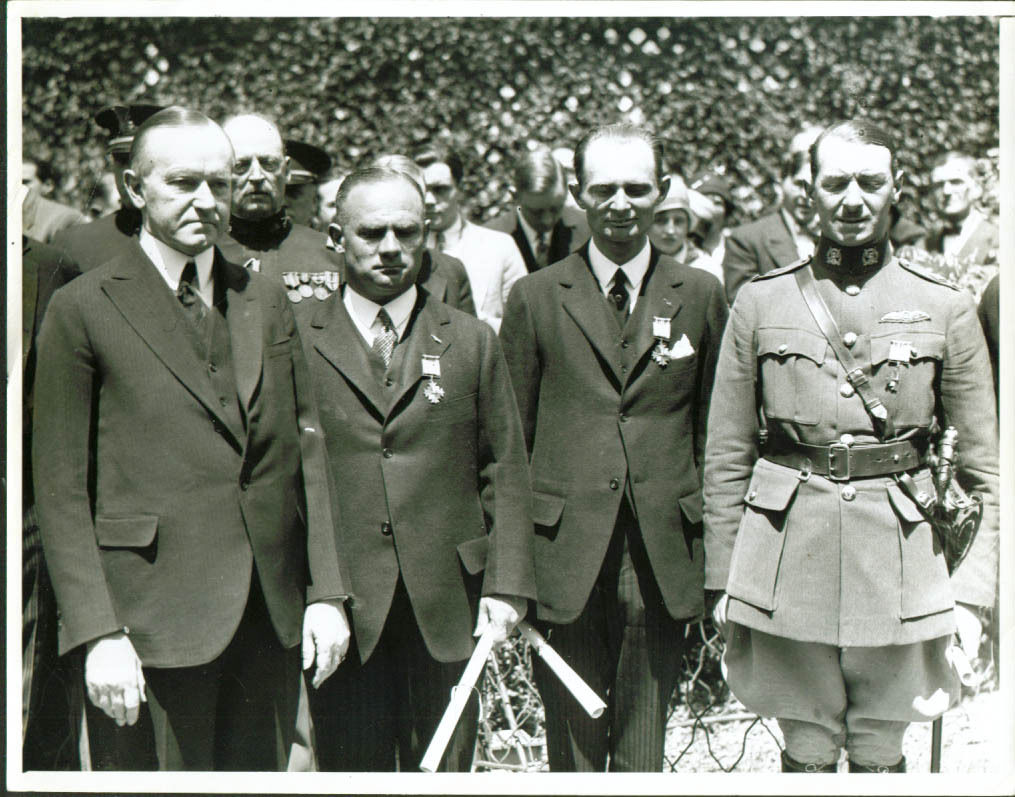
While Lindbergh was the first to receive the Distinguished Flying Cross in medal form on June 11, he was not the first to receive the citation, as the ten pilots of the Pan-American Goodwill flight of 1926 were, seen here. Lindbergh would join a vast assembly of aviators, inventors and entrepreneurs, before and after him, who would take on the unknown and leave their mark on the development of flight. As Coolidge would recount, from the earliest efforts of Wilbur and Orville Wright, along the shores of Kitty Hawk on December 17, 1903, to the circumnavigation of the globe by Major Frederick L. Martin in 1924, the effort to make flight attainable came through much trial and error, failure and success. Commander John Rodgers would begin a transpacific crossing in 1925 and be rescued after ten days at sea off the coast of Hawaii. Commander Richard E. Byrd, joined by Warrant Officer Floyd Bennett, would fly over the North Pole on May 9, 1926. The first shore to shore non-stop flight would be done by Lieutenants John A. Macready and Oakley Kelly from New York to San Diego in May 1923. After signing the legislation that created the Distinguished Flying Cross, President Coolidge would recognize upwards of fifty-eight aviators between 1927 and 1929 whose “act of heroism or extraordinary achievement” merited the honor.

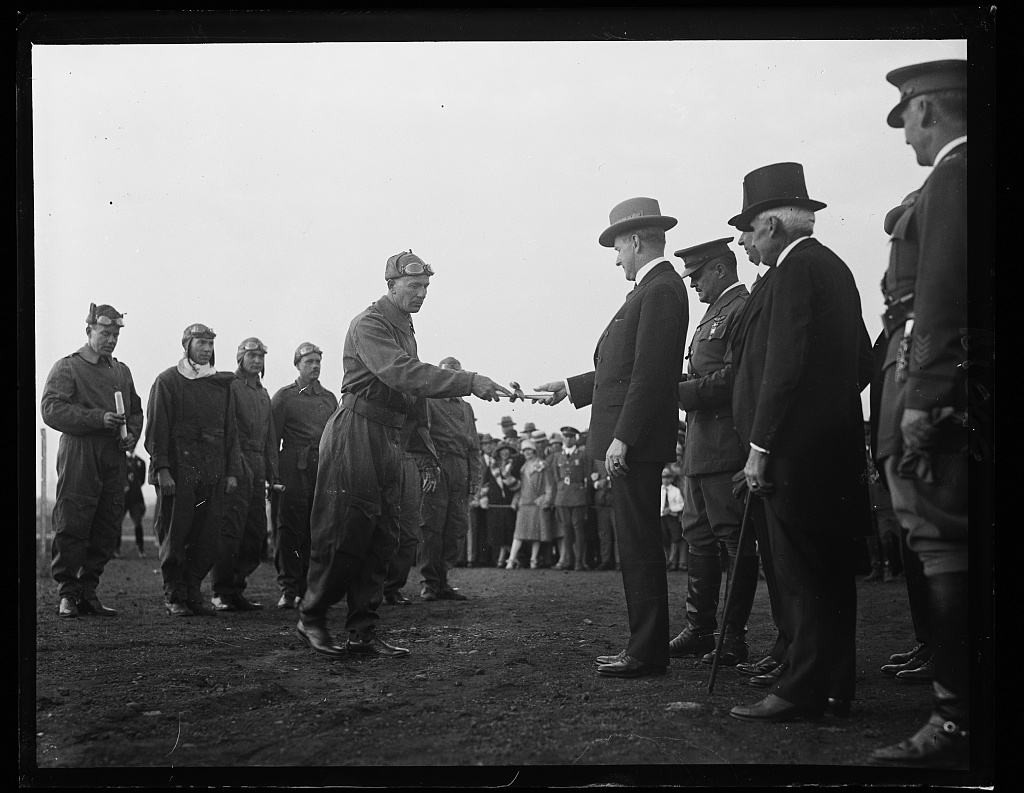
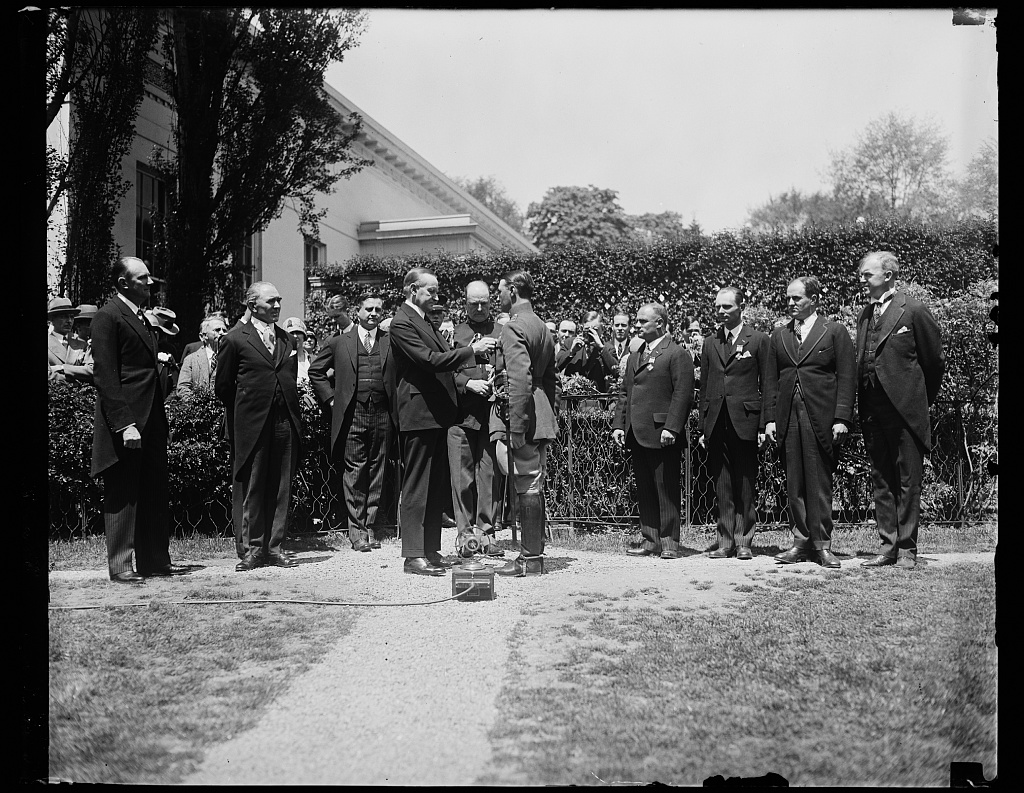
President Coolidge gave the Distinguished Flying Cross certificate for the first time just over a month before the Lindbergh ceremony. Here Major Herbert A. Dargue accepts one of the ten awards bestowed that day, May 2, 1927. Two would be given posthumously in recognition of Captain Clinton Woolsey and Lieutenant John Benton who tragically died from collision with another of the 5 ships to take part in the Pan-American Goodwill Flight, February 26, 1927.

President Coolidge gave the Distinguished Flying Cross certificate for the first time just over a month before the Lindbergh ceremony. Here, at Bolling Field in Washington, Major Herbert A. Dargue accepts one of the ten awards bestowed that day, May 2, 1927. Two would be given posthumously in recognition of Captain Clinton Woolsey and Lieutenant John Benton, who tragically died from collision with another of the 5 ships participating in the Pan-American Goodwill Flight, February 26, 1927.

The pilots of the Pan-American Goodwill Flight, 21 December 1926-2 May 1927

The pilots of the Pan-American Goodwill Flight, 21 December 1926-2 May 1927

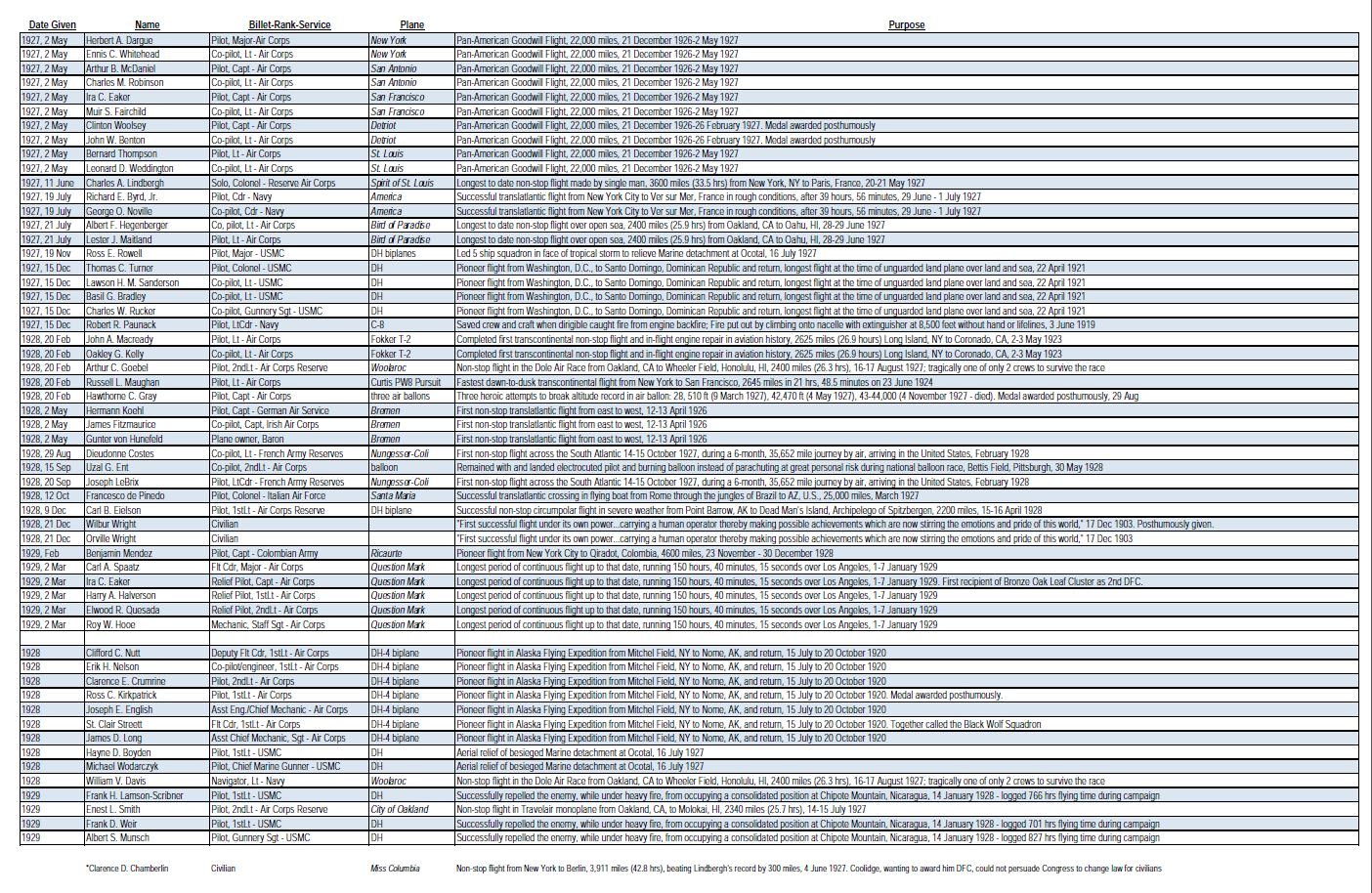
Here is a working list of the 55 individuals who were awarded the Distinguished Flying Cross during the Coolidge years. While many are not on this list including those who flew operations during this time period but were recognized later and certain civilians to whom the award was granted prior to revision of section 12 of the Air Commerce Act by Coolidge's Executive Order 4601 effective March 1, 1927. As research best confirms the names are in chronological order by date of award, with a second list noting known recipients by year only.

Here is a working list of the 56 individuals who were awarded the Distinguished Flying Cross during the Coolidge years. Many are not on this list including those who flew operations during this time period but were recognized after Coolidge’s term of office ended and certain civilians to whom the award was granted prior to revision of section 12 of the Air Commerce Act by Coolidge’s Executive Order 4601 effective March 1, 1927. As best research confirms the names are in chronological order by date of award, with a second list noting known recipients by year only. The name at the bottom is one whom the President tried unsuccessfully to have approved for the medal by Congress. Mr. Chamberlin declined the requirement of qualification: joining either the Air Corps or Navy as an aviator. As such he was never awarded the DFC. Also absent from this list are the tanker crews who collaborated in the endurance tests of Question Mark but failed to receive official recognition until 1976.

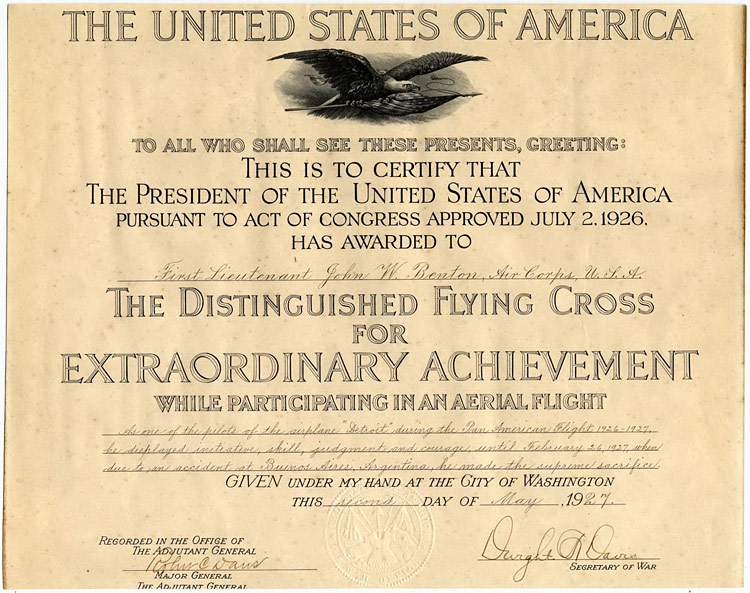
Lieutenant John W. Benton's Distinguished Flying Cross citation, May 2, 1927, representative of what was given by President Coolidge to the aviators of the Goodwill flight that day.

Lieutenant John W. Benton’s Distinguished Flying Cross citation, May 2, 1927, representative of what was given by President Coolidge to the aviators of the Goodwill flight that day.

As pointed out by the Distinguished Flying Cross Society, the law contained three fascinating elements in awarding the DFC:

1. The medal could be bestowed retroactively, as would be done by Coolidge for the Wright brothers, who were recognized on December 18, 1928. Wilbur received it posthumously, having died in 1912. Orville, still alive, would meet Lindbergh and take an active part in the Civil Aeronautics Conference in 1928. Many would carry out their work in aviation during the early 1920s but not be honored until after Coolidge’s time.

2. The medal was not predicated upon combat heroism, it placed an equal esteem for heroism in peacetime. Of the fifty-six given under the Coolidge administration, the vast majority would be for actions done outside of hostilities. James Doolittle would earn his first two Flying Crosses for the first cross-country flight in 1922 and work with acceleration in 1924 but not be officially recognized until August 1, 1929. For the first endurance record, logging 150 hours in air, all five crewmen of the Question Mark would be given the Flying Cross as one of Coolidge’s last official acts in January 1929. Even aviators of other countries were recognized with the medal for their pioneering work, such as Captains Hermann Koehl and James Fitzmaurice with Baron von Hunefeld, who were the first to cross the Atlantic from Europe to America eleven months after Lindbergh landed in Paris.

Captain Koehl of Germany being presented with the Distinguished Flying Cross by President Calvin Coolidge, at noon on May 2, 1928.

Captain James Fitzmaurice of Ireland being presented with the Distinguished Flying Cross by President Calvin Coolidge, at noon on May 2, 1928.

Coolidge also recognized Captain Koehl's co-pilot, Captain James Fitzmaurice of Ireland and Baron von Hunefeld with Flying Crosses for together becoming the first to successfully cross the Atlantic from east to west, proving that in spite of stiffer wind patterns travel could go both ways by air.

Coolidge also recognized Captain Koehl of Germany and the owner of the Bremer, Baron von Hunefeld (between Koehl and Fitzmaurice), with Flying Crosses for making the trek jointly thereby becoming the first to successfully cross the Atlantic from east to west and proving that in spite of stiffer wind patterns travel could go both ways by air.

3. The medal was the first to be universal to all branches of the service. Up to then, medals were distinct to the specific part of the military to which one was attached. The Distinguished Flying Cross, representing sacrifice and flight, is not only the oldest military aviation medal but, perhaps more than any other, encapsulates America. In a unique way the medal brought down artificial barriers and reminded us of our obligations to others, celebrating what is best about our country and most noble in human nature itself. Maybe that is why Coolidge liked it so much. He understood more enduring good could be secured not by fixating on her imperfections but by reflecting on the reasons America inspires and remains worthy of respect and admiration. If our nation was to improve, it remained with us not to tear down but build up, not nurse old hatreds and envies but contribute by first being better people, better neighbors, and better citizens ourselves.

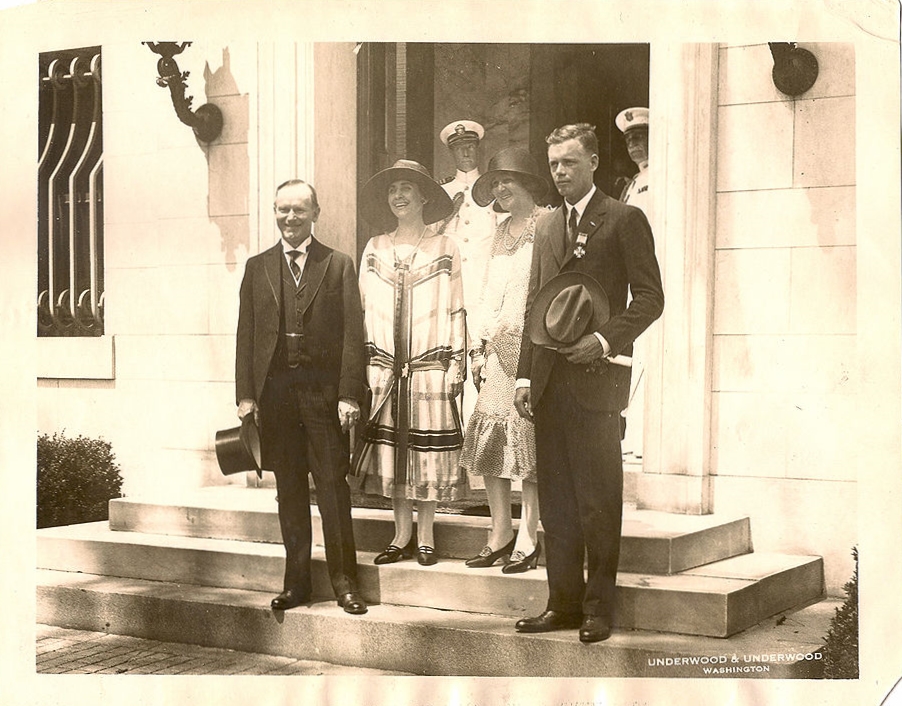
Lindbergh and his mother hosted by the Coolidges at DuPont Circle, where the President and his wife stayed during repairs to the White House roof that spring. Notice how everyone is cheerful except the unexpectedly sober figure on the right. Lindbergh, about to appear in a light suit, was corrected by Coolidge who chose a dark suit for him as better befitting the formality of the occasion. Even returning heroes need to take care of the way they dress. They set a deeper example than they may realize, one  that should not be treated flippantly.

Lindbergh and his mother hosted by the Coolidges at DuPont Circle, where the President and his wife stayed during repairs to the White House roof that spring of 1927. Notice how everyone is cheerful except the unexpectedly sober figure on the right. Lindbergh, about to appear in a light suit, was corrected by Coolidge who chose a dark suit for him as better befitting the formality of the occasion. Even returning heroes need to take care of the way they dress. They set a deeper example than even they may realize. It is one that should not be treated flippantly.