“Any man who has been placed in the White House can not feel that it is the result of his own exertions or his own merit. Some power outside and beyond him becomes manifest through him. As he contemplates the workings of his office, he comes to realize with an increasing sense of humility that he is but an instrument in the hands of God” — Calvin Coolidge, ‘The Autobiography’ (1929)
legacy
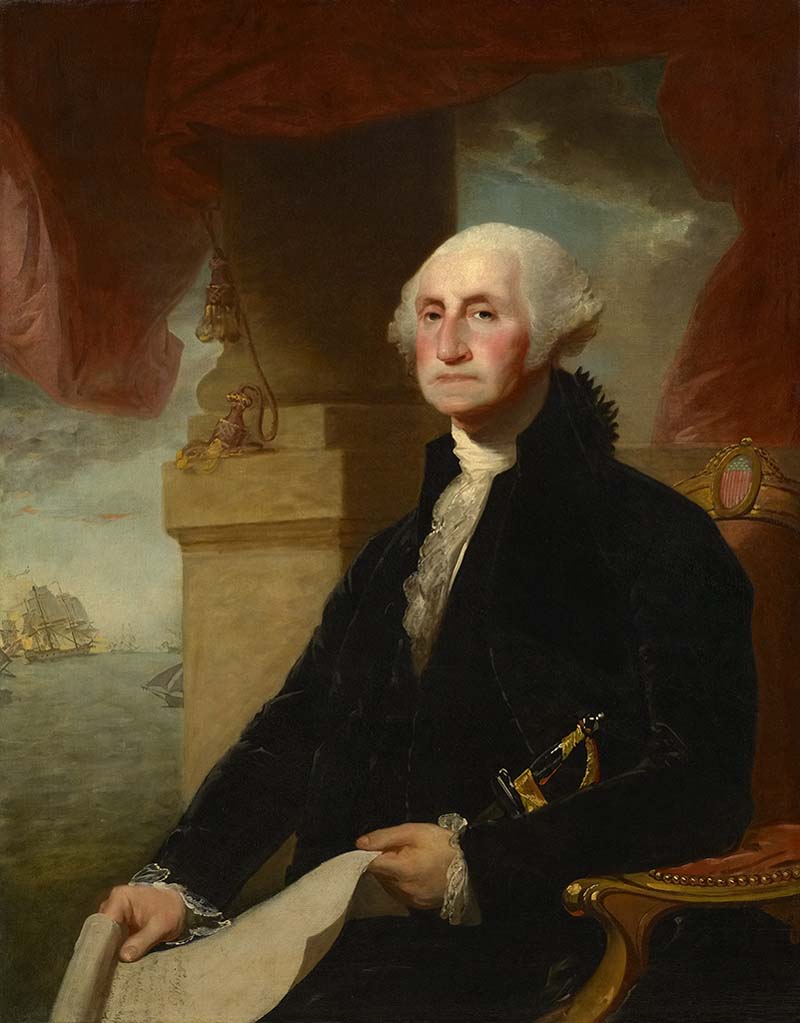
On George Washington
“February 22 marks the …birthday of George Washington. His stature has only increased with the years. His public life was characterized by complete unselfishness. Indifferent to his own fortunes, his only concern was for his country. He needed no pretense and no art. He was simply and naturally great.” He was, in short, “the personification of judgment and character” — Calvin Coolidge, February 20, 1931.
Tomorrow marks the two-hundred eighty-first anniversary of President Washington’s birthday. To Coolidge, the first President was not without his mistakes, as with any man, but he remains worthy of our esteem and emulation for not only his life of service but also his impeccable integrity. As the former President looked back on the example of Washington in the early months of 1931, he may have recalled the remarkable precedent his forbear set by laying down the power of his office after only two terms. Washington could have held the Presidency for life or passed it to his heirs and yet he laid it down with characteristic humility. Coolidge adhered to that same selfless demonstration in 1929. As he describes the attributes of Washington, however, he reminds the reader of not only what made the first President truly great but also of those qualities the thirtieth President prized and practiced in his own life. One instantly thinks of Coolidge when the absence of pretense is commended. There were no ostentatious displays with Coolidge. What you saw is who he was without conceit or facade. He had no patience for those who put on airs. He would even make the bejeweled “social queens” of Washington wait in the reception lines while he “took a break” from shaking hands. Humble simplicity defined him in public just as it did in private. Coolidge bequeaths a legacy not unlike Washington’s to those who sincerely honor character above politics and service above self-importance.
A Short Walk Through Coolidge Literature

As we await Amity Shlaes’ long-anticipated “Coolidge” on Tuesday, I think back on the lengthy line of treatments he has received since Robert M. Washburn’s “First Biography” was printed in 1920. In 1923, when Washburn produced his revised 169-page biography under the same title, the President was given a copy to critique. Not one given to self-promotion, he had refused to allow his collection of speeches published as “Have Faith in Massachusetts” to be circulated during the 1920 campaign. But Washburn’s style caught his attention so much so that Coolidge was soon showing off the first chapter of the book to Bruce Barton, “Pretty good, isn’t it?” he proudly declared (Fuess 493). A number of the earliest efforts to both understand who Coolidge was and how to relate that to others fell short in the rush to the printers. Fellow Amherst alumni (like Robert A. Woods), fellow state legislators (like Roland Sawyer), relatives of friends (like Richard Scandrett, brother-in-law of Dwight Morrow) and Boston journalists (like Michael Hennessy and Edward E. Whiting) would all make attempts to capture their elusive subject for curious readers. Then there were those who knew him from childhood, like his former schoolteacher, Edward C. Carpenter, who wrote “The Boyhood Days of President Calvin Coolidge” in 1925. His secretary, C. Bascom Slemp, collected a broad range of the President’s comments on various subjects and organized them for publication as “The Mind of the President” in 1926. Neither vain nor pretentious, the President underscored his political consistency when he had an opportunity to mention the book during one of his bi-weekly press conferences on March 12, 1926, after a copy had been brought to him. “Glancing at it I see that it is very well indexed and there is topically arranged in the book things that I have said in relation to a great many subjects. I think your offices ought to provide each one of you with a copy of the book.” When the pressmen asked for his autograph in each copy, he dryly retorted, “Yes, I would be glad to, and whenever you want to know what my position is on any subject, if you will just glance at that index it will very quickly refer you to a place in the book where you can learn what I have said in relation to a very great many different subjects” (“The Talkative President,” p.27). Talk about consistency! His positions were not driven by popular sentiment.
There were also those who, like disgruntled Ike Hoover, had an ax to grind when it came to Coolidge. Their treatments tell us far more about the writer’s prejudices than they honestly reveal about their supposed subject. The efforts to discredit the man came quickly on the wings of his retirement, like with Duff Gilfond’s sarcastic lampoon, “The Rise of Saint Calvin,” (read in the fall of 1932 by the former President, Fuess p.463) Others, would follow in the steps of “New Deal” historians years later, who had to discredit Coolidge in order to validate the policies of his successors. As Jim Cooke has said, however, “friends don’t let friends read” William Allen White’s “Puritan in Babylon” without first reading Sheldon Stern’s essay on the Coolidge Stereotype (http://www.calvin-coolidge.org/william-allen-white.html). I don’t recommend wasting those precious hours of your life wading through White at all. Donald McCoy would channel the “approved history” when he, in “Quiet President,” discarded Coolidge’s political outlook as too simplistic and inept for what America needed (p.56). Apparently, for “New Deal” historians, what is needed is more government, more spending and less economic and political freedom. Thomas Silver has superbly dissected these unjust biases of historical reporting in his “Coolidge and the Historians.” In truth, “Silent Cal” speaks clearer and more directly to America’s needs than they will admit. Since President Reagan replaced Jefferson’s portrait with that of Coolidge’s, a renewal of appreciation for the man has been growing. Up to that time, the only worthwhile, full-length biography of Coolidge was by Claude M. Fuess entitled “Calvin Coolidge: The Man From Vermont,” written forty years before! Certainly, since that biography an accumulating body of work has been done by Edward C. Lathem, Howard Quint, Robert Ferrell and others to recover the truth about the man buried underneath a mountain of historical misinformation. The Calvin Coolidge Memorial Foundation has kept the fires burning through it all. The return of Coolidge’s writings and speeches to publication in no small way enables a renewal of appreciation for him and his accomplishments. The best introduction to Coolidge is found in his own words. “The Autobiography,” “Have Faith in Massachusetts,” “The Price of Freedom” and “Foundations of the Republic” are the greatest starting points to meet the man.
In the last forty years we have seen the work of a “great cloud of witnesses” including Marvin Stone, John Earl Haynes, Paul Johnson, Robert Sobel, Jerry Wallace, Hendrik Booraem V, J. R. Greene, David Pietrusza, John Derbyshire, Peter Hannaford, Jim Cooke and Amity Shlaes (among a multitude of others) who have and continue to help bring Coolidge and his principles out of the “silence” they have been held for far too long. To appreciate who he was and what he accomplished is not merely some abstract exercise or reactionary dream, it has direct bearing on our future. It furnishes us today with a proven course that, if implemented, charts the way out of enslaving debt and the institutionalized repression of our experiment in self-government began that summer of 1776.
 The Importance of the Obvious