On Political Satire

Image

On January 4, 1928, Will Rogers, the era’s renowned cowboy comedian-columnist, led a radio hookup that featured participants all across the country, including the famous Al Jolson and the influential Paul Whiteman and his orchestra. It is interesting that both Jolson and Whiteman profoundly inspired many Americans (from Duke Ellington and Billie Holiday to Dick Clark and Bing Crosby) to launch their talents on the public stage. Whiteman was known as the “King of Jazz” while Jolson provided a sense of common identity and respect between minorities, immigrants and “Anglo-Saxons” through his black-face performances. Derided now, Jolson was loved across the demographics then. Will Rogers led this colorful gathering of talent to advertise Dodge automobiles.

As he continued the broadcast, in his characteristic drawl, he said, “Radio fans, I have a friend in Washington who on account of what the Automobiles have done for his Economy wants to speak to you, Mr. Coolidge, all right Mr. Coolidge go ahead…”

Rogers then employed a clever impersonation of the President’s “Vermont twang” and style of expression, ribbing Coolidge with this nonsensical series of comments:

     Ladies and Gentlemen, I am supposed to deliver a message every year on the condition of the country, I find the County as a WHOLE prosperous. I don’t mean by that, that the WHOLE country is prosperous, But as a WHOLE, its prosperous, That is its prosperous as a WHOLE. A WHOLE is not supposed to be prosperous, There is not a WHOLE lot of doubt about that…

Rogers, continuing to replicate Coolidge’s voice went on to political events in succinct and casual snippets, mentioning Mellon at Treasury, the Congress, “Smart Boy” Dwight Morrow and “Lindberg.” Rogers wrapped it up with a reference to Coolidge’s “I do not choose to run” statement from the previous year and how Prohibition was going.

All seemed fine until a few days later when Rogers dined at the home of Speaker Nicholas and his wife, Alice Roosevelt Longworth. To Rogers’ shock he learned of a New York Times piece chastising the comedian for “going too far” when it came to Presidential satire. He had even confused and angered some listeners who took issue with a President endorsing Dodge vehicles. Immediately, he sent a profuse letter of apology to both Mr. and Mrs. Coolidge, ending with the line with characteristic lack of punctuation, “If there ever was a sad Comedian, I am one, and I do ask all the forgiveness that its in your and Mrs. Coolidges power to give, Yours most respectfully, Will Rogers.”

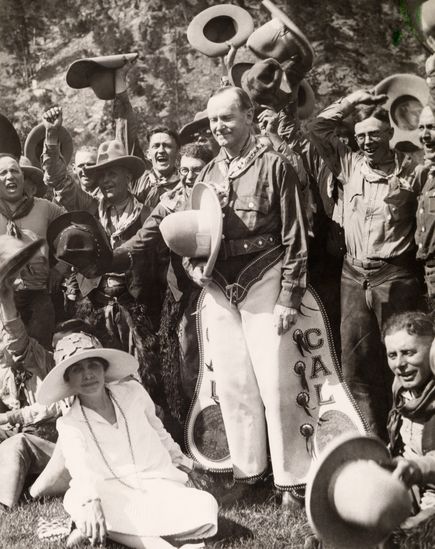
The President, who responded to criticism directed at him the previous year for wearing that silly cowboy outfit including customized chaps with, “It is good for people to laugh,” wrote this kind and sensible reply to the ashamed comedian:

     THE WHITE HOUSE

     Washington

                                                                                                      January 11, 1928

     My dear Mr. Rogers:-

     Your letter has just come to me. I hope it will cheer you up to know that I thought the matter of rather small consequence myself though the office was informed from several sources that I had been on the air. I wish to assure you that your note makes it all plain that you had no intention save harmless amusement.

     I hope you will not give the affair another troubled thought. I am well aware how nicely you have referred to me so many times.

                                                                                                      Cordially yours,

                                                                                                      Calvin Coolidge

As Lawrence E. Wikander, former Curator of the Coolidge Room at Forbes Library, has noted in his article, “Will Rogers and Calvin Coolidge” in The Real Calvin Coolidge, volume 13, “Even a slight acquaintance with the President would convince one that would not send such a warm letter if he were offended” (p.14). Yet that is exactly what biographers have done since 1939! Each seems oblivious to this letter and Coolidge’s explicit dismissal of any offense taken. Such is one of the many persistent Coolidge myths to continue in spite of the facts.

As Mr. Wikander points out, Rogers not only considered the matter closed…he would impersonate Coolidge again and in the coming years after the White House regularly chided Coolidge with public satire. They would meet in March of 1930 at the dedication of Coolidge Dam in Arizona and remain clearly on the warmest of terms.

This obscure incident of political satire from eighty-five years ago illustrates how far the culture has gone. Instead of continuing the progress evident in Coolidge’s day, the culture has become more restrictive, seemingly incapable of laughing at itself, “choosing” to take offense rather than embracing the healthy sense of proportion that events warrant.

It is forgotten what a long road of passionate political expression has been traversed in our country. When President Washington received Chief Justice Jay back from Great Britain following the negotiation of an unpopular treaty with the recently vanquished “Mother Country,” Jay observed he could travel back to the capital by the lights of likenesses of him burned in effigy. Everything from death threats to obscene acts were directed against President Bush, an experience shared by numerous Presidents before him.

Infinitely less has been done by the rodeo clown at the Missouri State Fair. Yet, in spite of the enthusiastic reaction from those who were in the audience…it is “racist,” “hateful” and “intolerant” to lampoon the President. Apparently he is to be held above criticism, however comedic. It is a grave loss to our liberty when political correctness is awarded the power to silence the most harmless of satirical performances while destroying the individual who utters anything not approved by government authorities. What is left of our freedom to express political opinion when satire is no longer allowed?

Image

On Responsible Governing

Image

“When you substitute patronage for patriotism, administration breaks down. We need more of the Office Desk and less of the Show Window in politics. Let men in office substitute the midnight oil for the limelight” — Calvin Coolidge, September 1916, from full speech in Have Faith in Massachusetts, p.46.

While Coolidge was specifically addressing his state’s departure from a responsible exercise of civic obligation toward the sick, poor, and mentally infirm, the “unfortunates” were not being helped by a system that rewarded the appearance of caring over substantive actions. As he had said two years before, “The normal must care for themselves. Self-government means self-support…Do the day’s work. If it be to protect the rights of the weak, whoever objects, do it. If it be to help a powerful corporation better to serve the people, whatever the opposition, do that. Expect to be called a stand-patter, but don’t be a stand-patter. Expect to be called a demagogue, but don’t be a demagogue…Don’t expect to build up the weak by pulling down the strong.”

Coolidge was incensed by the partisan posture that passed laws, rewarded political friends and manifested “compassion” based on the electoral calendar. This utter abandonment of responsible governance is being repeated today. State legislators, like those in Wisconsin, have skipped borders to avoid voting on public expenditure cuts. Other states, like California, are assuming greater and greater control of the cities against those of other citizens in the towns and countryside. Cities, like Detroit, are filing bankruptcy because local government has forfeited the future by spending gratuitously on political favorites rather than serving all its people with constructive economy and limited regulation. The federal government has not passed a budget for four years, yet has spent more than $10 trillion through continuing resolutions, administrative subterfuge and unprecedented disregard of the laws. 

The postponement of yet another provision of Obamacare, this time the full brunt of premium costs, at least until after the midterm elections, is just the kind of “Show Window” partisanship Coolidge found abhorrent in 1916. This postponement of an already unpopular, unaffordable and unworkable law is calculated for one purpose: to benefit the President and his Party in the next election. Such blatant manipulation of government to serve its own ends rather than those which genuinely benefit all the people deserves loud and wide rebuke. Next year’s ballot box affords a direct opportunity to turn out against this reckless system and for responsible governance.

On Books and the Pursuit of Learning

This bookplate was designed by Timothy Cole in 1929 and features an intricate bell-shaped system of roots in which the Plymouth Homestead is depicted in Vermont. The scene includes both of Coolidge's famous white collies, Rob Roy and Prudence Prim. In the foreground, a fishing rod leans against a tree beside a basket, both accessories of his many fishing trips. The flag unfurls on either side of a portrait of George Washington, framing the simple scene above Coolidge's name.

This bookplate was designed by Timothy Cole in 1929 and features an intricate bell-shaped system of roots in which is depicted the Plymouth Homestead in Vermont. The scene includes both of Coolidge’s famous white collies, Rob Roy and Prudence Prim. In the foreground, a fishing rod leans against a tree beside a basket, both accessories of his many fishing trips. The flag unfurls on either side of a portrait of George Washington, framing the simple scene above Coolidge’s name.

What a man reads and the quality of books in his library says as much as any other witness could about his character. From youth, he translated Cicero’s Pro Archia Poeta, the defense of the poet Archias’ citizenship against false accusations. As a man, he translated Dante’s Inferno from Italian. He reveled in the wisdom imparted by the great texts of civilization. In “Calvin Coolidge: At Home in Northampton,” Susan Lewis Well, the author of that excellent little book, recounts:

     Coolidge read before falling asleep at night, and Grace told of the pile of books that were on his bedside table never to be disturbed. The Bible was always there plus the Letters, Lectures, and Addresses of Charles Edward Garman…and two paperback volumes of Paradise Lost. Even when traveling, Coolidge carried the two copies of Milton’s classic.

     Mrs. Coolidge remembered that his library was housed in one small five-shelved oak bookcase ‘with a sateen curtain in front.’ His collection numbered about one hundred books including his college texts plus a leather-bound set of Shakespeare’s plays, three Kipling novels, and a set of Hawthorne’s works. Grace admitted that he seldom bought a book, although friends and writers gave him volumes until they numbered about five thousand by the time his presidential term was over.

The exponential growth of his library was not the only outcome due to the generosity of friends. One of the greatest of friends, Frank W. Stearns, commissioned the design of a bookplate in 1926 for Coolidge’s personal library. By 1928, Stearns had finally secured Sidney L. Smith, a renowned engraver, to complete the task. Smith drew the original work with two panels, the lower window featured the signing of the Mayflower compact in 1620 while the upper window depicted the Homestead at Plymouth. Sadly, Smith fell ill and passed away the following year before cutting the design in copper for replication.

     Stearns, undeterred, approached Timothy Cole, a very successful craftsman from New York City who specialized in the almost “lost art” of wood engraving. Cole, building on the design of Smith, completed the distinct work shown above.

In a fascinating survey of the personal libraries of the Presidents, well-known collector and a devoted Antiquarian like President Coolidge, Abraham S. W. Rosenbach said this about the thirtieth president in 1934:

     Calvin Coolidge will probably go down in history as one of the wisest of the Presidents. He had the reputation of being extremely cautious and I have a presentation copy of his Life, by William Allen White which seems to corroborate this statement. It bears on the fly-leaf in the President’s writing: ‘Without recourse, Calvin Coolidge.’

Characteristically, Coolidge says more in two words than most of us say in paragraphs. Employing this legal phrase, Coolidge is refusing any responsibility or endorsement of White’s work. A wise position to take, as time only makes more evident where White’s book is concerned.

Mr. Rosenbach continues, however,

     Mr. Coolidge was interested in the news of the world. He read of the sale in London of the original manuscript of ‘Alice in Wonderland’ which I had purchased. On my return from abroad in May, 1928, the President asked me to lunch at the White House and to bring with me the manuscript. I found that ‘Alice in Wonderland’ was one of his favorite books, that he was interested in Shakespeare, that he liked to own good editions. He asked me details of the first publication of ‘Alice in Wonderland’ and I tried to explain to him that the first edition, issued in 1865, not being altogether to [Lewis] Carroll’s liking, was suppressed. ‘Suppressed,’ said the President, ‘I did not know there was anything off-color in Alice!’

Rosenbach wraps up his presentation on Coolidge by noting the collection the President accumulated during the White House years would find a welcome home back in Northampton, all forty cases worth (an estimated 4,000 volumes). The built-in bookcases Coolidge would discover upon moving into “The Beeches” enabled him to unpack and organize his vast collection of literary treasures. Not the relentless purchaser that President Jefferson was, Coolidge steadied his love for great books with his abiding sense of economy [from the Greek, oikonomia]. His discernment of human nature came from his grounding in classical literature. It was his informed taste combined with the generosity of friends and citizens across America that made this wise man’s library.