“Law and Order,” 1920

“Law and Order,” 1920

In 1920, even as Calvin Coolidge would become Vice President-elect, few suspected that his voice, as clear and well-suited for radio as it was, would become a frequent part of life in the coming decade. As he would tell Senator James Watson, “I am very fortunate that I came in with the radio” (“As I Knew Them,” p.239). Jerry Wallace, in his superb book, “Calvin Coolidge Our First Radio President,” has found that not only was Coolidge the first to make full use of radio as President but he would become an instantly known and beloved voice of the era. As radio ownership would skyrocket in the 1920s, families would grow up with that distinctive “nasal twang” of President Coolidge on the waves. Of his one hundred and thirty-five Presidential speeches, including the first of his messages to Congress in December 1923, over thirty percent of those were delivered on the radio (some 40 messages, between 1923-1929). In this speech, Coolidge potently encapsulates his philosophy on government and citizenship. The text of this recording, produced by Nation’s Forum during the 1920 campaign to introduce the Harding-Coolidge team, is as follows:

“It is preeminently the province of government to protect the weak. The average citizen does not lead the life of independence that was his in former days under a less complex order of society. When a family tilled the soil and produced its own support it was independent. It may be infinitely better off now, but it is evident it needs a protection which before was not required.

Let Massachusetts continue to regard with the greatest solicitude the well-being of her people. By prescribed law, by authorized publicity, by informed public opinion, let her continue to strive to provide that all conditions under which her citizens live are worthy of the highest faith of man. Healthful housing, wholesome food, sanitary working conditions, reasonable hours, a fair wage for a fair day’s work, opportunity — full and free, justice — speedy and impartial, and at a cost within the reach of all, are among the objects not only to be sought, but made absolutely certain and secure.

Government is not, must not be, a cold, impersonal machine, but a human and more human agency: appealing to the reason, satisfying the heart, full of mercy, assisting the good, resisting the wrong, delivering the weak from any impositions of the powerful. This is not paternalism. It is not a servitude imposed from without, but the freedom of a right to self-direction from within.

Industry must be humanized, not destroyed. It must be the instrument not of selfishness, but of service. Change not the law, but the attitude of the mind. Let our citizens look not to the false prophet but to the pilgrims. Let them fix their eyes on Plymouth Rock as well as Beacon Hill. The supreme choice must be not to things that are seen, but to things that are unseen.

Our government belongs to the people. Our property belongs to the people. It is distributed. They own it. The taxes are paid by the people. They bear the burden. The benefits of government must accrue to the people. Not to one class, but to all classes, to all the people. The functions, the power, the sovereignty of the government, must be kept where they have been placed by the Constitution and laws of the people. Not private will, but that public will, which speaks with a divine sanction, must prevail.

There are strident voices, urging resistance to law in the name of freedom. They are not seeking freedom for themselves, they have it. They are seeking to enslave others. Their works are evil. They know it. They must be resisted. The evil they represent must be overcome by the good others represent. Their ideas, which are wrong, for the most part imported, must be supplanted by ideas which are right. This can be done. The meaning of America is a power which cannot be overcome. Massachusetts must lead in teaching it.

Prosecution of the criminal and education of the ignorant are the remedies. It is fundamental that freedom is not to be secured by disobedience to law. Even the freedom of the slave depended on the supremacy of the Constitution. There is no mystery about this. They who sin are the servants of sin. They who break the laws are the slaves of their own kind. It is not for the advantage of others that the citizen is abjured to obey the laws, but for his own advantage. That what he claims a right to do to others, that must he admit others have a right to do to him. His obedience is his own protection. He is not submitting himself to the dictates of others, but responding to the requirements of his own nature.

Laws are not manufactured. They are not imposed. They are rules of action existing from everlasting to everlasting. He who resists them, resists himself. He commits suicide. The nature of man requires sovereignty. Government must govern. To obey is life. To disobey is death. Organized government is the expression of the life of the commonwealth. Into your hands is entrusted the grave responsibility of its protection and perpetuation.”
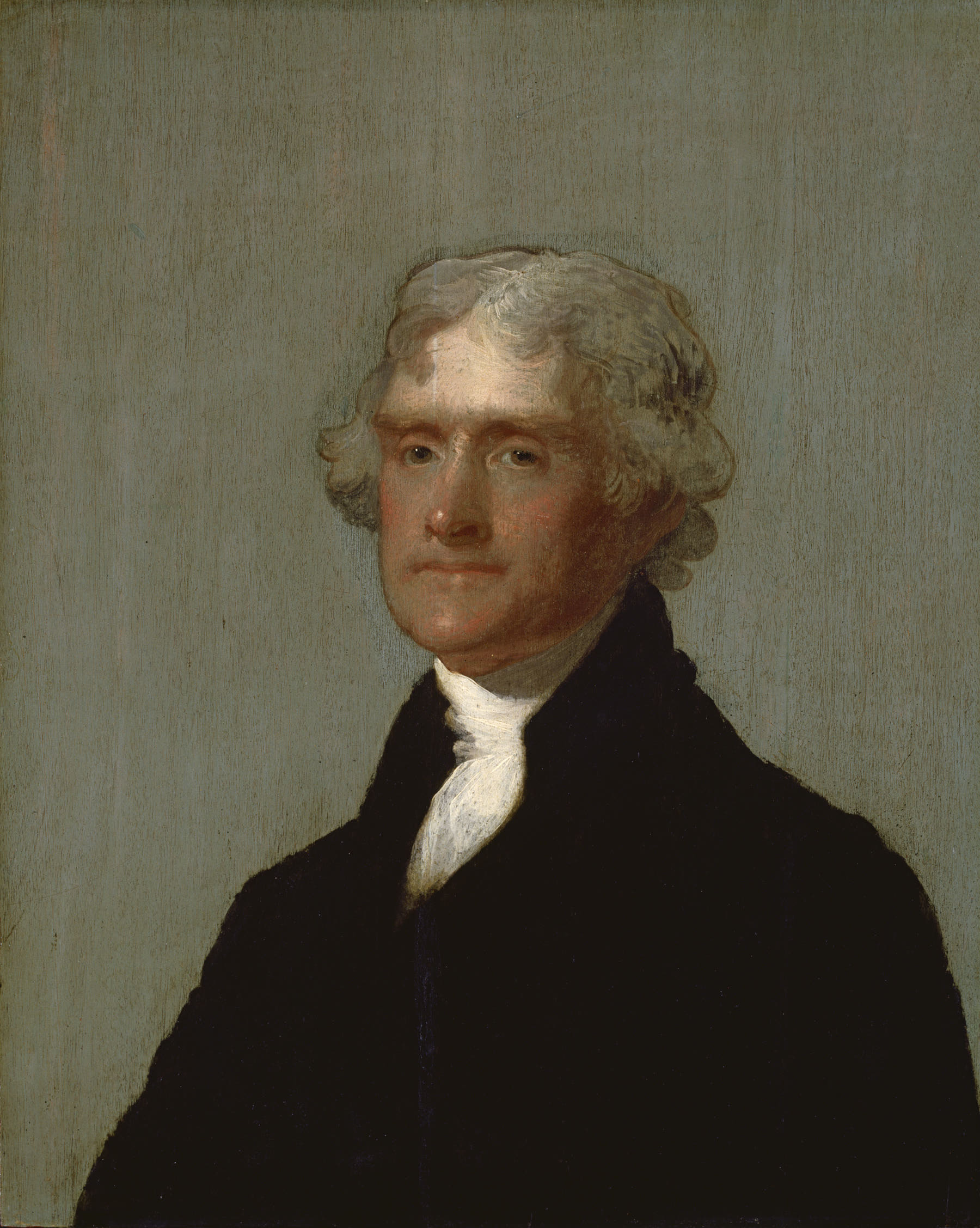
On Jefferson, Impeachment of Judges and State Nullification

“President Jefferson seems to have entertained the opinion that even the Supreme Court should be influenced by his wishes and that failing in this a recalcitrant judge should be impeached by a complaisant Congress. This brought him into sharp conflict with John Marshall, who resisted any encroachment upon the independence of the Court. In this controversy the position of Marshall has been vindicated…In spite of all his greatness, anyone who had as many ideas as Jefferson was bound to find that some of them would not work. But this does not detract from the wisdom of his faith in the people and his constant insistence that they be left to manage their own affairs. His opposition to bureaucracy will bear careful analysis, and the country could stand a great deal more of its application. The trouble with us is that we talk about Jefferson but do not follow him. In his theory that the people should manage their government, and not be managed by it, he was everlastingly right” (Calvin Coolidge, ‘The Autobiography,’ pp.214-5).

The independence of the Judiciary, even with the partisan campaigning of Justice Chase and perceived activism of Marshall, was the larger issue. If the courts were to retain autonomy as an equal branch in the national government without manipulation by the President or reprisal from Congress, it had to stand firm. Asserting its independence kept it from becoming subservient to either form of interference. It preserved the ability of the people to find justice. If the Court had simply deferred, the people would have lost liberty, having no legal recourse or remedy from either Executive will or Legislative preference. It maintained the Constitutional equilibrium and kept the courts open to the people’s claims.

Due to the intense unpopularity of the Eighteenth Amendment, ushering in Prohibition, the states sought to find ways to override it. Nullification, even in the leading state of Massachusetts became a distinct possibility. The state legislature went so far as to pass a bill making possible the sale of small amounts of beer and alcohol in the state. It was a direct challenge to make void a Constitutional amendment by legislative act. It came to Governor Coolidge’s desk in May of 1920. Vetoing the measure with a firm rebuke, Coolidge registered his dissent, “There can be no constitutional instruction to do an unconstitutional act. The authority of the law is questioned in these days all too much. The binding obligation of obedience against personal desire is denied in many quarters. if these doctrines prevail all organized government, all liberty, all security are at an end. Force alone will prevail. Can those intrusted with the gravest authority set any example save that of the sternest obedience to law? Can Massachusetts afford to take any position which may turn out to be, which can anywhere be interpreted to be, an act of nullification? If rights are infringed the way to the court is open. The cases are pending which will undoubtedly decide the question here raised. Let the Supreme Court of the United States talk. The Massachusetts method of determining the authority of the law ought always to be by litigation and never by nullification, which is legislative direct action” (Coolidge, ‘The Price of Freedom,’ p.407).

It is clear that while in recent years state and federal legislation, allowed to pass without due deliberation for all concerned, is seeking but does not possess Constitutional supremacy. They are legislative acts not Constitutional Amendments. They are the products of surrendering legislative independence to the will either of the Executive or the pressure lobbied upon them by interested minorities. To a natural law theorist like Coolidge, such actions are neither right nor representative of true law. The Amendment process, ignored because the legislation is not widely desired or supported, has been supplanted by making legislatures and even courts defer to hastily crafted and recklessly passed rules for society. Even so, to Coolidge, nullification was not the answer. The Constitution did not protect the right of states to do wrong any more than it did the National Government. If the law is to change, state nullification was not the way to accomplish it. Both repeal and the Constitutional amendment process are available means.

Until then, the courts must retain their independence from Congress, the President and political pressure groups to hear claims impartially and without interference. Unpopular legislation will undo itself when reality catches up to administration. The states already possess the power of implementation and will expose bad laws for what they are until repeal occurs. But nullification, such as that argued by Thomas Woods, reaches outside the Constitutional framework for an escape clause that, when it functioned under the Articles of Confederation, did not prevent the chaos that ensued.

     Image

On Judicial Power

The judiciary, to no less degree than the executive and legislative branches of the national government, was to remain independent. This meant that in the courts were vested the final authority for deciding the meaning and application of the Constitution’s provisions. When abuses occurred, the courts remained open and it was then time to “Let the Supreme Court talk.” This also meant that the courts were not subject to recall, legislative veto or executive override. Channeling Federalist number 78, Calvin Coolidge explains what the Framers thought when they separated the judicial power from that of the other two roles, “When the judicial function was set apart and made the third independent but coordinating factor in the form of government, the scheme of a perfected democratic-republicanism was for the first time presented to the world. That was the great contribution made by the founding fathers in our Constitution. By virtue of it, the people were at last assured equality against the tyranny of any despotic executive and the tyranny of any despotic legislature. Neither of them, nor both of them together, might thereafter impose a lawless will upon a defenceless people.”

But what when the Courts themselves were accused of tyrannical abuses? “Somewhere must be lodged the power to declare the Constitution. If it be taken away from the Court, it must go either to the executive or the legislative branch of the Government. No one, as far as I know, has thought that it should go to the Executive. All those who advocate changes propose, I believe, that it should be transferred in whole or in part to the Congress. I have a very high regard for legislative assemblies. We have put a very great emphasis upon representative government. It is the only method by which due deliberation can be secured…But the legislature is not judicial…It is well known that when the House of Representatives sits as a judicial body, to determine contested elections, it has a tendency to decide in a partisan way. It is to be remembered also that under recent political practice there is a strong tendency for legislatures to be very much influenced by the Executive. Whether we like this practice or not, there is no use denying that it exists. With a dominant Executive and a subservient legislature, the opportunity would be very inviting to aggrandizement and very dangerous to liberty. That way lead toward imperialism.

Coolidge explained the basis for this lesser of evils balance, “When our Constitution was adopted it established the Supreme Court of the United States to be the very citadel of justice. Its members are appointed for life in order that they may be devoted entirely to the administration of justice according to law, and as independent and impartial as it is possible for men to be.” Remembering that this framework was dependent on finite people to make it work, Coolidge understood what the Framers knew all too well, that “[w]e have adopted a written Constitution in order that the minority, even down to the most insignificant individual, might have their rights protected. So long as our Constitution remains in force, no majority, no matter how large, can deprive the individual of the right of life, liberty, or property, or prohibit the free exercise of religion or the freedom of speech or of the press. If the authority now vested in the Supreme Court were transferred to the Congress, any majority, no matter what their motive, could vote away any of these precious rights. Majorities are notoriously irresponsible. After irresponsible damage had been done the only remedy that the people would have would be the privilege of trying to defeat such a majority at the next election.” The framework, being made for and enacted by flawed humanity, would not be perfect but it would err in favor of the individual, not the collective or the democratic majority. To so place the rights of individuals at the mercy of electoral politics would be a permanent fixture of society if judicial power were assumed by the Congress. Did Coolidge, or the Founders for that matter, think the Supreme Court would never abuse their role? Hardly, for he said, “It is not necessary to prove that the Supreme Court never made a mistake. But if this power is taken away from them, it is necessary to prove that those who are to exercise it would be likely to make fewer mistakes.” Experience has shown the wisdom of this statement since Congressional and Executive actions precede and dwarf Judicial abuses. “It is proposed to place this power, which it must be remembered is that of life and death, in the hands of the Congress. That would give to that body power to violate all the rights which I have just mentioned, the power to destroy the states, abolish the Presidential office, close the courts, and make the will of the Congress absolute. Is it supposed that in the exercise of this power they would be more impartial, more independent than the judges of the Supreme Court?”

Coolidge knew the “power and that authority has to reside somewhere in every government…One of the great contributions which America made to the science of government was the establishment of an independent judiciary department under which this authority resides in the Supreme Court. That tribunal has been made as independent and impartial as human nature could devise.” Coolidge reminds his listeners that perfection was not realistic but while the courts were open, “a minority would have no remedy for wrong done them. Their ultimate refuge is the Supreme Court of the United States.” Was Coolidge advocating the virtually unlimited scope of interpretation granted by the concept of a “living Constitution”? Far from it, he like Justice Harlan Fiske Stone, whom he would nominate to the Supreme Court, held to set principals of an independent judiciary and limited authority. If the Constitution did not address the matter directly, it was no business of the Court to supply the meaning it wanted. Coolidge and Stone both agreed that the Amendment process, deliberately difficult, ensured changes could be made only through the deliberative consent of the people and the states. Considering four historic amendments were advanced and duly ratified as Coolidge and Stone came into national prominence, it was no abstract argument that Amendments are the means to change, not Judicial improvisation. Besides, as Coolidge would reiterate, “The pressing need of the present day is not to change our constitutional rights, but to observe our constitutional rights.”

As the Court, including Justice Stone, would drift toward expedient concession to Congressional power, the independence of the courts Coolidge had fought to articulate would be lost for a time. It serves to remind us that our institutions are ultimately what we make of them and allow them to be. The best framework still depends, no less than it did then, on men and women who understand the proper role and powers of a judge. The less and less it is understood the independence given the Judiciary by the Constitution, the more it becomes an arm of one or both of the other branches. But, Coolidge even before the Court became populated with former legislators and executives through the 1930s and beyond, he said,

     “The time to stop those who would loosen and weaken the fabric of our Government is before they begin. The time for Americans to range themselves firmly, squarely, and uncompromisingly behind American ideals is now. The great body of our people have an abiding faith in their own country. The time has come when they should supplement that faith with action. The question is whether America will allow itself to be degraded into a communistic and socialistic state, or whether it will remain American. Those who want to continue to enjoy the high estate of American citizenship will resist all attempts to encroach upon their liberties by encroaching upon the power of the courts.”

Image

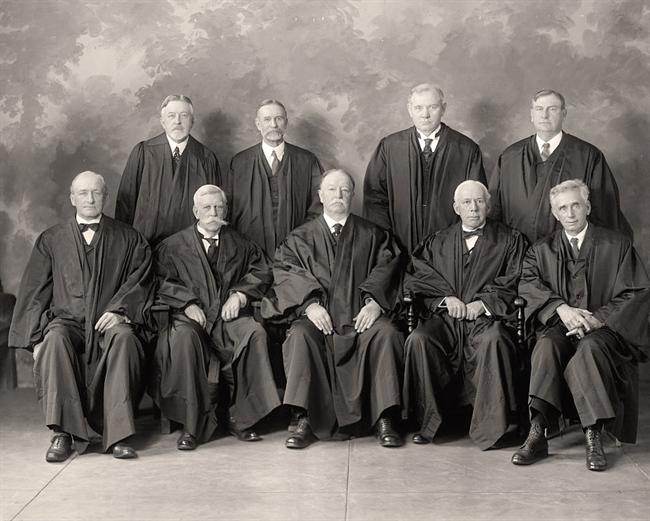
Taft Court, 1921-1930, photographed in 1925 (Chief Justice Taft, center front with Associate Justices alternating by seniority, FRONT: Oliver Wendell Holmes, Taft’s right; Willis Van Devanter, Taft’s left; James Clark McReynolds, outside right; Louis Brandeis, outside left; BACK: George Sutherland, over Taft’s right shoulder; Pierce Butler, over Taft’s left shoulder; Edward Terry Sanford, outside right; Harlan Fiske Stone, outside left).