On Patriotism

Image

Yesterday marked twelve years since the despicable attacks against the innocent thousands at their jobs in the World Trade Center Towers, the Pentagon and against the passengers of Flights 175, 11, 77, and 93. The depth of hatred for this country by those who withhold freedom from their own people and choose death as a weapon against all who oppose them, is unfathomable. There is no reforming it, there is no justifying it, there is no understanding it. There can be no conciliation with evil.

Many of us still remember the shock we felt from that day. Despite best efforts to the contrary, we are forever changed by it. But the way we responded as Americans deserves equal remembrance. We joined together, united in our common identity as Americans, comforting those in grief but resolute in who we are and what justice demanded be done. We flew the flag proudly, without shame or apology because we were not to blame for the wrongs inflicted among us. We knew America was the moral force for good in this world. It was not a blind refusal to see her faults, but it was not a psychotic inability to see the immense good America represented. It was the power of its ideals that rekindled a genuine and nationwide patriotism.

It was not long before a small percentage of the population — members of the modern Left — embarrassed and disgusted with this “corny” love for country, began a drumbeat that would not only discredit President Bush but dispirit and divide the nation again. The flag has long been offensive to them and so it ought to be intolerable to others, they intoned. For these unhappy souls there is nothing to love without complete and absolute perfection. It is no wonder they are so unhappy here. The appreciation of what is good and beautiful in this imperfect world must be quite lost on such sad people. Even with confronted with the only Perfection ever to visit earth, they reject Christ, ridiculing anyone who wears the name Christian.

It was clear patriotism had to be redefined if the Democrat Party was ever going to win another election. A simple love for country was too much to espouse for these discontented folks. Hillary Clinton stepped forward to laud true patriotism as dissent, the courage to see and criticize America’s faults. Howard Dean screamed the mantra that the flag belongs to everyone, not just Rush Limbaugh, despite the fact that the only persons burning it, cheering for its defeat and encouraging our enemies were Democrats like Dean. Of course, we recall Michelle Obama’s profession of pride in America only after electing her husband. Nothing remotely good or praiseworthy preceded this, apparently. Unprecedented liberty, opportunity, the individual exceptionalism that recurred for millions coming to America, our fight over slavery and the protection of civil rights, the story of our march from the political, religious and economic tyranny of the Old World did not count, it seems. Then there is the President’s distinction, when asked September 4 whether his credibility was on the line, between himself and America, saying, “My credibility is not on the line.  The international community’s credibility is on the line.  And America’s and Congress’s credibility is on the line.” So America has to fend for itself when it comes to credibility? The President has no role in upholding American credibility now? Patriotism should not be exclusive to any political party in this country. It speaks to how far the Democrat Party has strayed from its roots.

Patriotism was not so confused a concept to Coolidge.

For Calvin Coolidge, “[p]atriotism is easy to understand in America. It means looking out for yourself by looking out for your country. In no other nation on earth does this principle have such complete application…Patriotism does not mean a regard for some special section or attachment for some special interest, and a narrow prejudice against other sections and other interests; it means a love of the whole country.”

Coolidge did not live blissfully unaware of America’s short-comings, but neither did he insist all flaws be removed forthwith before disbursing love and admiration for his country. He always found a greater number of reasons existed to love, not hate, America. He refused to see only the negative. He lived in reality and as such knew patriotism inspires improvement through the pursuit of ideals. It has defined America’s entire history.

Coolidge would drive the point home when he said, “Not to know and appreciate the many excellent qualities of our own country constitutes an intellectual poverty which instead of being displayed with pride ought to be acknowledged with shame.” It is the systematic ostracism of showing our patriotism that should shame the modern Left. The love for America they refuse to understand or at least respect, exhibits a spirit not of enlightenment and objectivity but of closed-mindedness and intolerance. Coolidge expressed respect for our flag and what it represents even more frankly, when he said, “He who lives under it and is loyal to it is loyal to truth and justice everywhere. He who lives under it and is disloyal to it is a traitor to the human race everywhere.”

They would mock and scorn what Coolidge said next about encouraging patriotism, “We must eternally smite the rock of public conscience if the waters of patriotism are to pour forth. We must ever be ready to point out the success of our country as justification of our determination to support it.” Or, when he said to the National Education Association concerning American children, “patriotism is always to be taught.” Or, finally, when he spoke to immigrants in 1925, saying, “Our America with all that it represents of hope in the world is now and will be what you make it. Its institutions of religious liberty, of educational and economic opportunity, of constitutional rights, of the integrity of the law, are the most precious possessions of the human race. These do not emanate from the Government. Their abiding place is with the people. They come from the consecration of the father, the love of the mother, and the devotion of the children. They are the product of that honest, earnest, and tireless effort that goes into the rearing of the family altar and the making of the home of our country. They can have no stronger supporters, no more loyal defenders, than that great body of our citizenship which you represent.”

Image

On Labor

In Robert A. Woods’ fascinating little book entitled, “The Preparation of Calvin Coolidge,” the author recounts the numerous ways Coolidge advanced American labor. Coolidge backed policies that improved conditions for everyone, not merely one interest group over that of another. Through cutting state executive government down from 120 agencies to 19, Coolidge enabled the people of Massachusetts to keep more of their wages every week for themselves instead of sending up increasing quantities in taxes to Boston. He supported the decrease of work hours because it helped those who worked…not simply those who led unions, even though, ironically, it originally had the firm opposition of organized manufacturers. Known for his principled stand for law and order, he not only backed Commissioner Curtis for refusing to reinstate 19 police officers after they led most of the department on strike in September 1919. Having become affiliated with the American Federation of Labor, in violation of long-standing department regulations, their duty to the public became secondary to an ideological allegiance that already brought them in conflict with their sworn obligation.

Any or all of these three instances could have alienated political friends, forced Coolidge out of office or worse, led to a violent series of repercussions around the state, even the country.

1919 was hardly a peaceful year, despite the War’s end. But this was not all he encountered since the Lawrence textile and phone operators strikes could have blown into larger conflicts as well. They did not spiral out of control principally because of sound leadership. It is through good leadership that complex and seemingly insurmountable obstacles are resolved with clear and consistently applied principles. Coolidge, known by everyone for his fairness, gave partiality to none. He adhered to the law, even when it might cost him personally or politically. As such, he gained the support of those who saw past the bias and political agendas of those calling for violence, social upheaval, nationwide strikes and economic change for its own sake.

He continually lauded the glory of work. As Coolidge would observe on Labor Day in 1919, “Workmen’s compensation, hours and conditions of labor are cold consolations, if there be no employment. And employment can be had only if some one finds it profitable. The greater the profit, the greater the wages.” Such a truth needs no clearer illustration than where we stand in September 2013. If only the realization of Coolidge’s day, that “we can take from one class and give to another class” is never going to fix the problem. The problem only aggravates, as it did then, when class warfare rhetoric convinces Americans to expect fairness without freedom for all and benefits without the work to earn them.

Coolidge recognized the right to form unions by mutual agreement. Without consent, both unions and arbitration of disagreements were impossible to reconcile “with the right of individual freedom,” which could never be surrendered to any effort to equalize labor. He saw a clear distinction of responsibility when it came to those performing a service to the public, be it policemen, telephone operators or (in Reagan’s case) air traffic controllers.

This is why Coolidge told labor leaders on September 1, 1924, “Of course employment affecting public safety and public necessity is not private employment, and requires somewhat different treatment.” Those who work in public unions are not simply serving themselves, as Coolidge said on April 21, 1919, “There is another principle involved which has received very little attention, and that is the obligation that exists on those who enter the public service to continue to furnish such service even at some personal inconvenience. This obligation reaches to the highest officer or government official to the humblest employee. The public has rights which cannot be disregarded.” Such is why Coolidge endorsed resolution by peaceful arbitration — not the coercion of strikes, violence and disregard of law and orderly behavior — when disagreements occur. The “us” versus “them” rhetoric only proved increasingly hollow as tax reduction and constructive economy revealed the property owners and the laborer to be one and the same.

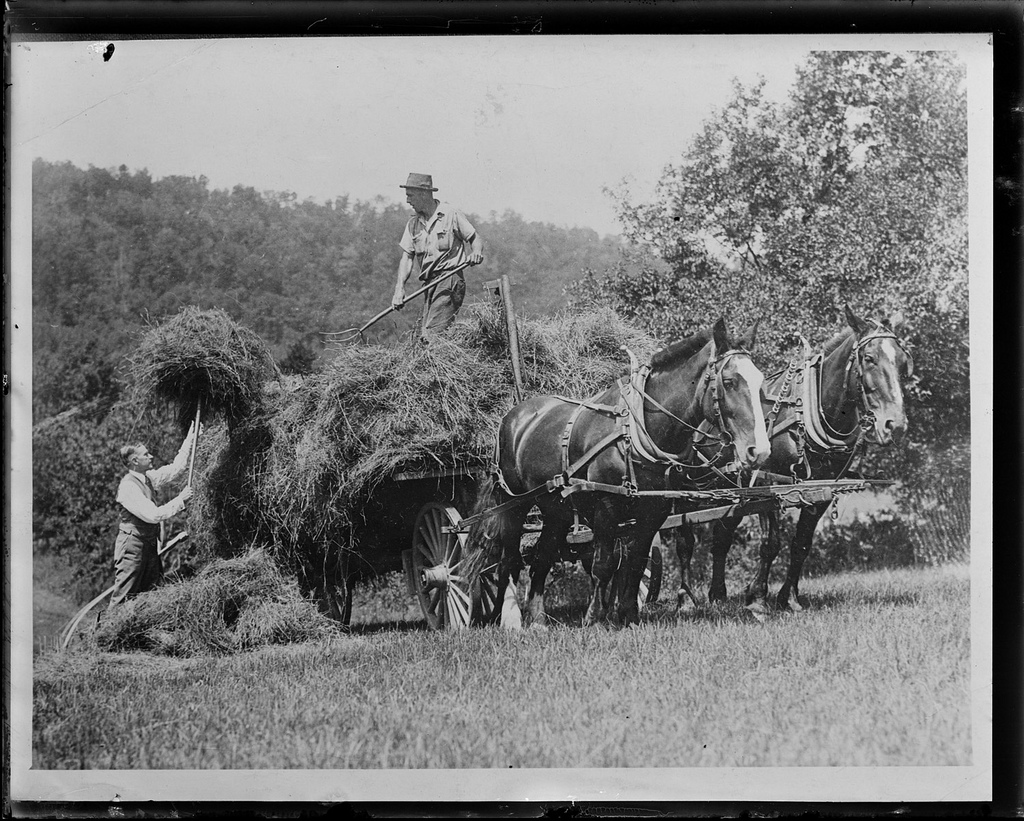
The emphasis on what one is entitled, rather than what one owes, misses both the importance and increased opportunity hard work affords to each person. No short cut exists. One cannot demand the fruits of toil without the effort to acquire them. The welfare of all, made clear from the earliest experiments in socialism by Plymouth colony, is never achieved by the many enjoying the rewards earned by a few. Work and the ability to keep its results have proven, through centuries of human experience, to be the means toward progress, the agency of mutual prosperity, and the continuance of civilization.

It is why Coolidge, in his address to the leaders of labor, said this,

“America recognizes no aristocracy save those who work. The badge of service is the sole requirement for admission to the ranks of our nobility. These American policies should be continued. We have outlawed all artificial privilege. We have had our revolution and our reforms. I do not favor a corporation government, a bank government, a farm government or a labor government. I am for a common-sense government by all the people according to the American policy and under the American Constitution. I want all the people to continue to be partakers in self government.”

With Coolidge, his actions matching his words, we can know that he meant it.

Image

On the Basis of Racial Harmony

“On account of the migration of large numbers into industrial centers, it has been proposed that a commission be created, composed of members from both races, to formulate a better policy for mutual understanding and confidence. Such an effort is to be commended. Everyone would rejoice in the accomplishment of the results which it seeks. But it is well to recognize that these difficulties are to a large extent local problems which must be worked out by the mutual forbearance and human kindness of each community. Such a method gives much more promise of a real remedy than outside interference” — President Coolidge, Annual Message to Congress, December 6, 1923.

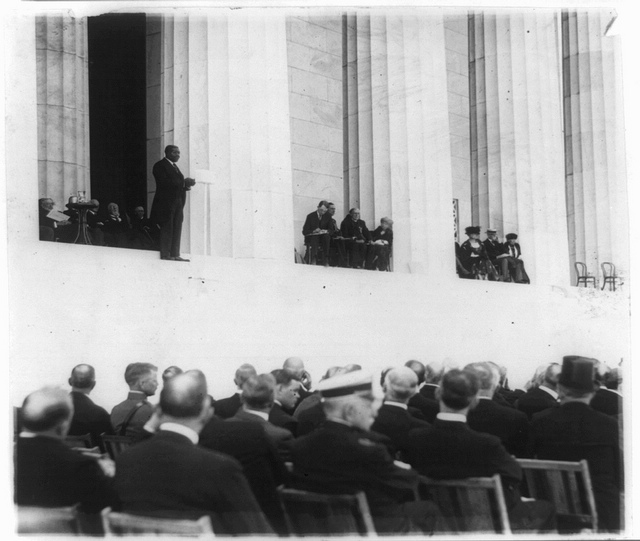
These words were not mere platitudes nor were they a white man’s effort to pander. They reinforced what Dr. Robert Moton had said the previous year on the steps of the Lincoln Memorial, “This is a fair and goodly land. Much right have we, both black and white, to be proud of our achievements at home and our increasing service in all the world. In like manner, there is abundant cause for rejoicing that sectional rancours and racial antagonisms are softening more and more into mutual understanding and increasing sectional and inter-racial cooperation. But unless here at home we are willing to grant to the least and humblest citizen the full enjoyment of every constitutional privilege, our boast is but a mockery and our professions as sounding brass and a tinkling cymbal before the nations of the earth.”

8556421087_30d56dd4f7_z moton speaks

When it came out that Veteran Bureau officials had hired an incompetent white woman over a better qualified candidate in the person of John H. Calhoun, graduate of Hampton Institute (Dr. Moton’s alma mater), Coolidge launched into action. He voided the Bureau’s appointments, required full retesting of the candidates through which it was discovered that not only did the woman flunk the exam but Calhoun had earned the highest score among all applicants. Despite threats to his life, Calhoun arrived safely in Washington to take up his public responsibilities. This was simply Coolidge’s way, rooted in a respect for all people. Color or race was immaterial to him. The “content of one’s character” and the competence of the individual mattered far more.

“Under our institutions success is the rule and failure is the exception. We have no better example of this than the enormous progress which is being made by the Negro race. To some of its individuals it may seem slow, toilsome, and unsatisfactory, but viewed as a whole it has been a demonstration of their patriotism and their worth. They are doing a great work in the land, and are entitled to the protection of the Constitution and the law. It is a satisfaction to observe that the crime of lynching, of which they have been so often the victims, has been greatly diminished, and I trust that any further continuation of this national shame may be prevented by law” — President Coolidge, upon accepting the Republican nomination for President, August 14, 1924.

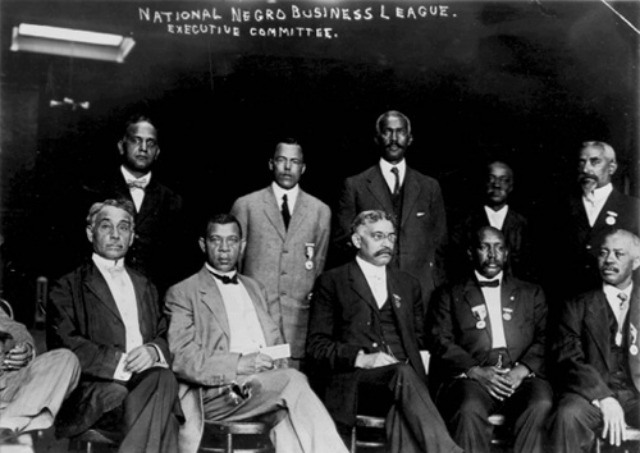
The demands to move society faster toward the ideal of co-existence on equal terms is not new. Legislation will never accomplish what is lacking in the human heart. It will ever always move as quickly as the individual’s conscience and love for others permits. It accomplishes nothing to be paralyzed by “victimhood” and refuse to embrace the responsibilities of life, the bettering of self and others through each one’s work. It was Dr. Booker T. Washington who made this clear to crowds gathered for the Atlanta Exposition on September 18, 1895, “Our greatest danger is that in the great leap from slavery to freedom we may overlook the fact that the masses of us are to live by the productions of our hands, and fail to keep in mind that we shall prosper in proportion as we learn to dignify and glorify common labour, and put brains and skill into the common occupations of life; shall prosper in proportion as we learn to draw the line between the superficial and the substantial, the ornamental gewgaws of life and the useful. No race can prosper till it learns that there is as much dignity in tilling a field as in writing a poem…The wisest among my race understand that the agitation of questions of social equality is the extremest folly, and that progress in the enjoyment of all the privileges that will come to us must be the result of severe and constant struggle rather than artificial forcing…It is important and right that all privileges of the law be ours, but it is vastly more important that we be prepared for the exercise of these privileges.” Coolidge would heartily agree, referring to Dr. Washington when he said, “His vision of the problems of the coloured people was indeed that of a seer, and…[the National Negro Business] League is one of the monuments to his life work.”

national_negro_business_league

Washington and Moton, both closer to slavery than any of the self-professed “victims of white oppression” alive today, gave no place to any status as “victims” owed something from anyone — they were not victims to be coddled and pitied, they were free men who, with diligence and hard work could reap the rewards of their individual efforts in life. Nobody owed them a higher wage, a home, healthcare, affluence. These were to be earned through their own abilities. They refused to settle for less than what they knew could be accomplished by their own powers of mind, body and spirit. Welfare robs potential, they knew all too well.

What Dr. Washington termed “casting down your bucket where you are” (bettering things wherever life starts you), Dr. King addressed in “The Three Dimensions of a Complete Life,” on April 9, 1967, “What I’m saying to you this morning, my friends, even if it falls your lot to be a street sweeper, go on out and sweep streets like Michelangelo painted pictures; sweep streets like Handel and Beethoven composed music; sweep streets like Shakespeare wrote poetry; sweep streets so well that all the host of heaven and earth will have to pause and say, ‘Here lived a great street sweeper who swept his job well,’ If you can’t be a pine on the top of a hill be a scrub in the valley–but be the best little scrub on the side of the hill, Be a bush if you can’t be a tree. If you can’t be a highway just be a trail. If you can’t be the sun be a star; It isn’t by size that you win or fail–Be the best of whatever you are.”

These truths are really no different in substance than what Coolidge said to fellow Amherst graduates on February 4, 1916, “Work is not a curse, it is the prerogative of intelligence, the only means to manhood, and the measure of civilization. Savages do not work. The growth of a sentiment that despises work is an appeal from civilization to barbarism.” It is also the basis to which he appealed to labor leaders September 1, 1924, “I cannot think of anything that represents the American people as a whole so adequately as honest work. We perform different tasks, but the spirit is the same. We are proud of work and ashamed of idleness. With us there is no task which is menial, no service which is degrading. All work is ennobling and all workers are ennobled. To my mind America has but one main problem, the character of the men and women it shall produce. It is not fundamentally a Government problem, although the Government can be of a great influence in its solution. It is the real problem of the people themselves.”

The ultimate source of deliverance has never been in trusting Government to right the wrongs experienced by past generations for us but success resides in the power within our own grasp to advance from where we started to where we can be. The attempt to deny that individual exceptionalism is possible, outside of Government action — as President Obama asserted on PBS this week — closes eyes to the incredible accomplishments of men and women of all backgrounds throughout our history. These individuals, like Dr. Washington who was born on a Virginia plantation, or Coolidge, born in the exceptionally mean circumstances of rural Plymouth Notch, have built from nothing, overcame countless limitations, and left the world better for having worked and served. Segregated existence, acceptance of fixed placement in social class structure and dependence on others to fix our problems are not what bold men like Washington, Moton, King and Coolidge strove to bequeath future generations.

It is through the development of character and the application of work that betterment continues for every individual, of whatever race, color, background. It is in striving for excellence in the work each of us does that we find fulfillment and peace, not only with each other but, ultimately, with God.

Image