On Race Relations and Presidential Power, Part 2

James Weldon Johnson, head of the National Association for the Advancement of Colored People. Photo taken around 1920.

James Weldon Johnson, head of the National Association for the Advancement of Colored People. Photo taken around 1920.

When it was arranged for James Weldon Johnson, the first black leader of the National Association for the Advancement of Colored People, to visit the White House in the early months of the Coolidge Administration, Mr. Johnson was not only glad to leave but, unfortunately, left with a completely mistaken perception of the President. Even more unfortunate, Johnson let that first impression influence future interaction with the Vermonter. Johnson wrote years later of this meeting,

“He, it appeared, did not want to say anything or did not know just what to say, I was expecting that he would make, at least, any inquiry or two about the state of mind and condition of the twelve million Negro citizens of the United States. I judged that curiosity, if not interest, would make for that much conversation. The pause was painful (for me at least) and I led off with some informational remarks; but it was clear that Mr. Coolidge knew absolutely nothing about colored people. I gathered that the only living Negro he had heard anything about was Major Moton (Booker T. Washington’s successor at Tuskegee). I was relieved when the brief audience was over, and I suppose Mr. Coolidge was, too.”

William Monroe Trotter, editor of the Boston Guardian. Coolidge had come across Mr. Trotter back in the Massachusetts Senate days back in 1915.

William Monroe Trotter, the fiery editor of the Boston Guardian. Coolidge had come across Mr. Trotter back in the Massachusetts Senate days in 1915.

Asa Philip Randolph of the preeminent news source, The Messenger, would go on to lead the Brotherhood of Sleeping Car Porters in 1925. He would become an elder statesman during the 1960s Civil Rights Movement.

Asa Philip Randolph of the preeminent news source, The Messenger, would go on to lead the Brotherhood of Sleeping Car Porters in 1925. Randolph had accompanied James W. Johnson on his visit to the White House in February 1924. He would become an elder statesman during the 1960s Civil Rights Movement.

William H. Lewis, standing, argues a case before a Massachusetts court, 1910s. He had graduated Amherst three years before Coolidge, who wrote his father at the time about Lewis' skill as a football player, saving the college team on more than one occasion. Lewis, a Republican, failed to see why Coolidge would not verbally condemn the Klan in 1924. Lewis failed to appreciate Coolidge's subtle yet more effective approach to the problem.

William H. Lewis, standing, argues a case before a Massachusetts court, 1910s. He had graduated Amherst three years before Coolidge, who wrote his father at the time about Lewis’ skill as a football player, saving the college team on more than one occasion. Lewis, a Republican, failed to see why Coolidge would not verbally condemn the Klan in 1924. Coolidge’s subtle yet more effective approach to the problem prevailed.

Born a slave, Giles Beecher Jackson worked his way to freedom, becoming a Richmond attorney and relentless advocate for a Negro Industrial Commission, which (thanks to his efforts) found its way into the Republican platform of 1924. Coolidge endorsed his idea and urged Congress to create it in 1923. Regrettably, Mr. Jackson died without seeing it come to fruition. Coolidge, however, continued to remind Congress, and anyone who asked about it, of the need for such a joint effort.

Born a slave, Giles Beecher Jackson worked his way to freedom, becoming a Richmond attorney and relentless advocate for a Negro Industrial Commission, which (thanks to his efforts) found its way into the Republican platform of 1924. Coolidge endorsed his idea and urged Congress to create it in 1923. Regrettably, Mr. Jackson died without seeing it come to fruition. Coolidge, however, continued to remind Congress (and anyone who asked about it) of the importance of this joint effort started by Mr. Jackson.

While this short meeting illustrates the importance of an accurate understanding it also demonstrates the need for a healthy measure of forbearance. It underscores that even someone as eager for a good relationship between blacks and whites was still vulnerable to prejudice sometimes. As Alvin Felzenberg points out, Mr. Johnson was completely unaware of the broad network of associations already forged between Coolidge and quite a few black leaders in education, business and media, including such notables as William M. Trotter, editor of the Boston Guardian, Nahum B. Brascher, Editor-in-Chief of the Associated Negro Press, A. Philip Randolph of The Messenger, William H. Lewis (who had been an upperclassman at Amherst with Coolidge), Giles B. Jackson, who introduced the idea of a Negro Industrial Commission, and numerous other educators and public servants. Felzenberg reminds us that this was simply the Coolidge temperament, making no distinction between what color the visitor was. We recall that Frank Strearns’ initial impression of “Silent Cal” was not favorable either. One could say that Mr. Stearns was still trying to acclimate to Coolidge’s reticent habits years after becoming good friends with him. Coolidge learned not merely by engaging in conversation, but by observation. His keen judgment of people’s character worked through it all, the quiet and the loquacious times. A person’s presence could tell him volumes about the individual. He explains what he was doing in his Autobiography,

“I called in a great many people from all the different walks of life over the country…It has been my policy to seek information and advice wherever I could find it. I have never relied on any particular person to be my unofficial adviser. I have let the merits of each case and the soundness of all advice speak for themselves” (p.188).

From the very earliest days in state government through his years in the White House, it became apparent to those who followed his career that Coolidge simply did not “slop over” with enthusiastic guarantees for anyone, regardless of who they were. A master of time management, he listened carefully, remained polite but curt and then followed up quietly without any of the standard operating procedures expected of politicians. This was what unsettled Mr. Johnson most and he never quite understood it. Consequently, we of today should not be so quick to condemn circumstances or people when, at the time, even the most dedicated leaders were struggling to understand each other accurately, addressing how to solve problems and determining what were the best means for everyone to move forward. The twelve million “colored” people in America no more agreed on one, solitary solution than did the rest of the country. It is a mistake to assume one-size-fits-all fixes from Coolidge or anyone else in Washington were capable of resolving each issue…especially when it involves people.

William Edward Burghardt DuBois (pronounced Doo-boyz) helped found the NAACP in 1909 and was a seminal influence on what was to be done about race relations in the twentieth century. Coolidge sought to include him in diplomatic work but Dr. DuBois declined to be part of what he considered a rigged political system. He too, underestimated Coolidge's courage and willingness to tackle the tough political questions between blacks and whites.

William Edward Burghardt DuBois (pronounced Doo-boyz) helped found the NAACP in 1909 and was a seminal influence on what was to be done about race relations in the twentieth century. Coolidge sought to include him in diplomatic work but Dr. DuBois declined to be part of what he considered a rigged political system. By refusing to participate, he unwittingly helped thwart the mechanism for an expression of popular government through party principles. He too, underestimated Coolidge’s courage and willingness to tackle the tough political questions between blacks and whites.

The “black community” of the 1920s was anything but monolithic. The death of Booker T. Washington in 1915 had left a vacuum of leadership and direction. Still, many wise and able leaders had stepped forward since the formal emancipation. Veteran reformer, W. E. B. DuBois, continued to work, write and influence the movement toward more drastic changes than the political process or economic growth could accomplish, he felt. Ever the skeptic, DuBois wanted sweeping action taken to right the wrongs through social justice. It would not happen by merely helping blacks help themselves improve through vocational training, commerce, and political involvement. For DuBois, it demanded expansive changes to society. Nevertheless, despite criticism by DuBois and others, real successes in a short seventy years could be claimed. Much remained to be done but it did not negate the very significant advances experienced by blacks through education, hard work and engaged civic participation. The path to addressing the problems in race relations was by no means clearly marked. We, who look back on the past, often mistake the hindsight of the present with the clarity of what should have been known and done at the time. This is but another form of prejudicial perception: interpreting what has been through the lens what now is.

Some favored a segregated civil service, like black attorney Perry W. Howard, while others sought a broad executive order to ban all discrimination and bigotry in government. Making the despicable act of lynching a Federal crime was paramount to many, including Coolidge himself, who considered the constitutional question of declaring martial law to confront areas especially rampant with lynching. Still others, distrustful of either political party, sought the development of literature and the arts as the means to racial equality, like James W. Johnson and the NAACP. Some believed that economic development should remain secondary to social and political changes, emphasizing the reform of voting rights and “Jim Crow” laws ahead of the self-help made possible by a strong educational and commercial effort, as exemplified by Booker T. Washington’s Tuskegee Institute, Howard University and other “colored” organizations. Even Marcus Garvey, directing the vibrant 400,000 member Universal Negro Improvement Association, gravitated to this concept of self-sufficiency applying it to a drastic break from American laws and institutions for a solution less committed to improving conditions in this country than to establishing a nationalist identity independent of the “white man’s” America. Yet, in 1927, it was Coolidge who commuted Garvey’s sentence of imprisonment for mail fraud, a penalty meted out by Wilson’s xenophobic Justice Department.

Marcus Garvey, native-born Jamaican, established and led the Universal Negro Improvement Association. Many, including DuBois, perceived him as a dire threat to blacks everywhere. This photograph was taken in the summer of 1924. He would leave his mark on movements around the world, including the Rastafari movement, which considers him a prophet. His second wife,  Amy Jacques Garvey, petitioned President Coolidge for his release, which was granted in November 1927 followed by deportation back to Jamaica.

Marcus Garvey, native-born Jamaican, established and led the Universal Negro Improvement Association. Many, including DuBois, perceived him as a dire threat to blacks everywhere. This photograph was taken in the summer of 1924. He would leave his mark on movements around the world, including the Rastafari movement, which considers him a prophet. His second wife, Amy Jacques Garvey, petitioned President Coolidge for his release, which was granted in November 1927 followed by deportation back to Jamaica.

The Veterans’ Hospital was another trouble spot early in the Coolidge Administration. Led by an overtly bigoted official, the proposal among blacks and whites to temporarily keep segregation ensured that everyone received the care they needed without partiality or discrimination. The decisive action taken by Coolidge on this, as with the other specific moves to stop discrimination on his watch, will be discussed in the next part of our series. Yet, his energy to act in concert with those who did not always agree with him like William M. Trotter and William H. Lewis, using the talents of men like Emmett Jay Scott and William Matthews on behalf of the abused and aggrieved has been largely suppressed since it fails to neatly fit with the accepted narrative of a “racist white, Anglo-Saxon, Protestant” Republican Party and President. Prejudiced by ideology instead of honesty about the actual record, too many historians have mistaken, like the unfortunate James W. Johnson, a first impression of Cal’s “inactive” approach with the complete picture of Coolidge, the man and what he actually did about race relations.

In the third part of this series, we will examine in further detail how Coolidge responded to racial conflicts and helped lay a foundation for progress grounded in Christian forbearance, humility and voluntary collaboration. By emphasizing the respect we owe our neighbor, whatever race or color, and promoting constructive opportunities rather than perpetuating a victim mentality, more was done for people as the unique individuals we all are than the approach taken in subsequent decades to corral everyone into a collective existence centered around the determinations of what is “just” and “equal” from Washington.

On Race Relations and Presidential Power, Part 1

“Death and life are in the power of the tongue; and they that love it shall eat the fruit of it” — Proverbs 18:21

“A word fitly spoken is like apples of gold in fittings of silver” — Proverbs 25:11

Few, especially in public life, have respected the truth of these maxims than Calvin Coolidge. He understood the power of the spoken word. It carries the ability to inspire one to greater heights of goodness and nobility or to destroy with malice and hatred. It can build up the soul or crush the spirit. It carries a potency that cannot be entirely harnessed or contained once uttered and thus dare not be exercised flippantly or with casual disregard for the responsibilities which fall to the speaker, especially as the President of the United States of America.

Coolidge wielded this power effectively during his Presidency by deploying the spoken word sparingly, giving what he would say maximum effect upon the listener. Coolidge knew the speaker can control the timing of what is said while the damage done to credibility by spiteful and vindictive rhetoric cannot be undone. If the President gave legitimacy to what is petty, hateful and divisive, however culturally or politically influential those forces may be, it would be no less an abdication of duty than the Boston police abandoning their posts to the lawless and violent. It would bring impugn not only the trust placed in our leaders but upon what America is and what it has done, as Coolidge noted in his Inaugural Address in 1925. This is why he so carefully withheld his words and refrained from being the first to intervene with “comment” upon every area of life. Experience taught him that more harm came when a President indulges the desire to be “quick to speak” and “slow to hear” without a fair hearing of all the facts thereby taking sides against the fairness and decency of Americans. This is why his silence and refrained involvement, so often mistaken for insensitivity, disinterest or rudeness, were actually measured with a sincere and heartfelt regard for the situation and what was in the best interest of everyone directly concerned. His respect for people gave him pause. After all, Coolidge understood what too many current politicians find to be an inconvenient, confining truth: Freedom is a zero-sum game. Every action taken by the President removes a commensurate ability from individuals to so act for oneself.

6193340720_d9b2b2299b_b

With a word, Presidents can exacerbate strife and division or heal and comfort. To have used the Presidential platform and denounced the Klan, as the Democrat candidate Mr. Davis urged in 1924, would have validated an utterly illegitimate organization with enough importance to warrant a sitting President’s attention. The Klan, despite how politically powerful they were, simply did not merit a moment of official recognition. Instead, he went to Howard University and spoke of the genuinely phenomenal advancement of black Americans since emancipation. To a Mr. Gardner, who wrote protesting the participation of black candidates that election year, Coolidge replied,

“Our Constitution guarantees equal rights to all our citizens, without discrimination on account of race or color. It is the source of your rights and my rights. I propose to regard it, and administer it, as the source of the rights of all the people, whatever their belief or race. A colored man is precisely as much entitled to submit his candidacy in a party primary, as is any other citizen. The decision must be made by the constituents to whom he offers himself, and by nobody else. You have suggested that in some fashion I should bring influence to bear to prevent the possibility of a colored man being nominated for Congress. In reply, I quote my great predecessor, Theodore Roosevelt: ‘I cannot consent to take the position that the door of hope–the door of opportunity–is to be shut upon any man, no matter how worthy, purely upon the grounds of race or color.’ ”

August 16, 1924 edition of The New York Age. What Coolidge did made headlines and further strengthened the trust and credibility Coolidge possessed.

August 16, 1924 edition of The New York Age. Coolidge’s emphatic endorsement of Harlem’s candidate, Dr. Roberts, further strengthened the credibility and trust  between Cal and black Americans. W. E. B. DuBois estimated that 1 million blacks voted for Coolidge that fall.

He went to the Holy Name Society and declared, “He who gives license to his tongue only discloses the contents of his own mind. By the excess of his words he proclaims his lack of discipline. By his very violence he shows his weakness.” He went to Omaha, two years after Klan-inspired riots shook the city, and Coolidge spoke before the American Legion on October 6, 1925, saying,

“If we are to have that harmony and tranquility, that union of spirit which is the foundation of real national genius and national progress, we must all realize that there are true Americans who did not happen to be born in our section of the country, who do not attend our place of religious worship, who are not of our racial stock, or who are not proficient in our language. If we are to create on this continent a free Republic and an enlightened civilization that will be capable of reflecting the true greatness and glory of mankind, it will be necessary to regard these differences as accidental and unessential. We shall have to look beyond the outward manifestations of race and creed. Divine Providence has not bestowed upon any race a monopoly of patriotism and character.”

He went to the Congress annually over the course of nearly six years to devote a portion of each Message to the circumstances of what then were 12 million “colored” Americans. Offering his set of proposals for Congress to act upon, he recognized that these difficulties are to a large extent local problems which must be worked out by the mutual forbearance and human kindness of each community. Such a method gives much more promise of a real remedy than outside interference.” He would confront discrimination firmly and bigotry honestly but he would not strip an individual of his or her freedom in order to pursue the impossible: perfect equality through government-directed vengeance.

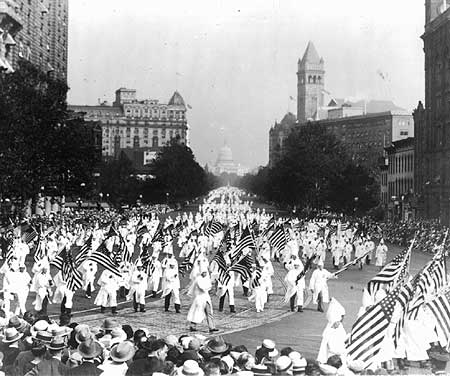
In what the coming years would reveal was the last desperate gasp of "respectable" Klan retrenchment, the KKK took advantage of Coolidge's absence from Washington to follow the debacle that was the 1924 Democrat Convention to march down Pennsylvania Avenue, August 8, 1925. Coolidge would help deliver the decline and demise of the Klan's membership and influence in the coming years.

In what the coming years would reveal was the last desperate gasp of “respectable” Klan retrenchment, the KKK took advantage of Coolidge’s absence from Washington to follow the debacle that was the 1924 Democrat Convention to march down Pennsylvania Avenue, August 8, 1925. Coolidge would help deliver the decline and demise of the Klan’s membership and influence in the years ahead. They would never again be the nationally regarded organization it had been under President Wilson.

He could have opined the injustice of it all, decried the unfairness of “the system” and demanded sweeping legislation to “fix” it. Because he did not hardly makes him a do-nothing enabler, he was appealing to higher ideals than perpetual victimhood. Ideals that constructively edify and encourage everyone to rise above the typical to strive for the exceptional, opportunities at self-betterment and self-sufficiency only possible when individual freedom is honored. It seems that bad laws simply do not exist in the eyes of this current regime. As with any authoritarian, any action is justified to meet the situation. The President behaves as it there is no virtue in refrained action, withholding the use of power to take stock of what collateral damage is being done. In actuality, the array of unintended and intended consequences meted out to political enemies in order to settle scores and correct “inequities” in America’s traditions and institutions is the exact opposite of wisdom or justice. Coolidge reminds us that there are situations when the best use of power is not to parade it, when the wisest means of diffusing conflict is not to advertise it and the surest solutions rest not in Executive word or deed but in the renewed commitment to the ideals on which America began. These ideals find expression not merely in great parchments and speeches but in the lives of a people free to govern themselves.

In the series that will follow on race and Presidential power, we are going to examine Coolidge’s record on race, reappraising what he did do when it came to differences between Americans, how he addressed discrimination and segregation, how he fought to end lynching, how he worked to build up not tear down with the power of the spoken word and acted, usually behind the scenes, to handle requests and calm tensions all without sweeping civil rights legislation or grandiose executive might. His record on race, as with most of Coolidge’s accomplishments, is underrated not because it was uneventful or he did nothing about it but because his record under-promised but over-delivered. In a very real way, Coolidge’s approach to race relations achieved more than the boldness of TR, the retrenchment of Wilson or the flashy promises and empty results of FDR and LBJ. We will explore how in the coming days.

“The words of the President have an enormous weight and ought not to be used indiscriminately. It would be exceedingly easy to set the country all by the ears and foment hatreds and jealousies, which, by destroying faith and confidence, would help nobody and harm everybody. The end would be the destruction of all progress” — Calvin Coolidge, The Autobiography, p.186.

On “The Press Under a Free Government”

6208526588_53203fac4d_b Coolidges

Few men have been as singularly characterized by one misquotation as Calvin Coolidge. It is ironic that of all the misrepresented statements which could be made of our thirtieth President, the one incessantly parroted derives from a speech to the American Society of Newspaper Editors. If anyone is supposed to be curious enough to check their facts, research context and accurately report what is found, is it not the press?

Yet, each time, “the business of America is business” is the final word echoed on all that is ever worth knowing about the man and his era, those greedy, materialistic Twenties. Thank you, William Allen White. This “sound-byte” premise sets up a convenient marketing contrast for what came after in the charismatic person of F.D.R. and his “triumph” over economic depression made possible through the “New Deal.” Now just short of ninety years since Coolidge spoke to those members of the press on January 17, 1925, it becomes obvious to anyone who actually reads this speech in full that “Silent Cal” was not claiming business rightly functioned as the end-all of American existence. He was asserting the opposite. The same man who, in actuality, said, “The chief business of the American people is business” also said in the next paragraph, “The chief ideal of the American people is idealism.” He was lauding ideals, the spiritual commodities that accrue to character: peace, honor and charity, and the integrity of the soul, not the absorption in materialism.

If anything, looking at what the media has become, Coolidge was ahead of his time, identifying the very methods the Left has incrementally used to dominate modern education and deploy the “sources of public information” as purveyors of propaganda rather than sound information. These sources have become exactly what Coolidge warned they would be if the press succumbed to autocratic government.

President Coolidge, on the White House grounds, reviews plans for the National Press Building later that same year, September 15, 1925.

President Coolidge, on the White House grounds, reviews plans for the National Press Building later that same year, September 15, 1925.

In his ability to see the danger and explain it, Coolidge’s wisdom is a threat to a news media subservient to those in power. This is why he has been lampooned and caricatured, his statements yanked from context and his credibility discounted by the self-appointed “smartest of the smart.” He refuses to fit neatly into the box built for him all these years by the political and cultural elite, who now rule in alliance with each other. It is this speech, perhaps more cogently than any other, that exposes their motivations and procedures for what they are. He entered into their arena and is it any wonder that Coolidge has been so vilified and maligned for it? To restore Coolidge to his rightful position and his words to their proper perspective would be the beginning of the end for this modern regime. It is, after all, a ruling class of politicians and propagandists who can only retain legitimacy through the perpetuation of ignorance, the maintenance of false standards, and the perverse union between those devoted to power rather than committed to the truth. This elite caste serves the ideological interests of a few rather than the “general interest of the whole people.” Freedom cannot endure without truth.
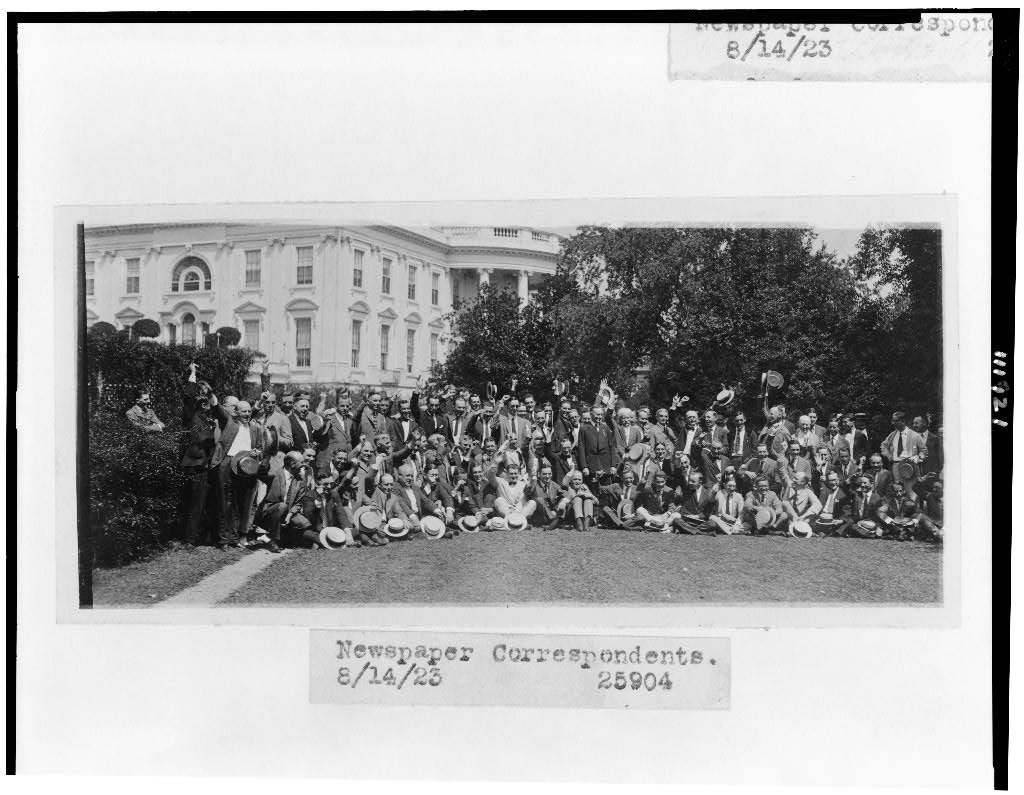
President Coolidge poses with the Washington correspondents corps on the lawn of the White House, August 14, 1923. The press, not without its biases and healthy curiosity even then, remained fair to Coolidge throughout his five years and seven months in office. They had their hostile critics, like correspondent Frank Kent and others, but none walked in the unquestioned conformity they largely do today. Coolidge could honestly assess their coverage in these terms: "You have been, I think, quite successful in interpreting the administration to the country. I have known that I wasn't much of a success in undertaking newspaper work, so I have left the work of reporting the affairs of my administration to the experts of the press. Perhaps that is the reason that the reports have been more successful than they would have been if I had undertaken myself to direct them" (March 1, 1929, The Talkative President, p. 34). Coolidge practiced what he preaches, letting the press do their job, free of forceful directives on what to report from the White House.

President Coolidge poses with the Washington correspondents corps on the lawn of the White House, August 14, 1923. The press, not without its biases and healthy curiosity even then, remained fair to Coolidge throughout his five years and seven months in office. Coolidge had his detractors, like correspondent Frank Kent, Charles Michaels and others, but none walked in the unquestioned conformity they largely do today. Coolidge could honestly assess their coverage in these terms: “You have been, I think, quite successful in interpreting the administration to the country. I have known that I wasn’t much of a success in undertaking newspaper work, so I have left the work of reporting the affairs of my administration to the experts of the press. Perhaps that is the reason that the reports have been more successful than they would have been if I had undertaken myself to direct them” (March 1, 1929, The Talkative President, p. 34). Coolidge practiced what he preached, letting the press do their job, free of fabricated “facts” or political strategy directives on what to report from the White House.

Here it is, President Coolidge’s speech to the American Society of Newspaper Editors in full:

“The relationship between governments and the press has always been recognized as a matter of large importance. Wherever despotism abounds, the sources of public information are the first to be brought under its control. Wherever the cause of liberty is making its way, one of its highest accomplishments is the guarantee of the freedom of the press. It has always been realized, sometimes instinctively, oftentimes expressly, that truth and freedom are inseparable. An absolutism could never rest upon anything save a perverted and distorted view of human relationships and upon false standards set up and maintained by force. It has always found it necessary to attempt to dominate the entire field of education and instruction. It has thrived on ignorance. While it has sought to train the minds of a few, it has been largely with the purpose of attempting to give them a superior facility for misleading the many. Men have been educated under absolutism, not that they might bear witness to the truth, but that they might be the more ingenious advocates and defenders of false standards and hollow pretenses. This has always been the method of privilege, the method of class and caste, the method of master and slave.

“When a community has sufficiently advanced so that its government begins to take on that of the nature of a republic, the processes of education become even more important, but the method is necessarily reversed. It is all the more necessary under a system of free government that the people should be enlightened, that they should be correctly informed, than it is under an absolute government that they should be ignorant. Under a republic the institutions of learning, while bound by the constitution and laws, are in no way subservient to the government. The principles which they enunciate do not depend for their authority upon whether they square with the wish of the ruling dynasty, but whether they square with the everlasting truth. Under these conditions the press, which had before been made an instrument for concealing or perverting the facts, must be made an instrument for their true representation and their sound and logical interpretation. From the position of a mere organ, constantly bound to servitude, public prints rise to a dignity, not only of independence, but of a great educational and enlightening factor. They attain new powers, which it is almost impossible to measure, and become charged with commensurate responsibilities.

“The public press under an autocracy is necessarily a true agency of propaganda. Under a free government it must be the very reverse. Propaganda seeks to present a part of the facts, to distort their relations, and to force conclusions which could not be drawn from a complete and candid survey of all the facts. It has been observed that propaganda seeks to close the mind, while education seeks to open it. This has become one of the dangers of the present day.
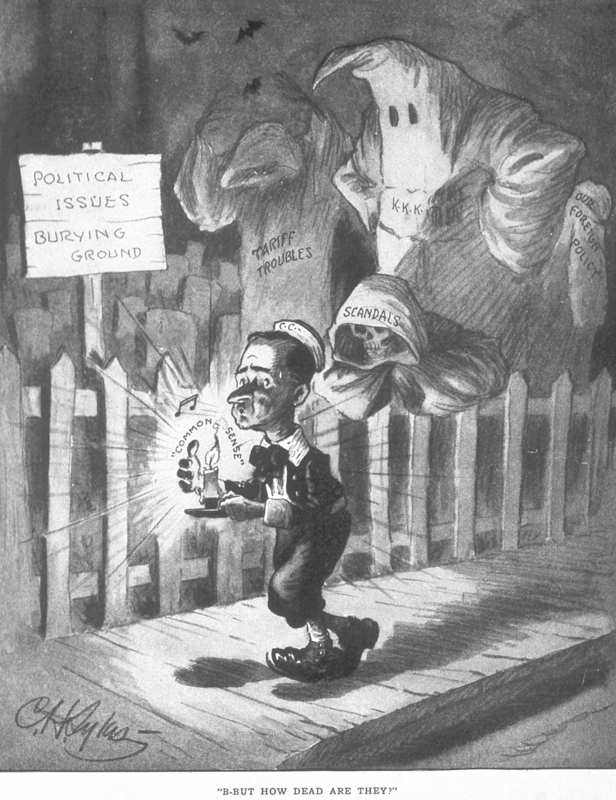
Cartoon by C.H. Sykes appearing in Life magazine, October 2, 1924.

Cartoon by C.H. Sykes appearing in Life magazine, October 2, 1924.

“The great difficulty in combating unfair propaganda, or even in recognizing it, arises from the fact that at the present time we confront so many new and technical problems that it is an enormous task to keep ourselves accurately informed concerning them. In this respect, you gentlemen of the press face the same perplexities that are encountered by legislators and government administrators. Whoever deals with current public questions is compelled to rely greatly upon the information and judgments of experts and specialists. Unfortunately, not all experts are to be trusted as entirely disinterested. Not all specialists are completely without guile. In our increasing dependence on specialized authority, we tend to become easier victims for the propagandists, and need to cultivate sedulously the habit of the open mind. No doubt every generation feels that its problems are the most intricate and baffling that have ever been presented for solution. But with all recognition of the disposition to exaggerate in this respect, I think we can fairly say that our times in all their social and economic aspects are more complex than any past period. We need to keep our minds free from prejudice and bias. Of education, and of real information we cannot get too much. But of propaganda, which is tainted or perverted information, we cannot have too little.

“Newspaper men, therefore, endlessly discuss the question of what is news. I judge that they will go on discussing it as long as there are newspapers. It has seemed to me that quite obviously the news-giving function of a newspaper cannot possibly require that it give a photographic presentation of everything that happens in the community. That is an obvious impossibility. It seems fair to say that the proper presentation of the news bears about the same relation to the whole field of happenings that a painting does to a photograph. The photograph might give the more accurate presentation of details, but in doing so it might sacrifice the opportunity the more clearly to delineate character. My college professor was wont to tell us a good many years ago that if a painting of a tree was only the exact representation of the original, so that it looked just like the tree, there would be no reason for making it; we might as well look at the tree itself. But the painting, if it is of the right sort, gives something that neither a photograph nor a view of the tree conveys. It emphasizes something of character, quality, individuality. We are not lost in looking at thorns and defects; we catch a vision of the grandeur and beauty of a king of the forest.

“And so I have conceived that the news, properly presented, should be a sort of cross-section of the character of current human experience. It should delineate character, quality, tendencies and implications. In this way the reporter exercises his genius. Out of the current events he does not make a drab and sordid story, but rather an informing and enlightened epic. His work becomes no longer imitative, but rises to an original art.
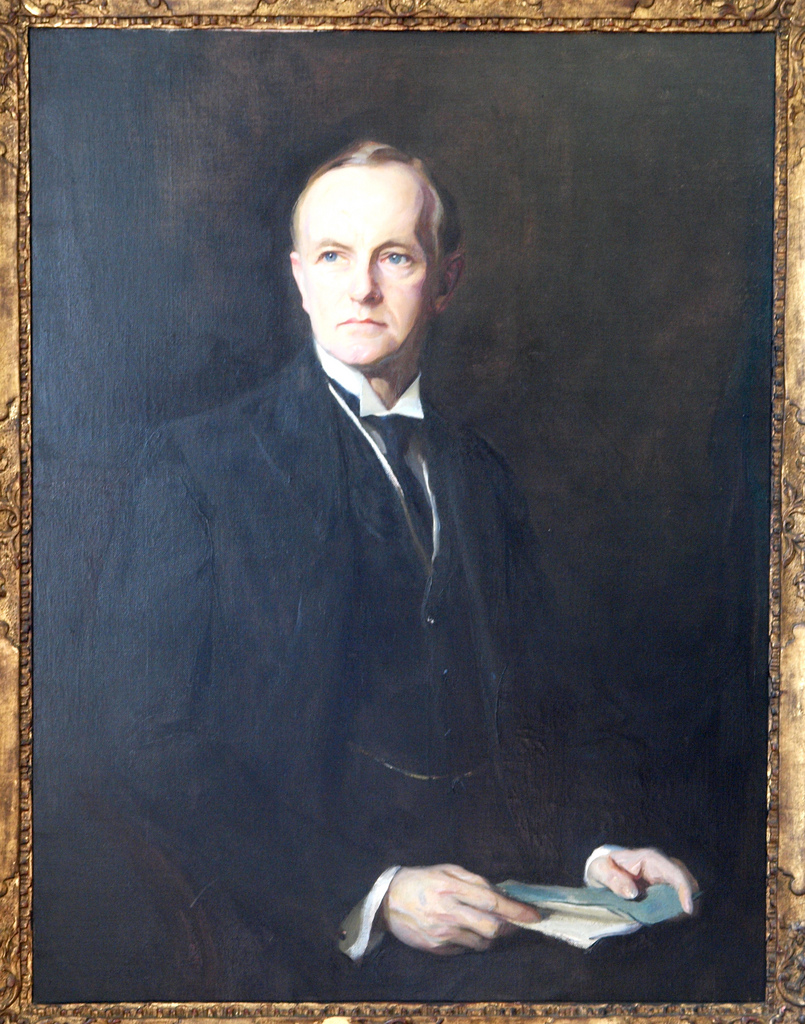
Portrait of Coolidge by Hungarian artist Philip de Laszlo, 1926.

Portrait of Coolidge by Hungarian artist Philip de Laszlo, 1926.

“Our American newspapers serve a double purpose. They bring knowledge and information to their readers, and at the same time they play a most important part in connection with the business interests of the community, both through their news and advertising departments. Probably there is no rule of your profession to which you gentlemen are more devoted than that which prescribes that the editorial and the business policies of the paper are to be conducted by strictly separate departments. Editorial policy and news policy must not be influenced by business consideration; business policies must not be affected by editorial programs. Such a dictum strikes the outsider as involving a good deal of difficulty in the practical adjustments of every-day management. Yet, in fact, I doubt those adjustments are any more difficult than have to be made in every other department of human effort. Life is a long succession of compromises and adjustments, and it may be doubted whether the press is compelled to make them more frequently than others do.

“When I have contemplated these adjustments of business and editorial policy, it has always seemed to me that American newspapers are peculiarly representative of the practical idealism of our country. Quite recently the construction of a revenue statute resulted in giving publicity to some highly interesting facts about incomes. It must have been observed that nearly all the newspapers published these interesting facts in their news columns, while very many of them protested in their editorial columns that such publicity was a bad policy. Yet this was not inconsistent. I am referring to the incident by way of illustrating what I just said about the newspapers representing the practical idealism of America. As practical newsmen they printed the facts. As editorial idealists they protested that there ought to be no such facts available.

“Some people feel concerned about the commercialism of the press. They note that great newspapers are great business enterprises earning large profits and controlled by men of wealth. So they fear that in such control the press may tend to support the private interests of those who own the papers, rather than the general interest of the whole people. It seems to me, however, that the real test is not whether the newspapers are controlled by men of wealth, but whether they are sincerely trying to serve the public interests. There will be little occasion for worry about who owns a newspaper, so long as its attitudes on public questions are such as to promote the general welfare. A press which is actuated by the purpose of genuine usefulness to the public interest can never be too strong financially, so long as its strength is used for the support of popular government.

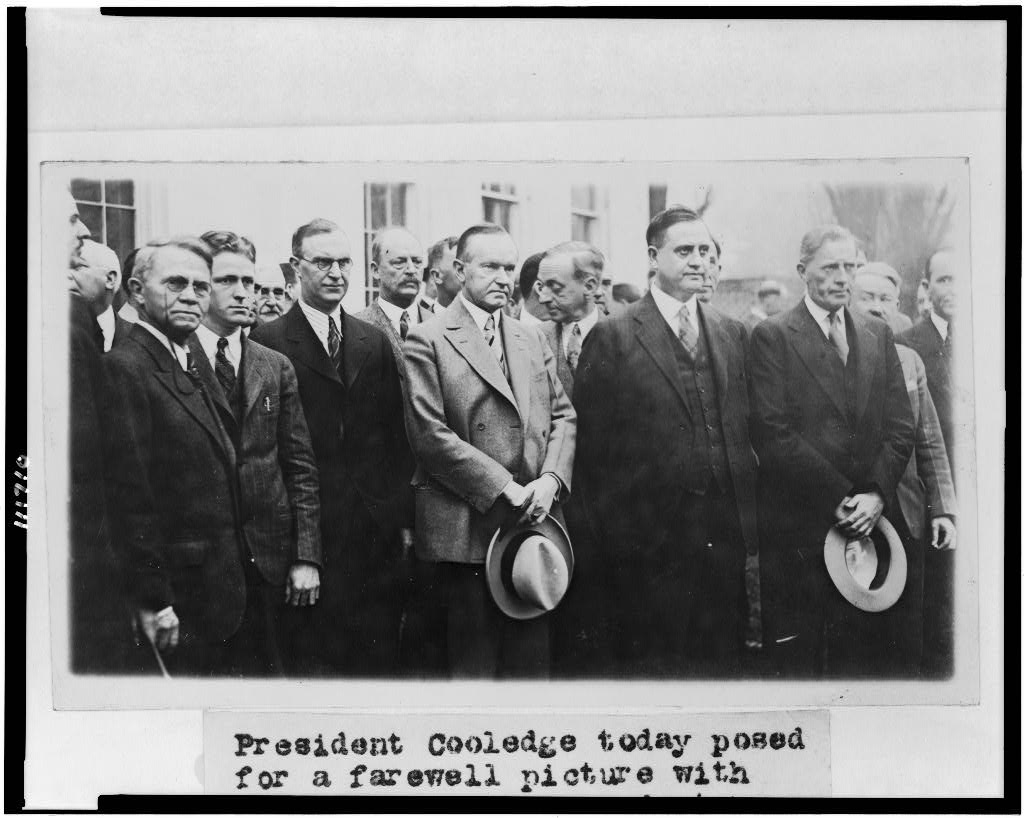
Coolidge standing for the farewell picture with White House correspondents, February 26, 1929.

Coolidge standing for the farewell picture with White House correspondents, February 26, 1929.

“There does not seem to be cause for alarm in the dual relationship of the press to the public, whereby it is one one side a purveyor of information and opinion and on the other side a purely business enterprise. Rather, it is probable that a press which maintains an intimate touch with the business currents of the nation, is likely to be more reliable than it would be if it were a stranger to these influences. After all, the chief business of the American people is business. They are profoundly concerned with producing, buying, selling, investing and prospering in the world. I am strongly of opinion that the great majority of people will always find these are moving impulses of our life. The opposite view was oracularly and poetically set forth in those lines of Goldsmith which everybody repeats, but few really believe:

‘Ill fares the land, to hastening ills a prey,

‘Where wealth accumulates, and men decay.’

“Excellent poetry, but not a good working philosophy. Goldsmith would have been right, if, in fact, the accumulation of wealth meant the decay of men. It is rare indeed that the men who are accumulating wealth decay. It is only when they cease production, when accumulation stops, that an irreparable decay begins. Wealth is the product of industry, ambition, character and untiring effort. In all experience, the accumulation of wealth means the multiplication of schools, the increase of knowledge, the dissemination of intelligence, the encouragement of science, the broadening of outlook, the expansion of liberties, the widening of culture. Of course, the accumulation of wealth cannot be justified as the chief end of existence. But we are compelled to recognize it as a means to well-nigh every desirable achievement. So long as wealth is made the means and not the end, we need not greatly fear it. And there never was a time when wealth was so generally regarded as a means, or so little regarded as an end, as today.

“Just a little time ago we read in your newspapers that two leaders of American business, whose efforts at accumulation had been most astonishingly successful, had given fifty or sixty million dollars as endowments to educational works. That was real news. It was characteristic of our American experience with men of large resources. They use their power to serve, not themselves and their own families, but the public. I feel sure that the coming generations, which will benefit by those endowments, will not be easily convinced that they have suffered greatly because of these particular accumulations of wealth.
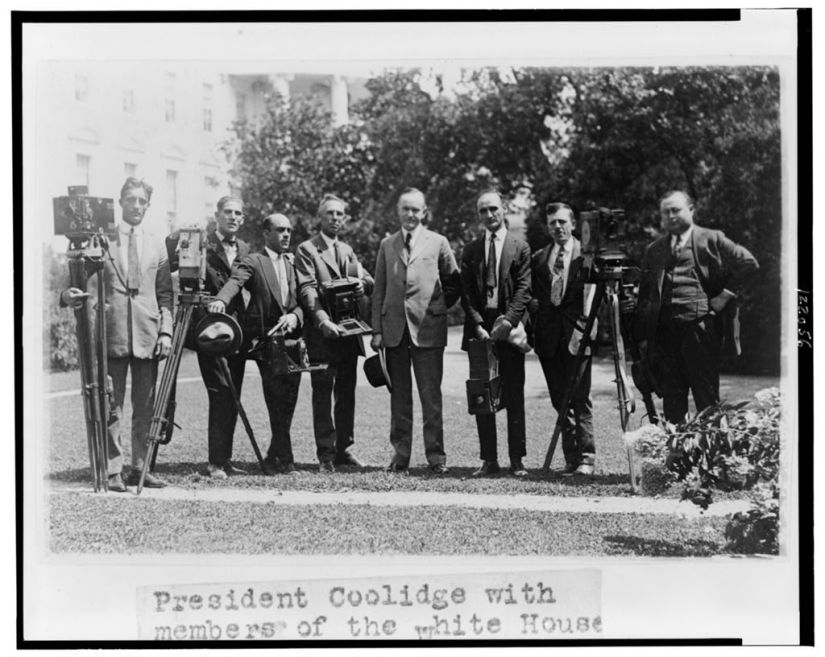
President Coolidge with members of the White House Photographers Association, 1923.

President Coolidge with members of the White House Photographers Association, 1923.

“So there is little cause for the fear that our journalism, merely because it is prosperous, is likely to betray us. But it calls for additional effort to avoid even the appearance of the evil of selfishness. In every worthy profession, of course, there will always be a minority who will appeal to the baser instinct. There always have been, and probably always will be some who will feel that their own temporary interest may be furthered by betraying the interest of others. But these are becoming constantly a less numerous and less potential element in the community. Their influence, whatever it may seem at a particular moment, is always ephemeral. They will not long interfere with the progress of the race which is determined to go its own forward and upward way. They may at times somewhat retard and delay its progress, but in the end their opposition will be overcome. They have no permanent effect. They accomplish no permanent result. The race is not traveling in that direction. The power of the spirit always prevails over the power of the flesh. These furnish us no justification for interfering with the freedom of the press, because all freedom, though it may sometime tend toward excesses, bears within it those remedies which will finally effect a cure for its own disorders.

“American newspapers have seemed to me to be particularly representative of this practical idealism of our people. Therefore, I feel secure in saying that they are best newspapers in the world. I believe that they print more real news and more reliable and characteristic news than any other newspaper. I believe their editorial opinions are less colored in influence by mere partisanship or selfish interest, than are those of any other country. Moreover, I believe that our American press is more independent, more reliable and less partisan today than at any other time in its history. I believe this of our press, precisely as I believe it of those who manage our public affairs. Both are cleaner, finer, less influenced by improper considerations, than ever before. Whoever disagrees with this judgment must take the chance of marking himself as ignorant of conditions which notoriously affected our public life, thoughts and methods, even within the memory of many men who are still among us.

“It can safely be assumed that self-interest will always place sufficient emphasis on the business side of newspapers, so that they do not need any outside encouragement for that part of their activities. Important, however, as this factor is, it is not the main element which appeals to the American people. It is only those who do not understand our people, who believe that our national life is entirely absorbed by material motives. We make no concealment of the fact that we want wealth, but there are many other things that we want very much more. We want peace and honor, and that charity which is so strong an element of all civilization. The chief ideal of the American people is idealism. I cannot repeat too often that America is a nation of idealists. That is the only motive to which they ever give any strong and lasting reaction. No newspaper can be a success which fails to appeal to that element of our national life. It is in this direction that the public press can lend its strongest support to our Government. I could not truly criticize the vast importance of the counting, room, but my ultimate faith I would place in the high idealism of the editorial room of the American newspaper.”

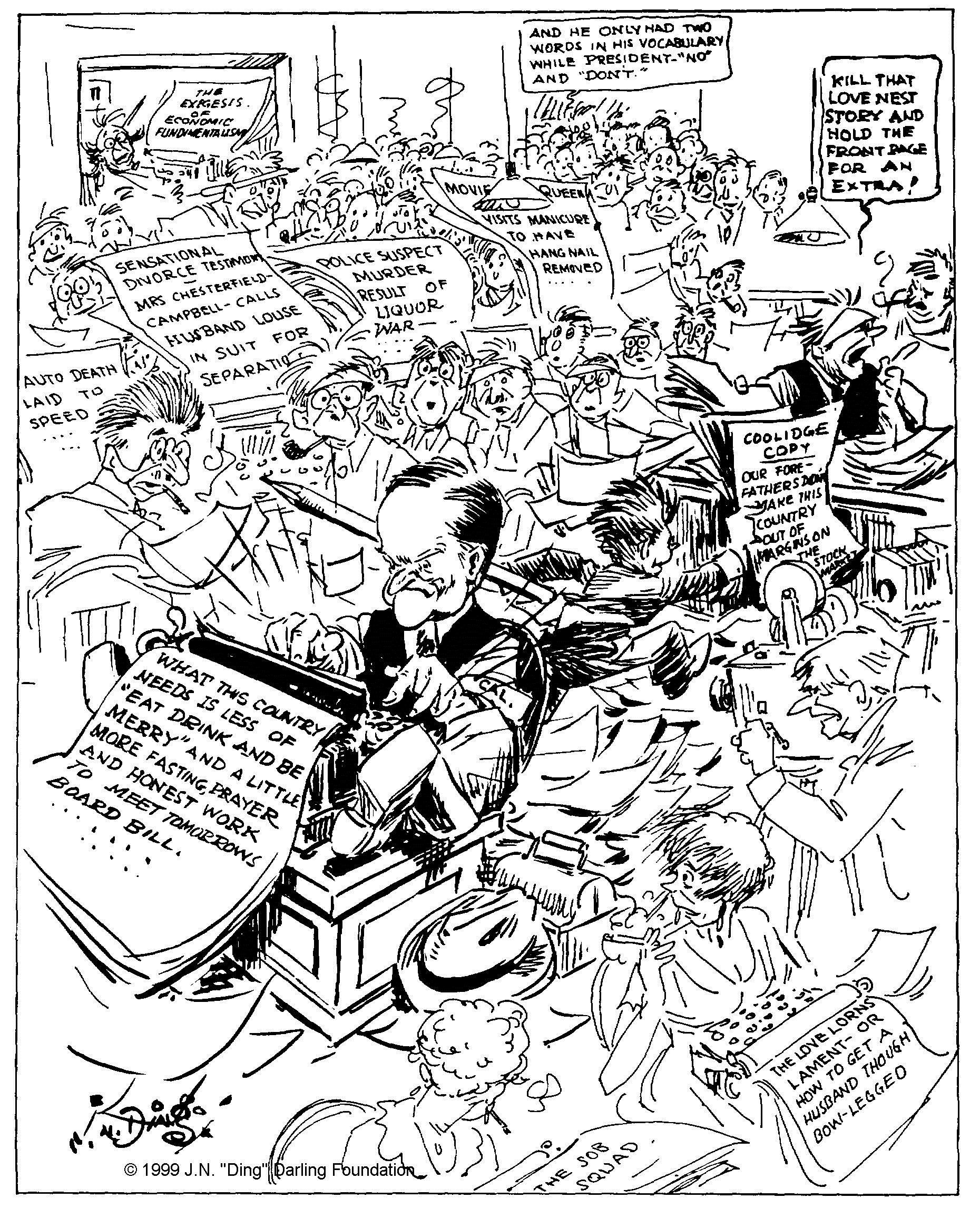
"The New Editor Goes to Work" by Jay "Ding" Darling, as former President Coolidge joined the editorial room as a daily columnist in the summer of 1930.

“The New Editor Goes to Work” by Jay “Ding” Darling, as former President Coolidge joined the editorial room as a daily columnist in the summer of 1930.

It is both illustrative and ironic that the most frequently misquoted statement used to misrepresent Coolidge’s character was prompted by a speech on the danger of institutionalized media bias. Having so successfully relegated Coolidge to the oblivion of a weak, do-nothing President for so long, the modern mainstream of news coverage is content to keep him marginalized indefinitely. As a much older Massachusetts man once said, however, “facts are stubborn things.” A media that, over the course of nine decades, has betrayed their trust as independent and open-minded “sources of public information,” for the benefit of the entire people, is no longer living up to that practical idealism Coolidge knew to be essential for free and popular government. Freedom and truth are inseparable. Either America will remain free and soundly informed or enslaved and ignorant, it cannot be both ways. Our country will not retain political and economic liberty without intellectual and spiritual freedom. Instead, far too many have given themselves over to a slavish adherence to propaganda, closing minds in order to advance the interests of despotic and autocratic politicians.

What some have ridiculed as Coolidge’s “patriotic journalism,” is simply interpreting human experience anchored by a conscientious and careful integrity instead of through the lens of distorted facts, withheld information, suppressed moral standards and a wholesale denial that biases exist everywhere, even among the media and the “experts” on which they rely. The major networks and news sources have donned a cloak of “objectivity” for so long, they are convinced by the self-delusion that journalism requires no obligation to either the American people or their founding ideals. Enslaved by their own closed-minded fidelity to partisan power, many in the press have mentally and morally renounced citizenship as Americans and the duty they once held to all the people, furnishing them a press free and independent of government.
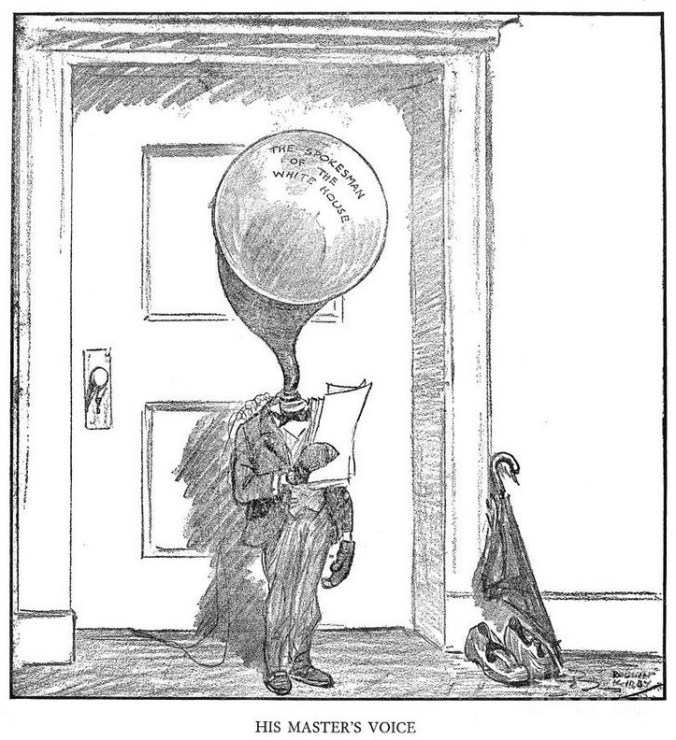
Cartoon by Rollin Kirby in the New York World, February 11, 1926. The "White House spokesman" was a rhetorical device employed by the press corps when referring to a position of the White House. Coolidge never authorized its use and, in fact, detested it, especially as it became an obvious reference to the President himself. It took on a life of its own as portrayed by Kirby in the cartoon above.

By Rollin Kirby in the New York World, February 11, 1926. The “White House spokesman” was a rhetorical device employed by the press corps when referring to a position of the White House. Coolidge never authorized its use and, in fact, detested it, especially as it became an obvious reference to the President himself despite express requests never to quote him directly. Nevertheless, it took on a life of its own as portrayed by Kirby in the cartoon above. See Coolidge’s thoughts on the matter in The Talkative President, p. 30.

Coolidge understood that both the business side and editorial sphere of media serve distinct purposes. This is as it should be. They remain separate for a reason. It is the suicide of a free press when what is newsworthy benefits the image and agenda of authority at the expense of those in “flyover country.” Likewise, when news sources disconnect from the business life of America, cutting themselves off from the practical considerations of regular Americans, the credibility of journalism is lost. Attacking America’s people and heritage, character and accomplishments, constitutional and economic institutions, focusing only on its failures and defects while ignoring its goodness and successes will only squander the opportunity to educate, inform and progress. It does not work here. We expect such cynical misunderstanding of America by international media, not by our own press. The mainstream press, so long insulated from the rest of us as strangers in a place they consider foreign to them, are losing to the new media for this reason.

The success of Rush Limbaugh, Matt Drudge and others like them is not due to some mystical indoctrination method, it is due to simply explaining what we already know to be true, credible and right. They have tapped into an open-minded and highly information-literate American audience finished with the incessant suppression of factual reporting by a correspondent corps subservient to those in office. Americans expect high standards from journalism and we will not condone those who engage in half-truths and unquestioned propaganda on behalf of state-approved authority, moving at purposes without our consent and designs hostile to our free system. The very real good of an independent and honest press comes, just as Coolidge reminded us eighty-nine years ago, from a genuine commitment to the character and ideals Americans work to live up to every day. The truth matters to us and in order to preserve our republican form of government, we return to what Coolidge dubbed “practical idealism,” the rigorous standards of a new press unafraid to meet is obligations, reapplying the practices the mainstream press once did. America’s new media, such as Rush and Breitbart, are justifying Calvin Coolidge’s enduring faith, not in the counting room, but in the editorial rooms of America’s real journalists.

President-Calvin-Coolidge

“[T]he accumulation of wealth cannot be justified as the chief end of existence … So long as wealth is made the means and not the end, we need not greatly fear it…Important, however, as this factor is, it is not the main element which appeals to the American people. It is only those who do not understand our people, who believe that our national life is entirely absorbed by material motives” — Calvin Coolidge, January 17, 1925, emphasis added.