On the Pilgrims

Image

As Liberty and Rush Revere take every reading list by storm across the country, this day observes not only the honor we render to our veterans but also the day the Pilgrims committed themselves to the rule of law through the Mayflower Compact in 1620. Derided as “Puritans” for their belief in the sanctity of conscience, committed to live by higher standards than the mediocre choices made for them by the King, the Pilgrims separated themselves from the coercive government of England for the freedoms, first, of Holland and then after two treacherous months crossing the Atlantic, the risks and opportunities of the New World. Still aboard the Mayflower on this day in November, three hundred ninety-three years ago, thirty-one Pilgrims signed the first charter of government by consent in the New World, binding all under the authority of just and equal laws. Their courage, faith and exceptional sense of purpose — risking everything for the fundamental truth of the God-given liberty of conscience — set America from the start on a vastly different foundation than the accepted norm practiced by the rest of the world’s despotic and lawless governments.

It was Governor Coolidge who saw the cause joined for which both the Pilgrims sacrificed and our veterans’ sacrifices now of everything in this life so that we would attain a society not subsisting at the behest of government force but thriving under the reign of law over governor and governed alike. In official proclamation, Coolidge declared, “War is the rule of force. Peace is the reign of law. When Massachusetts was settled the Pilgrims first dedicated themselves to a reign of law. When they set foot on Plymouth Rock they brought the Mayflower Compact, in which, calling on the Creator to witness, they agreed with each other to make just laws and render due submission and obedience. The date of that American document was written November 11, 1620.

“After more than five years of the bitterest war in human experience, the last great stronghold of force, surrendering to the demands of America and her allies, agreed to cast aside the sword and live under the law. The date of that world document was written November 11, 1918.”

Rush Limbaugh’s look at the historical record restores an unjustly excised chapter from our exceptional American life. It simply is not being learned by our children under the stifling regime of modern education. Americans, thanks to this superb book, are being taught again what Coolidge and his generation not only knew by heart, humbly cherished with warranted pride, but found from those men, women and children, despised and rejected by tyrants and despots, an inspiration to greater faith and perpetuation of exceptional achievements.

In a history replete with exceptional people of all kinds, Coolidge held these Pilgrims, who left all they knew to undergo hardships we do not even approach today, with the highest esteem and admiration. No trivial reason drove them to so profound a step into the unfamiliar and deadly in order to secure the blessings of freedom endowed, not by monarchs or Parliaments, but by our Creator.

ImageThe Coolidges looking up toward the memorial to the Pilgrims, Plymouth, Massachusetts

As Coolidge speaks, in his own account of those brave Pilgrims, we can hear in his words the enthusiasm and reverence for the moral power of their example, a force that no arbitrary force, however strong, can withstand. An unchallenged management of every choice in life from Washington can only and absolutely succeed, not by disarming the people physically but by severing Americans from their history — disarming the people intellectually and spiritually. Coolidge spoke then and Rush speaks now so that we retain the long memory of our liberties, as it resists the slow, yet destructive, encroachments of those who sincerely believe they are acting for our own good.

Addressing the National Geographic Society in 1923, Coolidge recounts the Pilgrim’s exceptional accomplishment, “Whatever power is lodged in a monarch, always he has sought to maintain and extend it by encroachment upon the liberties of the people. When the more advanced of the Puritans sought to put their principle of freedom into practical effect by separation from the established church, they were met by the notorious threat of the King that he would make them conform or he would harry them out of the land.

“In that threat lay the foundation of Massachusetts. That little band, from among whom were to come those made forever immortal by that voyage of the Mayflower, sought refuge in Holland, where, by an edict of William the Silent, freedom of religion had been established…”

Citing the words of their preacher, John Robinson, Coolidge continued, ” ‘The people…are industrious and frugal. We are knit together as a body in a most sacred covenant of the Lord, of the violation whereof we hold ourselves strictly tied to all care of each others’ good and of the whole by every one, and so mutually. It is not with us as with men whom small things can discourage.’ In that simple statement is to be found,” Coolidge summarized, “the principle of prosperity, responsibility, and social welfare, all based on religion.” That was not the end of the story, however. “They were of humble origin,” Coolidge noted. These families were not living high on the backs of the poor. They did not get where they were going by confiscation or oppression of others. “The bare necessities of existence had been won by them in a strange country only at the expense of extreme toil and hardship. They did not shrink from the prospect of a like experience in America…

“It was such a people, strengthened by such a purpose, obedient to such a message, who set their course in the little Mayflower across the broad Atlantic on the sixth day of September, 1620…

“A providential breeze carried them far to the north, while storms and the frail condition of their ship prevented them from continuing to their destination. They came to anchor off Provincetown far outside the jurisdiction of their own patent and the authority of existing laws…

“Undismayed they set about to establish their own institutions and recognize their own civil authority. Gathering in the narrow cabin of the Mayflower, piously imploring the divine presence, in mutual covenant they acknowledged the power ‘to enacte, constitute, & frame just & equall lawes, ordinances, actes, constitutions & offices,’ to which they pledged ‘ all due submission & obedience.’ So there was adopted the famous Mayflower Compact. It did not in form establish a government, but it declared the authority to establish a government, the power to make laws, and the duty to obey them. Beyond this it proclaimed the principle of democracy. The powers which they proposed to exercise arose directly from the express consent of all the governed. The date of this document, remarkable for what it contains, but more remarkable still because it reveals the capacity and spirit of those who made it, is November 11, 1620, old style; under the new calendar it is destined long to be remembered as Armistice Day…
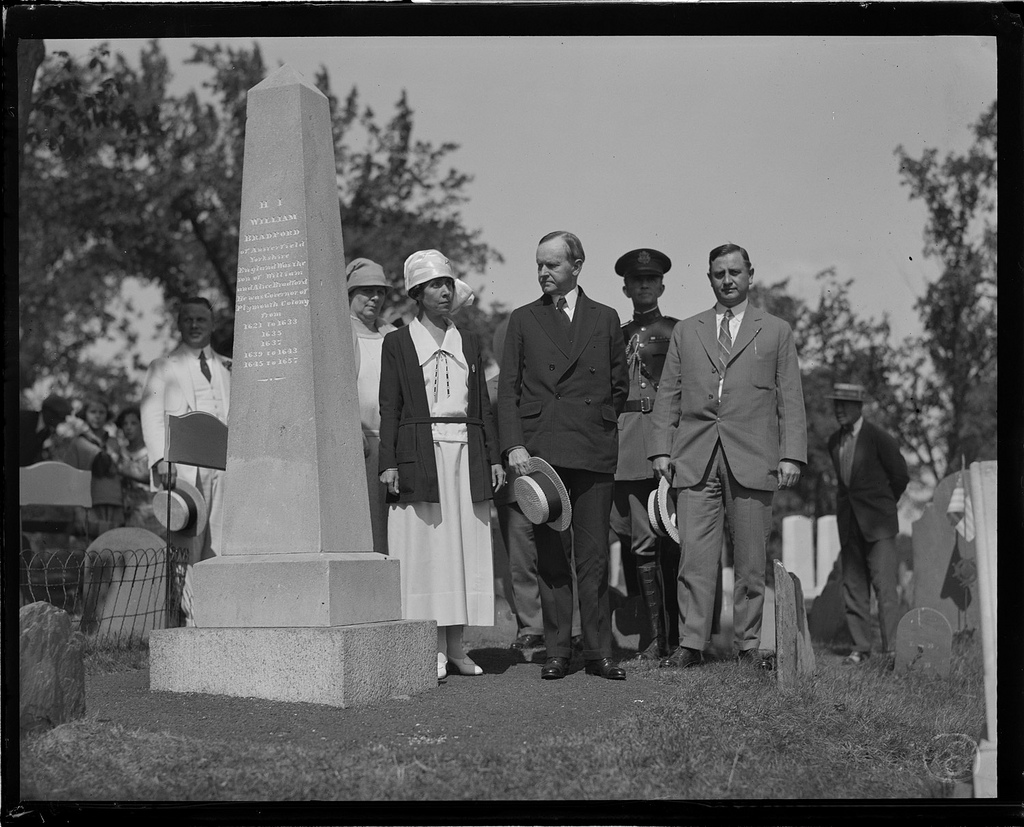
ImageThe Coolidges visiting the memorial marker of William Bradford, leader of the Plymouth settlement

“Such was the beginning of Massachusetts, men and women humble in position, few in numbers, seemingly weak, but possessed of a purpose, moved by a deep conviction, guided by an abiding spirit, against which both time and death were powerless. It is said that upon the old Colony of Plymouth there is no stain of bigoted persecution. They carried with them the atmosphere of holy charity. Their efforts and their experience stand forth distinctly, raising a new hope in the world…” Indeed, they still do, inspiring even the youngest Americans among us to love and share the same great principles those brave Pilgrims demonstrated nearly four centuries ago.

ImagePilgrims signing the Compact aboard the Mayflower, November 11, 1620

Madison Project: Coolidge on Immigration

Madison Project: Coolidge on Immigration

This past May, the policy director of the Madison Project, Daniel Horowitz, took an important look at what Calvin Coolidge thought about immigration. As the pressure is on to overhaul current law on the matter, historical perspective from the man who took time to explain the purpose of restriction and its very real benefits to both Americans and those who want to come here, this short piece merits attention.

The President signing the Johnson-Reed Act, on the south lawn of the White House, May 26, 1924.

The President signing the Johnson-Reed Act, on the south lawn of the White House, May 26, 1924.

Included in Japanese Immigration by Raymond Leslie Buell. Boston: World Peace Foundation, 1924. Digitized at http://pds.lib.harvard.edu/pds/view/4009420?n=95&s=4&printThumbnails=no.

Included in Japanese Immigration by Raymond Leslie Buell. Boston: World Peace Foundation, 1924. Digitized at http://pds.lib.harvard.edu/pds/view/4009420?n=95&s=4&printThumbnails=no.

On “The Genius of America”

Having spoken the previous day about the power of religion on the making of America, Calvin Coolidge addressed a group of naturalized citizens on this day eighty-nine years ago. He not only told his audience how glad he was to welcome them to the White House but he even made a couple jokes, the first of which went, “if Methuselah (the longest living man, Genesis 5:27) were at this time an American in his period of middle life, and should drop in on our little party, he would regard us all as upstarts.” With his dry wit, Coolidge underscored the youthfulness of our country among the aged nations of the world.

How was it then that America, still so new among civilizations, had “been blessed with an unparalleled capacity for assimilating peoples of varying races and nations”? What other nation could claim so rapid a population growth in so short a time? While, the population trends were predominantly in a western direction, something different was at work than the simple relocation of peoples that had filled Europe over the centuries.

“It was the fate of Europe to be always a battleground.” Animus over the differences between race, religion, politics and social standards made peace the abnormal condition of life. For Europe, as with most of the globe, it has been war disrupted briefly by conciliation that has been the norm. “It is one of the anomalies of the human story that these peoples, who could not be assimilated and unified under the skies of Europe, should on coming to America discover an amazing genius for cooperation, for fusion, and for harmonious effort.” They were the same people who left the shores of the Old World and stepped into the New. What made the difference? What furnished that incredible genius that transformed antagonism into collaboration and perpetual discord into a people united? Coolidge enumerated three factors responsible for shedding the “ancient antagonisms” of race and class.

First, the “broadly tolerant attitude that has been a characteristic of this country” was responsible. Used in its fullest sense, Coolidge meant the wide forbearance Americans show on a daily basis to each other in regard to religious opinions, political differences and social relationships. These differences, as long as they remained law-abiding, did not hinder fellowship as equals. The increased perception of partisanship is due to an intolerance (not native to American ideals) for mitigating racial and class distinctions. While an intolerant few wish to equate so quintessential an American trait with conformity and compliance, Coolidge saw the strength of this country’s success in its ability to look past such irrelevant differences to real equality. This equality was not a suppression of differing opinions or a coerced conformity of outcomes. This equality rested in maximizing opportunity for “every American to become the architect of whatever fortune he deserves.” The opportunity, not the result, afforded by forbearance is what set apart America from the inherited caste systems of Europe. Leaving the security of the crowded cities and old towns of Europe for the open chance to start anew in America, immigrants quickly found forbearance and cooperation were necessary to succeed.

Second, “our Republican system of Government” was responsible. Leaving behind the centralized governments of the Old World, where subjects neither shared in nor held power to make their own decisions, immigrants to America discovered what self-government truly means. Here equals shared in the burdens as well as the privileges of governance. The benefits of being American did not fall exclusively to masters in some distant capital. For the first time an individual could direct his own affairs through institutions which limited central authorities and liberated people.

Third, “our system of universal free education” was responsible. That system was to serve as an ever-watchful sentry against “the revival of old, or the creation of new regional or group hostilities.” No longer would the prejudices and jealousies of the Old World hold sway. Education was not merely for the wealthiest and most connected among us, it was a measure to which all could attain. The American ideal was to open the mind to the possibilities of the individual, not close it through the victimhood of class warfare and the paralysis of predetermined fate. Education was not for a select few to monopolize their peculiar status, it was the shared endowment of all who strove to become Americans.

Looking out over the audience gathered at the White House, President Coolidge expressed his admiration for those most recently arrived in a long line of loyal, patriotic and law-abiding immigrants. They understood, perhaps more keenly than most, the supreme treasure America’s opportunities afford. He knew and his audience understood that it required the best of each individual, hard work to reap the rewards. It was not gifted. It had to be earned. The only entitlement was for an individual to keep the fruits of his own labor.

When land was abundant and large territories still unsettled, conditions lent themselves to receiving large numbers of immigrants. That had changed by 1924. In order to preserve and maximize opportunity, first for those already here and then for those who have yet to become Americans, limits are applied. It has nothing to do with any of the classes or creeds of the Old World. Rather, it considers the good of everyone concerned. If too many came at once, the country would be unable to assimilate them, wages would fall and the means of bettering one’s conditions would be depleted. If America is to preserve robust opportunity to both the newcomer and those already established here, it must set limits on immigration.

Taking this principle one step forward, Coolidge ventured to his final point. If America welcomed the world, it would no longer remain a distinctive and exceptional place of opportunity for everyone. The first responsibility, however, the Nation owed was to its inhabitants, be they native or naturalized. Coolidge shared their sympathies to help the Old World with its “long established hostilities.”

How can America best help the world, though? Coolidge answered, “We want our America to continue an example and a demonstration that peace, harmony, cooperation and a truly national patriotic sentiment may be established and perpetuated on an American scale. We believe our first great service to the Old World will be in proving this.” Our example was to show how peace and strength come to nations by reinforcing liberty and shedding class differences. That example was to be done “on an American scale,” not a global scale. It was not ours to “Americanize” everyone else. It was up to the Old World to determine its own destiny. Yet, it would come by letting go of those long-cherished yet self-destructive habits. By proving this sentiment of peace, cooperation and patriotism, Coolidge continued, “we shall be doing the things that will best equip us, spiritually and materially, to give the most effective help toward relieving the suffering nations of the Old World.”

What was the best way for the individual immigrant to help the struggling nations of the world? It was not to throw money at the symptoms (hunger, poverty, war), while neglecting the causes: an institutionalized denial of forbearance, self-government and education. It was not to import the Old World’s “race prejudices and race hatreds into action here.” Transforming into the likeness of Old Europe would not work in America. “Bringing America down” would benefit no one and rectify nothing.

What was needed most, as Coolidge encouraged, was “devotion to religion.” To best help, an attachment to the faith of one’s fathers was crucial. America, and consequently the rest of the world, would be far weaker if allowed to drift away from the cultivation of religious faith. Coolidge fostered an environment where immigrants remembered their duty to God as well as man.

America sought to help everyone as the need arose. This policy was not offering to aid one and dispensing harm to another. Nor by hurting America would the world’s distress be alleviated. Instead, Coolidge declared, “We can be in a position to help only by unifying the American nation, building it up, making it strong, keeping it independent, using its inclination to help and its disinclination to injure. Those who cast in their lot with this country can be true to the land of their origin only by first being true to America.” It is then that the “genius of America” is at its finest,  reinforcing individual opportunity that thrives in rejection of Old World intolerance, despotism and ignorance.