The judiciary, to no less degree than the executive and legislative branches of the national government, was to remain independent. This meant that in the courts were vested the final authority for deciding the meaning and application of the Constitution’s provisions. When abuses occurred, the courts remained open and it was then time to “Let the Supreme Court talk.” This also meant that the courts were not subject to recall, legislative veto or executive override. Channeling Federalist number 78, Calvin Coolidge explains what the Framers thought when they separated the judicial power from that of the other two roles, “When the judicial function was set apart and made the third independent but coordinating factor in the form of government, the scheme of a perfected democratic-republicanism was for the first time presented to the world. That was the great contribution made by the founding fathers in our Constitution. By virtue of it, the people were at last assured equality against the tyranny of any despotic executive and the tyranny of any despotic legislature. Neither of them, nor both of them together, might thereafter impose a lawless will upon a defenceless people.”
But what when the Courts themselves were accused of tyrannical abuses? “Somewhere must be lodged the power to declare the Constitution. If it be taken away from the Court, it must go either to the executive or the legislative branch of the Government. No one, as far as I know, has thought that it should go to the Executive. All those who advocate changes propose, I believe, that it should be transferred in whole or in part to the Congress. I have a very high regard for legislative assemblies. We have put a very great emphasis upon representative government. It is the only method by which due deliberation can be secured…But the legislature is not judicial…It is well known that when the House of Representatives sits as a judicial body, to determine contested elections, it has a tendency to decide in a partisan way. It is to be remembered also that under recent political practice there is a strong tendency for legislatures to be very much influenced by the Executive. Whether we like this practice or not, there is no use denying that it exists. With a dominant Executive and a subservient legislature, the opportunity would be very inviting to aggrandizement and very dangerous to liberty. That way lead toward imperialism.“
Coolidge explained the basis for this lesser of evils balance, “When our Constitution was adopted it established the Supreme Court of the United States to be the very citadel of justice. Its members are appointed for life in order that they may be devoted entirely to the administration of justice according to law, and as independent and impartial as it is possible for men to be.” Remembering that this framework was dependent on finite people to make it work, Coolidge understood what the Framers knew all too well, that “[w]e have adopted a written Constitution in order that the minority, even down to the most insignificant individual, might have their rights protected. So long as our Constitution remains in force, no majority, no matter how large, can deprive the individual of the right of life, liberty, or property, or prohibit the free exercise of religion or the freedom of speech or of the press. If the authority now vested in the Supreme Court were transferred to the Congress, any majority, no matter what their motive, could vote away any of these precious rights. Majorities are notoriously irresponsible. After irresponsible damage had been done the only remedy that the people would have would be the privilege of trying to defeat such a majority at the next election.” The framework, being made for and enacted by flawed humanity, would not be perfect but it would err in favor of the individual, not the collective or the democratic majority. To so place the rights of individuals at the mercy of electoral politics would be a permanent fixture of society if judicial power were assumed by the Congress. Did Coolidge, or the Founders for that matter, think the Supreme Court would never abuse their role? Hardly, for he said, “It is not necessary to prove that the Supreme Court never made a mistake. But if this power is taken away from them, it is necessary to prove that those who are to exercise it would be likely to make fewer mistakes.” Experience has shown the wisdom of this statement since Congressional and Executive actions precede and dwarf Judicial abuses. “It is proposed to place this power, which it must be remembered is that of life and death, in the hands of the Congress. That would give to that body power to violate all the rights which I have just mentioned, the power to destroy the states, abolish the Presidential office, close the courts, and make the will of the Congress absolute. Is it supposed that in the exercise of this power they would be more impartial, more independent than the judges of the Supreme Court?”
Coolidge knew the “power and that authority has to reside somewhere in every government…One of the great contributions which America made to the science of government was the establishment of an independent judiciary department under which this authority resides in the Supreme Court. That tribunal has been made as independent and impartial as human nature could devise.” Coolidge reminds his listeners that perfection was not realistic but while the courts were open, “a minority would have no remedy for wrong done them. Their ultimate refuge is the Supreme Court of the United States.” Was Coolidge advocating the virtually unlimited scope of interpretation granted by the concept of a “living Constitution”? Far from it, he like Justice Harlan Fiske Stone, whom he would nominate to the Supreme Court, held to set principals of an independent judiciary and limited authority. If the Constitution did not address the matter directly, it was no business of the Court to supply the meaning it wanted. Coolidge and Stone both agreed that the Amendment process, deliberately difficult, ensured changes could be made only through the deliberative consent of the people and the states. Considering four historic amendments were advanced and duly ratified as Coolidge and Stone came into national prominence, it was no abstract argument that Amendments are the means to change, not Judicial improvisation. Besides, as Coolidge would reiterate, “The pressing need of the present day is not to change our constitutional rights, but to observe our constitutional rights.”
As the Court, including Justice Stone, would drift toward expedient concession to Congressional power, the independence of the courts Coolidge had fought to articulate would be lost for a time. It serves to remind us that our institutions are ultimately what we make of them and allow them to be. The best framework still depends, no less than it did then, on men and women who understand the proper role and powers of a judge. The less and less it is understood the independence given the Judiciary by the Constitution, the more it becomes an arm of one or both of the other branches. But, Coolidge even before the Court became populated with former legislators and executives through the 1930s and beyond, he said,
“The time to stop those who would loosen and weaken the fabric of our Government is before they begin. The time for Americans to range themselves firmly, squarely, and uncompromisingly behind American ideals is now. The great body of our people have an abiding faith in their own country. The time has come when they should supplement that faith with action. The question is whether America will allow itself to be degraded into a communistic and socialistic state, or whether it will remain American. Those who want to continue to enjoy the high estate of American citizenship will resist all attempts to encroach upon their liberties by encroaching upon the power of the courts.”
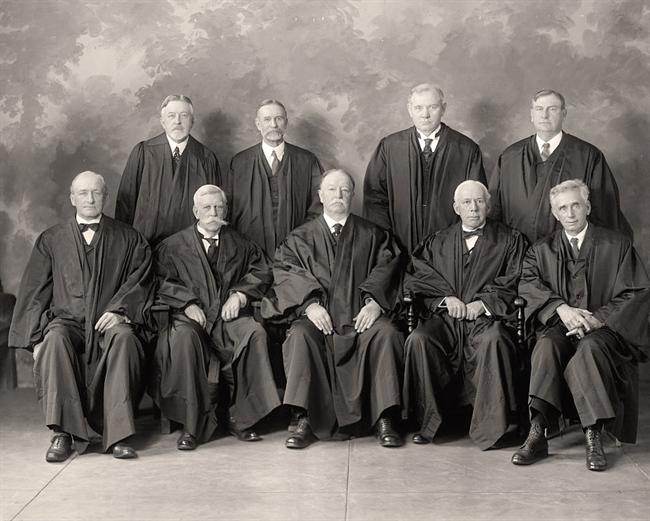
Taft Court, 1921-1930, photographed in 1925 (Chief Justice Taft, center front with Associate Justices alternating by seniority, FRONT: Oliver Wendell Holmes, Taft’s right; Willis Van Devanter, Taft’s left; James Clark McReynolds, outside right; Louis Brandeis, outside left; BACK: George Sutherland, over Taft’s right shoulder; Pierce Butler, over Taft’s left shoulder; Edward Terry Sanford, outside right; Harlan Fiske Stone, outside left).
 The Importance of the Obvious