On Presidential Limits

The custom of two terms established by President Washington was faithfully preserved for one hundred and fifty-one years until the precedent was broken by Franklin Delano Roosevelt, winning his third term in 1940. Coolidge had been gone seven years by that time. F. D. R.  would be elected for a fourth term in 1944 and die in office the following April. The twenty-second Amendment was ratified in February 1951 in order to formally establish the original two-term limit as part of the Constitution.

Looking back on his five and a half years as President, Coolidge offered some enduring insights on the need for Presidential limits. This is not only exemplified by the term of office custom, which is now law, but the necessity to respect the Office, honor the limits of its power and guard against its delusory sense of greatness. This risk is not unique to the Presidency; one’s approach to authority on any level is just as prone to abuse and self-deception.

Coolidge, never buying the notion that he was a great man, held each responsibility with the humility of one who could handle what was expected of him without pretentiousness or “muscle-flexing.” He made the difficult look easy but his ability to lead came from discipline, training and perspective not arrogance or condescension. He had this to say about limits,

…[I]rrespective of the third-term policy, the presidential office is of such a nature that it is difficult to conceive how one man can successfully serve the country for a term of more than eight years.

     While I am in favor of continuing the long-established custom of the country in relation to a third term for a President, yet I do not think that the practice applies to one who has succeeded to part of a term as Vice President. Others might argue that it does, but I doubt if the country would so consider it…

     …A President should not only not be selfish, but he ought to avoid the appearance of selfishness. The people would not have confidence in a man that appeared to be grasping for office.

     It is difficult for men in high office to avoid the malady of self-delusion. They are always surrounded by worshipers. They are constantly, and for the most part sincerely, assured of their greatness.

     They live in an artificial atmosphere of adulation and exaltation which sooner or later impairs their judgment. They are in grave danger of becoming careless and arrogant.

     The chances of having wise and faithful public service are increased by a change in the presidential office after a moderate length of time.

     In the higher ranges of public service men appear to come forward to perform a certain duty. When it is performed their work is done. They usually find it impossible to readjust themselves in the thought of the people so as to pass on successfully to the solution of new public problems.

     An examination of the records of those Presidents who have served eight years will disclose that in almost every instance the latter part of their term has shown very little in the way of constructive accomplishment. They have often been clouded with grave disappointments.

     While I had a desire to be relieved of the pretensions and delusions of public life, it was not because of any attraction of pleasure or idleness.

     We draw our Presidents from the people. It is a wholesome thing for them to return to the people. I came from them. I wish to be one of them again…Our country does not believe in idleness. It honors hard work. I wanted to serve the country again as a private citizen.
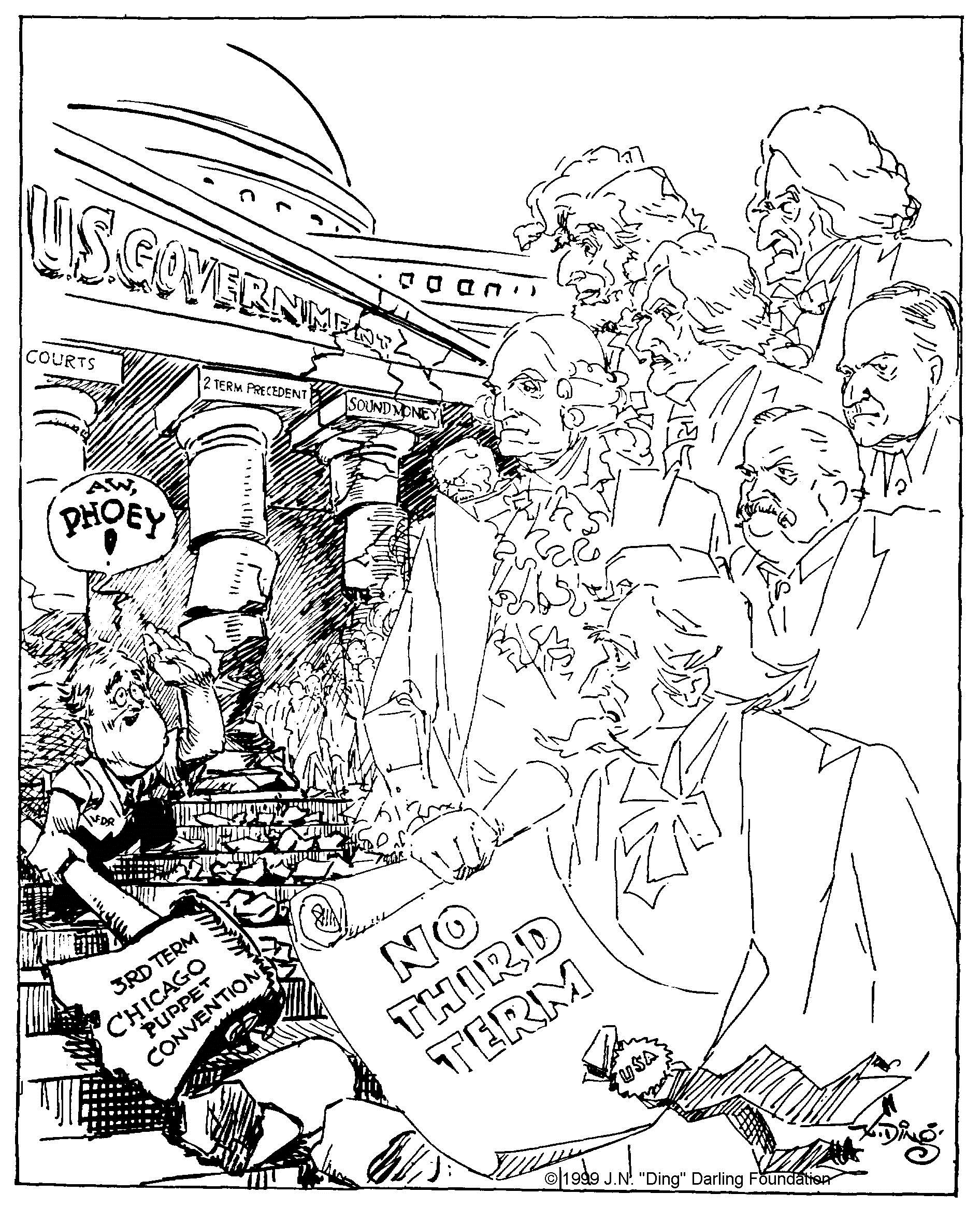
ImageIn this editorial depiction by J. N. “Ding” Darling entitled, “Just a whole lot of nobodies who never knew nothin’,” published October 15, 1940, the cartoonist conveys F. D. R.’s destructive disregard of our institutions and traditions. It is a suitable tribute that, among the “ghosts” of past Presidents arrayed against Roosevelt, Calvin Coolidge is conspicuously among them (L to R: Washington, Lincoln, Jefferson, Jackson, Cleveland and Coolidge stand in the foreground, with Theodore Roosevelt and the rest of those Presidents who have gone on, standing in the background). Coolidge’s warnings echo even now.

On Separate Classes

jb_jazz_coolidge_3_e

“There is yet another manifest disposition which has preyed on the weakness of the race from its infancy, denounced alike by the letter and the spirit of the Constitution, and repugnant to all that is American, the attempt to create class distinctions. In its full development this means the caste system, wherein such civilization as exists is rigidly set, and that elasticity so necessary for progress, and that recognition of equality which has been the aim and glory of our institutions, are destroyed and denied. Society to advance must be not a dead form but a living organism, plastic, inviting progress. There are no classes here. There are different occupations and different stations, certainly there can be no class of employer and employed. All true Americans are working for each other, exchanging the results of the efforts of hand and brain wrought through the unconsumed efforts of yesterday, which we call capital, all paying and being paid by each other, serving and being served. To do otherwise is to stand disgraced and alien to our institutions. This means that government must look at the part in light of the whole, that legislation must be directed not for private interest but for public welfare, and that thereby alone will each of our citizens find their greatest accomplishment and success” — Governor Calvin Coolidge, formally accepting Republican nomination as Vice-President, July 27, 1920.

More than ten years later, in the midst of economic downturn, Garet Garrett would echo the same point through his column in the Saturday Evening Post. In articles like, “There Goes Mine,” written in 1932, Garrett attacks the fallacy that economic classes are both fixed and permanent. He refers to the resentment during depressions of car ownership and how confidence in one’s ability to move upward from poverty to prosperity remains entirely within each person’s reach. Coolidge and Garrett both understood that liberty means opportunity, an opportunity that is not coincidental but directly due to our unique political and economic system as founded. Margaret Thatcher, the late British prime minister, grasped the significance of this truth better than have many Americans. She observed that when opportunity is maximized, class distinctions diminish and the disparity between “rich” and “poor” decreases, contrary to every economic “expert.”

As all three realized, however, the opposite holds true every time socialism is allowed to set policy, be it locally or nationally. For the Left, as Thatcher noted, it is better for the poor to stay poor “provided the rich were less rich.” Such a view summarizes modern liberalism. It is the Left’s animus against success and its vested interest in perpetual victim-hood which drive its agenda. It is never about rising to higher aspirations or striving for greater ideals. It is about exchanging our independence for the security they provide, a security of marginal existence.

Coolidge, Garett and Thatcher all knew what the Left denies to this day: policies that maximize individual opportunity remove class distinctions automatically and enable equality on the basis of each person’s determination and potential. Modern liberals would have us all equally poor, feeling guilty of ever rising above the marginal, dependent and miserable and call that “progress.” Incapable of fixing the problems Coolidge’s policies addressed, all that is left for modern liberalism is to keep the class warfare going, to provoke violence, and to project its failures onto those striving to heal and reunite us with the freedom of a truly classless society envisioned by our Framers.

Garet-Garrett margaret-thatcher

On National Defense

Image

The Reagan Doctrine, summarized as “Peace through Strength,” is rightly praised for its sensible protection of our interests and the conscientious pursuit of peace in our dealings with the world. However, it did not start with Reagan. Among the many debts the “Great Communicator” derives from his predecessors, his pursuit of peace through preparedness owes some credit to President Coolidge. While Coolidge certainly preceded the prospect of nuclear proliferation in our time, the struggle for world power was no less prevalent then. The principles remain unchanged because they stem from human nature.

In the first of his three-part series on “Promoting Peace” published after leaving the White House, Calvin Coolidge outlines the immense task of preventing war through adequate defense. Coolidge certainly understood the complexity of the problem and this enabled him to distill it down to its essence: a question of human nature. He writes,

When the test comes the people will give up almost any other human right to secure safety and protection. Whenever anarchy imperils a state a military dictator always appears, because they prefer him to the lawlessness of the mob…In protecting its citizens abroad as well as at home the government, in reality, is only protecting itself. To refuse and neglect to do this is nothing short of national suicide.

     This principle is so well understood and so long established that nations accord to a foreign country, whenever the rights of its citizens are threatened or violated, the privilege of sending its naval and marine forces to protect them without considering such intervention an act of war.

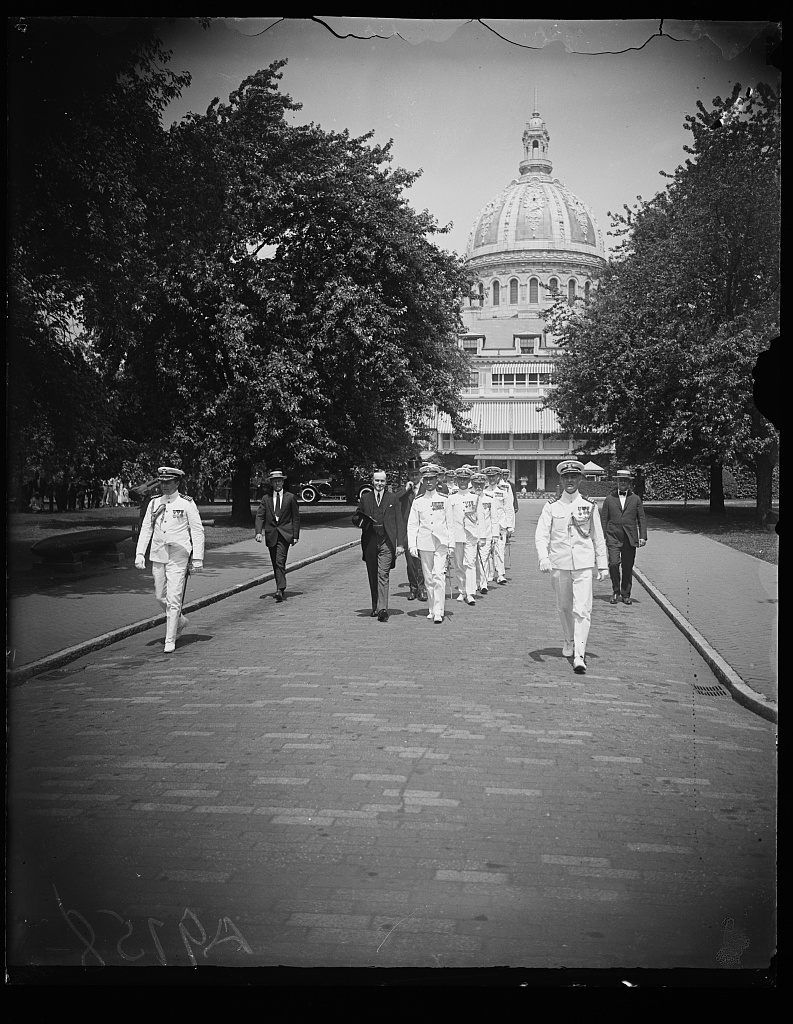
     One of the methods by which each government undertakes to preserve order so that it may protect its people from domestic violence and foreign hostilities is known as preparation for national defense. The great object that it all seeks to accomplish is peace…We do not have these [police, Army and Navy] for the purpose of making war, but for the purpose of preserving peace. The ability to protect the people within its borders and to insure to them the security which can only come from the orderly administration of law is so much and so peculiarly the first requisite of every government that under international usage civilized nations do not recognize a government which can not or does not meet these obligations. 45060v CC at Naval Academy 1925

As the inordinate power of the current regime grows, it becomes ever more apparent how far removed it is from this essential purpose of lawful order and national defense.

While Coolidge ensured the ratification of Kellogg’s Pact against war, he understood good government protects its citizens from lawless violence. At the same time, he knew that no measure could ever eradicate conflict completely. What he worked to maintain was an adequate force to meet evil, understanding that the unjust and violent are enabled when national defense is neglected. The former President continues,

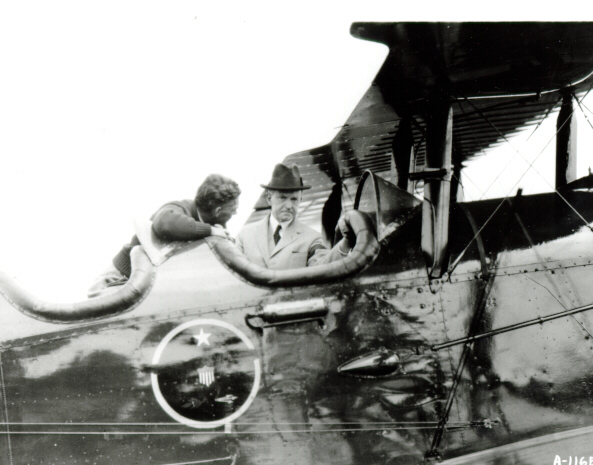
No sure way has ever been found to prevent war. We all realize that it is one of the most hideous afflictions to which mankind is subject. Opinions may differ as to whether nations with adequate military forces are more likely to enjoy peace than those which neglect their defenses. In the last analysis, this is a question of dealing with human nature. Every one knows that if there were no police our cities would be ransacked within twenty-four hours. I very strongly suspect that if there were but one nation in the world supplied with an army and a navy, and, to make the supposition as strong as possible, if that nation were our own, it would not be long before the other nations had been overrun. It seems to me that it is almost a moral certainty that we should find some excuse for taking that action. But when we know that other countries have a considerable ability to defend themselves, it is human nature for us to regard them with a more wholesome respect and be more careful about violating their rights. If we reverse this picture we can likewise conclude that if others know we are prepared to defend ourselves they will be less likely to commit offenses against us. coolidge bolling field 9-9-24

We perform no favors by taking up the burden of each nation’s duty to self-defense. The lessons of the Great War taught him that. Europe would again defer to America for its rescue in World War II and, it seems, in every conflict since. Coolidge saw danger in the policy of making the world “safe for democracy.” Likewise, we only enable our rights to be ransacked and our lives taken if we indulge our enemies through a lack of preparedness. An absence of resolve and an absolute refusal to use force only encourage injustice to continue with impunity against our citizens and their rights. What constitutes an adequate defense, then?

The President answers,

They should be large enough so that others would see there would be a great deal of peril involved in attacking us. They should not be so large that our country would feel we would undergo no peril in attacking others…I have ventured the opinion that war would have broken out in Europe much earlier than 1914 if those countries had not been prepared to resist attack. I also believe that some of them were overprepared…Adequate defense does not require a return to the conditions which then existed, but rather requires their avoidance.

The question of defense, like a coin, has another side. Military might has natural limitations. It can grow too large and thereby undermine its goal to preserve peace. Defenses, however lethal or expansive, will never permanently override human nature’s “determination to be free.” What about individuals who have ideological, instead of national, loyalties? What of those who freely embrace death for their radical dream, like islamofascists?

Coolidge summarizes,

That the wrongdoer, whether it be the individual or the nation, can be checked by force is apparent, but no force will be found adequate for an extended period to impose upon any considerable body of people a system which is recognized by the general standards of humanity as injustice and servitude. Such an attempt would create a revolt in which it would be found that the victims would rather die than yield. While an army and navy can be very useful to protect a nation from wrongful attack and unjust aggression, they cannot afford an absolute guarantee against war. Preparation for defense seems to me to be necessary in the world as we find it at the present time, and is useful, but it is well to recognize that there are limits beyond which it does not and cannot go in preserving peace…

Both sides of our obligation need equal care. This means understanding clearly that the use of national defense is not the evil here. Lawless and abusive destroyers of our citizen’s lives and liberties are the evil here, as Coolidge concludes,

…[W]e should take every precaution to prevent war, of which adequate defense is one. But we should also take every precaution to protect ourselves to the fullest possible extent from its ravages, if it does come. The Army and Navy serve the double purpose of prevention and defense. The individual and the race have not progressed beyond the point where they need the teaching and effect of discipline. We require not only the existence, but the outward manifestation, of authority.

Without the policeman impartially enforcing the law, and the members of our military and National Guard prepared to do their duty, peace is impossible. Without a national defense ready to use strength to confront the individual or nation who takes American lives, exacting life for life, the murderous and lawless continue emboldened. Reagan and Coolidge both understood that the problem was embedded in human nature. The bully, the criminal, and the despot best understand the language of force. Reason and law mean little to them without physical demonstration. It is by exercising our duties of adequate national defense that law and peace are reestablished, evil men and women are deterred and a balance of righteous force restored.

Image

998243_10151699964766321_1262093981_n SD National Guard