On Modern Art

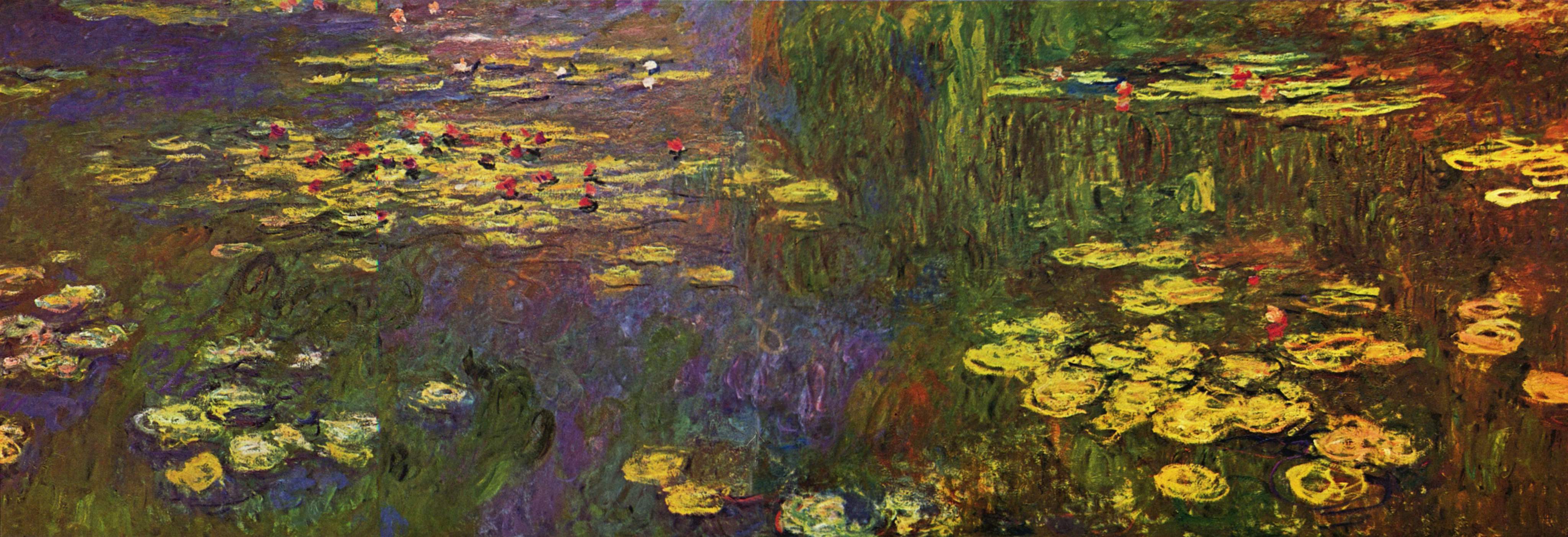
Painting of water lilies by Claude Monet, completed in 1926.

Les Nympheas – Painting of water lilies by Claude Monet, completed in 1926.

When British critic and socialite Beverly Nichols interviewed Calvin Coolidge in 1927 for Nichols’ book, “The Star Spangled Manner,” the subject turned to modern art. When it came to the frequently random images hailed as great work, “Silent Cal” was anything but taciturn. As he peered into the canvases of those paintings, he saw something far more profound than haphazard brush strokes. He told Mr. Nichols,

“Not long ago, I happened to visit an exhibition of modern pictures. it was held in Pittsburgh, and almost every European nation was represented–[the United Kingdom], France, Germany, Italy–the whole lot of them. And as I looked at those pictures, I felt that I could see through them, into the minds of the nations which had created them. I could see the torment out of which they had been born. If that nation’s psychology was still diseased, so was its art. The traces of neurosis were unmistakable. If, on the other hand, the nation was on the road to recovery, if its people were rediscovering the happiness which they had lost, the story was told in the picture, too.”

Art reflects a nation’s health and well-being. Artists are usually the earliest prophets of a nation’s direction. A nation’s art reflects its grasp, or refusal to face, reality. Coolidge’s understanding of this simple yet profound truth illustrates how deep a thinker he actually was.

On “Negative” Liberties

For Coolidge, when the Constitution said “no” it not only meant what it said, it said so for a good reason. It said “no” in order to preserve good liberties. Much maligned these days is the importance of saying “no,” when it is much easier to say “yes.” While facing the consequences of saying “no” is undeniably unpleasant to the officeholder in the present, it yields good fruit down the road to those who remain unmoved by the intense pressures to relent on behalf of this or that interest.

Much in vogue in recent decades is the academic ridicule of saying “no” when it comes to constitutional governance. It simply is not fashionable to preserve, protect and defend a charter believed to be obsolete and pre-modern. By dubbing them as “negative liberties,” the freedoms articulated by the Bill of Rights (our first ten amendments to the Constitution), it is hoped that a stigma will attach to them without having to explain in what way they somehow lack soundness or credibility.

It is fascinating to consider that a man so widely proclaimed by far too many historians to be an embodiment of presidential shortsightedness was far more prescient and, especially, honest than they. Calvin Coolidge, long before Justice Brennan pined for a “living” Constitution, struck at the heart of this argument. It was not that the Constitution was so old or its provisions so inept at relating to modern Americans, the essence of the complaint went deeper than that. Seeing the essential nature of the matter, Coolidge explained what was really bothering the proponents about a constitution that said “no” rather than “yes.” He first described the grievance, “We often hear people say that our Constitution is antiquated, that it might have been suited to the conditions existing when it was adopted, but we have had so many changes in our mode of life since then that it is not now applicable to our needs.” Some today even go so far as to claim the Constitution “reflects deep flaws in American culture,” remedied not by better application of its principles or through the process of amendments (outlined within the document itself) but by transforming society through unilateral government power.

When specifics are sought, however, the complaint unravels. It unravels because the loudest proponents of replacing the Constitution do not understand the timelessness of human nature. The same reality we face today confronted the Framers two hundred years ago. They grappled with the same issues of individual responsibility versus government power. The Constitution, addresses all of human nature’s weaknesses and strengths to form a framework of principles on which to build now and into the future. Steeped in direct experience with unchecked power, those men and women of two centuries ago preserved a balance of sovereignty decisively with the people not government. Explaining how this framework is “deeply flawed” confuses the imperfections of human nature with the best means ever attained of restraining that human tendency to abuse power and destroy the liberty of others.

For Coolidge, like those men and women of colonial America, “negative” liberties were not a bad thing. They were not to be mocked, maligned or feared. They were safeguards against depriving liberties so precious to all. They kept government in check, limited to specific tasks delegated to it by the states and individuals. Coolidge knew the “beef” with the Constitution went deeper than its supposed flaws. As he would say, “When such people are pressed for particulars, it often develops that they do not want to be limited to raising taxes for public purposes, they despise due process of law, they desire to apply confiscation to other people, impair the obligation of contracts and take property for public use without just compensation.”

The root of the problem, then, was not in the Constitution but in a government hungering to live outside its limits and lawful confines. It is a decidedly positive thing that liberties are denied under such circumstances by our Constitution. When liberties are regarded not as constructive freedoms but as stifling obstructions, it is well that a constitution be zealously supported to say “no.” Granting a power unrestrained by any “no,” to what is, by nature, a hungry Leviathan (as Hobbes coined absolute government) imperils the very real and practical liberties we exercise every day. By performing our liberties dutifully the freedom which government assumes to act for us is correspondingly negated. Coolidge reminds us that such a circumstance is not a negative at all. It restrains those who need restraint and frees those best equipped to exercise liberty. Each of us is infinitely better off as a result.

Image

On “Religion and the Republic”

Unveiling of the Equestrian Statute of circuit-riding missionary Francis Asbury, October 15, 1924. President Coolidge is seated, with back turned to the camera, directly behind the speaker.

Unveiling of the Equestrian Statute of circuit-riding Methodist missionary Francis Asbury, October 15, 1924. President Coolidge is seated, with back turned to the camera, directly behind the speaker.

When President Coolidge spoke on this day eighty-nine years ago, he reflected upon the circumstances of America’s making. Addressing those gathered in honor of one of the most dedicated missionary-circuit riders to America, the Methodist Francis Asbury, Coolidge recalled the great power of spiritual revival and religious renewal that set the stage for the political and economic freedom that followed. Our nation was not built on humanistic creeds, demanding a censorship of God, a silence of any public profession of Christ, or separation of religious belief from one’s public responsibilities. Our nation did not entrust its foundation stones to the Old World’s belief that man was his own final authority. Nor did America trust, as would France, Italy and many other nations, that the State, as the embodiment of that blind confidence, deserved omnipotent power to effect human perfection. On the contrary, Coolidge looking across the years concurred with those who were there at America’s making, “in the direction of the affairs of our country there has been an influence that had a broader vision, a greater wisdom and a wider purpose, than that of mortal man, which we can only ascribe to a Divine Providence.”

Religion informs our understanding of self-government. Religion makes freedom possible. It is what preserves the balance between liberty and tyranny. It was no demand for oppressive theocracy. It was the opposite of coerced belief systems, a deliberate protection of the individual conscience from government mandating what to believe and practice. It gives strength to culture and preserves a peace in society that no order of government can attain. This is why something so fundamental to America’s life and growth cannot be divided into secular and sacred. It was the spreading of religious truths that prefaced the fight for independence in the years that followed America’s “Great Awakening.” No man could honestly claim credit for these events. America owes its existence not simply to some great man, or committee of sages, but to Providential favor.

The experience of history teaches us that there are two, irreconcilable theories of government. Coolidge explains, “One rests on righteousness, the other rests on force. One appeals to reason, the other appeals to the sword. One is exemplified in a republic, the other is represented by a despotism.” Coolidge knew that a proper grasp of religious belief did not clash with logic, it made rationality possible. Faith was no “crutch for the masses,” it was the bedrock of sound living. Government, on the other hand, is blunt force. By keeping government clear of regulating what individuals must believe and worship, reason not force prevails. In this way, the conscience is preserved not in service to the State but to God, where it must remain. Just as Coolidge would reaffirm, America made its decision which theory of government would function here at its founding. Consequently, Coolidge could, without apology, declare, “Under our constitution America committed itself to the practical application of the rule of reason, with the power held in the hands of the people.” Not consigned to the malleable interests of government, “the work of religion” is done by the individual. “We cannot escape a personal responsibility for our own conduct. We cannot regard those as wise or safe counselors in public affairs who deny these principles and seek to support the theory that society can succeed when the individual fails.” No government can supplant the personal obligation of each one of us to live rightly. We are no more able to delegate our moral duties than government is to mandate its own redefined morality upon each individual. Making abortion or same-sex marriage legal does not make them moral. Forcing individuals to violate conscience may become law but it cannot be made righteous. Government cannot make moral what is immoral. Government cannot relieve one from the duties of conscience. Government cannot save the soul.

As President Coolidge concluded his dedication of the devout minister’s life and example, he considered all the hardships through which the missionary triumphed. His success was America in miniature. It served as a reminder that this nation, having faced some of the fiercest storms imaginable, emerges truer and better on the other side. The current troubles were not cause for despair or surrender. For, Coolidge noted, “[U]nderneath it all our country manifested then and has continued to manifest a high courage, a remarkable strength of spirit and an unusual ability, in a crisis, to choose the right course. Something has continued to guide the people.” That guide was not from human greatness or mortal ability but came by heeding “the still small voice,” the Divine authority that inspires men to carry on and live by “the word of truth” in the most violent storm. Such is necessary if the “contests of the day” are to be “preparations for victories on the morrow.” To all those detractors of America, Coolidge said, “America continues its own way unchallenged and unafraid. Above all attacks and all vicissitudes it has arisen calm and triumphant; not perfect, but marching on guided in its great decisions by the same spirit which guided Francis Asbury.” That spirit guides, not in the power of government to redefine morality, but in the conscience of the individual free to believe and practice its obligations without fear or hindrance. The individual, first committed to the truth, finds the ultimate source of strength and bulwark of fulfillment not in a “benevolent” despotism but in God through service. When the exercise of religion is left free from a grasping State, political and economic self-government follow. The strength of our Republic and the basis for its future continuance, will correspond to the strength of our religious faith, the reasoned belief in the truth.