On Government in Business

The White House, over the past couple days, has gone in a direction that vividly illustrates why government does not belong in business. Beginning first with Valerie Jarrett’s tweet, then Jay Carney’s press conference, followed by Health and Human Services Secretary Kathleen Sebelius’ testimony before Congress and now President Obama’s speech at Fanueil Hall in Boston, all attribute the broken promises and failures of “Obamacare” to those irresponsible insurance companies who took their products out of the market. It is not the fault of government for first getting involved in business, they claim. The utter disingenuousness of this claim vindicates what former President Coolidge wrote in 1931 as he observed the same phenomenon by a Washington incessantly intervening in commerce,

“Another proposal to be made in the name of relieving unemployment will undoubtedly be an extension of government ownership. Healthy and normal employment consists of serving another for his personal satisfaction or profit. As the government is not personal, its proper business employment would be for those serving for its profit…For the wage earners to benefit in time of general depression it would be necessary to assume that government ownership would prevent fluctuations in the business in which it engages…” As the post office makes clear even now, that never happens. Conditions are anything but stable after government takes over.

“It is assumed,” Coolidge continued, “that payment of wages will go on without work, that is not employment, but relief. Then no one should work.” Any system relying on the work of a few to support the many cannot, nor ought, to succeed. It places an immoral burden on the individual to work that others may reap the rewards of his labor. In another era, that was not known as progress, nor even liberalism, but it was nothing less than slavery.

Finally, the insightful Mr. Coolidge comes to the heart of the issue: “The government has never shown much aptitude for real business.” The challenge of providing a competitive good or service, operating from a profit, making payroll, acquiring the best equipment, cutting expenses and hiring qualified people have never been concerns to government. It can ignore all of these components and still levy more taxes to cover its waste and pass stricter regulations to change the “rules of the game,” at its convenience.

Instead, Coolidge reminds his readers, “The most free, progressive and satisfactory method ever devised for the equitable distribution of property is to permit the people to care for themselves by conducting their own business. They have more wisdom than any government.”

The actions of insurance companies have not occurred in a vacuum. They directly correlate to what the White House has forced on everyone, outside the favored few. The administration’s latest string of ignorant invectives against business underscores yet again how little government understands about operating a company in the market and how much they are counting on our cluelessness when it comes to its oppressive involvement in the economy.
Image

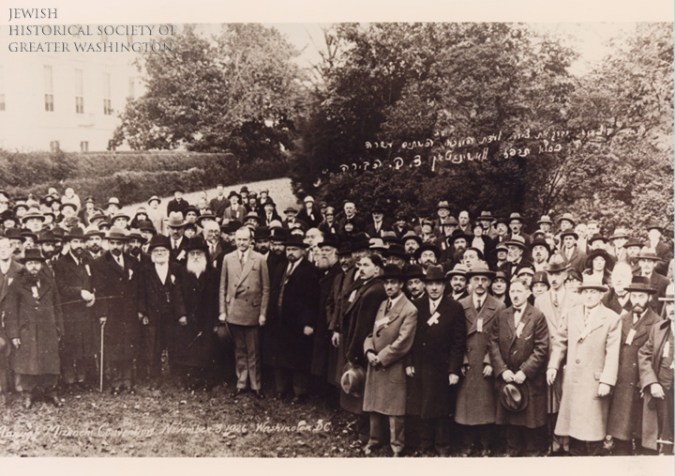
Meeting at the White House, 1926

Meeting at the White House, 1926

“I think — the best thing I can wish to the Jews in Palestine — is that they will get on — as well as they get on — over here” — Calvin Coolidge, 1926.


As a result of a mixture of hostility to Jewish settlement throughout Europe and the activities of the radical “Parushim,” of which Justice Brandeis was a leader, the move to establish homes in British Palestine gained momentum following the First World War. Most Americans, including Jewish Americans, had no interest in carving out a “Promised Land” in Palestine. Here President Coolidge is pictured with Orthodox Zionists. These men and women were working to establish a place where Jews from everywhere would live together as a nation. Rather than observe the principle: be at peace with all men so far as it depends on you, the movement sought to pull up roots and plant anew.  Coolidge’s statement, as the representative of America’s ideals, is a testament to this more excellent way here at home and in our relations abroad. The solution for the peace of the world was not in mandated Statehood but in exercising the obligations of citizenship here and wherever Jews already resided.

Photo part of a collection held by the Jewish Historical Society of Greater Washington.

On the Importance of Budgeting

“To be confidential for a moment, I may confess that an invitation to make a speech is not the rarest experience that comes into a President’s life. But I listened with, I hope, proper politeness, down to the point where your spokesman started explaining that you were to devote an evening to the consideration of a budget. Then I began to take real interest, for the budget idea, I may admit, is a sort of obsession with me. I believe in budgets. I want other people to believe in them. I have had a small one to run my own home; and besides that, I am head of the organization that makes the greatest of all budgets–that of the United States Government. Do you wonder, then,, that at times I dream of balance sheets and sinking funds, and deficits, and tax rates, and all the rest?

     “Yes, I regard a good budget as among the noblest monuments of virtue. It is deserving of all emulation; but there are other topics that afford more obvious inspiration to popular oratory. So when I found that you actually wanted a budget speech, I felt a warming sense of gratitude…

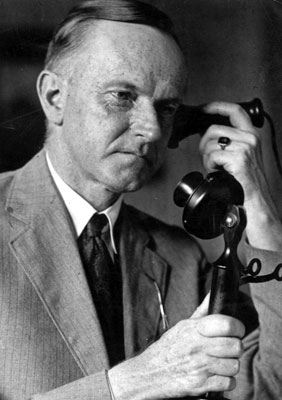
     “Nothing is finer than the open hand and the generous heart that prompt free and unselfish giving. But modern social science knows, also, that ill-directed charity is often directly responsible for encouragement of pauperism and mendicancy. The best service we can do for the needy and the unfortunate is to help them in such manner that their self-respect, their ability to help themselves, shall not be injured but augmented. Nobody is necessarily out merely because he is down. But, being down, nobody gets up again without honest effort of his own. The best help that benevolence and philanthropy can give is that which induces everybody to help himself” — Calvin Coolidge, speaking over the telephone from the White House to the Federation of Jewish Philanthropic Societies of New York City, October 26, 1924, as they listened together from the Hotel Pennsylvania.

317