Too often promises are made merely to send the inquirer away with hopes of fulfillment rather than informed answers or reliable results. The assurance matters more than the outcome on far too many occasions, it seems. We do not always have the answer but how often do we commit to finding one, only to never actually follow-up on the matter? Besides, who can be so confident (or is it disciplined?) to listen intently, guarantee nothing and then immediately set to work on what has been requested? When someone comes to us seeking information, do we respect him or her enough to keep our answers clear, concise and truthful?
To say what you mean to say and then follow through consistently from both factual certainty and dependable action establishes credibility. It is what sets apart the trustworthy from the unreliable and the faithless. Coolidge was notorious for his keen ability to listen without ever giving his consent or promise of fulfillment. It was not what Coolidge refused to say at the time, it was what he did after each visitor left that mattered. Coolidge would take the time to immediately follow-up on each matter before seeing the next appointment. By his deeds not his words, he accomplished far more with less “fuss,” simply doing what needed to be done. For Coolidge, it was the substance of the outcome not the intentions of the process that meant the most.
In Horace Green’s The Life of Calvin Coolidge, the author sets to work verifying from firsthand sources the facts from the fiction already growing up around the new President. One incident in particular, among those which actually took place, illustrates the seemingly effortless way Coolidge established credibility both personally and professionally. Of course, the perception of effortlessness did not reveal the work it took, the rigorous discipline Coolidge imposed upon himself from a very early age. It was how Mr. Coolidge overcame what so many in society and especially in politics consider even now a serious handicap: his willful taciturnity. By 1924, so many versions existed of young lawyer Coolidge’s “Can Move Body” story that Mr. Green was compelled to correct the record.
The original account, confirmed by Mr. Green’s research, begins with an older gentleman named Orville Prouty, who was currently serving as one of the selectmen of Hadley, Massachusetts. Throughout New England boards of “selectmen” or “aldermen” functioned as city executives whereas the legislative role was exercised directly by the people in town meetings. Hadley was a section of Northampton, the town young Coolidge had settled upon to “read” law. He chose the firm of John C. Hammond and Henry P. Field. Both men had ably and reliably served Northampton, and Massachusetts, for many years.
A man had been shot and killed while rowing on a small lake in the Hadley section of town. It was imperative that the recovery of the body be determined as soon as legally possible. Mr. Prouty needed to know whether he had lawful authority to remove the body himself without violating the law or compromising the collection of evidence for trial. He went to the law office he trusted, the same firm of Hammond and Field. However, neither man was there. There was only a thin young man he had never seen before, intently reading a law book. The young man responded to Selectman Prouty that “everybody was out.” As Mr. Green notes, “Apparently it never occurred to the selectman that the young man was anybody” (p.37). After nervously pacing around the room for a few moments, awaiting the return of either attorney, Mr. Prouty finally presented his question to the quiet youth.
Hearing out Mr. Prouty’s situation, the young man calmly replied, “Can move the body.” Without elaboration or excitement, Coolidge went back to his reading, respecting the selectman’s need for haste. Mr. Prouty could not account for this unruffled certainty. Asking whether Coolidge was completely sure, the young man responded, “Yes, can move the body.”
Astounded, Mr. Prouty met Mr. Hammond on the stairs after he walked out of the office. “Say, who the devil is that young tongue-tied blonde you got upstairs? Doesn’t he ever get excited?” To that Mr. Hammond, smiling, answered, “That young fellow isn’t much when it comes to gab, but he’s a hog for work. If he tells you you can move the body, you can bet your life you can. He’s only been in this office a few months, but I’ve found out that when he says a thing is so, it is.”
Coolidge’s reputation as a credible authority did not come without concerted preparation. He knew the difference between what were essentials and what was trivial. He did not waste time on the latter, whether the time was his or belonged to someone else. His internal focus did not permit the “show” of knowing more or promising much just to pacify the person. On the contrary, he invested himself in actually knowing the law and when he spoke, he would speak only on the firm ground of facts. Anything less would be a betrayal of himself and the trust reposed in him. His sense of economy presided not merely over his debt and budget-cutting policies but it was a consistent rule for his whole life. Just as he would not waste others’ money and time, so he would not waste words, not expecting people to be content with any answer, however correct, or manifold promises, without action. Enacting this resolute program of self-discipline, despite mystifying many while successfully defying the conventional path, made Coolidge a force of credibility that overcame time and again his reticent temperament and anti-social persona.
Dubbed “Coolidge luck” by those who cannot identify it, his diligence readied him unconsciously to be the best wherever conditions placed him, taught him to under-promise and over-deliver and gave him the confidence to lead through quiet action, instead of presumptuous fanfare. Never trumpeting what he intended to do, he dedicated himself to simply doing it, placing the substance of public service on accomplishments not aspirations. Coolidge’s approach had the effect of giving people further confidence in his credibility because they saw what he did, not just spoke of doing.
Judge Field, the other partner in the firm, was exceptionally active in the affairs of Massachusetts. He was not a man to award praise lightly. He assessed the basis for Coolidge’s credibility this way:
“I’ve never known a man who could say what he means more concisely than Coolidge. Moreover, he has an amazing faculty for reducing what he wants to say, to epigrams. No man has ever known Calvin Coolidge to go back on his word. He has lived in this city for more than twenty-three years, and you won’t find a man or woman, Republican or Democrat, but will tell you that this is true. I’ve never known any one who was a better judge of men. I’ve never known any one who doubted his courage. I’ve never known a cleaner man, a more decent citizen, a more loyal friend…Now, I say, that a man who doesn’t know how to advertize better than that is thoroughly lacking in what, from a practical political view, is the essential qualification in the science of self-exploitation.”
As Mr. Green points out, Judge Field said this before Coolidge reached national office. Yet, Coolidge turned that conventional “science of self-exploitation” on its head as he rose to the pinnacle of leadership. It was not by accident just as it was not entirely outside his control. His credibility, built from many years of effort, provides an inspiring reminder that trustworthiness is a quality each of us can attain through a similar dedication as we prepare ourselves, commit to the essentials and cherish substance over appearances. Coolidge remains credible today not because of any soaring pledges, grand intentions, or idealistic crusades but for his quiet competence, humble integrity, and decisive actions.
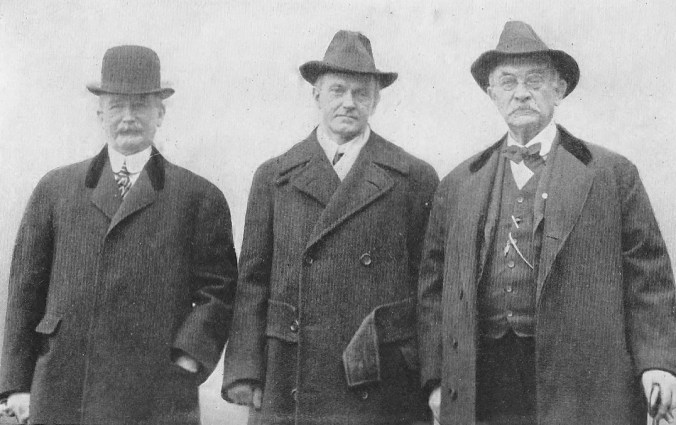
The Honorable John C. Hammond, President Calvin Coolidge and Judge Henry P. Field, attending a reunion of Amherst alumni.


 The Importance of the Obvious