On Inauguration Day a Century Ago

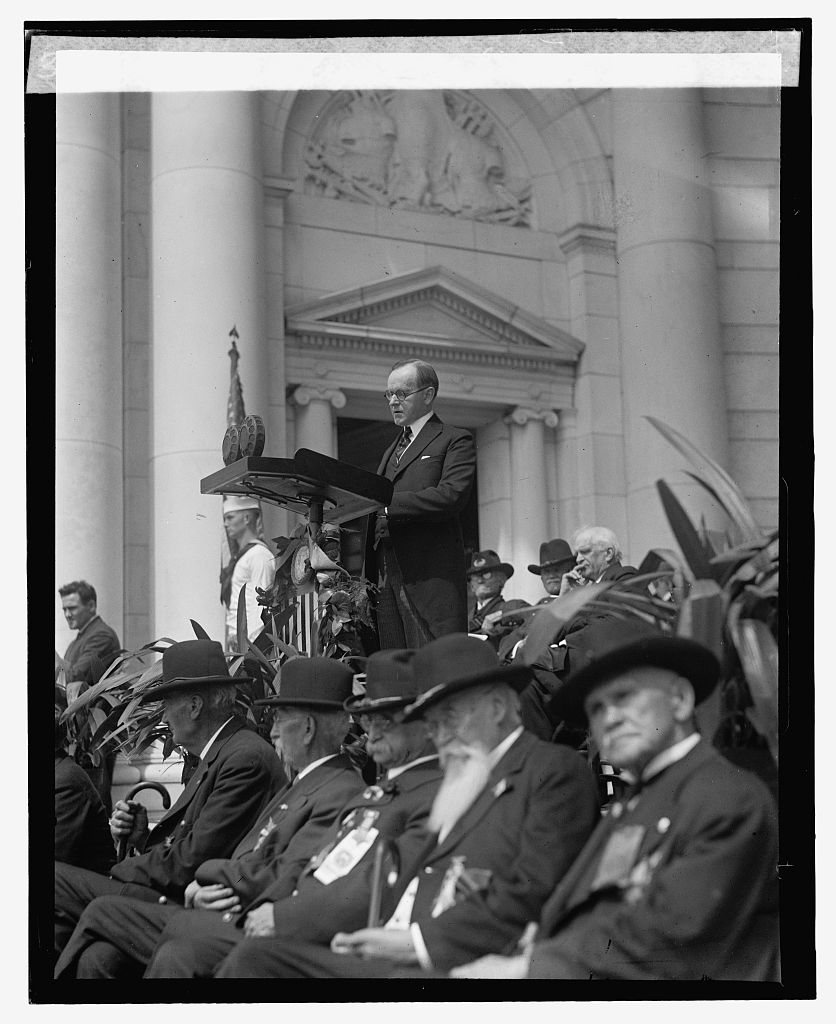
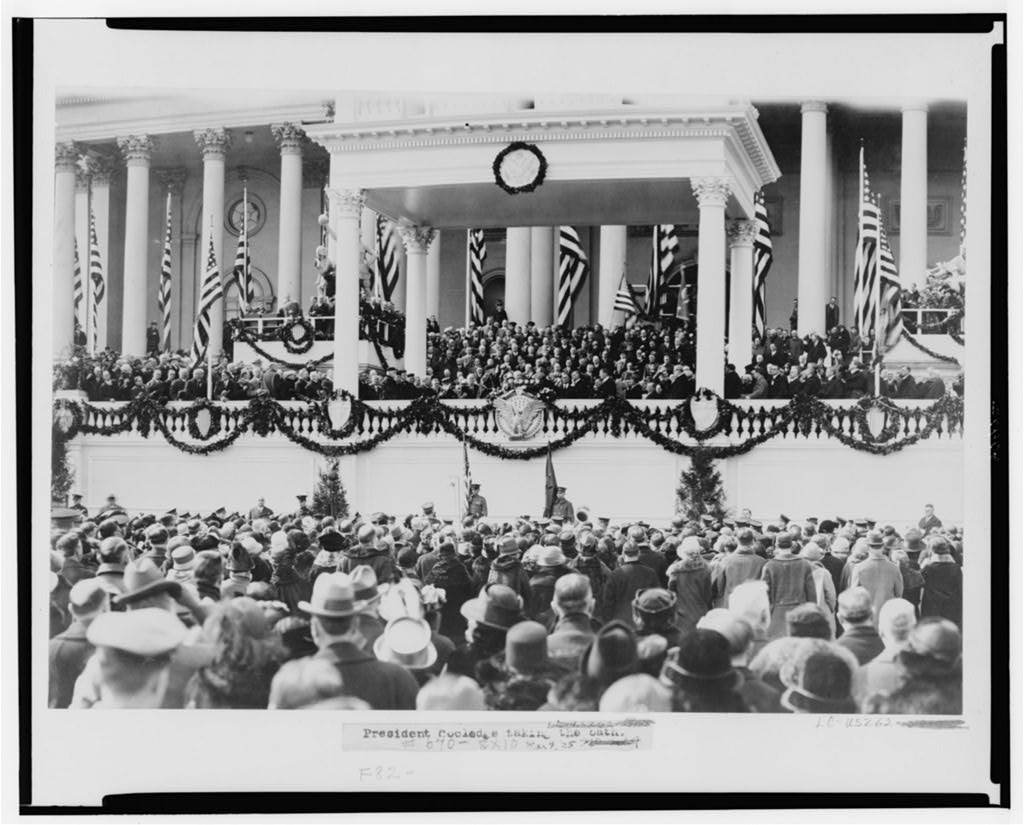
U.S. President Calvin Coolidge, right foreground, delivers his inaugural address after taking the oath of office on the East Portico of the Capitol building in Washington, D.C. on March 4, 1925. Coolidge was sworn in as the 30th president of the United States. Photo credit: Associated Press.

One of the unheralded heroes on Inauguration Day a century ago was legendary radio announcer Graham McNamee. He had already initiated the now familiar tradition of giving historical context and commentary to the news in President Coolidge’s first Annual Message in December 1923. McNamee’s image, wired from the resplendent Public Auditorium in Cleveland the previous summer while covering the Republican National Convention, became one of the first transmitted by the rapidly accelerating powers of the medium. The transmission, just developing at the time, took four minutes. His work for WEAF remained on the cutting edge as he was set to cover the Presidential Inaugural Address in March 1925, the first in history to be carried by radio. It was estimated by correspondents at the time that between 22 to 25 million people heard the Inaugural, including the full recording of Coolidge’s 4,000 plus word Address. Carried across twenty-two stations spanning coast-to-coast, the still novel technology captured the sounds of the pages and the President’s voice so crisply (including more than one of his inspirations!) that he seemed to be on the stage of nearly every school gym and public gathering in the country at the same, shared moment in time. It was America’s first synchronized experience of a vital cultural and political tradition, carrying with implications set to transcend the constraints of the globe itself. Yet, well on his way to earning the Radio Digest Award that year as the “World’s Most Popular Radio Announcer,” McNamee almost missed the entire occasion.

McNamee recalled it this way: “The inauguration proved a meaner job than most, as it was so hard to get information. Washington was full of officials, each apparently knowing all about what was to take place but unwilling to impart much of their knowledge. Everything was confusion, likewise everybody was passing the buck; and it was almost impossible to make our arrangements. For one thing we didn’t know when to go on the air.” It was predicated, McNamee explained, on how long the vice-presidential oath and ceremonies in the Senate Chamber took. It could be twenty minutes or an hour. No telephone wires were permitted in the Senate and so word had to be carried by runner. “Yet,” McNamee continued, “once on the air we had to stay on.” The announcer had to be ready to innovate, crafting the role of political commentator along the way. “So again I wrote reams of stuff, historical stories, and so on, as filler-in-material. Meantime I had stationed messengers in the capitol to hot-foot it to me as soon as the President and Vice-president left the Senate Chamber to come to the capitol steps, where the President himself was to take the oath of office.”

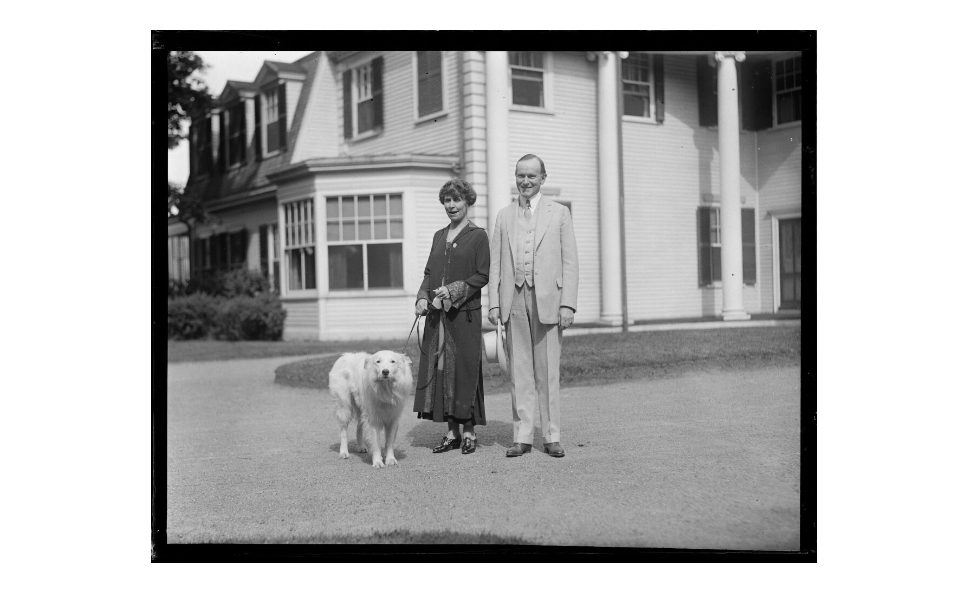
WASHINGTON, D.C. — March 4, 1925, Calvin Coolidge Inauguration. Mr. and Mrs. Coolidge. Photo credit: Baltimore Examiner and Washington Examiner.

Then it happened. “I got lost and the radio sets were almost left flat without an announcer,” McNamee recalled. “My booth was on the pedestal of one of the statues by the steps of the capitol; and all the messengers being busy, I left the booth for a minute, while the officials were still in the Senate Chamber, to get word to one of our staff. To reach him I had to hurdle a temporary fence built to keep the President’s pathway clear of intruders; and, once on the other side, I found I couldn’t get back. A patrolmen yanked me by the shoulder just as I was climbing over on the return journey, and refused to let me go further. I vain I pleaded: ‘Against orders,’ he said. I told him of the microphone lying silent and pictured all the people from coast to coast that would be disappointed. But he was evidently a man of a single-track mind, one of those burly and not very imaginative policemen that will stick like a bulldog to an order, once they get it, and who are inflexible when given a little authority.”

It became desperately close to time. “For ten minutes I argued until at last I saw light–another way of approach through the crowd, which I had not noticed before. I asked him about it; that was all right–it was out of his jurisdiction, but never would he have let me over that fence in spite of the waiting twenty-five million. And that was the total estimated by the newspapers, the audience on this occasion being vastly increased by the children. Almost every school in the land had a loud-speaker installed in its auditorium or its one little room, in the case of the country hamlets.”

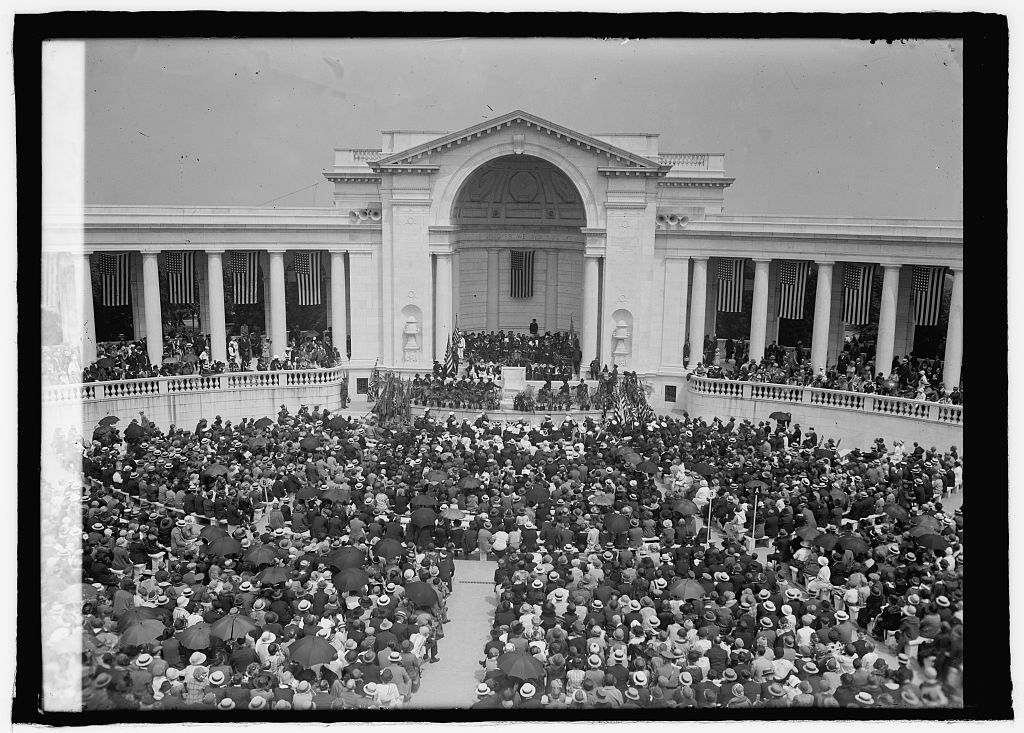
Inauguration Day, March 4, 1925, looking across the thousands gathered to witness the ceremony. Photo credit: Library of Congress.

McNamee got back to his booth just in time. “And at that I was caught, for after I reached the booth, and went on the air, with a little description, then a story, I was halfway through that story when a messenger came racing to me, saying that the procession had started from the Senate Chamber. We were having difficulty enough in timing things, anyway, and General Dawes upset even our tentative calculations. Instead of swearing-in the senators one by one, he had done it in batches. That story was pretty well jumbled, I am afraid, for the President was on its heels. I had to cut off my microphone quickly and signal the control room to put on the President’s microphone, just in time to catch the administration of the oath of office by Chief Justice Taft.”

Chief Justice (and former President) William Howard Taft administering the oath of office to President Coolidge, prior to the Inaugural Address. Photo credit: Library of Congress.

“The President stood there very quietly, looking subdued and careworn, I thought; this was so soon after his boy’s death; and his reply to the oath was so low that none of the people there present, excepting the few immediately around him, and none of the radio audience, heard it. We answered many inquiries by mail, afterwards, telling them that the response was a simple, ‘I do.’ ”

McNamee at the 1924 World Series.

Read more about the legendary Graham McNamee in Salient Cal’s America: Reappraising the Harding & Coolidge Era. Thanks to McNamee and his excellent team’s work, here is an excerpt of President Coolidge’s Inaugural Address (which was recorded in full, at the time), the first of its kind carried via radio a century ago.

Happy Birthday Mrs. Coolidge!

Grace Coolidge is one of those fortunate people who looks well in almost anything she puts on…she is able to wear more different colors successfully than most women. Very few things were unbecoming to her; white, pink, yellow, blue, red, orchid, old rose, and certain carefully chosen shades of gray and taupe suited her equally well. Flowered materials, however, were seldom good on her, and black she almost always avoided, as Mr. Coolidge had a strong aversion to it; but I still think it more becoming to her than anything else–and strangely enough, when she entered the White House as First Lady, she was dressed in black from head to foot–in deep mourning for President Harding…I never knew any man more interested in his wife’s clothes than Mr. Coolidge, and the handsomer and more elaborate Mrs. Coolidge’s dresses were, the better he liked them. He was fond of bright colors, conspicuous ornaments, glittering beads. Usually careful of expenditures, unbelievably economical in many ways, he not only spared no expense–he gave way to wild extravagance when it came to the question of Mrs. Coolidge’s clothes.” — Mary Randolph, Mrs. Coolidge’s excellent personal secretary

Born in Vermont’s Queen City, Burlington, in 1879, Grace Anna Goodhue Coolidge deserves renewed appraisal for the legacy she left as First Lady. The White House as a non-partisan historic site, bringing together the artifacts of past residents, became so to her credit. Her sense of taste, her human sympathy, and her superb restraint, all aptly fitted to each occasion, commend her as a First Lady of the very highest order. She was truly a great lady.

This additional remembrance from Mary Randolph underscores the caliber of the great lady she served,

Mrs. Coolidge liked to go shopping herself, as she had always done in her home town of Northampton, and in Boston; and wishing to do so in peace, she often avoided using the White House car — always conspicuous because of the President’s seal on the door panel — doing her errands on foot. But no sooner did she enter a store than news of her arrival spread quickly to all departments; and often a respectful, keenly interested crow would gather and stand nearby, gazing their fill, missing no detail of the way in which this First Lady made her purchases–what she bought, and how much of it; and Mrs. Coolidge, with her quick human sympathy, was always understanding and patient with this type of interest. But when in one large shop where she had gone to the street floor to buy gloves and stockings, she was almost immediately approached by a well-meaning saleswoman from another department carrying a large collection of evening wraps over her arm, and bringing them to Mrs. Coolidge’s attention–she was annoyed, and left the shop as soon as possible, for she disliked being made conspicuous. ‘If,’ she afterwards said to me, ‘I had wanted an evening coat, I would have gone to the department where they are sold’…

Grace knew how to comport herself, when to speak, when to be silent, and when interaction needed something more, with a keen understanding for what the human heart and soul before her most needed. She suffered that highest of losses for any mother, the death of a son in the prime of youth. Yet, she rose to every occasion, elevating the moment as only great ladies can. Each response chosen was arrayed in the gracious style that was fully and genuinely hers. We have too few like her now. We ought to have more ladies of her quality. Happy Birthday, Mrs. Coolidge!

In Memory of Jimmy Carter, 1924-2024

Gifted with a post-presidential legacy of service few have so abundantly enjoyed, former President Jimmy Carter was born a month prior to the Presidential Election that kept Calvin Coolidge in office for four more years. The connections do not end there, however. Both Governors and Washington outsiders, Carter and Coolidge had the opportunity to write memoirs with profoundly touching reminiscences. Carter’s “An Hour Before Daylight: Memories of a Rural Boyhood” shares some of the most poignant and well-written prose of any President looking back on his life. “My most persistent impression as a farm boy was of the earth. There was a closeness, almost an immersion, in the sand, loam, and red clay that seemed natural, and constant,” Carter recalled. “Country life does not always have breadth, but it has depth. It is neither artificial nor superficial, but is kept close to the realities,” Coolidge observed.

“It is obvious that our ties to Plains are strong,” Carter noted. Having dedicated this autobiography to grandson Hugo, Carter recorded his thoughts “with hopes that this book might someday let him better comprehend the lives of his ancestors.” Reinforcing that purpose, Carter wrote, “We still take our grandchildren and some guests to the family cemeteries, one north and the other south of the town, where our great-great-grandfathers, all born in the 1700s, settled, farmed the land, and were buries with their wives and progeny…Plains is where I’ve seen the members of my family laid to rest, and where we expect to be buried.” Coolidge’s sentiments of his own small-town beginnings bear marked resemblance, “When settlers began to come in around the time of the Revolution, the grandfather of my grandfather, Captain John Coolidge, located a farm near the height of land westward from the river…where he settled in about 1780…They were a hardy self-contained people. Most of them are gone now and their old homesteads are reverting to the wilderness. They went forth to conquer where the trees were thicker, the fields larger, and the problems more difficult…It was into this community that I was born on the 4th day of July, 1872.”

Carter, like Coolidge, found restoration and renewal in his community. “I found that the love I had for the hills where I was born,” Coolidge once said, “touched a responsive chord in the heart of the whole nation.” Carter echoed, “There is a sense of permanence in Plains, of unchanging values and lasting human relationships, and the town has been a haven for us during times of political or financial crisis. Having visited almost 120 foreign countries and ‘seen the sights,’ we find the quiet attractions of Plains stronger with our increasing age, so that, no matter where we are in the world, we soon begin wishing we were back home.” Remembering the loss of his mother (and, no doubt, his own youngest son), Calvin reflected, “They all rest together on the sheltered hillside among five generations of the Coolidge family.”

Perhaps the greatest legacy both share is expressed in the words Coolidge relayed on Presidential retirement, “We draw our Presidents from the people. It is a wholesome thing for them to return to the people. I came from them. I wish to be one of the again. Although all our Presidents have had back of them a good heritage of blood, very few have been born to the purple…They have only the same title of nobility that belongs to all our citizens, which is the one based on achievement and character, so they need not assume superiority. It is becoming for them to engage in some dignified employment where they can be of service as others are. Our country does not believe in idleness. It honors hard work.” Few greater embodiments of that claim to nobility, dignified employment, and work of service surpass that of Jimmy Carter. Coolidge and Carter can now both share in that restful return home.