On Columbus Day

Image

Few individuals in Western civilization have undergone as pervasive a demonization as Christopher Columbus. He has been designated the “poster boy” of all that is wrong with the West, in general, and America, in particular. He is blamed for Western racism and slavery (as if those policies are unique to dead white Europeans) because of his enslavement of the indigenous population, despite discovering a New World that would establish freedom as the governing ideal of human existence. He is blamed for Western Christendom because of his conversion of the natives, despite taking the first step toward what would become a haven of religious liberty and freedom of conscience in America. He is blamed for Western imperialism because of his accidental destruction (by an uncontrollable lack of immunity) of the various cultures with which he came in contact, despite introducing a New World that would form the greatest melting pot of diversity ever accomplished. It was nothing less than American opportunity and freedom, at the basis of our institutions, that made this possible. None of the good America has meant to human history and its unprecedented advancement would have happened without that first step into the dark unknown.

The same folks who discredit and ridicule men like Columbus for his failures not only defend the most violent thugs and genocidal regimes of this and the twentieth century — one need only recall the Western media’s adulation for Mao, Castro, Qaddafi and “Uncle Joe” Stalin — to recognize the double standard. The “blame America first” mentality illustrates the failure, not of America, but of human nature itself. The principles that formed America as the exception to the rule of human affairs is not at fault here. We honor our heroes not because they lack imperfections or never committed any wrongs. We honor men like Columbus because we revere and love what good they did accomplish. It is a respect for good above evil that merits our praise and admiration. Meanwhile, as Coolidge would say,

[I]t is a very hasty and ill-considered judgment to conclude that there is more bad than good in any one. We are all a combination of both elements. While we ought not to approve of the evil in ourselves or in others…The only perfect man ate and drank with publicans and sinners. It did not scandalize Him, it was some of those who were not perfect who were scandalized.

The politically correct demand for perfection is chasing an eternally elusive object. When the only subjects worthy of study are those who never violated the politically correct creed, we will have an extremely narrow, and uninformed, view of human nature. We may know much but without a full understanding of our nature, the good with the bad, it becomes a fantasy fixated on the reality we choose, not the reality which is.

Coolidge reminded those reading his daily column,

There is enough good in all of us to support the law of human fellowship. We shall be much more effective for good if we treat men not as they are but as they ought to be. If we judge ourselves only by our aspirations and every one else only by their conduct we shall reach a very false conclusion. When we have exhausted the possibilities of criticism on ourselves it will be time enough to apply it to others. The world needs high social standards and we should do our best to maintain them, but they should rest on the broad base of Christian charity. 

If the politically correct code sought to lift and inform the culture with higher standards, it would not mock the only Perfect Man Coolidge mentioned. Christ would be its greatest example. The hypocrisy evident in “blaming America first” is laid bare by this point. The offense of Columbus, in these folks’ eyes, is not what they claim it to be. His offense is helping to make America possible. The exploitation and oppression he perpetrated (meant to assign the full guilt we should all feel for being Americans) defines all we need to “know” about him. The good he did — not the first to arrive but the first to introduce the New World to the Old — is spoiled and negated by his sins against political correctness. Nothing but the evil he represents matters to such people because it fits the political agenda not honest historical perspective.

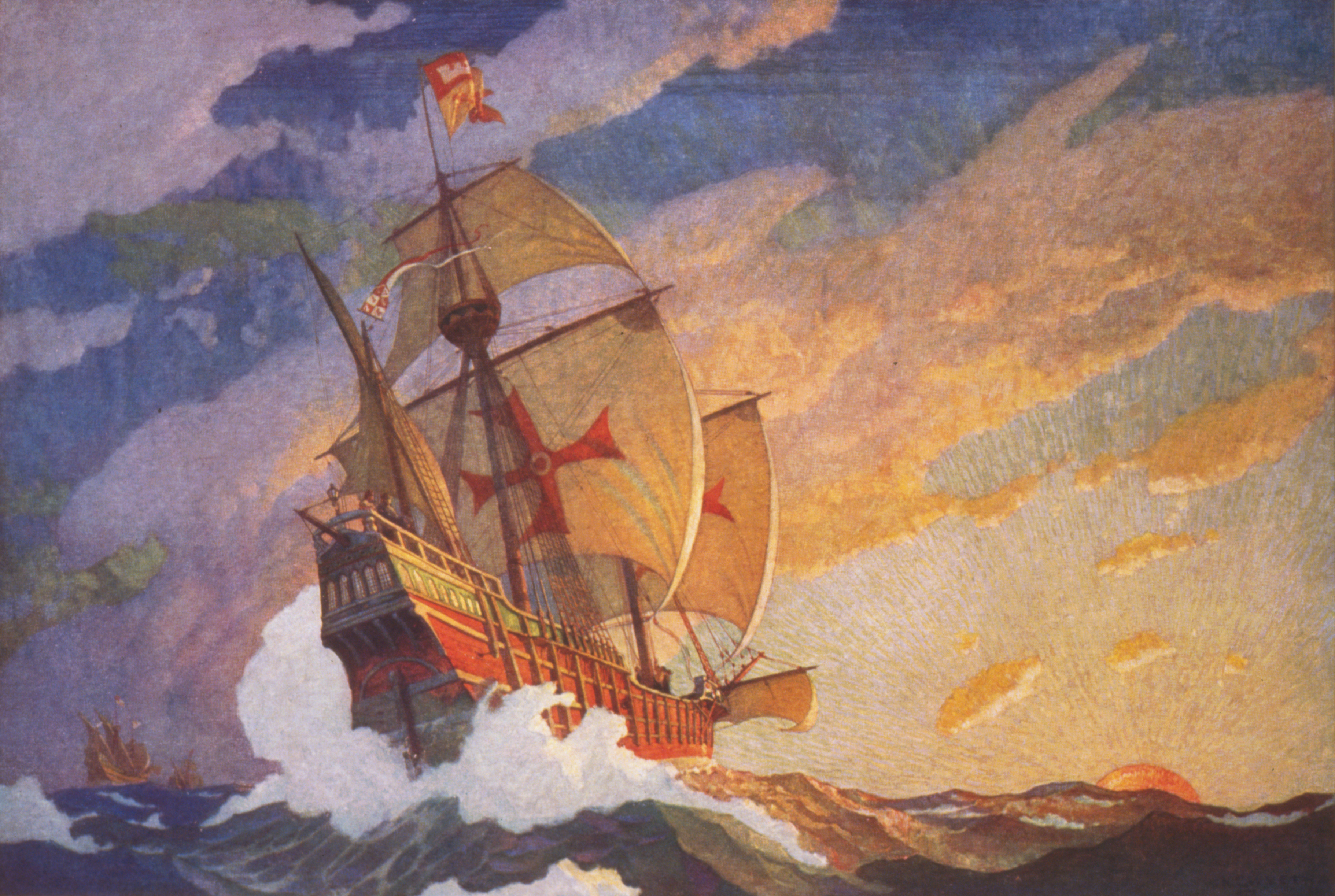
Ultimately, it is a denial of good itself. Truth learns from both the wrong examples and the right ones, honoring good where it can be found, even in flawed and imperfect people like Columbus. Pessimists and cynics may long for the “good old days” when Meso-American empires sacrificed their own human populations and chiefs, like Powhatan, consolidated power through war and genocide. But, if not for the Christian boy Chanco, murder would have continued unabated. Considering Americans were the first to appeal to higher ideals, ideals grounded in a moral conscience, Coolidge could rightly say of Columbus on October 11, 1930,

He is entitled to rank forever as the greatest of all explorers. But the glory of his exploit, great as it was, becomes almost unimportant when compared with its results. It marked the inception of the modern era. The minds of men were opened to new thoughts. The gold and silver of America gave a new trend to the life of Europe. The arts began to flourish. The people began to assert their rights. More colonies brought more trade. A new age appeared, great in captains, admirals, statesmen, poets and philosophers, and finally new nations dedicated to human freedom arose on this side of the Atlantic. These are partly the reasons why Christopher Columbus is entitled to be honored.

The substance for recognizing Columbus in this, the five hundred and twenty-first year since his discovery, resides not so much in what he personally did, or failed to do. It resides in the part he played in the opportunity to establish, for the first time, a place where people can live free to govern themselves, keep the rewards of their own work, and practice, unfettered, the obligations of their conscience before God and mankind.
Ships_of_Christopher_Columbus

On the Armenian Orphan Rug

Image

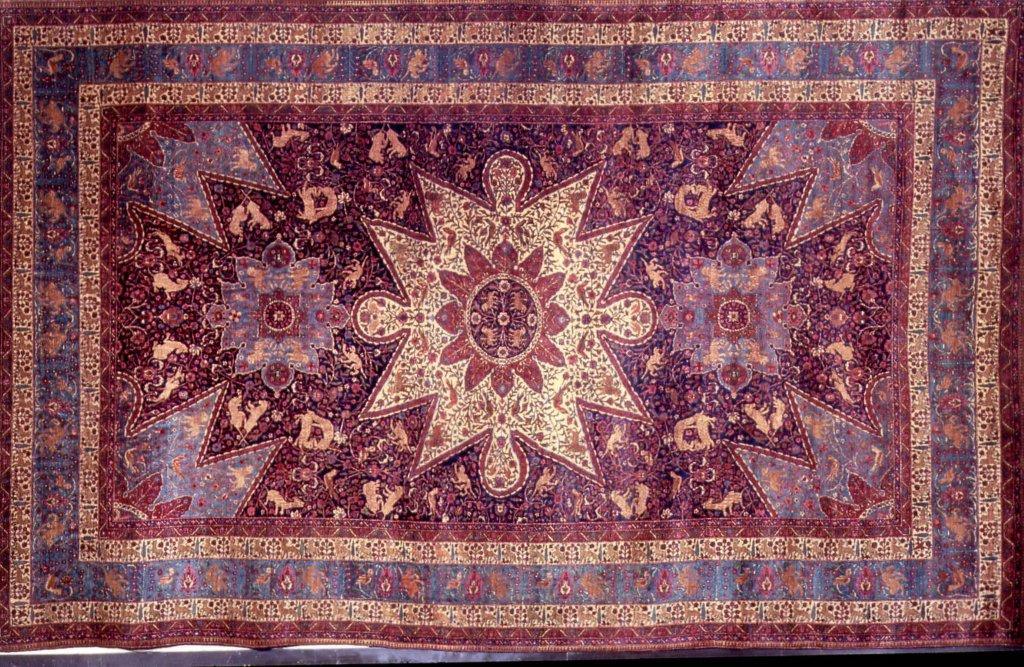
“The beautiful rug woven by the [Armenian] children in the [Ghazir] orphanage in the Lebanon has been received. This, their expression of gratitude for what we have been able to do in this country for their aid, is accepted by me as a token of their goodwill to the people of the United States. . . The rug has a place of honor in the White House, where it will be a daily symbol of good-will on earth” — President Coolidge, December 4, 1925.

A new book, President Calvin Coolidge and the Armenian Orphan Rug by Dr. Hagop Martin Deranian, delves into the regrettably little known events in Armenia that resulted in an unprecedented rescue and relief effort led by Americans of one million refugees, including 100,000 orphans, displaced by genocide. The rug, presented to President Coolidge in 1925, hung prominently in the prestigious Blue Room of the White House until 1928, respectfully preserved by Grace in their Northampton home and returned to Washington in 1983. The author recalls, “It was an emotional feeling to touch this very rug. These girls with their nimble fingers wove their gratitude to America into every stitch.”

The Armenian Cultural Foundation will host a reception open to the public giving Dr. Deranian an opportunity to present his work on October 20, 2013, in Arlington, Massachusetts at 3PM. It is well worth attending!

On Honoring Our Veterans

As Senate Democrats continue to back the President’s cherry-picking approach on which public sites to shut down and who deserves funding, veterans simply do not contribute anything to their Party agenda that merits respect or support. In the midst of what is supposed to be a Government “shutdown,” we saw the reinforcement of the World War II Memorial fencing by seven Park Service employees. At the same time, the Normandy American Cemetery and Memorial in France has been chained shut “due to the U.S. Government shutdown.” So, we are spending money to reinforce gates and place guards at closed sites because we no longer have the money to keep them open?

Meanwhile, Camp David, the Presidential retreat, is kept open. The Blue Angels and NASA programs have long been shut down as visible symbols of American achievement and patriotism. Now Senator Harry Reid is refusing every effort to fund the National Guard, salaries for Reserve personnel, veterans’ services, and museums and parks. Taking all of these together, combined with the rabid attacks by Democrats against our military for serving in Iraq and Afghanistan during the previous administration, it forces the question: What do the Democrats have against our Armed Forces? Of course, they do not have value to the agenda.

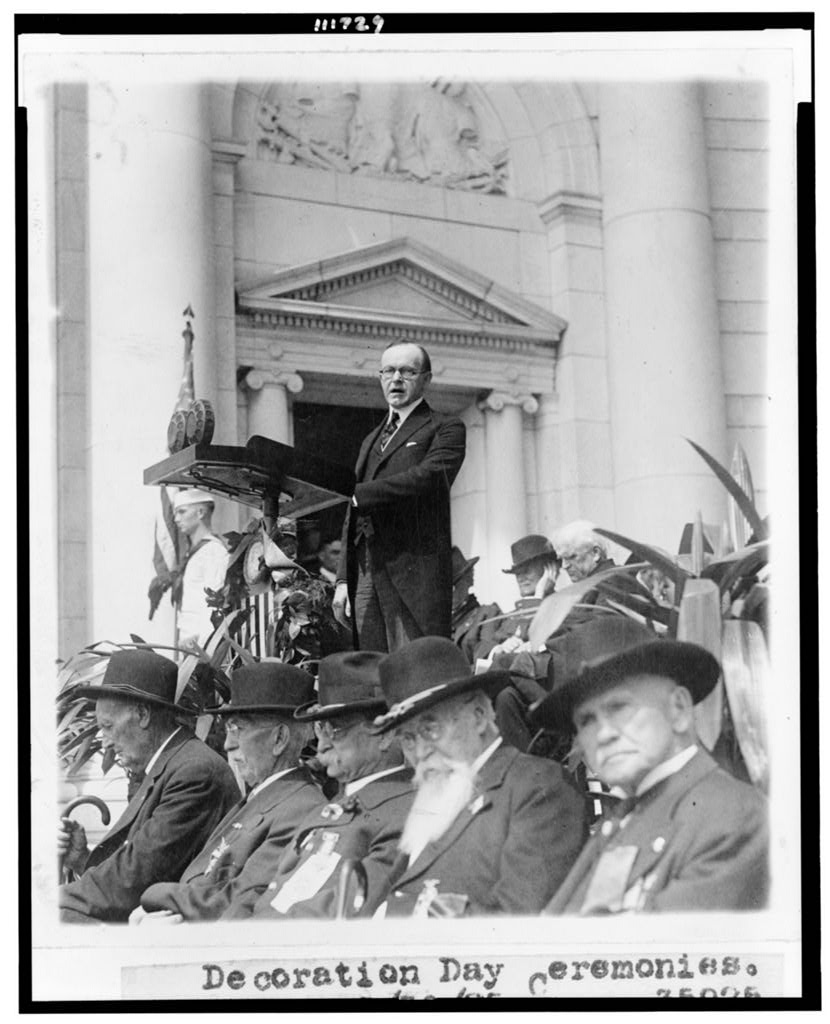
Calvin Coolidge, upon being officially informed of his nomination as Vice Presidential candidate, spoke at length on what the country needed. He saw America suffering under a militant White House, continuing to prosecute the powers of wartime in peace. When a return to respect for our laws and institutions was needed, President Wilson and his Party kept the hostility and obstruction going. Evading their responsibilities to govern, the Democrats had assumed control at the expense of the people’s sovereignty. Millions were now unemployed, many of them World War I veterans and their families. The economy was stagnating under high taxation rates extracted by the Internal Revenue Service. A culture of fear was being perpetuated by Wilson’s Justice Department. The Democrats were shirking the duty they held not only to all the people but to those who had served. The unrestrained waste of the people’s substance had to be stopped. It was time to change those in charge. What they were doing was wrong and the first opportunity for the people to correct the direction in which America was going came with the 1920 election. As we know the people took their country back decisively, sweeping the White House, the Congress and state governments across the land.

Image

When it came to veterans, while there could be no price quantified for what they had sacrificed, America had an obligation to them they could not pass off to anyone else. Coolidge said,

Whenever in the future this nation undertakes to assess its strength and resources, the largest item will be the roll of those who served her in every patriotic capacity in the world war. There are those who bore the civil tasks of that great undertaking, often at heavy sacrifices, always with the disinterested desire to serve their country. There are those who wore the uniform. The presence of the living, the example of the dead, will ever be a standing guaranty of the stability of our republic. From their rugged virtue springs a never-ending obligation to hold unimpaired the principles established by their victory. Honor is theirs forevermore.

The form this honor should take is what compelled Coolidge to stand on principle against cash payments to veterans, or any other special demographic. He knew what the perception of a Government giving money away does even to good and honest people. He knew that no amount could adequately recompense those who risked all, some giving life itself, for America’s ideals. When he vetoed measures to bestow cash bonuses to veterans, he acted with full awareness of what it might cost him politically. Principle mattered more to him. The principle of honoring sacrifice to Coolidge did not consist of merely appropriating money to show that “we care” but by embracing a deeper, more profound respect and reverence for what our veterans have done. The Congress of his day, overrode his veto.

Americans had made promises to veterans and those promises must be kept. Coolidge continued,

Duty compels that those promises, so freely made, that out of their sacrifices they should have a larger life, be speedily redeemed. Care of dependents, relief from distress, restoration from infirmity, provision for education, honorable preferment in the public service, a helping hand everywhere, are theirs not as a favor but by right. They have conquered the claim to suitable recognition in all things.

This recognition would be desecrated, however, if honoring our veterans became nothing more than a cash giveaway. More is required than simply to throw money at the problem and walk away. Unless we take up the service of those who served, no amount we give purchases the compassion and respect we owe. By helping the veteran who lives next door, providing for the assistance of his family, supporting the education and upward mobility of our defenders, wherever they are, ensuring the wounded are healed, the forsaken encouraged and the war-torn are built up, we are meeting that obligation. Responsible government appropriates the funds but it accomplishes nothing without the active participation of you and me serving those who served.

On numerous memorials across our nation, what Coolidge said next is fittingly preserved for posterity on the stones we have established in recognition of our veterans’ sacrifices. He reminds us still, “The nation which forgets its defenders will be itself forgotten.”

Image