Section 1 of Article II of the Constitution prescribes the oath each President is to promise and observe as he carries out the responsibilities of his office, ‘I do solemnly swear (or affirm) that I will faithfully execute the Office of President of the United States, and will to the best of my Ability, preserve, protect and defend the Constitution of the United States.’
When the occasion arose to succeed the President in the early hours of the morning on August 3, 1923, Coolidge did not have to consult a team of legal experts or “brainstorm” with Cabinet members over the telephone about what comes next. He simply consulted the Constitution which sat on his father’s bookshelf and found the oath to be taken by the President, the same he had affirmed over two years before. The answer, to anyone able to read and understand, was accessible simply by looking at the Constitution, our blueprint and road-map.
“Having found this form in the Constitution I had it set up on the typewriter and the oath was administered by my father in his capacity as a notary public, an office he had held for a great many years.”
When it came to the Constitution, Coolidge’s grasp of its power and clarity is no less essential a message for the current President than it has been for the previous forty-three,
…[T]he President exercises his authority in accordance with the Constitution and the law. He is truly the agent of the people, performing such functions as they have entrusted to him. The Constitution specifically vests him with the executive power. Some presidents have seemed to interpret that as an authorization to take any action which the Constitution, or perhaps the law, does not specifically prohibit. Others have considered that their powers extended only to such acts as were specifically authorized by the Constitution and the statutes…This has always seemed to me to be a hypothetical question, which it would be idle to attempt to determine in advance. It would appear to be the better practice to wait to decide each question on its merits as it arises…
Coolidge is not sanctioning an improvisational Presidency employing situational compliance with the Constitution and our laws as it suits the individual. He makes that plain with what he says in the very next paragraph.
For all ordinary occasions the specific powers assigned to the President will be found sufficient to provide for the welfare of the country. That is all he needs. All situations that arise are likely to be simplified, and many of them completely solved, by an application of the Constitution and the law. If what they require to be done, is done, there is no opportunity for criticism, and it would be seldom that anything better could be devised…by simply finding out what the law required (The Autobiography, pp.200-202, emphasis added).
Office holders today, whatever level of importance, would do well to take their oath with the same seriousness of mind and reverence for duty that Coolidge held for it.
greatness
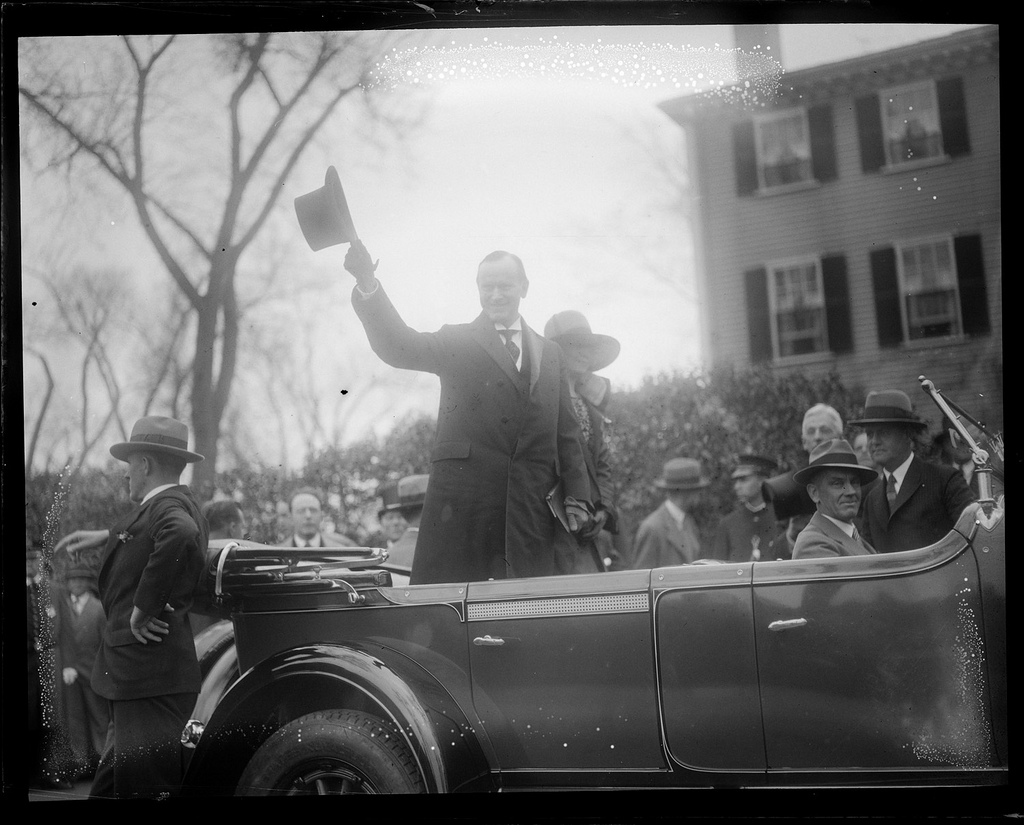
On the Move
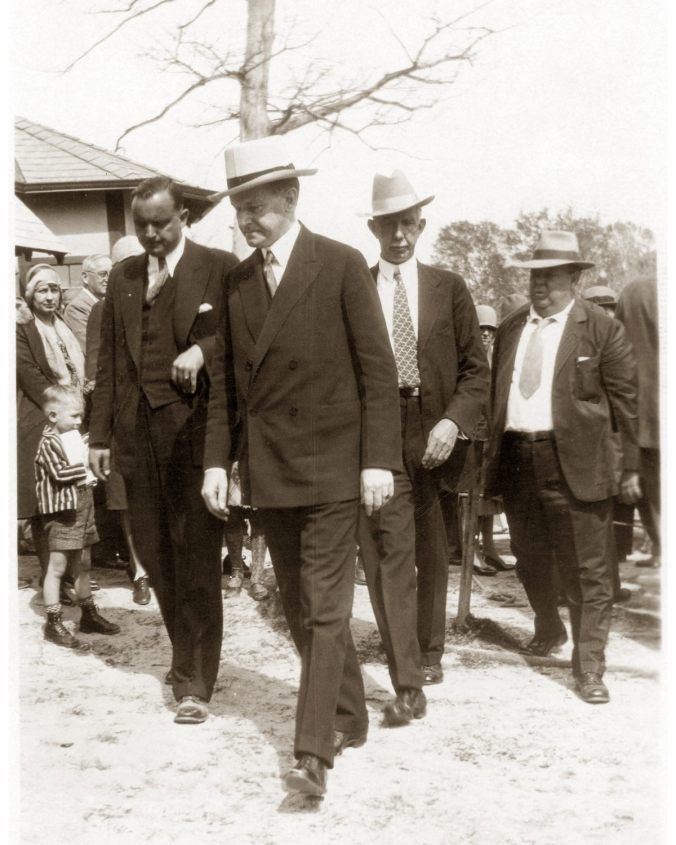
Here former President Coolidge, staying at the Lakeside Inn, Mount Dora, Florida, is walking along with Archie Hurlburt (behind Coolidge), Cal’s friend and also the manager of the Inn at that time, Carl Ray (to his right), and “Shorty” Davidson (behind Hurlburt).
Ray and Davidson, both Ocala-area entrepreneurs, teamed up in 1924 to revitalize Silver Springs into a successful attraction. They made it work and it drew folks for decades afterward as a result of their efforts.
On this Sunday afternoon, February 9, 1930, Coolidge accompanied them on the hour-long glass-bottom boat tour, seeing the various underwater springs including the area near the dock which, even then, was becoming a favorite for underwater filming.
The Coolidges stayed at Lakeside for a month on their way to California. Trying to travel as private citizens again, the Coolidges could not escape the crowds drawn to their every stop. Finally concluding unobtrusive travel was no longer possible, Coolidge never saw all he wanted to of the country. He sacrificed his curiosity to see and do to the solitude and separation from public life he wished still more after having walked away from the most powerful office in the world.
On Presidential Limits
The custom of two terms established by President Washington was faithfully preserved for one hundred and fifty-one years until the precedent was broken by Franklin Delano Roosevelt, winning his third term in 1940. Coolidge had been gone seven years by that time. F. D. R. would be elected for a fourth term in 1944 and die in office the following April. The twenty-second Amendment was ratified in February 1951 in order to formally establish the original two-term limit as part of the Constitution.
Looking back on his five and a half years as President, Coolidge offered some enduring insights on the need for Presidential limits. This is not only exemplified by the term of office custom, which is now law, but the necessity to respect the Office, honor the limits of its power and guard against its delusory sense of greatness. This risk is not unique to the Presidency; one’s approach to authority on any level is just as prone to abuse and self-deception.
Coolidge, never buying the notion that he was a great man, held each responsibility with the humility of one who could handle what was expected of him without pretentiousness or “muscle-flexing.” He made the difficult look easy but his ability to lead came from discipline, training and perspective not arrogance or condescension. He had this to say about limits,
…[I]rrespective of the third-term policy, the presidential office is of such a nature that it is difficult to conceive how one man can successfully serve the country for a term of more than eight years.
While I am in favor of continuing the long-established custom of the country in relation to a third term for a President, yet I do not think that the practice applies to one who has succeeded to part of a term as Vice President. Others might argue that it does, but I doubt if the country would so consider it…
…A President should not only not be selfish, but he ought to avoid the appearance of selfishness. The people would not have confidence in a man that appeared to be grasping for office.
It is difficult for men in high office to avoid the malady of self-delusion. They are always surrounded by worshipers. They are constantly, and for the most part sincerely, assured of their greatness.
They live in an artificial atmosphere of adulation and exaltation which sooner or later impairs their judgment. They are in grave danger of becoming careless and arrogant.
The chances of having wise and faithful public service are increased by a change in the presidential office after a moderate length of time.
In the higher ranges of public service men appear to come forward to perform a certain duty. When it is performed their work is done. They usually find it impossible to readjust themselves in the thought of the people so as to pass on successfully to the solution of new public problems.
An examination of the records of those Presidents who have served eight years will disclose that in almost every instance the latter part of their term has shown very little in the way of constructive accomplishment. They have often been clouded with grave disappointments.
While I had a desire to be relieved of the pretensions and delusions of public life, it was not because of any attraction of pleasure or idleness.
We draw our Presidents from the people. It is a wholesome thing for them to return to the people. I came from them. I wish to be one of them again…Our country does not believe in idleness. It honors hard work. I wanted to serve the country again as a private citizen.
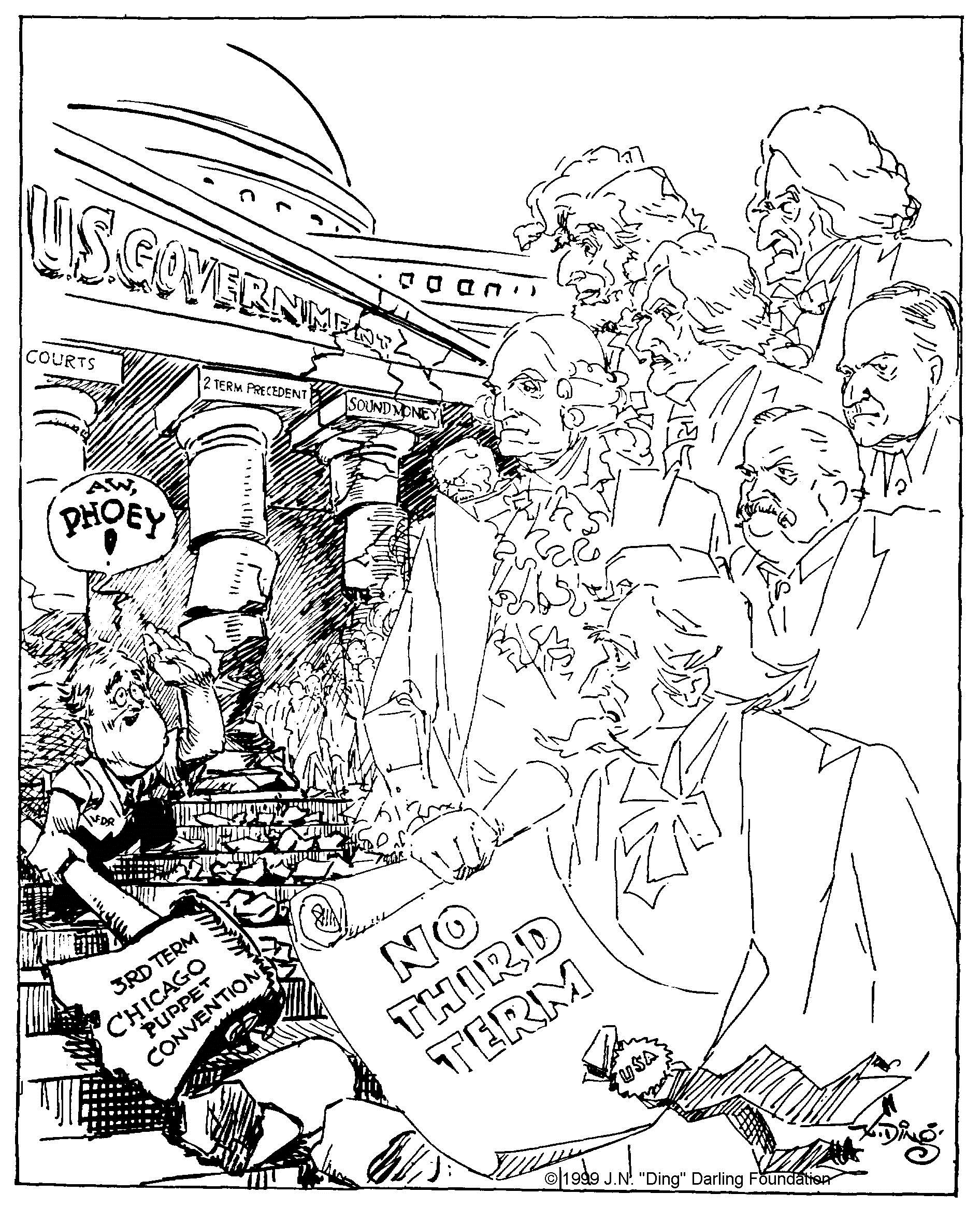 In this editorial depiction by J. N. “Ding” Darling entitled, “Just a whole lot of nobodies who never knew nothin’,” published October 15, 1940, the cartoonist conveys F. D. R.’s destructive disregard of our institutions and traditions. It is a suitable tribute that, among the “ghosts” of past Presidents arrayed against Roosevelt, Calvin Coolidge is conspicuously among them (L to R: Washington, Lincoln, Jefferson, Jackson, Cleveland and Coolidge stand in the foreground, with Theodore Roosevelt and the rest of those Presidents who have gone on, standing in the background). Coolidge’s warnings echo even now.
 The Importance of the Obvious