Who said, “The plan is to reduce the cost of Federal government operations by 25 per cent”?
Or, “We should plan to have a definitely balanced budget for the third year of recovery and from that time on seek a continuing reduction of the national debt”?
How about, “The Treasury is all right and we are balancing the budget — you needn’t worry”?
Or, finally, “It has taken courage for the Federal government to go into the ‘red’…But it has been worth it”?
If you guessed “Calvin Coolidge,” you would be wrong. It was Franklin Delano Roosevelt, between 1932 and 1938. As Bruce Barton pointed out, however, there was no further talk of economy after 1938. “The talk was about the preparation for war and, later, about the fine new world the war was going to usher in.”

Bruce Barton, whose 1953 article, “Unless It Hurts, It’s No Good,” is featured here.
Not only had 1931 seen the first budget deficit in twelve years, the debt stood at $21 billion by January 1933. When Roosevelt died in April 1945, the debt had ballooned to $233 billion. President Truman built upon that infamous legacy with another $32 billion of his own. Writing as a new President was taking office in 1953, Bruce Barton hastened to the point of his article: “Both of these presidents talked economy, but neither of them had any real heart for it. Neither of them was willing to do anything that would endanger the support of a pressure group in the next campaign.” Both were pandering to people, telling voters what they wanted to hear but never delivering anything more than eloquent words and good intentions. When the occasion called for it, the cuts promised in the heat of campaigns were too politically painful to make, risked the alienation of some support group somewhere and endangered electoral success in the future. They cared too much for the appearances and not enough for the substantial harm inflicted on people by the curtailment of growth and opportunity because of Government’s limitless spending habits. It is a lack of discipline, not bravery, that Government demonstrates when spending more than it has. Saying one thing and doing another, especially when one is the President of the United States, does not illustrate courage either, it exemplifies cowardice.
In contrast, Barton continues, “Calvin Coolidge cut the debt of his day by nearly 25 per cent. To disparage him is now the fashion. He is slurred over as a ‘do-nothing’ president, a national nonentity. Actually he was all guts.”
Before you snicker and chortle, dear reader, consider carefully Barton’s four examples substantiating that claim.
1. “As governor, he had the guts to break the Boston police strike. When Samuel Gompers, the country’s most powerful labor leader, demanded that the striking policemen be reinstated, Coolidge wired: ‘There is no right to strike against the public safety by anybody, anywhere, at any time.’ ” While it has often been incorrectly asserted that the danger had already passed and that Governor Coolidge took credit for something he did not do, this telegram might never have been sent and so cogently framed the heart of the issue had Coolidge not sent it. He was not the politician who runs from confrontation.
2. “He had the guts to veto the act passed by the members of both Houses of the Legislature raising their own salaries.” The veto, just like the telegram, did not have to be sent. Governor Coolidge could have joined the General Court that spring of 1919 with a wink and a nod, signing their $500 increase and saying nothing. Like trimming down state agencies from 120 to 19 departments, however, Governor Coolidge refused to simply “punt” difficult tasks to his successor, even when the law allowed for delay.
3. “As president, he had the guts to veto the first big farm subsidy, the McNary-Haugen Bill, on the grounds that the bill was not only an abuse of the taxing power, but also a sure path to overproduction.” The sharp language of both veto messages took everyone by surprise at the time, who considered Coolidge incapable of being riled about anything. He took on the issue firmly and ended attempts at government control of agriculture for the rest of his term. This is all the more incredible considering that two solid Republicans sponsored the bill, a large majority passed it twice and a very influential “Farm Bloc” wanted it to be law.
4. “He also killed the excessive soldiers’ bonus, since the veterans had already received a discharge bonus of 256 million dollars. Coolidge’s friends and foes agreed in predicting that such actions would kill him politically; yet the people gave him overwhelming re-election.” This, too, is stunning when, as it seems today, there is no price too high for veteran’s benefits.
Barton comes to the point, as America still stood at war-time levels of spending: it was time to reapply Coolidge’s courage, not merely echo the same empty words and pleasing promises. “History should teach us that you can’t slash without incurring the opposition of powerful pressure groups. That unless the slash hurts it isn’t any good.”
Coolidge put it this way, “Nothing is easier than spending the public money. It does not appear to belong to anybody. The temptation is overwhelming to bestow it on somebody.” Yet, ninety years ago, a reserved but courageous man from Vermont triumphed over that temptation, overcoming it not merely once or twice but repeatedly and consistently.
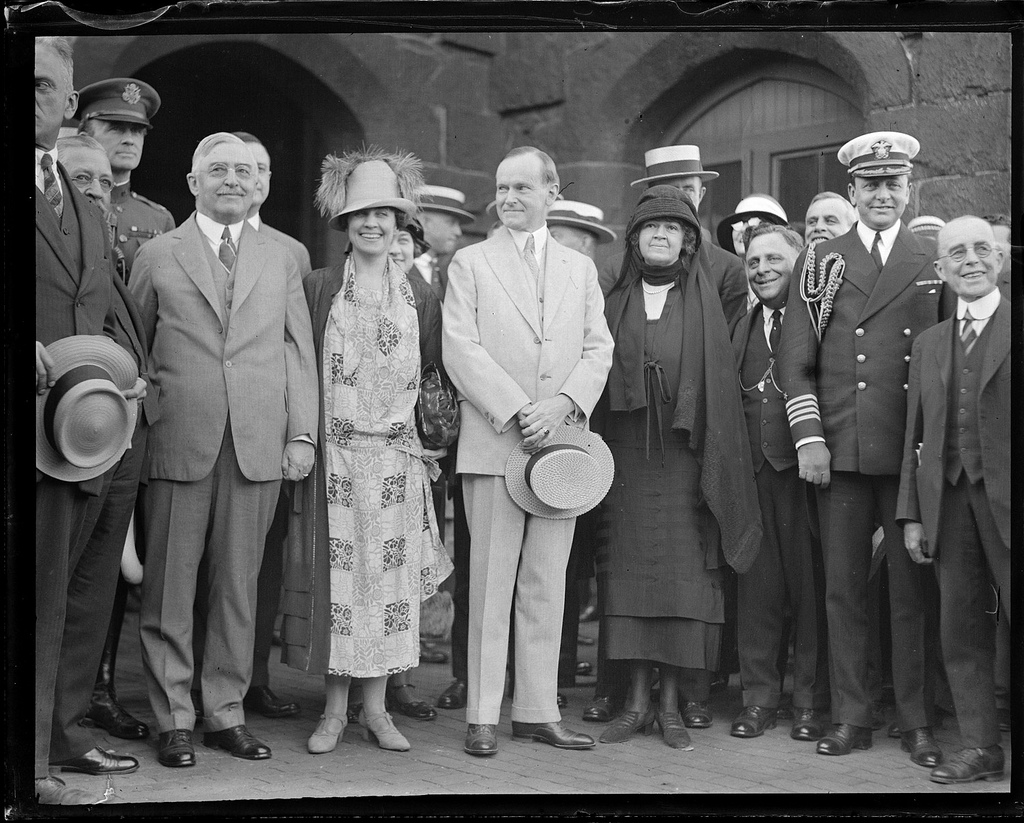
The Coolidges, among the crowd, at Salem, MA, train depot.
“I don’t think in all my experience, which has been very large…with proposals for spending money, I have ever had any proposal from anyone as to what could be done to save any money. Sometimes linked with the proposal for an immediate large expenditure is the suggestion that it ultimately will result in a saving…[T]hat is about the extent of the outside assistance I have had in that direction” — December 14, 1928.
“The appropriation of public money always is perfectly lovely until some one is asked to pay the bill. if we are to have a billion dollars of navy, half a billion of farm relief, four hundred millions of Mississippi flood control, two or three hundred millions of river and harbor improvements, two or three hundred millions of public buildings, hundreds of millions of good roads and other hundreds of millions of pensions, the people will have to furnish more revenue by paying more taxes. It is for them, through their Congress, to decide how far they wish to go” — August 4, 1930.


 The Importance of the Obvious