
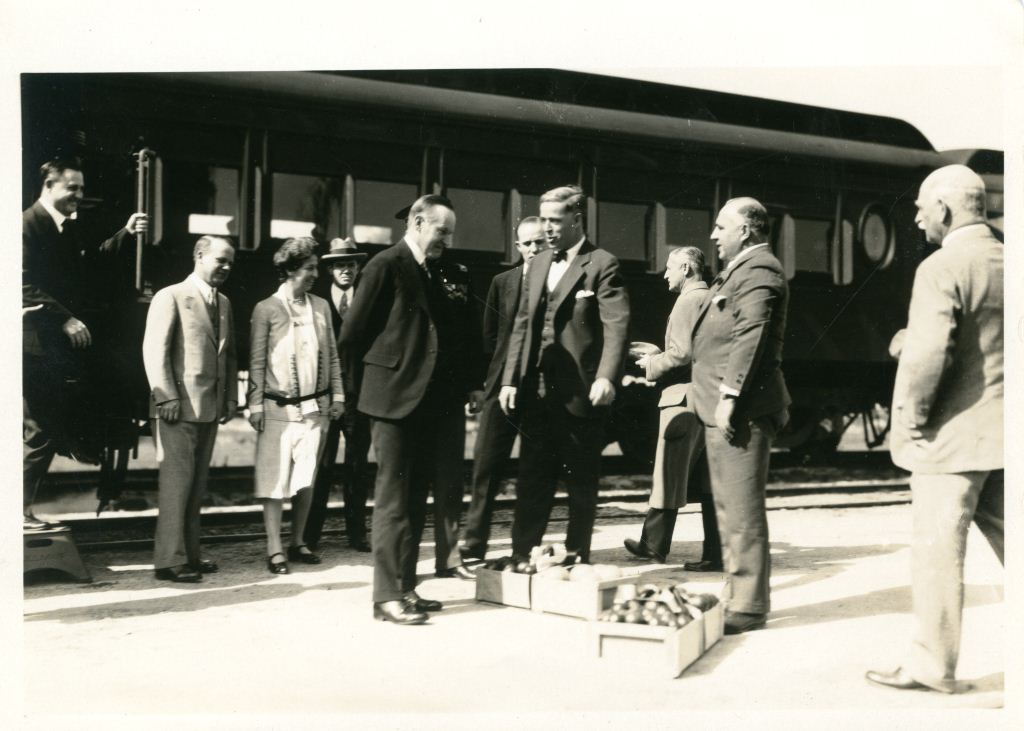
President Coolidge presenting a wreath at another landmark in honor of the General and 7th President, the Jackson Memorial in Lafayette Park, January 1924.
“One of the great sources of the strength of our country has been the pioneering spirit…Our people have ever been going forth into the forest and over the plain to establish themselves in the region of the unknown. They have sought new fields to conquer. They have been pioneers, however, not only in the physical world, but in the realm of ideas. The frontier has long since disappeared…but the ambition to enter uncharted regions of industry, of enterprise, of social relations, and of thought continues with increasing fervor.”
“We would miss much of the significance and meaning of the history of the United States unless we took into account this outstanding quality. Our whole outlook has been greatly influenced by it. It is the complete antithesis of all systems of class and caste…” Instead of finding that their place in life, and the way to think “had been previously ordained for them” America “came into existence” for the very “purpose of escaping from this doctrine…The people who came here were seeking freedom of action and freedom of mind. The great revelation of our country has been that men are not born to servitude and obscurity. They are born to all the possibilities of a glorious station which can be won by their own achieving.” Such is the essential difference between self-governed liberty and security by coercion and conformity. It resides in the confidence that we can be trusted with freedom and are born for great things, not the bureaucratic management of our mediocrity.
America’s history is something of which to we can yet find reason to admire and honor. The pioneers who lived and triumphed “by their own achieving” is not the rare exception, it is “our national epic…It is a record of untiring effort, undaunted courage, and persevering will, all of which have set an inextinguishable mark upon the history of our country.”
“One of the outstanding figures which so well represents this development of our national life is Andrew Jackson, the seventh President of the United States…Thrown on his own resources as he was, he grew up proud and high tempered, oftentimes violent in his disposition, and considerably interested in the sports of the countryside…” From the study of law he went on to serve as Tennessee’s first Representative in the House. General Jackson would go on to defeat the attacking British in New Orleans on January 8, 1815, before word of peace had reached our shores. “New Orleans being under martial law, he was soon engaged in altercations with the civil authorities. He did not hesitate to arrest judges and the United States attorney when they interfered with his orders…When civil authority was resumed he submitted to a fine of $1,000 for contempt of court. ‘I have during the invasion,’ he said, ‘exerted every one of my facilities for the defense and preservation of the Constitution and the laws. Considering obedience to the laws, even when we think them unjustly applied, is the first duty of the citizen. I entreat you to remember the example I have given you of respectful submission to the administration of justice.’ Nearly 30 years later the Congress remitted the fine with interest.”
“This was a most significant statement. It might well have been pondered by those who were undertaking to argue away the Constitution after General Jackson became President. Here was a man who stood ready to fight a duel, if he thought the circumstances required it – of an impetuous nature and impatient of all restraint, yet clearly announcing the supremacy of law. More than that, he was acting upon that principle…He believed that at all times and in all places the duly constituted authority of law should be supreme.”

The statute of Andrew Jackson, to which President Coolidge refers, stands underneath the dome of the Capitol in Washington.
Coolidge, finding much to admire about his predecessors, was not above the firm criticism or even the refrain of praise. Yet, when he identified closely with a frailty, he exemplified a remarkable measure of charity and understanding. Such was the case with President Jackson’s temper. Known for his outward calm, Coolidge could give vent to a fiery wrath of his own at times. Whereas some Presidents would look with hypocritical disdain, even withering contempt, for some of those who came before them, Coolidge practiced a humble forbearance, especially when it came to judging history. Being keenly aware of his own flaws, how could he harshly condemn others with all the benefits of hindsight while he shared in that lack of perfection too? He was no partisan hack either, taking cheap shots for their own sake, as his reflections on the Democrat Jackson make plain. In Coolidge, there was no double standard. For Calvin, treating others as we would be treated was not a trite phrase, it was his life. It is not the suppression of passionate conviction, it is sharing (regardless of party) a common fidelity to the supremacy of law and love for our exceptional foundations. It was simply what Americans, imbibing deeply the spirit of the pioneers, do.
As Coolidge surveyed the legacy of President Jackson, he revealed how profound an impact his predecessor had upon him, the Office and the Nation. “He was regarded as a President of the people, and in seeking to remove their burdens and improve their condition he favored economy and payment of the public debt. When this should be done, he favored dividing the surplus revenues among the States. He also criticized the United States Bank,” taking on (like Coolidge many years later) controversial issues which could easily have been deferred to others in the future.
Coolidge reminded his audience that Jackson, while not always consistent, held courageously to both the preservation of the Union and the obligations of the Executive. In the midst of Jackson’s historic battle with Calhoun over nullification in April 1833, he affirmed,
” ‘Our Federal Union – it must be preserved.’ ”
“Without reference to his former views on the tariff or States rights, when this ordinance was passed, President Jackson declared, ‘The duty of the Executive is a plain one. The laws will be executed and the Union preserved by all the constitutional and legal means he is invested with.’ He soon followed this with a proclamation denying the right of secession, refuting the power of a State to set aside an act of Congress, and asserting the supremacy of the Federal Constitution. This proclamation has been regarded as one of the best state papers of any American President…A service of this nature, rather at variance with some of the positions he had formerly taken and some of the policies strongly supported in his own party, could only have been performed by a great man.”

Tennessee Gentleman, portrait of Jackson from 1831. Part of the collection at The Hermitage, Nashville.
“His fight on the bank was not yet ended. His next move was an attempt to withdraw the public deposits…Of course, a violent change of this nature affecting the financial policies of the Nation, was bound to have an economic effect throughout the country. Government funds in local banks were used for speculation, which, as usual, brought the reaction of depression.” It is especially noteworthy that President Coolidge includes this concise illustration from history about speculation at a time coinciding with feckless investment in quick money on the market throughout 1928, the year of this speech. It was another occasion where President Coolidge gave sober warning to any who would heed. In this, and many other ways, his attempts to carefully “tap the brakes” (so as not to discourage sound growth) met with little notice at the time. “Opinions have differed,” just as they would over the causes and cures of the recession turned Great Depression of the 1930s, “but no one doubts the great courage of President Jackson in opposing it or the public approbation he received in support of his policy.” Jackson, contrary to Arthur Schlesinger’s wishful claim, was hardly the precursor of FDR, who spent while Jackson paid off the Nation’s entire debt and assumed greater supervision of individual freedoms while Jackson kept faith in the people to govern themselves.
No doubt anticipating his own retirement from public office in just less than eleven more months, President Coolidge turned to Jackson’s departure from Washington. “On the 7th of March, 1837, he set out for his old home, The Hermitage. He had triumphed over opponents who were considered then, and rank now, among the greatest statesmen of his day. Calhoun had gone down on nullification. The great figure of Daniel Webster had stood with the President on that issue, but had opposed his banking policies. Clay had compromised and lost…If at times he was high tempered and overbearing, there is no fairer story of chivalrous devotion and affectionate consideration than that which he lavished upon his wife. In her benign presence he was all submission.”
“History accords him one of the high positions among the great names of our country. He gave to the nationalist spirit through loyalty to the Union a new strength which was decisive for many years. His management of our foreign affairs was such as to secure a wholesome respect for our Government and the rights of its citizens. He left the Treasury without obligations and with a surplus. Coming up from the people, he demonstrated that there is sufficient substance in self-government to solve important public questions and rise superior to a perplexing crisis. Like a true pioneer, he broke through all the restraints and impediments into which he was born, and leaving behind the provincialisms and prejudices of his day pushed out toward a larger freedom and a sounder Government, carrying the country with him.”
“In recognition of the great qualities of her most illustrious son, the State of Tennessee has presented his statue to the National Government. In gratitude for the preeminent service which he rendered, I, as President of the United States, accept it, to stand here in the Hall of Fame so long as this Capitol shall endure.”
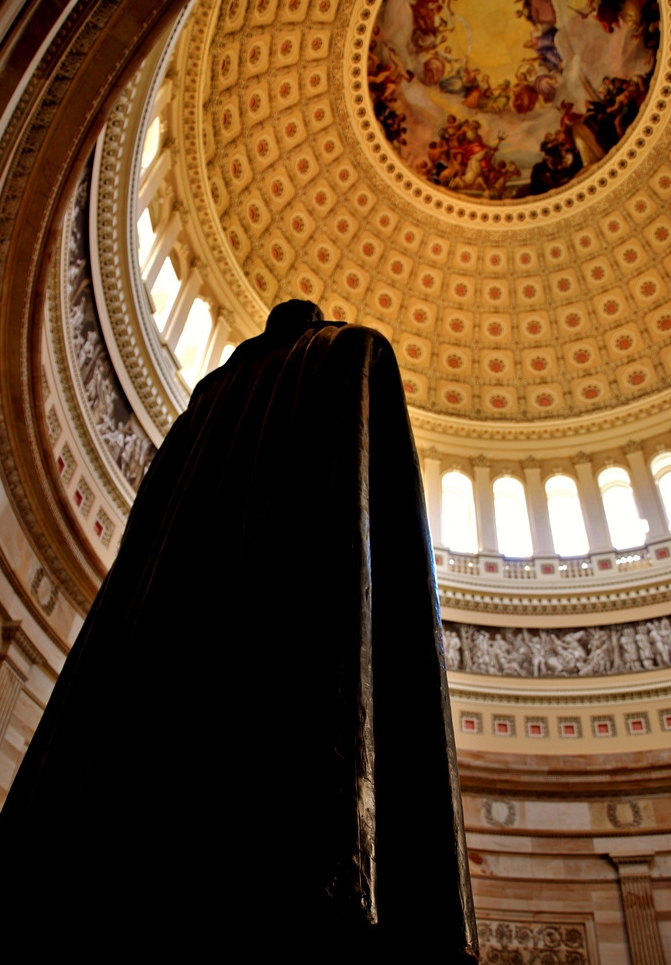
It was underneath this stunning view that President Coolidge accepted the bronze statute of Andrew Jackson from the State of Tennessee, April 15, 1928.































































 The Importance of the Obvious